
A single administrative error on a board resolution or power of attorney can stall a multi-million pound international deal for weeks. In the high-stakes corporate environment of the City, securing an apostille for company documents in London is no longer a simple administrative task, particularly as post-Brexit regulations now necessitate legalisation for documents used within the EU. You are likely facing the pressure of a tight tender deadline or a bank's rigid compliance requirements, whilst feeling uncertain about whether your specific paperwork requires a solicitor's certification or a full notary seal.
It's understandable to feel overwhelmed by the procedural rigour required to avoid document rejection by foreign authorities. This guide provides a clear, expert-led roadmap to mastering the legalisation process, ensuring your corporate records meet the highest international standards. We will examine the essential steps for different document types, explain current FCDO processing times, and show how Sheikh Najam – Mobile Notary Central London can handle these complexities at your office to ensure your global operations remain on schedule.
Key Takeaways
- Grasp the necessity of FCDO legalisation for ensuring your UK corporate documents are recognised across global jurisdictions and Hague Convention member states.
- Distinguish between public records and internal company documents to determine if you need a notary's certification before the apostille stage.
- Master the specific requirements for an apostille for company documents London to navigate international tenders and bank account openings with confidence.
- Streamline your legalisation timeline by utilising a mobile notary who brings the certification process directly to your Central London headquarters.
- Minimise the risk of administrative errors that lead to document rejection by following our expert-led, step-by-step preparation guide.
Understanding the Apostille for Company Documents: Why It Matters
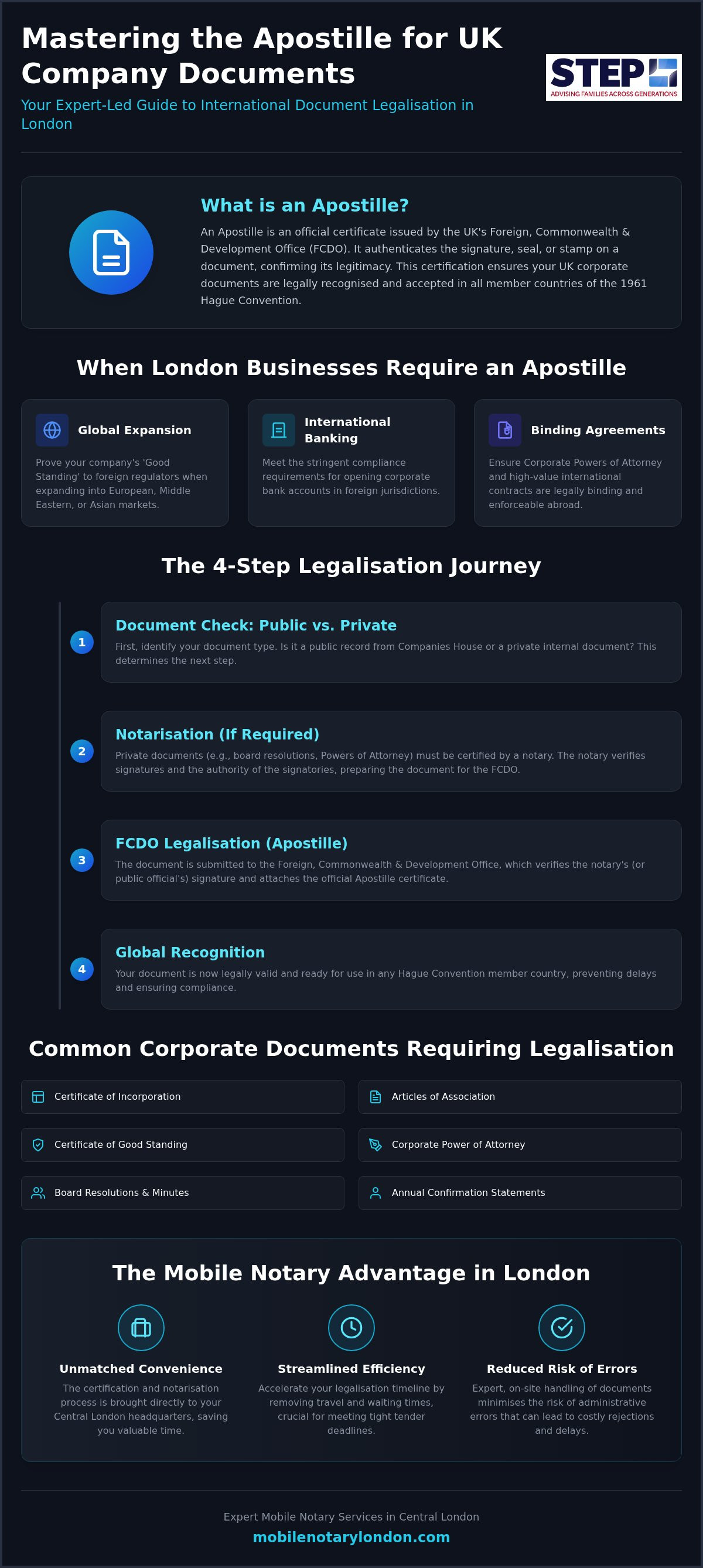
An apostille is far more than a bureaucratic formality. It's a critical certificate issued by the Foreign, Commonwealth & Development Office (FCDO) that confirms the authenticity of a signature, seal, or stamp on a public document. For a firm operating in the capital, securing an apostille for company documents London is the essential bridge between domestic registration and international validity. Without this specific verification, your UK-registered documents are frequently dismissed as unverified by foreign authorities, potentially halting commercial progress before it begins.
When Does a London Business Need an Apostille?
The requirement for legalisation typically arises during pivotal moments of corporate growth. If your business is expanding into European, Middle Eastern, or Asian markets, you'll likely be asked to prove your company's "Good Standing" to foreign regulators. This confirms that the entity is up to date with its filings and is legally authorised to conduct business. Similarly, appointing an overseas agent via a Corporate Power of Attorney requires an apostille to ensure the document is legally binding in the recipient jurisdiction. Other common scenarios include opening corporate bank accounts abroad or entering into high-value international contracts where the counterparty demands absolute certainty regarding your corporate identity.
The Hague Convention and Global Recognition
Before the 1960s, the process of legalising documents for international use was a convoluted, multi-step chain of certifications. This changed significantly with the Apostille Convention of 1961, a treaty that simplified the procedure for all member states. Today, if the country you're dealing with is a signatory, a single apostille from the UK's FCDO is sufficient for your documents to be recognised. This applies to many jurisdictions London firms interact with daily, such as the USA, Spain, and Italy.
It's vital to understand that "legalisation" is the umbrella term for the entire verification process, whilst the apostille is the specific certificate used between treaty members. For countries that haven't joined the convention, you may require a more complex process involving embassy legalisation. Because many corporate documents aren't considered "public" in their raw form, they often require Corporate Notary Services to verify the identities of directors and the validity of signatures before the FCDO will even consider issuing the apostille. Precision at this early stage is what prevents costly delays during international tenders or time-sensitive acquisitions.
Common Corporate Documents Requiring Legalisation
Identifying which papers require an apostille for company documents London is the first hurdle in international expansion. The list is extensive, ranging from foundational filings to specific board-level authorisations. Every document serves a distinct purpose in proving your company's legitimacy to a foreign counterpart, regulator, or financial institution. Failing to present the correct certified paperwork can lead to immediate rejection of a tender or a frozen bank account application.
The Certificate of Incorporation serves as the primary proof of a company's legal existence in the UK. Alongside this, the Articles of Association outline the internal constitution and the rules governing the business. For many foreign authorities, a Certificate of Good Standing is mandatory for due diligence. A Certificate of Good Standing is a document issued by Companies House confirming a company has been in continuous existence since incorporation. Finally, a Corporate Power of Attorney is vital for directors who need to delegate signing authority to an overseas representative. These documents must be drafted with precision to satisfy both UK law and the requirements of the receiving country.
Companies House Documents vs. Private Records
The Foreign, Commonwealth & Development Office (FCDO) distinguishes between documents held on the public register and private corporate records. Official documents like the IN01 form or annual confirmation statements often carry an official signature or stamp that the FCDO can verify directly against their database. In contrast, internal minutes or board resolutions are private. To Get a document legalised when it's a private record, a notary must first certify the signatures. This verification confirms the person signing has the authority to bind the company. If you cannot part with original certificates, you must arrange for certified copies to be prepared by a qualified professional. This is a common requirement for foundational documents where the original must remain at the registered office whilst a legalised copy travels abroad.
Specialised Documents: Tax and Pensions
Beyond standard corporate filings, international trade often involves HMRC Certificates of Residence. These are essential for claiming double taxation treaty benefits in foreign jurisdictions and preventing the company from being taxed twice on the same income. Similarly, global employee transfers may require legalised pension scheme documentation or employee benefit trust deeds to ensure benefit continuity across borders. Handling these sensitive papers requires a high degree of procedural rigor. Our corporate notary services provide the necessary certification for these specialised records, ensuring they are accepted by international tax authorities and pension providers without delay.
The Crucial Step: Notarisation vs. Legalisation
Understanding the distinction between notarisation and legalisation is the most critical hurdle for any business seeking an apostille for company documents London. Many directors mistakenly assume that any official-looking business paper can be sent directly to the UK government's legalisation office for an apostille. However, most corporate documents, such as board resolutions, minutes, and powers of attorney, are private instruments rather than public records. Unlike a birth certificate or a court order, these papers originate within your company and lack an inherent government seal. Consequently, the Foreign, Commonwealth & Development Office (FCDO) will almost certainly reject these documents unless they have been first certified by a Notary Public.
This is where the process becomes a two-stage verification. First, a notary verifies the identity of the signatories and the authenticity of the document. Only after this professional seal is applied will the FCDO issue the apostille to confirm the notary's own standing. Sheikh Najam – Mobile Notary Central London acts as the vital facilitator in this chain, bridging the gap between your corporate headquarters and the FCDO's administrative requirements to ensure a seamless transition from private record to internationally recognised legal document.
Why a Notary Public is Essential for London Firms
While some providers suggest that a standard solicitor's certification is sufficient, this often leads to rejection abroad. Notaries are globally recognised legal officers whose seals carry a weight that solicitors' stamps do not always match in foreign jurisdictions. For high-value international transactions, a notarial seal is often a "premium" requirement that cannot be bypassed. Beyond simple identification, a notary must verify "capacity." This involves confirming that the individual signing the document actually possesses the legal right to bind the company, such as being a registered director or an authorised signatory. This rigorous check provides the security foreign authorities demand before they accept UK corporate filings.
Mobile Notary Services: Efficiency in the City
Time is the most valuable asset for any London-based executive. Traditional notarisation often requires directors to leave their desks and travel to a fixed office, which is a significant logistical drain. Our Mobile Notary Central London service eliminates this inefficiency by bringing the legal process to your boardroom. We conduct on-site verification of original documents and perform all necessary identity checks in person. This "white-glove" approach ensures that sensitive corporate papers never leave your sight during the certification phase, providing both security and the speed required to meet urgent international filing deadlines.
Step-by-Step Guide: Getting Your Apostille in London
Transforming a domestic corporate record into a globally recognised document requires a methodical approach to satisfy the Foreign, Commonwealth & Development Office (FCDO). For most firms, the goal is to secure an apostille for company documents London without the common pitfalls that lead to administrative rejection. Following a structured sequence ensures that your paperwork moves through the legalisation chain with precision and speed.
- Step 1: Confirm Recipient Requirements. Always verify the exact document types and any specific certification wording required by the foreign bank, lawyer, or regulator.
- Step 2: Arrange a Notary Appointment. Most corporate documents require a Notary Public to verify the capacity of the signatories before the FCDO will accept them.
- Step 3: Select Your Service Level. Standard FCDO applications (£45 per document) currently take approximately 15 to 20 working days. For time-sensitive business needs, the next-day or premium tiers are essential.
- Step 4: Submit via a Registered Agent. Registered businesses can access the next-day paper-based service (£79 per document), bypassing the lengthy public post-in queues.
- Step 5: Secure Courier Return. Ensure your legalised originals are returned via tracked, high-security courier to prevent loss of critical corporate assets.
Preparing Your Documents for the Notary
Meticulous preparation before the notary arrives prevents delays. Gather original photo identification, such as passports or driving licences, for all directors or signatories involved. It is also vital to ensure your Companies House records are entirely up to date, as the notary will often perform a real-time check of the public register to confirm your current standing. If the documents are destined for a country where English is not the primary language, determine if a certified translation must be bound with the original before the apostille is applied. To streamline this initial phase, you can arrange your mobile notary appointment to take place directly at your London office.
Navigating the FCDO Fast-Track Service
The 2026 legalisation landscape offers distinct paths based on urgency. Whilst the general public is often restricted to the standard postal route, London businesses can leverage "Business" or "Premium" service levels through registered agents. This fast-track system is designed for the high-velocity needs of the City, where a 20-day wait for a tender document is commercially unacceptable. Using an agent allows for next-working-day results, providing a level of agility that standard applications cannot match. For a deeper analysis of these expedited options, consult our Urgent Apostille London guide, which details the latest 2026 requirements for priority processing.
Why Choose a Mobile Notary for Your London Business?
For a director or general counsel in the capital, the logistical challenge of securing an apostille for company documents London often clashes with the relentless pace of international commerce. Choosing a mobile notary is not merely a matter of convenience; it is a strategic decision that prioritises security and procedural speed. Unlike traditional mail-in services where sensitive corporate records are sent via post, a mobile service ensures your documents never leave your sight. This eliminates the risk of loss or damage to original certificates that are often difficult and costly to replace. Your private documents remain within your secure office environment, maintaining confidentiality whilst the legal certification is completed in your presence.
Speed is the second pillar of this on-demand service. By bypassing the delay of posting documents to a fixed office, you gain immediate momentum for your international filings. Sheikh Najam’s STEP qualification provides a layer of specialised expertise that standard providers lack. This background is particularly valuable when dealing with complex private wealth structures or intricate corporate frameworks that require a nuanced understanding of international protocols. It ensures that your certification is not just a stamp, but a robust legal verification that stands up to the scrutiny of foreign regulators. This level of technical immersion allows for the seamless handling of trust deeds and shareholder agreements alongside standard filings.
Premium Service for Mayfair and the City
Our presence in Mayfair, Westminster, and the City is designed to meet the demands of high-stakes legal and financial environments. We offer a discreet, professional service at your place of business or private residence, handling documentation with the gravity it deserves. A mobile notary can organise the entire legalisation chain from signature to FCDO submission in a single day. This bespoke approach caters to professionals who require elite qualifications paired with grounded, agile delivery. It is a premium, "white-glove" resource for those who cannot afford the downtime associated with traditional notary appointments.
The Problem-Solver Mentality
The path to legalisation is rarely without hurdles. If the FCDO queries a signature or the standing of a specific official, a proactive problem-solver is essential to navigate the rejection and find a remedy. This expertise is vital for the process of obtaining an apostille for company documents London when deadlines are non-negotiable. Our expertise extends beyond the Hague Convention to include embassy legalisation for territories like the UAE or Qatar, where additional layers of certification are mandatory. We act as your high-stakes facilitator, ensuring that every administrative obstacle is cleared with precision. To ensure your international transactions remain on track, Book your urgent mobile notary appointment today.
Securing Your Global Corporate Standing
The path to international expansion requires more than just administrative effort; it demands procedural precision to ensure your UK records are recognised without question. As we have explored, the distinction between private records and public filings is the primary reason for document rejection at the FCDO. By prioritising professional notarisation, you bridge the gap between internal corporate actions and the global standards required for a valid apostille for company documents London.
Sheikh Najam, a STEP-qualified Private Wealth Lawyer, provides a premium Central London mobile service that brings expert certification directly to your boardroom. As an expert in urgent international legalisation, he understands the gravity of high-stakes corporate filings and the necessity of meeting rigid deadlines. This mobile approach ensures that your sensitive documents never leave your sight, providing the security and speed essential for modern City-based firms. Whether you are opening a foreign branch or appointing an overseas agent, having a trusted advisor simplifies the most complex bureaucratic landscapes.
Don't let administrative friction stall your commercial momentum. Secure your urgent corporate apostille with a mobile notary visit today to ensure your business is ready for the global stage. We are here to facilitate your international success with calm efficiency and legal rigor.
Frequently Asked Questions
How long does it take to get an apostille for company documents in London?
Standard processing via the Foreign, Commonwealth & Development Office currently takes 15 to 20 working days for paper-based applications. If your business is facing a tight deadline, registered agents can access a next-day service to expedite the process. For the most time-critical requirements, a premium same-day service is available at the London legalisation office, though this route is restricted to authorised business users and registered agents.
Does a solicitor or a notary need to sign my company documents?
A Notary Public is usually required for corporate documents because their seal carries a higher level of international recognition than a solicitor's signature. Whilst a solicitor can certify copies of public records, foreign authorities almost always demand a notary to verify the "capacity" of a director signing a board resolution or power of attorney. Using a notary ensures your paperwork meets the strict global standards required to avoid rejection abroad.
Can I get a same-day apostille for my business in London?
Yes, same-day legalisation is achievable for London firms through the FCDO's premium service. This fast-track option isn't available to the general public via the standard online portal; it requires submission through an authorised agent or a registered business user. By arranging a mobile notary visit to your office in the morning, you can often facilitate the certification and submission needed for an apostille for company documents London within a single business day.
Which company documents need an apostille for opening a foreign bank account?
Foreign banks typically require a legalised set of foundational documents, including the Certificate of Incorporation and the Articles of Association. You'll likely also be asked for a Certificate of Good Standing and a Register of Directors to prove the company's current status and leadership. If a specific individual is authorised to manage the account, a legalised Corporate Power of Attorney is mandatory to verify their signing authority to the bank's compliance team.
What is the difference between an apostille and embassy legalisation?
An apostille is a simplified certificate used between member countries of the Hague Convention, such as the USA, Spain, or Italy. If you're dealing with a country that hasn't joined the convention, such as the UAE or Qatar, you must undergo embassy legalisation. This is a multi-stage process where the FCDO first issues an apostille, and the document is then sent to the relevant country's consulate in London for a second layer of verification.
Do I need to be present for the notarisation of company documents?
Presence is mandatory if you're signing a document that requires the notary to witness your signature and verify your identity, such as a Power of Attorney. If the notary is simply certifying that a document is a true copy of an original public record, your physical presence isn't strictly necessary. However, a mobile notary visit to your office is the most efficient way to handle both requirements whilst ensuring your sensitive originals never leave your premises.
Can you legalise documents that were not issued in the UK?
No, the UK's legalisation office can only issue an apostille for documents that originated in the United Kingdom or were signed by a UK-registered notary or solicitor. If your company documents were issued in another jurisdiction, like Delaware or the BVI, they must be legalised in their country of origin. A London notary can sometimes certify a copy of a foreign document, but the resulting apostille only verifies the notary's signature, not the document's original content.
How much does an urgent apostille for company documents cost?
Official FCDO fees for an apostille for company documents London are £45 for the standard service or £79 for the next-day business service. These government fees are per document and don't include the costs for professional notarisation or agent handling charges. Because corporate legalisation often involves complex certifications or multiple document sets, total costs vary depending on the volume of paperwork and the specific urgency of your international filing requirements.


