
Choosing the fastest Online Notary UK option might be the precise reason your legal documents are rejected by a foreign consulate. You're likely facing a tight deadline and the pressure of navigating complex international protocols, whilst trying to understand if a digital seal will satisfy a rigorous bureaucratic requirement abroad. It's understandable to feel anxious about these distinctions, especially when your time is at a premium and the stakes for your property or corporate affairs are high.
This guide clarifies the shifting landscape of remote online notarisation in 2026, helping you determine when a digital approach suffices and why a premium mobile notary visit remains the gold standard for guaranteed global acceptance. You'll gain a clear understanding of the latest Conduct and Discipline Rules, the necessity of urgent apostilles, and how to ensure your documents achieve total legal compliance without you ever having to leave your Central London office. We will explore how to balance the speed of modern technology with the procedural rigour required by international law.
Key Takeaways
- Understand the 2026 legal landscape of Online Notary UK services and how remote video verification aligns with current English regulations.
- Identify why the "Destination Country" rule is the most critical factor in determining whether a digital signature will be rejected or accepted abroad.
- Compare the convenience of remote appointments with the enhanced security of a premium mobile notary visit to your Central London location.
- Prepare effectively for your appointment by organising necessary KYC documentation and verifying specific apostille requirements for international use.
- Learn how a STEP-qualified lawyer can facilitate urgent legalisation and provide expert guidance on complex private wealth or corporate matters.
What is an Online Notary in the UK? Understanding the 2026 Landscape
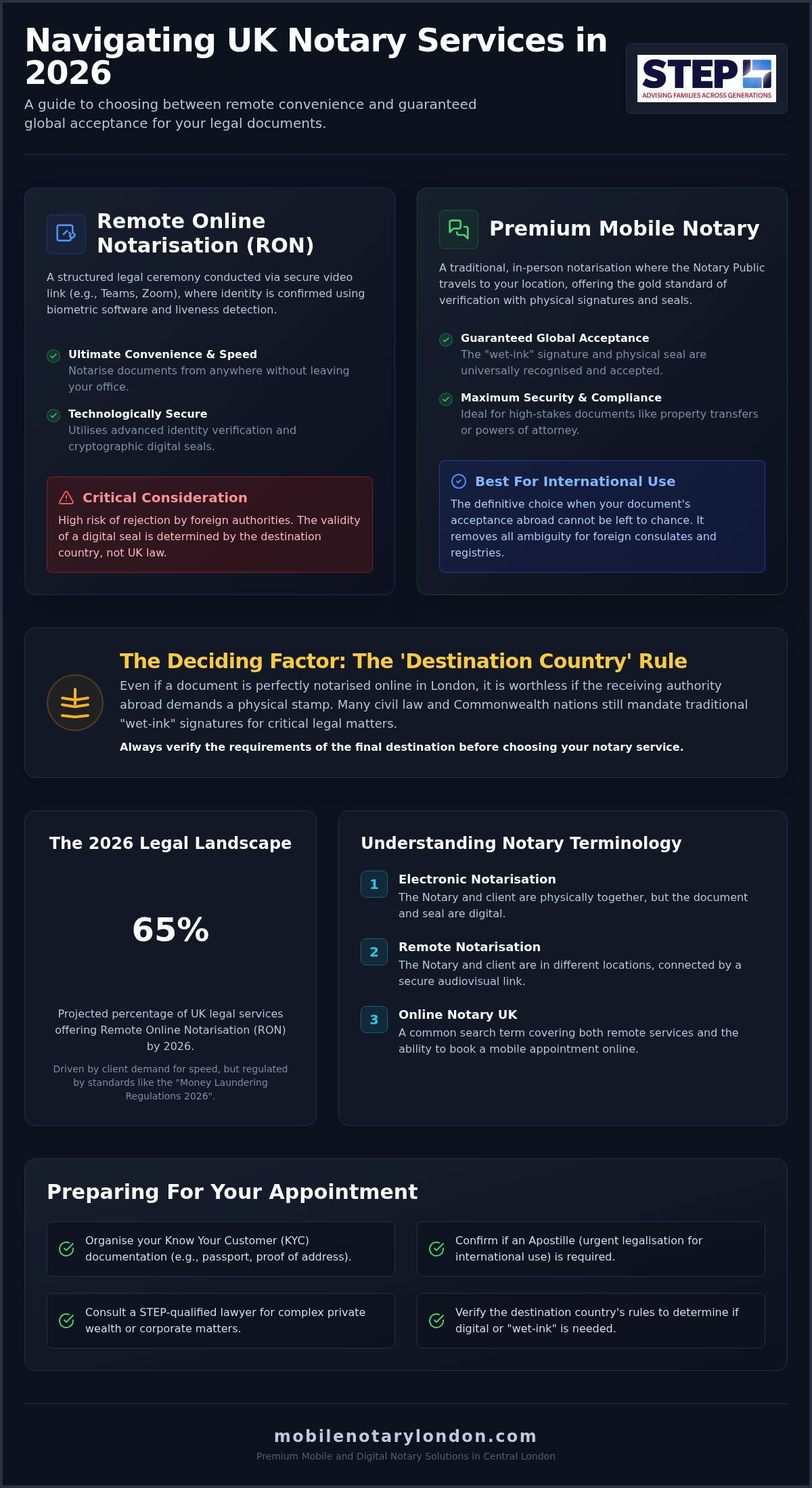
The term Online Notary UK describes a modern intersection of ancient legal tradition and cutting-edge technology. At its core, Remote Online Notarisation (RON) allows a practitioner to witness the signing of documents through secure video conferencing platforms like Microsoft Teams or Zoom. This process isn't merely a casual video call; it's a structured legal ceremony. It requires the notary to verify the participant's identity through advanced biometric software and liveness detection, ensuring the individual on screen matches their government-issued identification. A 2024 report projected that 65% of legal services would offer Remote Online Notarisation (RON) services by 2026, a milestone that has reshaped client expectations for speed and accessibility.
Whilst the technology exists to facilitate fully remote interactions, the phrase often serves as a digital gateway for those seeking a premium mobile service. Many clients begin their search for an "online" solution because they require speed and convenience. They often discover that a mobile visit to their Central London office offers the ideal balance of digital efficiency and physical security. A Notary public in this jurisdiction must ensure that every act meets the highest standards of validity, especially when documents are destined for foreign consulates that may still insist on traditional "wet-ink" signatures.
The Evolution of Digital Notarisation
The adoption of remote technology accelerated rapidly following the global shifts of the early 2020s. By July 2026, new standards for digital document security have become the baseline. These include the "Money Laundering and Terrorist Financing (Amendment) Regulations 2026," which mandate rigorous checks even in virtual environments. Despite these digital strides, the Notary's physical presence within the UK jurisdiction remains a cornerstone of legal integrity. Even when the client is remote, the Notary must typically be physically located in England or Wales to exercise their official powers, maintaining the procedural rigor that international authorities expect.
Key Terminology: Digital vs. Remote vs. Electronic
Confusion often arises amongst clients regarding the specific type of service they require. Understanding these distinctions is essential for ensuring your documents are fit for purpose:
- Electronic Notarisation: This occurs when the Notary and the client are in the same room, but the document being signed and sealed is a digital file rather than a physical piece of paper.
- Remote Notarisation: The Notary and the client are in different locations entirely, connected by a secure audiovisual link.
- Online Notary UK: This is the most common search term used by the public. It encompasses both of the above and the ability to book a same-day mobile appointment through a digital platform.
It's vital to distinguish between a simple electronic signature, which anyone can apply to a PDF, and a Notary's digital seal. The latter is a cryptographically secure mark that provides a high level of assurance regarding the document's provenance and the signer's identity. This distinction is often the difference between a document being accepted or rejected by a foreign land registry or court.
The Legal Validity of Remote Online Notarisation (RON)
The legal framework for an Online Notary UK service is robust but requires careful navigation. The Notaries Society acknowledges that remote appointments can be conducted under specific conditions, provided the notary can clearly identify the client and witness the signing in real-time. This is supported by the Law Commission's findings on the legal validity of electronic signatures, which established that digital formats carry the same weight as physical ones when executed correctly. In the context of digital commerce, a notarial act serves as a secure bridge of trust, verifying the authenticity of a document and the identity of its signatory through a legally binding electronic record.
However, the most vital factor isn't just UK law; it's the "Destination Country" rule. Even if a document is perfectly notarised via a video link in London, it's worthless if the receiving authority in another jurisdiction demands a physical stamp. Many civil law jurisdictions and several Commonwealth nations still mandate traditional "wet-ink" signatures for property transfers or complex powers of attorney. The efficiency of an Online Notary UK service is undeniable, but it must be tempered with an understanding of global standards. If you're unsure whether your document qualifies, consulting a Notary Public Central London can prevent costly delays and potential rejection by foreign consulates.
When is Online Notarisation Legally Accepted?
Digital signatures are frequently accepted for corporate resolutions, business contracts, and certain affidavits. The Hague Apostille Convention has paved the way for international recognition of these documents, yet the specific requirements vary wildly. Whilst many European nations have embraced digital workflows, others remain hesitant. This discrepancy often leads to confusion, making it essential to confirm acceptance with the end recipient before proceeding with a remote appointment. Choosing the wrong format can result in your documents being sent back, costing you both time and significant administrative fees.
The e-Apostille: Completing the Digital Chain
An e-Apostille is a digital certificate issued by the Foreign, Commonwealth & Development Office (FCDO) that verifies the signature of the notary on a digital document. Unlike a paper certificate, it's issued as a PDF with a digital signature, allowing for a completely paperless chain of legalisation. The FCDO e-Apostille service currently carries a fee of £35, providing a streamlined alternative for those with urgent deadlines. For those needing a comprehensive solution, understanding the nuances of an Urgent Apostille London service is essential to ensure your digital documents are recognised without delay.
Online Notary vs. Mobile Notary: Which Service Do You Need?
Deciding between an Online Notary UK service and a physical meeting often comes down to the sensitivity of the document and its final destination. Whilst a video call offers immediate gratification, a notary visiting your Mayfair or St James’s office provides an unparalleled level of risk mitigation. Physical presence remains the ultimate safeguard against identity fraud, as it allows for the tactile verification of security features on passports and property deeds that biometric software might occasionally misinterpret. This face-to-face interaction instils a level of confidence that is often required for high-value transactions.
High-stakes transactions in specific jurisdictions like Spain, the UAE, or India frequently demand a "wet-ink" signature. For these regions, the digital route is often a false economy. A document rejected by a foreign land registry results in more than just a lost fee; it can derail multi-million pound property deals or delay urgent corporate restructures. Weighing the speed of a digital seal against the absolute certainty of a physical stamp is the first step in any successful international legal process. A mobile visit ensures that the procedural requirements of the receiving country are met with meticulous precision.
The Case for a Mobile Notary Visit
Complex legal instruments, such as Power of Attorney notarisation, benefit significantly from a face-to-face consultation. This "white-glove" experience is particularly suited for high-net-worth individuals and corporate executives who require a seamless, discreet service that integrates with their demanding schedules. A mobile visit also facilitates the immediate collection of physical originals. This is essential for obtaining traditional paper apostilles or embassy legalisation that cannot be processed via the e-Apostille route, providing a comprehensive solution for documents destined for non-Hague Convention countries.
The Case for Remote Video Notarisation
Remote services excel in specific, lower-risk scenarios where speed is the primary driver. If you're currently abroad but need to certify a UK-based document for Companies House, an Online Notary UK service is often the most pragmatic choice. It's equally effective for simple identity verifications, such as Land Registry ID1 forms, or for standardising corporate board resolutions where directors are scattered across different time zones. In these instances, the digital workflow provides the agility modern business demands without compromising the integrity of the notarial act, provided the destination authority accepts electronic execution.
Ultimately, the choice depends on your specific deadline and the legal requirements of the recipient. For those managing international private wealth or complex property portfolios, the security of a mobile visit often outweighs the convenience of a screen. By choosing a practitioner who is also a STEP-qualified lawyer, you ensure that every document is handled with the highest degree of legal expertise, whether the meeting takes place in person or through a secure digital link.
How to Prepare for Your Online or Mobile Notary Appointment
Preparation is the cornerstone of a successful notarial act. Whether you're opting for a remote session or a mobile visit to your office, following a structured sequence ensures that your documents are legally sound and ready for international use. A seamless Online Notary UK experience depends on your ability to provide clear, verified information before the appointment begins, allowing the practitioner to focus on the procedural rigor required by law.
Your first step must always be to verify acceptance with the recipient in the destination country. As established in previous sections, the "Destination Country" rule is absolute; if they require a physical stamp, a digital signature will not suffice. Once confirmed, you should organise your proof of identity and address. Sharing a draft of your document with the notary for prior review is equally essential. This allows for the identification of potential errors or missing clauses that could lead to rejection abroad. Finally, ensure your environment is suitable. For video calls, a stable internet connection is non-negotiable, whilst a mobile visit requires a quiet, professional space where the signing can be witnessed without interruption.
Identity Verification Requirements
The "Money Laundering and Terrorist Financing (Amendment) Regulations 2026" have formalised the requirements for identity verification in both physical and digital settings. You'll need to present original, valid identification. Accepted forms include your passport, a current photocard driving licence, or a biometric residence permit. To verify your address, you must provide a utility bill or bank statement dated within the last three months. Even when using an Online Notary UK service, the physical original of your ID is required. The notary uses high-resolution video and biometric software to verify security features like holograms and watermarks, ensuring the individual on screen is the legitimate document holder.
Document Preparation Checklist
Adhering to a strict checklist prevents the most common administrative delays. Don't sign your document before the appointment. The notary must witness the act of signing in real-time, whether in person or via a secure video link. If the document requires additional witnesses, confirm beforehand if the notary can provide them or if you need to arrange for independent parties to be present. You must also clarify if the document requires further Apostille or Embassy legalisation. Identifying these needs early allows the notary to coordinate with the FCDO or relevant consulates immediately after the signing ceremony.
For a fast, hassle-free experience that guarantees total legal compliance, book your same-day mobile or digital appointment with a specialist who understands the intricacies of international private wealth and corporate law.
Premium Mobile and Digital Notary Solutions in Central London
Sheikh Najam provides a sophisticated solution that bridges the gap between digital efficiency and absolute legal certainty. Whilst many clients begin their search for an Online Notary UK service to save time, they often discover that the most secure and effective route involves the personalised oversight of a specialist. By combining advanced digital workflows with a premium mobile presence, he ensures that your documents meet the rigorous standards of both English law and international jurisdictions. This approach offers the agility of a remote service with the enhanced security of a face-to-face legal ceremony.
The advantage of engaging a STEP-qualified Private Wealth Lawyer cannot be overstated when dealing with high-stakes property or corporate matters. Unlike generic services, Sheikh Najam brings a deep understanding of international protocols and private wealth structures to every appointment. He provides same-day mobile notary services across Westminster, Mayfair, and the City of London, arriving at your home or office with the technical expertise required to navigate complex legal landscapes. This elite service is designed for those who demand meticulous attention to detail and a guarantee of validity for their most sensitive documents.
Why Choose a Specialist Mobile Notary?
Direct access to the practitioner is a hallmark of this "white-glove" service. You won't find yourself dealing with administrative gatekeepers or automated systems; instead, you speak directly with a seasoned expert who understands the nuances of international private wealth legal advice. This professional behaviour instils confidence, particularly when managing tight deadlines for power of attorney or company document notarisation. Every act is performed with a level of transparency and procedural rigour that ensures your documents are accepted without question by foreign consulates and land registries.
Booking Your Appointment in Central London
The process for securing a same-day appointment is designed for maximum convenience and speed. You can request a mobile visit through the website, providing the flexibility needed for urgent corporate restructures or private property deals. Sheikh Najam also manages the entire legalisation chain, including the bespoke handling of urgent apostilles and embassy legalisation. Once the notarial act is complete, he can arrange for secure document collection and courier delivery to the relevant authorities, ensuring a seamless transition from signing to final international recognition.
Don't leave your international legal affairs to chance with a standard digital seal that might be rejected. Organise your premium mobile notary visit today and benefit from the expertise of a trusted advisor who prioritises your security and success in every transaction.
Secure Your International Documents with Absolute Certainty
Whilst the flexibility of an Online Notary UK service provides modern agility, the ultimate success of your international legal matters depends on aligning with the specific requirements of your destination country. Ensuring your documents are fit for purpose requires more than just a digital seal; it demands the oversight of a seasoned professional who understands the gravity of international compliance. Sheikh Najam provides this essential expertise, combining his background as a STEP-qualified Private Wealth Lawyer with a same-day mobile service in Central London. Whether you require meticulous notarisation for property deeds or a specialist to navigate urgent apostille and embassy legalisation, his proactive approach ensures your deadlines are met with absolute precision.
Don't let administrative confusion delay your high-stakes transactions. Book a Premium Mobile Notary Appointment with Sheikh Najam today to experience a seamless, expert-led service that prioritises your peace of mind. Your international documents deserve the highest standard of professional care.
Frequently Asked Questions
Is an online notary legal in the UK in 2026?
Yes, remote notarisation is legally valid in England and Wales under the Electronic Communications Act 2000 and the updated 2026 Notary Regulations. A qualified practitioner must witness the signing via a secure video link whilst using advanced identity verification technology. It's essential to remember that whilst the act is legal in the UK, its validity depends entirely on whether the receiving country accepts digital formats.
Can I get an e-Apostille for a document notarised online?
You can certainly obtain an e-Apostille for documents that have been notarised with a digital seal. The Foreign, Commonwealth & Development Office (FCDO) provides a streamlined electronic service specifically for this purpose. This creates a secure, paperless chain of legalisation that is increasingly accepted amongst Hague Convention member states, provided the original notarial act was performed correctly.
Which countries do not accept remote online notarisation?
Many jurisdictions, particularly in the Middle East, South America, and parts of Asia, still insist on traditional "wet-ink" signatures and physical stamps. Countries like the UAE, Spain, and India frequently reject digitally notarised powers of attorney or property deeds. Before booking an Online Notary UK session, you must confirm with the local recipient or consulate that they will accept a remote digital signature.
How much does an online notary cost compared to a mobile visit?
Digital sessions often have a lower base cost because the practitioner doesn't need to account for travel time or physical overheads. Conversely, a mobile visit is a premium, "white-glove" service that reflects the convenience of an expert coming directly to your location. For complex or high-stakes international matters, the slightly higher investment in a mobile visit often saves money by preventing document rejection abroad.
Do I need a special app for a video notarisation appointment?
Most practitioners don't require you to download specialised software; standard, secure platforms like Microsoft Teams or Zoom are typically used. You will need a device with a high-definition camera and a stable internet connection. This allows the notary to perform the necessary biometric checks and witness your signature with the procedural rigour required by the Faculty Office.
Can a notary certify a copy of my passport online?
No, it's generally not possible to certify a true copy of a physical passport via a video call. A notary must physically handle and inspect the original document to verify its security features, such as watermarks and holograms. For passport or ID certification, a mobile notary visit to your Central London office is the only way to ensure the certified copy is legally robust.
What happens if my document is rejected by a foreign consulate?
If a document is rejected, you'll usually have to start the process again, which often involves a physical "wet-ink" notarisation. This results in lost time and additional fees for both the notary and the apostille service. To avoid this frustration, we recommend a mobile notary visit for any documents destined for jurisdictions known for strict, traditional bureaucratic requirements.
How quickly can I get a mobile notary to visit me in Central London?
Same-day mobile appointments are the standard for clients located in Mayfair, the City, or Westminster. Sheikh Najam specialises in urgent, on-demand visits, often reaching your location within a few hours to handle time-sensitive corporate or private wealth documents. This rapid response is frequently paired with urgent apostille services to ensure your legal matters stay on track.


