

What if a document holding up an international wealth transfer could be notarised without taking you away from your home or office? For private clients, family offices and advisers, finding a notary for private wealth management documents means more than arranging a signature. Tight deadlines, sensitive papers and different requirements across jurisdictions all need careful attention.
Powers of attorney, trust papers and other cross-border wealth documents may need notarisation followed by an Apostille or embassy legalisation, depending on where they will be used. Getting the process wrong can cause delays, so check the receiving institution’s requirements before signing.
This 2026 London guide explains what to prepare, how to check a destination country’s requirements and how notarisation and legalisation fit together. It also covers arranging a mobile appointment in Central London, including same-day options subject to availability. Sheikh Najam is a STEP-qualified Private Wealth Lawyer offering mobile notary services and support with powers of attorney, private wealth matters and international legalisation.
Key Takeaways
- Understand why a notary for private wealth management documents needs to consider the document’s purpose, signing requirements and destination country.
- Identify wealth documents that may require authentication, including international powers of attorney and trust papers.
- See how a mobile appointment can help London family offices arrange notarisation at a home or private office.
- Prepare original documents and identification before the appointment, and check what the receiving institution requires.
- Assess a notary’s credentials and experience with international legalisation before entrusting them with sensitive documents.
Why a Notary for Private Wealth Management Documents Requires Careful Preparation
A trust deed or international power of attorney can affect the control, transfer or administration of substantial assets. For a notary for private wealth management documents, the task involves more than witnessing a signature. The notary checks identity and takes steps to establish that the person signing understands the act and is doing so willingly. The precise checks and wording depend on the document and the receiving institution’s requirements.
Notarisation does not guarantee that an underlying transaction is valid or that every overseas bank will accept a document. A standard notarial certificate may not be enough either: a bank or authority may require specific wording, supporting evidence or further legalisation. Ask the recipient for its instructions before signing to help avoid preventable delays.
The Intersection of Notarial Law and Asset Protection
In cross-border matters, a notary provides independent authentication of a document’s execution. This can help the recipient verify the notary’s signature and seal, but it does not certify the truth of every statement in the document or replace the recipient’s own checks. Where an Apostille is required, it authenticates the notary’s signature and seal for use in participating jurisdictions under the Apostille Convention. Other destinations may require embassy legalisation.
This independent role brings scrutiny to identity, understanding and willingness at the point of signing. It is sometimes described as quasi-judicial because the notary performs a formal public function, but a notary is not a judge and does not decide disputes over assets or the merits of a transaction.
The Significance of STEP Qualification for HNWIs
STEP, the Society of Trust and Estate Practitioners, is associated with expertise in trusts and estate planning. For clients dealing with inheritance, succession or offshore structures, a STEP-qualified professional may understand the context around a document as well as its formalities. Sheikh Najam is a STEP-qualified Private Wealth Lawyer and offers private wealth legal advice.
That knowledge can be relevant when a document sits within a trust structure or succession arrangement. Before execution, clarify any issues with the document and check the receiving institution’s instructions. Notarisation is not a substitute for advice on foreign law or the transaction itself, but careful preparation can help address the required formalities.
Expect identity checks as part of the notarial process. Requirements can vary with the document, client and destination, so ask what identification and supporting information to prepare. For an appointment at a Central London home or office, see the mobile notary service in Central London.
Common Private Wealth Documents Requiring Authentication
Whether a document needs notarisation depends on the transaction and the overseas recipient’s instructions. For a notary for private wealth management documents, understanding the purpose of each instrument helps clarify what needs to be signed, witnessed or authenticated, and whether further legalisation may be required.
- International powers of attorney: These may authorise someone to manage overseas property, operate financial accounts or act on another person’s behalf. Check the receiving institution’s wording and signing instructions before the appointment.
- Trust deeds and Letters of Wishes: Documents connected with offshore trusts may need authentication for trustees, financial institutions or authorities. The trust structure and recipient’s requirements affect which documents and formalities are requested.
- Tax residency and investment migration papers: An authority or programme may request certified identity records, declarations or supporting evidence. Confirm precisely which documents need notarisation for a tax residency application or Golden Visa submission.
- Gift deeds and loan agreements: For significant transfers between family members or related entities, the recipient may require evidence that signatures and supporting documents have been properly authenticated.
Trusts and Offshore Entity Documentation
Trust administration can involve instruments appointing or retiring trustees, alongside deeds and supporting resolutions. Family investment companies may also need company records, such as Articles of Association, authenticated for use abroad. Notarisation does not itself confirm that a document’s contents are legally effective in another jurisdiction, so check the recipient’s instructions first. For related guidance, see notary for company documents London.
Succession and Inheritance Papers
A foreign probate authority may request a notarised copy, declaration or other evidence connected with a Will. The required form depends on the jurisdiction and the purpose of the submission, so do not assume the original Will should be signed or altered for authentication. An affidavit of law may also be requested to explain a point of English succession law. Confirm its preparation and acceptance with the relevant advisers. Read more about notarising a Will for use abroad.
Before arranging an appointment, ask the overseas bank, trustee, lawyer or authority for its current document checklist. Confirm any required certificate wording, translation or legalisation. The UK government guide to legalising documents explains the official legalisation process. Clear instructions help the notary assess the documents and the authentication steps required.
The Benefits of Mobile Notarisation for London Family Offices
For a family office managing a property transfer, trust matter or international transaction, arranging signatures should not add unnecessary travel to a demanding schedule. Mobile notarisation brings the appointment to an agreed home or private office in Central London, so clients and advisers can focus on the documents and signing requirements.
A private setting can help clients choose where the appointment takes place, rather than discussing sensitive business in a shared reception or waiting area. It does not replace careful document handling, but it can make coordinating signatories more practical. For a family office, the main advantage is logistical: the appointment can be arranged around the people who need to sign.
Timing matters, too. Same-day mobile appointments are available in Central London, subject to confirmation of availability and the document requirements. If an overseas closing date is approaching, contact the notary promptly and share the recipient’s instructions. This gives time to assess the notarisation and any Apostille or embassy legalisation needed. The Hague Conference on Private International Law provides information on the Apostille system, but you should still check the receiving jurisdiction’s requirements.
Arranging a Mobile Appointment in Central London
For clients arranging a signing in Central London, mobile service can avoid building extra travel into a busy day. A notary for private wealth management documents can also help clarify what to prepare, particularly where several signatories or supporting papers are involved. Read more about notary public services in Belgravia.
Why Mobile Service Helps with High-Value Transactions
Some transactions involve sensitive paperwork and multiple parties. For example, an art transaction may require documents to be signed or authenticated in connection with an international sale. Mobile notarisation can reduce the logistical burden of bringing relevant signatories together at one location, although the documents and arrangements should be agreed in advance. Explore this context in the guide to a mobile notary for art transactions.
Before booking, confirm the appointment location, who must attend, identification requirements and the destination authority’s instructions. This helps the notary assess the formalities and lets the family office plan without assuming every document can be completed or legalised on the same day.
How to Organise Private Wealth Document Legalisation
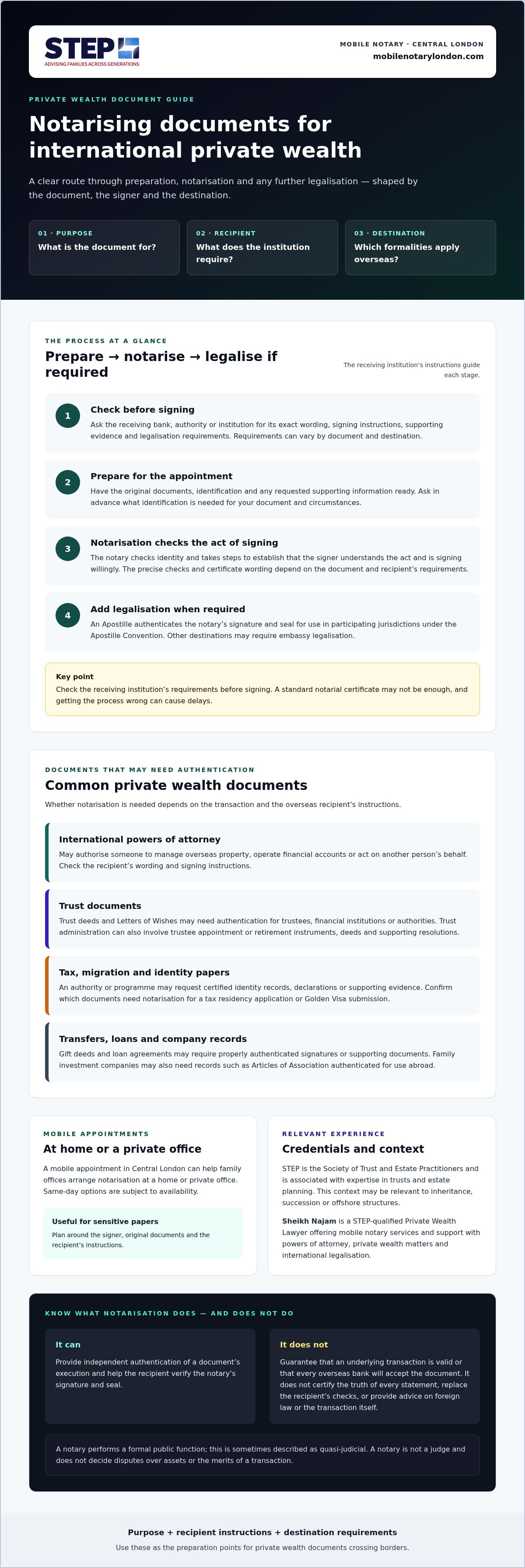
Legalisation is a sequence, not a single stamp. The steps depend on the document, destination country and receiving institution’s instructions. A notary for private wealth management documents can help identify the formalities, but confirm requirements with the overseas bank, lawyer or authority before signing. This is particularly important when a transaction has a firm completion date.
Preparing for Your Notary Appointment
Step 1: Prepare the documents and identification. Gather the original documents and check that they are in final form. Do not sign in advance unless instructed to do so. A passport and proof of address may be requested for identity checks, but confirm what to bring when arranging the appointment. Ask whether the recipient requires specific wording, a particular certificate or a translation.
Step 2: Arrange a mobile appointment. When requesting an appointment at your preferred Central London home or office location, share the document type, destination and any deadline. For trust papers or powers of attorney, say if multiple signatories need to attend. This helps with planning the appointment and document review.
For more guidance on preparing for a mobile notary appointment, check what information and paperwork to have ready beforehand.
From Notarisation to Legalisation
Step 3: Complete the notarisation. The notary checks identity and the document’s signing requirements, then oversees the relevant act. Sign only when instructed. If anything differs from the agreed version, pause and resolve it before signing.
Step 4: Check whether an Apostille is needed. For a destination that accepts Apostilles under the Hague Convention, the FCDO can authenticate the notary’s signature and seal. Paper-based and electronic Apostilles may have different acceptance requirements, so ask the recipient which it will accept. Processing options and availability can differ. Check current FCDO guidance before setting a completion date.
Step 5: Confirm any embassy legalisation. If the destination is not covered by the Apostille route, consular legalisation may be required after notarisation and Apostille. Requirements vary by country, including across Middle Eastern and Asian jurisdictions, so do not assume neighbouring countries follow the same process. Sheikh Najam’s practice provides notary, Apostille and embassy legalisation services for international documents.
To discuss the document, destination and required steps, arrange a discussion about your legalisation requirements.
Selecting a Premium Notary for International Wealth
For high-value cross-border documents, look beyond convenience. The notary should be properly regulated, understand the document’s international purpose and explain the steps needed for authentication and legalisation. A notary for private wealth management documents may handle sensitive powers of attorney, trust papers or company records, so clear communication and careful preparation matter.
Check the practitioner’s status with the Faculty Office, which regulates notaries in England and Wales. Ask about experience with the document type and destination, and share any instructions from a private bank or overseas authority. A STEP qualification can be relevant to trust and estate matters. Sheikh Najam is a STEP-qualified Private Wealth Lawyer offering private wealth legal advice and international legalisation support.
Before proceeding, ask for a clear explanation of the work involved and how fees are calculated, especially if the matter is urgent or includes Apostille and embassy legalisation. Do not assume every provider’s quote covers the same steps. Confirm whether the service includes mobile notarisation and the legalisation stages your destination requires, or whether you need to arrange any part separately.
Discretion and Professional Standards
Ask how identity documents and sensitive papers will be handled, and how confidential information is protected. You can also check the practitioner’s professional indemnity insurance and regulatory standing. Focus on relevant experience, clear procedures and a willingness to explain what the notarial act does and does not certify.
Booking a London Mobile Notary
If a completion date is close, share it when making an enquiry. Same-day mobile appointments are available in Central London, subject to confirmation. Check availability and any FCDO or embassy processing times rather than assuming they will fit your deadline. Provide the document type, destination, recipient’s instructions and number of signatories. With the client’s permission, coordinate with their private wealth lawyer or banker to clarify the required wording and legalisation route in advance.
For clients seeking an appointment at a Central London home or office, Sheikh Najam provides mobile notary services, with Apostille and embassy legalisation support for international documents. Book a mobile notary appointment to discuss the document, destination and timing.
Move Your International Wealth Documents Forward with Confidence
Choosing a notary for private wealth management documents means looking beyond the signature. Confirm what the receiving institution requires, prepare the right documents and identification, and establish whether an Apostille or embassy legalisation is needed for the destination.
For sensitive cross-border matters, specialist understanding can help make the process more considered. Sheikh Najam is a STEP-qualified Private Wealth Lawyer offering mobile notary appointments in Central London. Same-day appointments may be available, subject to confirmation, with support for embassy legalisation and complex wealth documents.
If you have a deadline, share the destination, document type and any instructions from your bank or adviser when making an enquiry. Enquire about a mobile notary appointment in Central London to discuss your document and the next steps.
Frequently Asked Questions
What is the difference between a notary and a solicitor for wealth documents?
A notary authenticates signatures, identities and documents for use abroad, whilst a solicitor may advise on the substance of legal matters and transactions. Their roles can overlap, as a notary is also a qualified lawyer, but the notarial act does not replace advice on the transaction or foreign law. For international wealth documents, check whether the recipient specifically requires notarisation and whether an Apostille or embassy legalisation is also needed.
Can a mobile notary legalise documents for use in offshore jurisdictions like the BVI or Cayman Islands?
A mobile notary can notarise documents at an agreed Central London location, and a provider offering Apostille and embassy legalisation can help arrange the relevant authentication steps. The route for the British Virgin Islands or Cayman Islands depends on the document and receiving authority’s requirements. Before signing, confirm whether an Apostille is accepted, whether further legalisation is needed and whether specific wording is required. Check acceptance with the recipient.
How long does the Apostille process take for urgent private wealth matters in 2026?
There is no reliable timeframe for every urgent matter. Processing depends on the FCDO service available at the time, the document and whether it is correctly prepared for legalisation. Notarisation and Apostille processing are separate stages, so a same-day notary appointment does not mean the Apostille will also be issued that day. Check current FCDO processing information before committing to a transaction deadline, and allow time for any embassy stage.
Do I need to be present in person for the notarisation of a Power of Attorney?
Usually, yes. The person signing a Power of Attorney should expect to meet the notary in person so their identity, understanding and willingness can be checked as part of the notarial process. A mobile appointment means the notary travels to an agreed location, not that the signing is automatically remote. Do not sign beforehand unless instructed. Confirm who must attend and whether the overseas recipient has specific execution requirements.
What identification do I need to provide for a private wealth notary appointment?
Be ready to provide a current passport and proof of address, but confirm the accepted documents with the notary before the appointment. Additional information may be needed for identity and anti-money laundering checks, depending on the client, document and transaction. Share the document type and destination in advance, and bring the original documents and any recipient instructions. This helps the notary identify what needs checking before the signing takes place.
Can you notarise documents at my private bank in Mayfair?
A mobile notary appointment may be arranged at a private bank in Mayfair, subject to availability and the bank’s permission and access arrangements. Agree the location with the bank and notary in advance, and confirm who will attend, what identification is required and whether suitable signing arrangements can be made. Sheikh Najam provides mobile notary services in Central London, including same-day appointments where availability is confirmed.
Is a mobile notary service legally recognised by international courts?
The fact that the notary travels to you does not by itself determine whether a document will be accepted abroad. Recognition depends on the notary’s authority, the document’s execution, the destination’s rules and any required Apostille or embassy legalisation. A court or other recipient may also have its own requirements. Check these with the relevant authority or overseas adviser before signing, especially for proceedings involving inheritance, property or trust matters.
What are the costs associated with embassy legalisation for Middle Eastern countries?
Costs vary according to the destination country, document type, embassy requirements and any preceding notarisation or Apostille steps. There is no single fee that applies across Middle Eastern jurisdictions, and a provider’s service charges may be separate from official fees. Ask for an itemised estimate identifying each stage, and verify current embassy requirements before proceeding. Do not assume a quoted legalisation service includes every required authentication or translation.
Article by
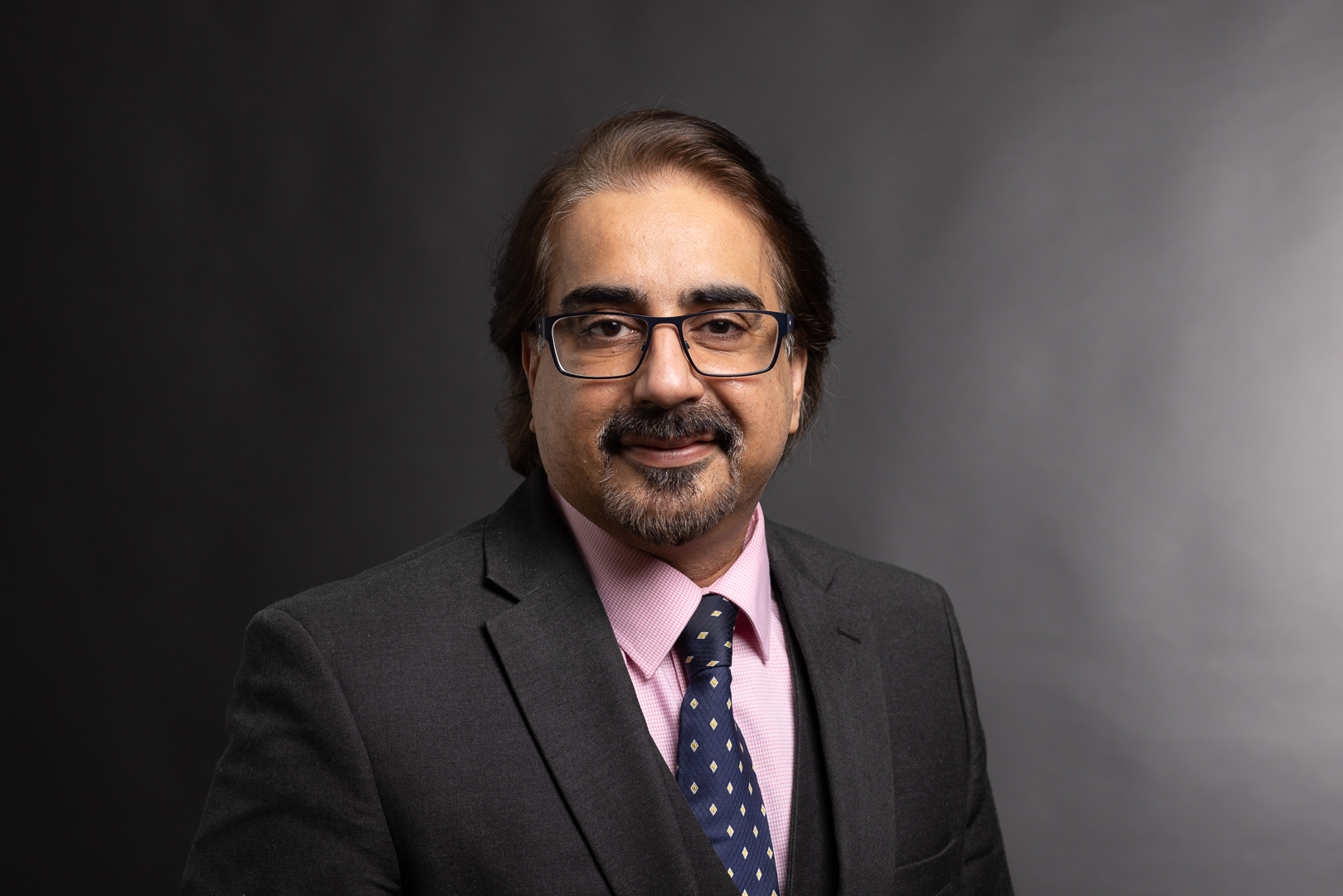
Sheikh Najam
Sheikh Najam LLB, TEP, MCIArb is a Notary Public and Commissioner for Oaths based in Central London, offering notary services to corporate, commercial and private clients across the City of London and beyond. His work includes notarising board and shareholder resolutions, powers of attorney, and certified copies of constitutional documents for use with foreign registries, banks and courts, with apostille and legalisation arranged as part of the same instruction. Alongside his notarial practice, he is a STEP-qualified international private wealth lawyer advising on cross-border transactions, company formation, trust drafting and succession planning. He is regulated by the Faculty Office (Court of Faculties) of the Archbishop of Canterbury and is a member of The Notaries' Society of England and Wales, STEP, and The Association of European Attorneys.


