

Imagine the sudden realisation that a lifetime of careful planning has been halted at a foreign border because a local registrar refuses to recognise a standard British Will. It is a stressful scenario, particularly when you are already managing the emotional weight of a bereavement or the logistical pressure of a time-sensitive property sale. You understand that international law is a complex web, and the fear of assets being frozen abroad is a valid concern that requires immediate, expert attention.
This professional guide simplifies the intricate process of notarising a will for use abroad, providing you with a clear roadmap to ensure your legal documents carry the necessary authority in foreign jurisdictions. We will bridge the gap between English probate requirements and overseas civil systems, clarifying the vital differences between mere notarisation and full legalisation. By the end of this article, you'll understand how to secure a legally robust document through a seamless, mobile service that respects both your schedule and the gravity of your requirements. We shall explore everything from FCDO Apostille protocols to the specialised oversight provided by a STEP-qualified practitioner, ensuring your international estate planning is handled with absolute precision.
Key Takeaways
- Understand why standard UK witnessing is often insufficient for foreign land registries and how a notary provides the necessary international validity for your testamentary documents.
- Discover the precise technical steps involved in notarising a will for use abroad, including the rigorous verification of identity and capacity required to satisfy overseas authorities.
- Learn the vital distinction between a notary's signature and the subsequent requirement for an FCDO Apostille or embassy legalisation for jurisdictions outside the Hague Convention.
- Explore the logistical advantages of a premium mobile notary service in Central London, which ensures sensitive private wealth matters are handled with total discretion at your convenience.
- Recognise how the specialised oversight of a STEP-qualified Private Wealth Lawyer can help you navigate the complexities of cross-border inheritance and conflicting legal systems.
Understanding Why Notarising a Will for Use Abroad is Essential
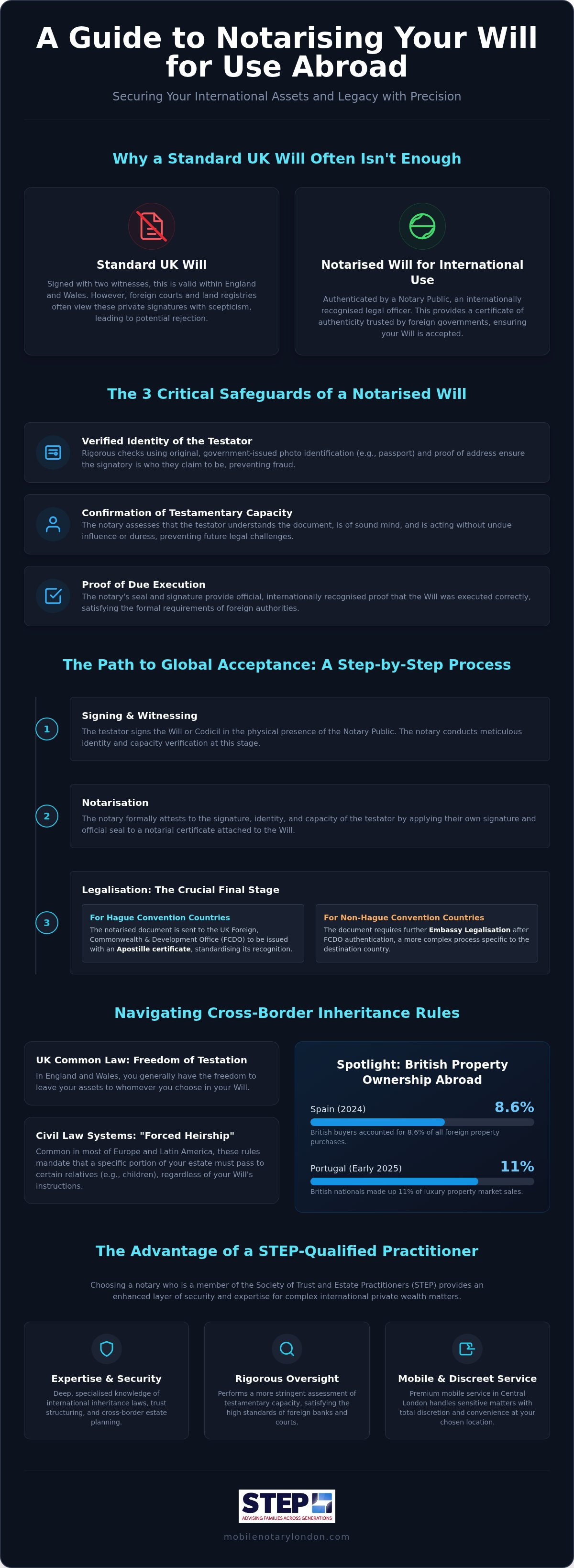
When dealing with assets in multiple jurisdictions, the legal validity of your testamentary documents is paramount. In England and Wales, a Will is typically valid if it's signed in the presence of two witnesses. However, foreign land registries and probate courts often view these private signatures with skepticism. This is where the role of a Notary Public becomes indispensable. By notarising a will for use abroad, you're obtaining a certificate of authenticity from an internationally recognised legal officer whose seal is trusted by foreign governments.
Whether you're dealing with a full Last Will and Testament or a Codicil, which is a document that amends an existing Will, the requirement for notarisation remains consistent. A Codicil must be executed with the same level of formality as the original Will to ensure it isn't dismissed by overseas authorities during probate. This process prevents fraud and ensures that your final intentions are honoured, protecting your global legacy from being entangled in bureaucratic delays.
A notarised Will provides three critical safeguards for your estate:
- Verified identity of the testator through rigorous government-issued documentation checks.
- Confirmation of testamentary capacity to prevent future litigation from disgruntled parties.
- Proof of "due execution" that satisfies the specific protocols of foreign land registries.
Bridging the Gap Between Legal Systems
Many clients are surprised to find that the "freedom of testation" enjoyed in the UK doesn't always apply elsewhere. Most of Europe and Latin America operate under Civil Law systems, which often include "forced heirship" rules. These regulations mandate that a portion of the estate must pass to specific relatives, regardless of what the Will states. This is particularly relevant for the thousands of UK citizens owning property in Spain, where British buyers accounted for 8.6% of foreign property purchases in 2024, or Portugal, where they made up 11% of luxury market sales in early 2025. A specialist notary ensures your Will is prepared in a way that respects these local laws whilst maintaining its validity under the Hague Apostille Convention, which standardises document recognition across participating nations.
The Role of the STEP-Qualified Notary
Choosing a practitioner who's a member of the Society of Trust and Estate Practitioners (STEP) provides an extra layer of security for your private wealth. A STEP-qualified professional possesses deep expertise in the complexities of international inheritance and notary and apostille services. They don't just witness a signature; they perform a rigorous assessment of the testator’s mental capacity and ensure there's no undue influence. This scrutiny is vital because foreign banks and courts often require explicit proof of testamentary capacity before they'll release assets. By notarising a will for use abroad with a specialist, you ensure the document meets the specific formal requirements of the destination country, significantly reducing the risk of your assets being frozen.
The Technical Process of Notarising a Last Will and Testament
Notarising a will for use abroad is far more than a simple rubber-stamping exercise. It's a formal legal ceremony conducted with the precision required by international law. When a mobile notary arrives at your Central London location, whether it's a private residence in Belgravia or a corporate suite in Chelsea, the process begins with a meticulous review of the document and the parties involved. Unlike a domestic Will, where witnesses might be neighbours with minimal verification, a Notary Public performs a high-stakes authentication designed to withstand the scrutiny of foreign probate courts.
Verification and Due Diligence
The foundation of any notarial act is the positive identification of the testator. You'll need to provide original, government-issued photo identification and proof of address. The notary doesn't just check your passport; they verify that you fully grasp the document's contents and its legal impact across different jurisdictions. This is especially vital for international estate planning, where a lack of clarity can lead to assets being frozen. The notary also ensures that witnesses meet the specific criteria of the destination country, as some jurisdictions have strict rules about who can witness a testamentary document. If you're unsure about the local requirements for your specific jurisdiction, it's often wise to consult a specialist before the signing ceremony begins.
Binding and Sealing the Document
Once the physical signature is witnessed, the notary performs the "Notarial Act" by attaching a formal certificate. To prevent tampering, the pages are bound together using traditional silk ribbons and secured with a legal wafer and the notary's embossed official seal. This physical security is a hallmark of professional notarising a will for use abroad. It ensures that no pages can be removed or substituted after the fact. A permanent record of this act is then entered into the Notary’s protocol, providing a vital audit trail for future legal enquiries. This level of rigour is often required before you can use the UK government's legalisation service to obtain an apostille, as the Foreign, Commonwealth & Development Office (FCDO) must first recognise the notary's signature and seal as authentic.
Legalisation Beyond the Signature: Apostilles and Embassy Requirements
Once the physical act of notarising a will for use abroad is complete, the document enters the legalisation phase. For many jurisdictions, the notary’s seal alone isn't sufficient for foreign probate courts or land registries to accept the Will. Most countries require an Apostille, which is a certificate issued by the Foreign, Commonwealth & Development Office (FCDO) that authenticates the notary’s signature and seal. This process is governed by the Hague Convention, an international treaty that simplifies the movement of legal documents between member states.
The UK government legalisation service is the central authority for this verification. Without this critical step, your Will may be treated as a mere private document, potentially leading to assets being frozen whilst legal arguments are settled in a foreign court. This is particularly vital for the 200,000 homes in the UK registered to overseas owners, where cross-border legal recognition is a daily necessity.
The Apostille Process in London
The FCDO maintains a database of all registered Notaries Public in England and Wales. When you submit a notarised Will, officials compare the seal and signature against their records to confirm the notary's authority. You must manage your timeline carefully. As of August 2026, the FCDO charges £45 per document for a standard paper-based apostille. If you're facing a tight deadline for a property sale or probate application, you might require an Urgent Apostille London service. This premium route, available through registered business users, carries an FCDO fee of £100 per document but ensures the process moves with the necessary speed to meet international requirements.
Embassy Legalisation for Non-Hague Countries
The process becomes significantly more complex for countries that aren't signatories to the Hague Convention. This includes several jurisdictions in the Middle East, such as the UAE or Qatar, alongside parts of Asia and Africa. In these instances, a simple apostille is insufficient. You must undertake a multi-layered verification chain:
- Notarisation by a qualified Notary Public.
- Legalisation by the FCDO.
- Final attestation by the relevant foreign Embassy or Consulate in London.
Each embassy has its own specific requirements, fees, and processing times. Missing a single step in this chain can cause months of delays. Professional oversight is vital to ensure that your documents move seamlessly through these bureaucratic layers, securing your global legacy without the risk of procedural rejection. This rigour is essential when notarising a will for use abroad for use in non-member states, where local requirements are often uncompromising and require precise administrative coordination.
Organising Your Mobile Notarisation Appointment in Central London
Time is often the most restricted asset for those managing complex global estates. Traditional office visits can be cumbersome and indiscreet, particularly when dealing with sensitive testamentary documents. Why choose a mobile notary? The answer lies in the seamless integration of legal compliance into your existing schedule. Whether you're at a private members' club in Mayfair or a family office in Marylebone, notarising a will for use abroad requires a quiet, controlled environment where sensitive details can be discussed with total privacy. A mobile service brings the expertise of a Notary Public directly to you, eliminating the need to navigate London traffic with original, high-value documents.
You'll need your original passport and a recent utility bill or bank statement, typically dated within the last three months, to satisfy rigorous Anti-Money Laundering (AML) regulations. If the foreign authority requires independent witnesses who aren't beneficiaries or relatives, you should arrange for them to be present. Whilst some countries allow the notary to provide witnesses for an additional fee, others insist on individuals who've known you for a specific duration. This preparation is a vital component of notarising a will for use abroad, as it prevents procedural delays that could jeopardise tight probate or property sale deadlines.
Serving Central London’s Elite Neighbourhoods
Our service is tailored for those in London's most prestigious postcodes. We provide premium mobile support across Mayfair, Marylebone, and Fitzrovia, ensuring that the legalisation of your private wealth documents fits into a busy afternoon of meetings or travel. For those located slightly further south, our Notary Public Belgravia Guide offers specific insights into handling high-value estate documents in that area. We prioritise same-day efficiency for urgent international requirements, ensuring your documents are ready for the next stage of the legalisation chain without delay. If you need to secure your international assets today, book your mobile appointment now to ensure total legal peace of mind.
Securing Your Global Legacy with Sheikh Najam
Choosing the right professional for notarising a will for use abroad is a decision that impacts the long-term security of your estate. Sheikh Najam provides a unique combination of legal rigour and mobile convenience, specifically designed for high-net-worth individuals with complex global footprints. As a STEP-qualified Private Wealth Lawyer, he understands the nuances of international inheritance and the specific phrasing required to satisfy foreign registries. This isn't just about a signature; it's about ensuring your documents are legally bulletproof in every jurisdiction where you hold assets.
The complexity of cross-border estates often means that a Will is just one part of a larger legal strategy. Sheikh Najam offers a holistic service that manages the entire legalisation chain. From the initial mobile appointment in Mayfair to the final embassy attestation, every step is handled with meticulous attention to detail. This integrated approach removes the burden of administrative coordination from the client, providing a single, reliable point of contact for all international private wealth matters. It ensures that the transition of your assets remains seamless, regardless of the legal system involved; for example, those with interests in the United States may wish to explore Probate Administration Services with The Probate & Estate Planning Co. to ensure their American holdings are correctly administered.
Expertise in International Private Wealth
Working with a specialist who holds a STEP qualification ensures that your estate planning is viewed through a global lens. This expertise is particularly valuable when managing concurrent Wills or navigating the forced heirship laws found in many civil law jurisdictions. Beyond Wills, Sheikh Najam provides comprehensive support for related documents, such as Power of Attorney Notarisation London, ensuring that your legal representatives have the authority they need abroad. This high-level oversight provides confidence that your documents will be accepted by foreign courts without the risk of costly procedural challenges.
Next Steps for Your International Will
Securing your global legacy shouldn't be a source of stress. Whether you're preparing for a property sale in Spain or reorganising your luxury portfolio in Portugal, professional certification is the key to a smooth transition. To begin the process of notarising a will for use abroad, you can request an instant quote tailored to your specific requirements. The service is designed to be agile, responsive, and entirely mobile, fitting into the gaps of a demanding schedule. You can Book your appointment via Calendly today to ensure your international documents are handled with the precision and discretion they deserve.
Protect Your International Interests Today
Securing a legacy across borders requires more than just a signed document; it demands a precise alignment of English law with foreign administrative standards. We've explored how notarising a will for use abroad serves as the essential bridge between legal systems, ensuring your intentions are recognised by overseas land registries and probate courts. Whether you're navigating the Hague Apostille Convention or the multi-layered requirements of non-member states, professional oversight is the only way to prevent assets from being frozen at a critical moment.
Sheikh Najam provides the specialised expertise of a STEP-qualified Private Wealth Lawyer combined with the practical efficiency of a same-day mobile service across Central London. From Mayfair to Chelsea, he ensures your high-stakes documents are handled with total discretion and technical accuracy. By managing the entire process, including FCDO and Embassy legalisation, he delivers the peace of mind that your global estate is fully protected. Don't leave your international inheritance to chance. Secure your international legacy — Book a premium mobile notary appointment with Sheikh Najam today to ensure your documents are legally robust and ready for immediate use.
Frequently Asked Questions
Does a UK Will need to be notarised for use in Europe?
A UK Will generally requires notarisation for use in Europe because most Continental jurisdictions operate under Civil Law. These systems don't recognise private signatures as having the same weight as a notarial act. Whether you own property in Spain or have accounts in France, the local authorities will insist on a certified document. This ensures the document is accepted by foreign land registries and probate courts without the risk of asset freezing.
What is the difference between an Apostille and notarisation for a Will?
Notarisation is the initial certification performed by a Notary Public to verify your identity and the document's execution. The Apostille is a subsequent certificate issued by the FCDO that validates the notary's authority. When notarising a will for use abroad, the Apostille acts as the international seal of approval. This two-step process is mandatory for countries within the Hague Convention to ensure the document is recognised as a valid legal instrument.
Can a mobile notary witness the signing of my Will at my home in London?
Sheikh Najam provides a premium mobile service specifically for notarising a will for use abroad, bringing expertise directly to your door. He can witness the signing of your Will at your residence, private office, or club in Central London. This is ideal for sensitive private wealth matters where discretion is paramount. By choosing a mobile appointment, you ensure the signing ceremony is conducted with legal rigour without the inconvenience of visiting an office.
How long does it take to legalise a Will for a non-Hague Convention country?
Legalising a document for non-Hague countries involves a multi-stage chain that includes the FCDO and the relevant foreign embassy. Whilst the FCDO stage can be completed quickly through an urgent service, embassy timelines vary significantly. Some consulates process documents in 48 hours, whilst others may take several weeks. It is essential to factor in these varying administrative speeds when managing deadlines for international probate or property transactions in the Middle East or Asia.
Do I need a separate Will for my assets held in a foreign country?
Do I need a separate Will for my assets held in a foreign country?
This depends on your specific estate and the jurisdictions involved. Whilst you can use one Will for multiple countries, it often creates complex legal hurdles during probate. Local laws, such as forced heirship rules in Europe, can conflict with your intentions. A STEP-qualified professional can advise on whether a separate local Will or a carefully coordinated international document is the most secure way to manage your global assets and protect your beneficiaries. For those with interests in specific jurisdictions, such as the Middle East or North America, the Israel Cross Border Law Firm offers specialised guidance on aligning your international legal strategy.
You must present your original passport and a recent proof of address, such as a utility bill or bank statement dated within the last three months. These are required to satisfy strict Anti-Money Laundering (AML) and "Know Your Client" protocols. You should also have the final, unexecuted Will ready. If the destination country requires independent witnesses who aren't related to you, ensure they are present at the appointment with their own identification.
Is a notarised Will legally binding in the UAE or Saudi Arabia?
A notarised Will is a vital prerequisite, but it isn't sufficient on its own in the UAE or Saudi Arabia. These jurisdictions require full embassy legalisation after the FCDO has issued an Apostille. For non-Muslims in the UAE, the document must be properly legalised before it can be registered with the DIFC or Abu Dhabi Judicial Department. This ensures your testamentary intentions are recognised and enforced by the local courts and registries.
Can Sheikh Najam assist with the legalisation of a Trust Deed as well?
Sheikh Najam frequently handles the legalisation of Trust Deeds alongside Wills and Powers of Attorney. His background as a STEP-qualified Private Wealth Lawyer makes him uniquely suited to certify complex fiduciary documents. Whether you need to establish a trust abroad or manage existing international assets, he provides a seamless service that covers notarisation, Apostille certification, and embassy attestation. This ensures your high-stakes private wealth documents meet the rigorous standards required by foreign financial institutions.
Article by
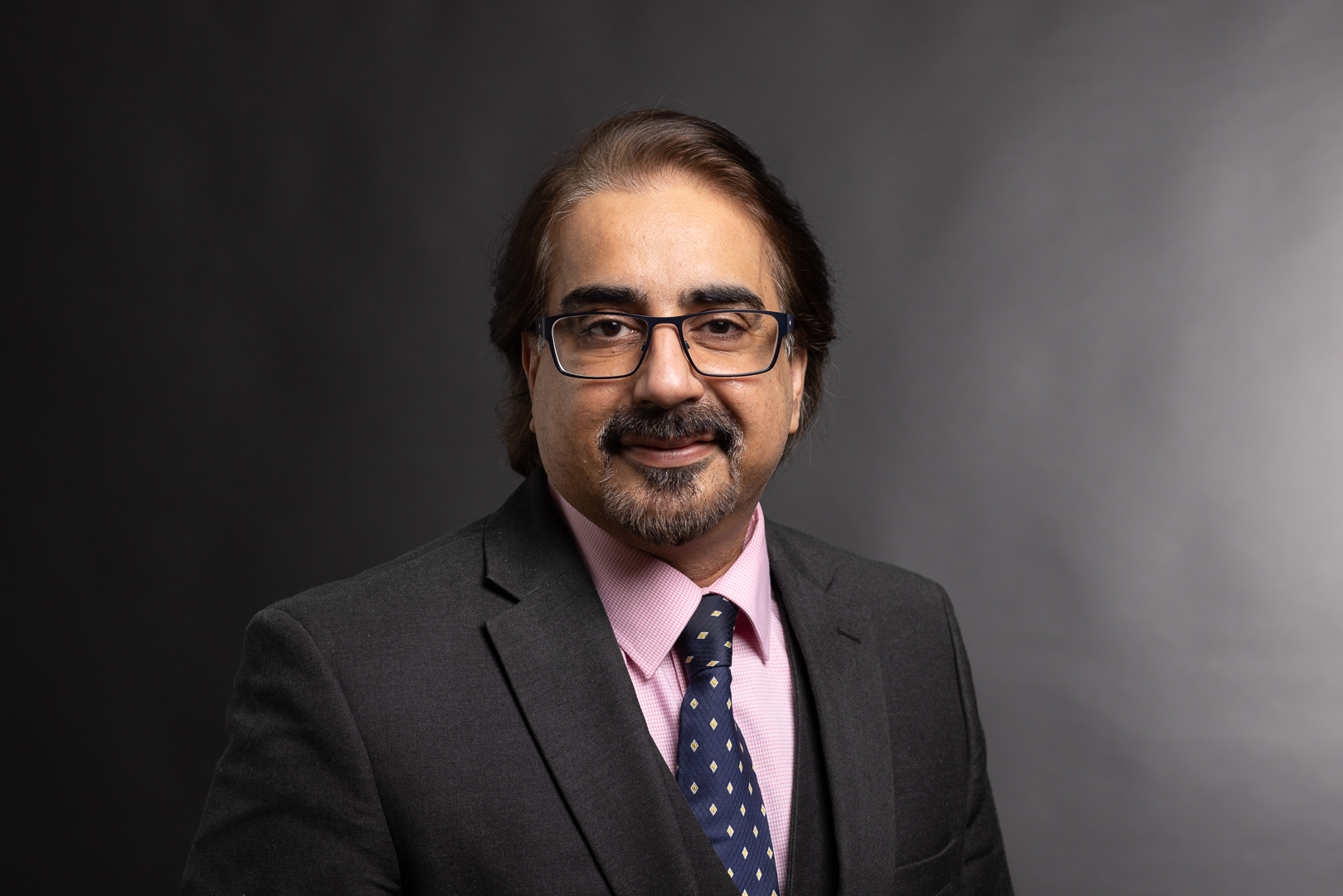
Sheikh Najam
Sheikh Najam LLB, TEP, MCIArb is a Notary Public and Commissioner for Oaths based in Central London, offering notary services to corporate, commercial and private clients across the City of London and beyond. His work includes notarising board and shareholder resolutions, powers of attorney, and certified copies of constitutional documents for use with foreign registries, banks and courts, with apostille and legalisation arranged as part of the same instruction. Alongside his notarial practice, he is a STEP-qualified international private wealth lawyer advising on cross-border transactions, company formation, trust drafting and succession planning. He is regulated by the Faculty Office (Court of Faculties) of the Archbishop of Canterbury and is a member of The Notaries' Society of England and Wales, STEP, and The Association of European Attorneys.


