

The overseas bank, not the notary, decides what form of identity certification it will accept. That’s why certifying identity for overseas bank use can be confusing: instructions may refer to a certified copy, notarisation or an apostille as though they mean the same thing. Choosing the wrong route could delay an application or compliance review.
Before arranging anything, ask the bank for a precise document checklist and confirmation of any wording, witnessing or legalisation requirements. This guide explains the difference between an identity check, a certified copy and notarisation, and when an apostille may be relevant. The receiving bank remains the authority on whether its requirements have been met.
You’ll also learn how to prepare for a notary appointment in Central London, including which original documents and bank instructions to bring. Sheikh Najam, a STEP-qualified Private Wealth Lawyer, provides mobile notary appointments across Central London and can discuss the requested certification. Confirm the required route with your bank before booking, so the appointment can be considered in light of its instructions.
Key Takeaways
- For certifying identity for overseas bank use, confirm the bank’s exact requirements before choosing a certification route.
- A certified copy, a witnessed signature and an apostille serve different purposes and aren’t interchangeable.
- Ask the bank in writing which certifier it accepts and what wording the document must include.
- Prepare for your appointment by bringing the original identity document and the bank’s full written instructions.
- Mobile notary appointments are available across Central London. The overseas bank decides whether the completed document meets its requirements.
Certifying identity for an overseas bank: what does the bank actually need?
Before arranging a UK appointment, establish exactly what the overseas bank is asking you to provide. The phrase “identity certification” isn’t used consistently. Requirements can differ by bank, country, account application and transaction. One institution may ask you to complete its own identity checks; another may request a copy of a document certified by an approved professional.
For certifying identity for overseas bank purposes, the task may involve confirming specified identity evidence or certifying a document, but only in the form the receiving institution requests. A notary can provide professional certification or witness a signature where instructed. This is separate from the bank’s own identity and compliance checks, which remain the bank’s responsibility. Notarisation doesn’t guarantee the bank will accept the document or approve an application.
What might an overseas bank mean by identity certification?
Read the request closely. “Verify your identity”, “provide a certified copy” and “sign in the presence of a notary” may describe different steps. The request might relate to a passport copy, a signature on a bank form or another specified identity document. Don’t assume one form of certification will satisfy another.
Ask the bank to confirm its instructions in writing. Check which document it requires, the format and certification wording, and whether it names an acceptable certifier, such as a notary public. If the instruction is unclear, ask what the certifier must do and what information should appear on the completed document.
Why the receiving bank’s instructions come first
The receiving bank determines what it will accept. Before booking an appointment, confirm which identity documents are acceptable and whether the bank requires an original, a certified copy, a witnessed signature or additional authentication. Ask whether a translation is needed and, if so, whether the bank specifies who must prepare or certify it.
An apostille may be requested as a further authentication step, but it isn’t a substitute for the certification the bank specifies. The Apostille Convention provides a framework for simplifying the authentication of certain public documents for use abroad. Whether an apostille is relevant depends on the bank’s instructions and the destination country’s requirements. Embassy legalisation may also be requested in some circumstances, so confirm the required route directly rather than assuming additional authentication is needed.
Keep the bank’s written response with your documents. It gives you a clear basis for discussing the requested service with a UK notary and reduces the risk of arranging certification that doesn’t match the bank’s stated process.
Notarised copy, witnessed signature or apostille: which route fits the request?
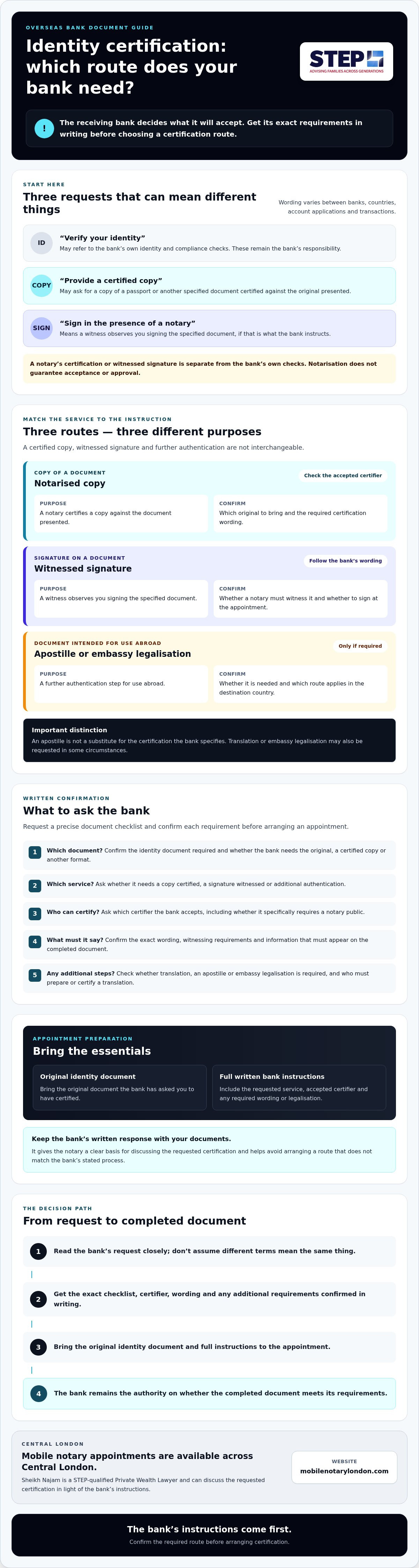
These options serve different purposes. A notarised copy concerns a copy of a document; witnessing concerns a signature; an apostille or embassy legalisation is an additional authentication step for use abroad. They aren’t interchangeable, so match the service to the bank’s written instruction before arranging an appointment.
| Route | Purpose | Who may perform it | What to confirm |
|---|---|---|---|
| Notarised copy | A notary certifies a copy against the document presented. | A notary public, if the bank accepts this certifier. | Which original document to bring and the required certification wording. |
| Witnessed signature | A witness observes you signing a specified document. | A notary or another person named in the bank’s instructions. | Whether the signature must be witnessed by a notary and whether you should sign at the appointment. |
| Apostille or embassy legalisation | Further authentication for a document intended for use abroad. | The relevant authority or embassy, following the required process. | Whether this step is required and which route applies in the destination country. |
When could a bank ask for a notarised identity document?
A bank may request a notarised copy of a passport or another identity document, but its written instructions determine whether notarisation is appropriate. A notary’s certification of a copy isn’t the same as the bank verifying your identity through its own compliance process. Nor should you assume that a scan or ordinary photocopy will satisfy a request for a certified copy. Check what the bank expects the notary to certify and whether it requires specific wording.
A notary may also witness your signature on a bank form. This confirms that the signing took place in the notary’s presence; it doesn’t replace any identity checks the bank carries out itself. If the instruction says “certified copy” but the accompanying form asks for a witnessed signature, ask the bank whether it needs one service or both.
When might an apostille or embassy legalisation be relevant?
Authentication may be needed when a notarised document is to be used overseas, but don’t add this step unless the bank or receiving authority requests it. The UK government guide to getting a document legalised explains the process. Confirm with the bank which authentication is required for the destination country, and whether embassy legalisation follows.
Sheikh Najam’s practice facilitates apostille and embassy legalisation where required. You can review the available notary and apostille services, then confirm the specific route with the bank before proceeding. For certifying identity for overseas bank use, the receiving institution’s instructions remain decisive.
How to confirm and compare your overseas bank’s certification options
Before arranging an appointment, turn the bank’s request into a clear checklist. This makes it easier to compare possible routes without assuming that a particular notary service will automatically meet the bank’s requirements. For certifying identity for overseas bank purposes, written confirmation is especially useful if the instruction uses broad terms such as “verification” or “legalisation”.
Questions to send to the overseas bank before booking
Contact the bank through its official channel and ask for precise answers. Keep its reply with your application documents, so you and the notary can refer to the same instructions.
- Which identity document is acceptable, and must you present the original or provide a certified copy?
- Who may certify the document? Does the bank require a UK notary public or accept another named professional?
- What exact wording, stamp or details must appear on the certification?
- Does a bank form need to be signed in front of a witness, and must that witness be a notary?
- Is a translation required? If so, does the bank specify how it must be prepared or certified?
- Is an apostille or embassy legalisation separately required for this document and destination?
Ask for sample wording or the relevant section of the bank’s form, if available. “Certified copy” may not tell you whether the bank requires a specific statement, date or identifying detail. Avoid relying on an informal assumption when the bank can clarify its process in writing.
How to choose a suitable UK notary
Once you have the bank’s response, compare options by the task requested, how the original document must be handled, location convenience and any additional authentication steps. Copy certification, witnessing a signature and legalisation address different requirements. Check that the notary service you’re considering covers the specific task, and share the bank’s instructions in advance to discuss whether they can be followed.
For an appointment in Central London, a mobile notary may be convenient if travelling with original identity documents is difficult. Sheikh Najam provides mobile notary appointments across Central London. You can check appointment arrangements, and confirm availability and location directly.
If the bank requests an apostille or other legalisation, verify the route before arranging it. The UK government guidance on legalising documents explains the official process; the bank or receiving authority should confirm whether it applies to your case. Compare the options against the bank’s exact instructions, not a general claim that one route works for every institution.
How to prepare for identity certification in the UK
Preparation starts with matching the appointment to the bank’s written requirements. Once you know whether the bank needs a certified copy, a witnessed signature or another specified step, gather the documents and information the notary will need to understand the request. This helps keep the appointment focused and reduces the risk of finding that an instruction or original document is missing.
Documents and information to have ready
Bring the original identity document named by the bank, along with every form or supporting document it has specified. If the request concerns a certified copy, the notary will generally need to see the relevant original to compare it with the copy. Ask beforehand if you’re unsure which originals or supporting records are needed.
Have the bank’s full written instructions available, not just a summary or cropped screenshot. Include its contact details, the destination country and any exact certification wording, template or form. Before the appointment, check that your name and other details are consistent across the identity document and bank paperwork. Look for differences in spelling, name order or dates, and ask the bank how to handle any discrepancy rather than altering a document yourself.
- Original identity document and the documents specified by the bank
- The full written request, including certification wording or forms
- The bank’s contact details and the destination country
- Any instructions about witnessing, translations or further authentication
What to clarify with the notary beforehand
Describe the requested task precisely. For example, explain whether the bank wants a copy certified against an original or a signature witnessed on a particular form. Share the bank’s instructions in advance and ask whether the notary needs to see originals or additional supporting documents. If the bank’s wording remains unclear, seek clarification from the bank before the appointment rather than asking the notary to guess what it will accept.
If the bank requires your signature to be witnessed, don’t sign the document in advance. Wait until the appointment and follow the notary’s instructions about when to sign. A signature already on the page may not meet a request for signing in the notary’s presence.
For clients in Central London, a mobile notary appointment may offer a practical way to arrange the requested certification. Sheikh Najam provides mobile notary services across Central London; confirm appointment availability and location when making arrangements. If your instructions and documents are ready, check appointment arrangements before proceeding.
Arrange overseas bank identity certification with a Central London mobile notary
Once you’ve confirmed the bank’s instructions, discuss the specific document and certification it requires. Sheikh Najam provides mobile notary services across Central London, including notarisation and certification support for international requirements. A mobile appointment may be a practical option if you need a UK notary to review an original identity document or witness a signature at an agreed location.
Sheikh Najam is a STEP-qualified Private Wealth Lawyer, bringing relevant professional experience to work involving international requirements. This doesn’t mean an overseas bank endorses the service or will accept a particular document. The bank remains responsible for its requirements and acceptance decision.
What a mobile notary appointment can help with
Depending on the bank’s written instructions, a notary may be able to certify a copy of an identity document or witness a signature on a bank form. Share the exact request before arranging the appointment, so the required task can be considered in context. If the bank also asks for an apostille or embassy legalisation, these may be facilitated where the receiving authority requires them. They aren’t automatic parts of every certification.
For more information about the Central London service, see the mobile notary service overview. Confirm appointment availability and location when making arrangements.
What to include in your enquiry
A clear enquiry helps establish what the bank has requested and what should be discussed before an appointment. Include:
- The destination country and the name of the overseas bank
- The deadline given by the bank, if there is one
- The type of identity document and any forms involved
- The exact certification wording or instructions, ideally in full
- Whether a signature must be witnessed or further authentication is requested
Sharing the bank’s instructions in advance gives the notary an opportunity to consider the requested certification and identify any points that need clarification. If the wording is ambiguous, ask the bank to explain it rather than relying on assumptions. For certifying identity for overseas bank use, a carefully prepared appointment can help align the notarial task with the request, although acceptance remains the bank’s decision.
Once you have the written requirements and relevant documents ready, discuss your overseas bank certification requirements with the Central London notary. Confirm appointment availability and the appropriate service directly.
Move forward with the right certification route
Before arranging certification, get the overseas bank’s requirements in writing. Confirm which identity document it accepts, whether it needs a certified copy or witnessed signature, and whether further authentication is required. These distinctions matter: notarisation doesn’t guarantee acceptance, and the bank makes the final decision.
For certifying identity for overseas bank use, match the appointment to the bank’s exact instructions and bring the relevant original documents. If an apostille or embassy legalisation is requested, check the required process with the receiving bank or authority before proceeding.
Sheikh Najam is a STEP-qualified Private Wealth Lawyer and provides mobile notary services across Central London. Apostille and embassy legalisation can also be facilitated when required. Share the bank’s instructions when enquiring so the requested service can be discussed clearly.
Discuss your overseas bank certification requirements. With the right instructions and documents prepared, you can take the next step with greater confidence.
Frequently Asked Questions
Can a UK notary certify my identity for an overseas bank?
Yes, a UK notary may carry out a certification or witness a signature if that task matches the bank’s instructions. For certifying identity for overseas bank use, the notary’s role is distinct from the bank’s own identity and compliance checks. The bank decides what it accepts. Before arranging an appointment, ask the receiving bank to confirm the required document, exact wording and which certifiers it will accept.
Does an overseas bank need a notarised copy of my passport?
Not necessarily. Requirements vary, and a bank may ask for a certified passport copy, a different identity document or another verification process. Don’t assume a passport copy will be sufficient. Before presenting documents to a notary, ask whether the bank needs to see the original, requires specific certification wording, expects a translation or wants additional authentication. Keep its written response so the notary can understand the precise request.
Is an apostille always required for identity certification for an overseas bank?
No. An apostille isn’t automatically required just because a document is intended for an overseas bank. The receiving bank or authority determines whether further authentication is needed. Ask whether notarisation alone is sufficient or whether an apostille or embassy legalisation must follow. Confirm any country-specific instructions directly with the bank or receiving authority before arranging the next step, as requirements can vary depending on the document and destination.
Can a notary certify a document without seeing the original?
It depends on the certification requested and the evidence the notary needs to examine. Don’t assume a scan or photocopy will be sufficient, particularly if the bank asks for a copy certified against an original. Explain the task and share the bank’s instructions with the notary beforehand. Ask whether you must present the original document and any supporting identification, so you can prepare the right materials for the appointment.
How do I prepare for a notary appointment for an overseas bank?
Bring the bank’s full written instructions, the specified original identity documents and any forms requiring certification or witnessing. Confirm the appointment requirements with the notary in advance, including whether supporting documents are needed. If the bank requires your signature to be witnessed, don’t sign the document beforehand. When enquiring, share the destination country and any deadline given by the bank, as well as the exact task requested.
Can a mobile notary in Central London help with overseas bank documents?
Yes. Sheikh Najam provides mobile notary services across Central London and can discuss the certification requested for documents intended for an overseas bank. The bank’s written instructions determine the appropriate task, and acceptance of a notarised document can’t be guaranteed. When contacting the practice, provide the required wording, destination country and details of the documents involved. Confirm appointment availability and location directly when making arrangements.
What happens if the overseas bank rejects my certified identity document?
Ask the bank to explain precisely why it rejected the document and what corrected format or additional step it requires. Don’t assume repeating the same certification will resolve the issue. Request updated instructions in writing, including any required wording, certifier or authentication. Once the bank clarifies its requirements, you can discuss the revised request with a notary or, if specified, a relevant apostille or embassy legalisation service.

Article by
Sheikh Najam
Sheikh Najam LLB, TEP, MCIArb is a Notary Public and Commissioner for Oaths based in Central London, offering notary services to corporate, commercial and private clients across the City of London and beyond. His work includes notarising board and shareholder resolutions, powers of attorney, and certified copies of constitutional documents for use with foreign registries, banks and courts, with apostille and legalisation arranged as part of the same instruction. Alongside his notarial practice, he is a STEP-qualified international private wealth lawyer advising on cross-border transactions, company formation, trust drafting and succession planning. He is regulated by the Faculty Office (Court of Faculties) of the Archbishop of Canterbury and is a member of The Notaries' Society of England and Wales, STEP, and The Association of European Attorneys.


