

A multi-million-pound private treaty sale can unravel in an instant over a single defective signature or an unverified bill of sale. When closing high-stakes acquisitions in Mayfair, St James’s, or bonded vaults, your principals cannot afford administrative friction or public exposure. You already know that discerning collectors and institutional trustees expect absolute confidentiality; they will not leave a private viewing suite simply to process transactional legalities. Retaining a dedicated mobile notary for art transactions has therefore become indispensable, ensuring that deeds of transfer, condition reports, and cross-border powers of attorney are authenticated impeccably on-site.
Discover how on-site mobile notarisation protects multi-million-pound art transactions, cross-border sales, and gallery acquisitions across Central London without disrupting your closing timetable. Below, we examine the legal mechanics of high-value art authentication, exploring how bespoke attendance, strict anti-money laundering compliance, and expedited apostille certification maintain an unbreakable chain of custody for international buyers.
Key Takeaways
- Learn why appointing a specialist mobile notary for art transactions protects client confidentiality and contractual validity within private galleries, residences, and secure vaults.
- Understand which critical documents, including bills of sale, condition reports, and cross-border powers of attorney, mandate formal notarial authentication to satisfy foreign jurisdictions.
- Examine how a multi-million-pound Mayfair private treaty sale met an uncompromising international closing deadline through coordinated, on-site legal verification.
- Discover how strict compliance with UK anti-money laundering standards and streamlined apostille legalisation maintain an uncompromised chain of custody for overseas buyers.
- Review the essential preparation checklist required by gallery directors and wealth advisers to secure seamless, same-day mobile attendance across Central London.
The Role of a Mobile Notary for Art Transactions in Central London
In high-stakes private treaty acquisitions, the legal formalities underpinning title transfer demand surgical precision. Appointing a specialist mobile notary for art transactions bridges the divide between rapid commercial negotiation and rigid cross-border enforceability. Instead of disrupting negotiations by sending signatories across town, a mobile notary attends directly on-site to authenticate signatures, verify corporate authority, and affix their official seal to instruments ranging from bills of sale to escrow release conditions.
London's premier art districts, Mayfair, St James’s, and Belgravia, generate multi-million-pound transactions that conclude in boardroom negotiations or secluded exhibition suites. Understanding why mobile notary attendance has become indispensable in these quarters requires recognising that transactional momentum cannot wait for standard administrative delays.
Safeguarding High-Value Chattels and Confidentiality
Seven-figure art sales demand total discretion. Transporting rare physical condition reports, provenance archives, and original bills of sale through public spaces exposes sensitive commercial terms to needless risk. By conducting the entire execution process within private viewing suites, family offices, or bonded vaults, principals ensure sensitive information remains strictly confidential. On-site attendance protects both the physical safety of high-value chattels and the anonymity of the parties involved.
The Legal Authority of a Notary Public in Art Deals
Domestic contracts often rely on simple solicitor witnessing, but international art deals require credentials that withstand foreign legal scrutiny. In England and Wales, notaries are appointed and governed under the Faculty Office of the Archbishop of Canterbury, constituting a legal profession distinct from solicitors. A notarial certificate provides incontrovertible proof of identity, legal capacity, and informed consent across civil and common law jurisdictions alike.
Understanding The Role of a Mobile Notary in this context clarifies why cross-border escrow agents, overseas museums, and foreign customs authorities insist on notarised deeds. The notarial act creates an unimpeachable legal record that prevents subsequent disputes over validity or signatory authority, preserving legal standing wherever the artwork travels.
Essential Art Documentation Requiring Specialist Notarisation
High-value fine art deals involve contractual frameworks far more complex than simple retail sales. When title transfers across borders, receiving jurisdictions demand formal proof that signatories hold valid authority and that agreements are unassailable. Deploying a mobile notary for art transactions ensures that every instrument, from initial loan covenants to final ownership releases, meets exacting foreign standards right at the point of signing.
Domestic English contracts rarely require notarial execution to be valid between local counterparties. International buyers, offshore trustees, and customs agencies, however, operate under civil law rules where unnotarised instruments carry minimal evidential weight. Discover why collectors choose why mobile notary solutions for complex private wealth holdings when managing multi-jurisdictional art portfolios.
Bills of Sale, Consignment Deeds, and Escrow Releases
A bill of sale represents the definitive transfer of title, containing core warranties regarding clear ownership, authenticity, and non-encumbrance. Multi-million-pound transactions routinely deposit funds with neutral escrow agents who will not disburse payments without certified confirmation of executed transfer deeds. Similarly, major auction houses and private brokers rely on notarised consignment agreements to establish clear agency authority before cataloguing lots.
Provenance Affidavits and Certificates of Authenticity
When artwork chains of ownership contain historical gaps, sworn provenance affidavits bridge the evidential void. Artist estates, scholarly committees, and authentication boards frequently execute formal declarations before a notary public to confirm attribution. These verified certificates become essential when applying for cultural property export licences, establishing compliance with the official AML guidance for the UK art market, and satisfying overseas customs declarations.
Corporate Resolutions and Powers of Attorney for Art Trusts
Blue-chip artworks are seldom held in an individual's personal name. Private wealth structures routinely deploy offshore trusts, special purpose vehicles (SPVs), and family foundations to manage valuable collections:
- Board Resolutions: Formally recording corporate authorization for acquisitions, pledges, or deaccessions.
- Specific Powers of Attorney: Granting fine art advisors or auction specialists the legal authority to inspect, bid, and execute agreements on behalf of institutional trustees.
- Incumbency Certificates: Validating that corporate directors possess current signing authority under company law.
For urgent transactions facing tight closing deadlines, galleries and private representatives can schedule an on-site appointment to execute these instruments without delay.
Case Study: Facilitating a Cross-Border Private Treaty Sale in Mayfair
Timing is critical when completing seven-figure private treaties across international borders. In a recent transaction, an established commercial gallery in Mayfair concluded the sale of a rare post-war British canvas valued at several million pounds to a prominent Swiss family foundation. With closing funds held in a Zurich escrow account, release terms mandated the delivery of fully authenticated, apostilled closing instruments before the day's banking cut-off.
Engaging a dedicated mobile notary for art transactions allowed both the vendor's representatives and the buyer's UK legal agents to finalise every instrument on-site without exposing the work or the parties to external disruption.
The Transaction Context: Dual-Jurisdiction Closing Protocol
Swiss foundation law and banking compliance imposed stringent conditions. Counsel required verified board resolutions, an authenticated warranty of title, and formal identity vetting of the ultimate beneficial owners before approving the release of capital. Readers can review comparable procedural demands within this mobile notary Mayfair art gallery case study.
Compounding the pressure was a strict four-hour window. The Swiss financial institution required verified proof of notarial execution and expedited apostille submission to meet the daily clearing window, leaving zero tolerance for defective paperwork.
On-Site Execution: Precision Verification and Sealing
The mobile notary attended the gallery's private viewing rooms in Mayfair to conduct comprehensive verification procedures:
- Examining original photographic identification and cross-referencing corporate registry filings for the selling entity.
- Administering formal declarations confirming clear legal title and the absence of third-party security interests.
- Attesting the physical wet-ink execution of the bill of sale, condition report, and escrow release instructions under official seal.
This structured execution meant all documentation was sealed within forty-five minutes of arrival, establishing an unshakeable evidential record.
Post-Execution Chain: Urgent Apostille and Courier Dispatch
Switzerland is among the roughly 130 member jurisdictions bound by The Apostille Convention, meaning an apostille certificate from the Foreign, Commonwealth & Development Office (FCDO) is required for formal foreign legal recognition. The sealed instruments were transferred immediately into an urgent Central London legalisation pipeline, followed by high-priority courier dispatch to Zurich. This seamless coordination allowed the escrow agent to disburse funds without delay, safeguarding the interests of both buyer and seller.
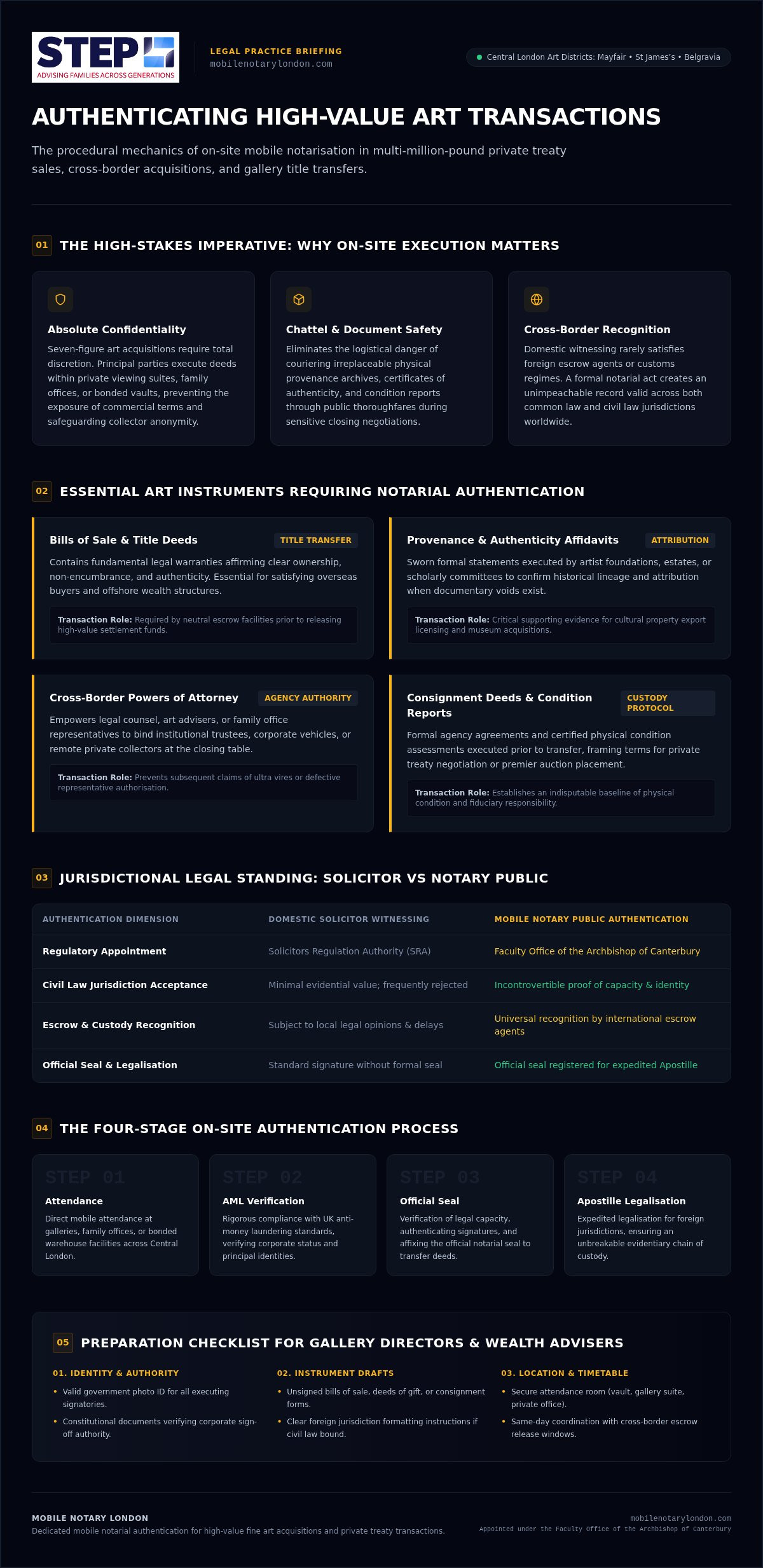
Due Diligence, AML Compliance, and Cross-Border Legalisation
Operating as an Art Market Participant (AMP) in the UK carries strict statutory responsibilities that directly intersect with notarial law. When structuring high-value acquisitions, retaining a qualified mobile notary for art transactions provides an indispensable layer of compliance. Notaries must satisfy their own independent regulatory obligations under the Faculty Office while reinforcing the statutory due diligence required of galleries, auction houses, and art advisors.
Every transaction involving works valued at £10,000 or more demands comprehensive Customer Due Diligence (CDD). Failing to verify corporate layers properly can stall closings or trigger severe regulatory penalties under UK anti-money laundering supervision.
Anti-Money Laundering Protocols for High-Value Art Sales
Under the Money Laundering, Terrorist Financing and Transfer of Funds Regulations 2017, professionals must identify and verify the ultimate beneficial owners (UBOs) behind complex ownership structures. Offshore trusts, private investment companies, and foundation accounts cannot serve as opaque veils. In accordance with the Economic Crime and Corporate Transparency Act, notaries verify all Persons with Significant Control (PSCs) alongside the corporate signatories physically present.
Having notarial oversight directed by a STEP-qualified Private Wealth Lawyer ensures that multi-tiered fiduciary structures receive thorough legal scrutiny. This rigorous verification creates an auditable compliance paper trail that withstands regulatory inspection from HMRC and international banking compliance teams.
Apostille Certification and Embassy Attestation Procedures
Document execution is only the initial hurdle when dealing with foreign jurisdictions. For contracting states of the Hague Apostille Convention, the Foreign, Commonwealth & Development Office (FCDO) must attach an apostille certificate confirming the validity of the notary's signature and seal. Non-signatory nations, however, enforce a more demanding, multi-tiered legalisation workflow:
- FCDO Authentication: The primary verification validating the notary public's official status and seal.
- Consular Legalisation: Secondary attestation conducted by the destination country's embassy or consulate in London.
- Chamber of Commerce Certification: Commercial invoices or export manifests occasionally require prior trade body certification before consular submission.
Key art markets across the Middle East and parts of Asia require full consular legalisation before local customs authorities permit import clearance. Exploring dedicated notary and apostille services ensures that authenticated paperwork transitions immediately into the correct international pipeline.
To coordinate on-site verification and expedited document legalisation for your upcoming private treaty sale, book a private consultation with our specialist mobile practice today.
Booking Premium Mobile Notary Services for London Art Transactions
Securing an on-site legal practitioner requires methodical advance preparation to maintain absolute transactional velocity. Appointing a premier mobile notary for art transactions ensures that signing protocols proceed without administrative friction, allowing collectors, gallery directors, and wealth managers to complete multi-million-pound transfers with utter confidence. A structured booking pathway pairs client availability with rigorous document pre-clearance.
When closing sensitive acquisitions, having attendance led by a STEP-qualified Private Wealth Lawyer provides unmatched legal certainty. This specialised dual qualification guarantees that complex trust deeds, corporate charters, and international powers of attorney receive rigorous scrutiny before any wet-ink signature is sealed.
Pre-Appointment Preparation Checklist
To avoid closing delays, parties must assemble specific verification elements prior to the notary's arrival:
- Government-Issued Identification: Valid original passports or national identity cards for all signatories.
- Proof of Address: Recent bank statements or utility bills dated within three months.
- Unexecuted Documentation: Final draft contracts, bills of sale, and condition reports presented clean without prior signatures or annotations.
- Corporate Authorisation: Certified board minutes, trust instruments, or powers of attorney evidencing execution authority.
- Certified Translations: Professional English translations paired with any foreign-language instruments requiring attestation.
Coverage Across Prime Central London Art Hubs
Our bespoke mobile service provides dedicated on-site attendance across London's historic art enclaves, including Mayfair, St James’s, Belgravia, Kensington, and the City. Whether you require attendance within a commercial gallery viewing room, a private wealth family office, or a high-security bonded facility, our practice guarantees absolute discretion and punctuality. Review broader prime residential and commercial standards within this notary public Belgravia guide.
Securing Your On-Site Legal Appointment
Streamlined pre-clearance prevents procedural defects before they arise. Prior to attendance, draft documentation undergoes comprehensive review alongside direct communication with your overseas legal advisers. This preliminary oversight ensures that specific foreign jurisdictional requirements, from civil law testimonial clauses to precise sealing formats, are satisfied fully on the first attempt.
For urgent completions, private treaty closings, or scheduled international consignments across Central London, you can Schedule your mobile notary appointment today to ensure seamless legal execution.
Ensure Flawless Execution for Your High-Value Art Acquisitions
High-value art acquisitions demand uncompromising legal precision and absolute discretion. Whether finalising a multi-million-pound private treaty in Mayfair or executing an international consignment in St James’s, retaining a specialist mobile notary for art transactions safeguards every link in the ownership chain. On-site verification ensures that bills of sale, provenance declarations, and trust instruments satisfy strict foreign jurisdictions without compromising client privacy.
Directed by Sheikh Najam, a STEP-qualified Private Wealth Lawyer and Notary Public, our practice delivers dedicated on-site attendance across Central London art districts. We handle the entire document lifecycle, pairing rigorous compliance with expedited apostille certification and consular legalisation management. Your transactional deadlines remain protected at every step. To ensure complete legal certainty for your next private treaty or gallery acquisition, contact Sheikh Najam to arrange your on-site notarial attendance today.
Frequently Asked Questions
Why is an on-site mobile notary necessary for high-value art transactions?
An on-site mobile notary for art transactions is essential to maintain confidentiality, security, and contractual validity. High-value private treaty sales involve prominent collectors and sensitive pricing structures that cannot be exposed to public offices. Bringing notarial authority directly to a gallery, residence, or private vault prevents logistical disruption, ensures immediate identity vetting, and guarantees that instruments meet strict foreign enforceability criteria before funds transfer.
What specific documents must be notarised during a private art sale?
The primary instruments requiring notarial certification include bills of sale, warranty of title deeds, and condition reports. In complex international transactions, parties also notarise sworn provenance affidavits, artist estate certificates, and irrevocable escrow release instructions. When corporate entities or private trusts purchase or sell artworks, notaries must authenticate board resolutions and cross-border powers of attorney authorising individual agents to execute binding contracts.
How does a notary public verify beneficial ownership in art holding companies?
Notaries verify beneficial ownership by examining certified registers of members, articles of association, and trust deeds to map out the entire ownership structure. In compliance with the Economic Crime and Corporate Transparency Act, they confirm the identity of all Persons with Significant Control (PSCs) alongside physical signatories. This rigorous documentary audit creates an evidential paper trail satisfying UK anti-money laundering regulations and international banking standards.
Can a mobile notary attend a private gallery or art storage vault in Mayfair?
Yes, specialist mobile attendance is designed specifically for high-security, confidential environments. Rather than requiring principals to attend an external office, the notary visits private viewing rooms, bonded art warehouses, and family offices across Mayfair, St James’s, and Belgravia. This on-site attendance allows key signatories to execute multi-million-pound contracts within their chosen sanctuary, ensuring seamless compliance without compromising transaction security or client discretion.
Is an apostille always required for art export and international sales agreements?
An apostille is necessary whenever transaction documents must satisfy foreign courts, registries, or customs authorities within Hague Apostille Convention signatory countries. If an overseas buyer, foreign bank, or destination customs office operates outside the UK, they require an apostille certificate from the Foreign, Commonwealth & Development Office to validate the notary's official seal. Non-Hague jurisdictions require additional consular legalisation through their London embassy.
What is the difference between a mobile notary and a general commercial solicitor?
While a commercial solicitor advises on domestic English contract law, a notary public holds a distinct public office regulated by the Faculty Office. A solicitor's signature rarely carries legal validity overseas without external validation. In contrast, notarial acts establish indisputable, internationally recognised proof of identity, legal capacity, and corporate authority, which cross-border escrow agents, overseas registries, and foreign civil law jurisdictions strictly mandate.
How quickly can a mobile notary be deployed for an urgent art transaction in London?
Same-day attendance can be arranged across Central London when time-sensitive closing schedules require immediate execution. Once draft documents and signatory identification details are submitted for rapid pre-clearance, a mobile notary for art transactions can attend private Mayfair galleries or offices within hours. This prompt mobilisation ensures that closing documents, banking cut-offs, and subsequent expedited apostille submissions proceed without jeopardising completion timetables.
Article by
Sheikh Najam
Sheikh Najam LLB, TEP, MCIArb is a Notary Public and Commissioner for Oaths based in Central London, offering notary services to corporate, commercial and private clients across the City of London and beyond. His work includes notarising board and shareholder resolutions, powers of attorney, and certified copies of constitutional documents for use with foreign registries, banks and courts, with apostille and legalisation arranged as part of the same instruction. Alongside his notarial practice, he is a STEP-qualified international private wealth lawyer advising on cross-border transactions, company formation, trust drafting and succession planning. He is regulated by the Faculty Office (Court of Faculties) of the Archbishop of Canterbury and is a member of The Notaries' Society of England and Wales, STEP, and The Association of European Attorneys.


