

If you're searching for a Qatar embassy legalisation UK notary, the right route for your UK document depends on what the receiving authority in Qatar requires. Notarisation, an FCDO apostille and embassy attestation are separate stages, and the required sequence or format can vary by document.
That uncertainty is understandable. A UK apostille alone may not complete the process, and preparing the wrong original or supporting evidence can cause delays. This guide explains the stages that may apply, what to confirm with the organisation receiving your document in Qatar, and how to prepare originals, supporting evidence and any required translation before arranging notarisation. It also explains the differences between personal and commercial documents, including where an additional certification route may apply. A notary can check identity, capacity or execution where required, but the receiving authority decides what it will accept. Checking the requirements before you begin can help you organise the next steps with more confidence.
Key Takeaways
- Ask the organisation in Qatar that will receive your document for written instructions on acceptable formats and required legalisation stages.
- Use the Qatar embassy legalisation UK notary process as a guide, not a fixed sequence. Requirements can differ for personal documents, powers of attorney and company papers.
- Before arranging notarisation, check whether you need an original, supporting evidence, identification or a translation.
- Confirm the current process with the relevant official bodies. Additional stages may apply, and processing depends on document readiness and authority requirements.
- A Central London notary can assist with required notarisation and facilitate apostille and embassy legalisation, but the receiving authority decides what it will accept.
Qatar embassy legalisation UK notary: what the process is designed to achieve
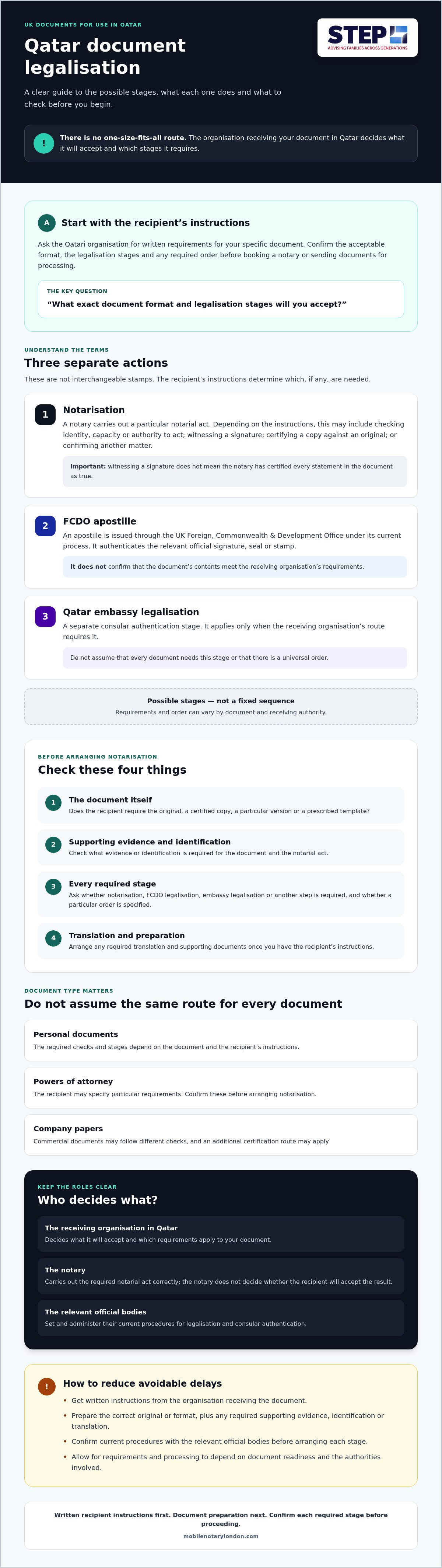
The required route depends on the document and the organisation or authority that will receive it in Qatar. A personal document, a power of attorney and a company record may need different checks. Don’t assume every document follows the same sequence or requires every stage.
These terms describe separate actions, not interchangeable stamps. Notarisation is a notary’s act of verifying or witnessing something about a document, such as a person’s identity and signature. An apostille is an official authentication of a signature, seal or stamp, issued under the applicable FCDO process. Embassy legalisation is a separate consular authentication stage, where the receiving route requires it. Together, these steps form part of the broader process of authenticating or certifying a document for use across borders. The relevant authorities determine which stages are needed.
What does a UK notary do for a document intended for Qatar?
A notary may check your identity and, where relevant, consider your capacity and authority to act. Depending on the document and the recipient’s instructions, the notary may witness your signature, certify a copy against an original or confirm another matter. These are distinct notarial acts: witnessing a signature does not mean the notary has certified every statement in the document as true.
The notary’s role is to carry out the required act correctly, not to decide whether a Qatari employer, bank, court or public authority will accept the result. For a mobile appointment in Central London, Sheikh Najam’s mobile notary service can assist with document preparation where notarisation is required. Confirm the recipient’s requirements before the appointment.
How are an apostille and embassy legalisation different?
An apostille is issued through the UK’s Foreign, Commonwealth & Development Office (FCDO), subject to its current rules. It authenticates the relevant official signature, seal or stamp; it does not confirm that the document’s contents meet the recipient’s requirements. Embassy legalisation is a separate consular step, required only if the recipient’s route calls for it.
That distinction matters when you’re searching for a Qatar embassy legalisation UK notary. Notarisation may prepare or authenticate a document for a later official check, but it is not itself an apostille or embassy attestation. Nor should you assume there is a universal order. Ask the receiving organisation for written instructions, then check the current FCDO and Embassy of the State of Qatar in London procedures before arranging each stage. This helps you confirm whether notarisation is needed and what must happen next.
How to legalise a UK document for Qatar: check requirements before booking
Confirm the destination requirements before booking a notary or sending documents for legalisation. A short written checklist from the organisation receiving your document can prevent avoidable rework, especially if it specifies an original, a particular format or a required signature.
Quotable checklist: Ask the recipient in Qatar first, confirm the document format, identify every required stage, then arrange the document’s preparation.
- Ask the recipient. Contact the Qatari authority, employer, bank, court or other organisation that will receive the document. Request written instructions for that specific document.
- Confirm the format. Check whether they need the original, a certified copy, a particular version of the document or a prescribed template.
- Identify the stages. Ask whether notarisation, FCDO legalisation, embassy legalisation or another step is required, and whether the recipient specifies an order.
- Arrange preparation. Once you have instructions, organise any relevant notarial act, supporting evidence and translation.
The UK government guidance on legalising documents for Qatar is a useful official reference for the UK legalisation route. Check it alongside the recipient’s written requirements and current instructions from the relevant authorities. Don’t rely on a general description if the receiving organisation has set document-specific conditions.
What should you confirm with the receiving authority in Qatar?
Ask precise questions. Does this document need a notary to witness a signature or certify a copy? Must it then be legalised by the FCDO or the Qatari Embassy? Is another attestation required? Confirm whether the recipient will accept an original or certified copy, requires a named signatory, or has supplied a template. Ask whether an Arabic translation is needed, whether the recipient specifies a translator’s credentials, and whether the translation itself needs legalisation. These details can vary, so check each requirement rather than assuming there is a standard route.
What should you prepare before seeing a notary in Central London?
Bring the complete document and follow the recipient’s instructions about whether to sign it before the appointment or in the notary’s presence. Don’t sign in advance if the notary must witness your signature. Prepare valid identification and, if signing for a company or another person, evidence showing your authority to do so. Check whether supporting documents or additional signatories are required, and tell the notary what the recipient has requested.
For relevant Central London arrangements, see the mobile notary appointment information. If you’re researching Qatar embassy legalisation UK notary requirements, take the recipient’s written instructions to the appointment. This helps clarify the notarial act needed, without treating the notary as the authority that decides acceptance.
Which Qatar legalisation route fits your document? Compare the possible stages
There isn’t one route for every Qatar-bound document. Its origin, format, how it was signed and the recipient’s instructions can all affect the preparation or authentication required. An apostille alone may not satisfy a request, so confirm directly whether the recipient also requires embassy legalisation or another step.
Use this comparison to identify the questions to ask, not as a substitute for the receiving authority’s instructions.
| Document type | Questions to confirm |
|---|---|
| Personal documents, such as certificates or records | Must it be the original, or will a certified copy be accepted? Does this particular document need notarisation, FCDO legalisation, embassy legalisation or another attestation? Is a translation or supporting evidence required? |
| Powers of attorney | Who must sign, and must the signature be witnessed in a particular way? Does the recipient require a specific form, language or notarial wording? Which authentication stages must follow execution? |
| Company documents | Does the recipient need company records, evidence of board authority or a certified copy? How must the signatory’s identity and authority be established? Does the document need a commercial certification route as well as any other legalisation? |
Do powers of attorney for Qatar need notarisation and embassy legalisation?
Don’t assume the answer from the document title alone. A power of attorney may require careful execution, but the required signing and authentication depend on the receiving party’s instructions. Ask who must sign, whether witnesses are needed, which language or template is acceptable, and whether notarisation, an apostille or embassy legalisation is required. A notary can carry out the requested notarial act, but cannot determine whether the recipient will accept the document.
Do company documents follow the same route as personal documents?
Not necessarily. A company document may raise questions about the type of record, who is authorised to sign and what evidence of corporate authority must accompany it. Confirm whether the recipient wants a board resolution, company records, an original or a certified copy. Commercial documents may also have an additional certification route, so check current instructions with the receiving organisation and relevant official bodies before proceeding.
For a Qatar embassy legalisation UK notary enquiry, use the table to build a document-specific checklist. Then verify every stage instead of relying on a general sequence. The right preparation is the one that matches the recipient’s requirements and the document you have.
Avoid delays: prepare your Qatar-bound documents and verify each stage
Small preparation errors can interrupt a legalisation application or prompt the recipient to request corrected documents. Before arranging notarisation, use this checklist to make sure the paperwork and instructions are aligned:
- Confirm the recipient’s written requirements. Check the acceptable document format and every required authentication stage with the organisation in Qatar.
- Review the document for completeness. Check names, dates, signatures, page attachments and supporting evidence. Make sure all required pages are present.
- Prepare identification and authority evidence. Have the identification requested for the notarial act, plus evidence that you’re authorised to sign for a company or another person, if relevant.
- Verify translation requirements. Ask whether a translation is needed, whether the recipient specifies a translator’s credentials, and whether the translation requires separate authentication.
- Check signing instructions. Don’t sign early if the notary or recipient requires the document to be signed in a particular setting or in the notary’s presence.
For an overview of the practice’s apostille and legalisation services, see the relevant service information. The receiving authority still decides what it will accept, so use its current instructions to guide your preparation.
What common mistakes can lead to delays or rejection?
An incomplete document, a signature made at the wrong time, missing evidence of authority or an unchecked translation requirement can all create avoidable complications. Check that names and dates match across the document and supporting papers, and that no attachments have been omitted. Don’t assume another person’s experience applies: a different document type, origin, format or recipient can mean different requirements. Confirm the instructions for your own submission.
How should you plan around official processing times?
Processing depends on the relevant authority, whether your paperwork is ready and whether an additional stage applies. Before making plans, check the current guidance from the FCDO and the Embassy of the State of Qatar in London. If your document requires extra certification or onward submission, allow for that in your planning and verify the route before sending anything.
Keep appointment availability separate from external processing and collection or delivery arrangements. A notarial appointment may address document execution, but it doesn’t control how quickly an authority handles a later stage. Urgent handling, where available, shouldn’t be treated as a guarantee that the complete route will finish by a particular date. If you’re preparing documents in Central London, contact the notary to discuss your document and requirements.
Arrange Qatar embassy legalisation support with a Central London notary
Start with the recipient’s instructions, then prepare the document in the required format. If notarisation is needed, arrange the appropriate notarial act before proceeding with the official legalisation stages confirmed for your document. The route may differ depending on what you’re submitting and who will receive it in Qatar.
Sheikh Najam facilitates notarisation and international legalisation, but the Qatari receiving authority decides whether a document meets its requirements. The practice is led by Sheikh Najam, a STEP-qualified Private Wealth Lawyer. Mobile notarial appointments are available across Central London, with same-day options subject to appointment availability and document suitability.
What information should you include in a legalisation enquiry?
A clear enquiry helps establish what preparation may be relevant. Include:
- Document type and origin: for example, a power of attorney or company document, and the country where it was issued.
- Intended recipient and purpose: identify the authority, employer, bank or other organisation in Qatar, and how the document will be used.
- Written requirements: describe or share the recipient’s instructions, taking care not to send unnecessary sensitive information.
- Preferred location and timing: state where in Central London an appointment would suit you and any deadline, so appointment options can be checked.
These details help clarify whether the document may need witnessing, certification or another notarial act. They also help distinguish the notary’s role from the later stages set by the relevant official bodies.
How can Central London mobile notary support help?
For suitable documents, mobile notarisation offers a practical way to arrange the required notarial act across Central London without travelling to an office. The practice also facilitates apostille and embassy legalisation. You can review the apostille and embassy legalisation support available, then verify the current route with the receiving organisation and official authorities. Availability and suitability must be confirmed for each enquiry.
If you’re looking for Qatar embassy legalisation UK notary support, share the document type, issuing country, recipient in Qatar and your deadline when you discuss your Qatar document requirements. Include any written instructions you have, but avoid sending sensitive personal details unless they’re needed and requested. This gives the practice useful context to discuss preparation and possible next steps, without implying that any stage or acceptance can be guaranteed.
Take the next step with confidence
The clearest starting point for Qatar-bound paperwork is the organisation that will receive it. Confirm its current instructions in writing, then prepare the document and arrange only the notarial and legalisation stages that apply. An apostille may not be the final requirement, and the correct route can depend on the document and its intended use.
If you need Qatar embassy legalisation UK notary support, Sheikh Najam can facilitate notarisation and international legalisation, while the receiving authority remains responsible for deciding what it will accept. The practice is led by Sheikh Najam, a STEP-qualified Private Wealth Lawyer, with mobile notary appointments across Central London subject to availability.
To discuss your document, share its type, issuing country, intended recipient in Qatar and any relevant deadline. Include the recipient’s written instructions if available, but avoid sending unnecessary sensitive information. Discuss your Qatar document requirements and clarify possible next steps. With the right instructions in hand, you can move forward with greater confidence.
Frequently Asked Questions
Does a UK document always need Qatar embassy legalisation?
No. The required route depends on the document and the organisation receiving it in Qatar. The recipient may ask for notarisation, FCDO legalisation, embassy legalisation or another requirement, but don’t assume every document needs every stage. Request current written instructions from the Qatari authority, employer, bank, court or other recipient before booking an appointment, arranging a translation or submitting documents. Check the relevant official guidance too.
Is an apostille enough for a document used in Qatar?
Not necessarily. An apostille authenticates a relevant signature, seal or capacity under the applicable legalisation process; it doesn’t confirm that a Qatari recipient will accept the document or that no further step is needed. The organisation receiving it may require consular legalisation or other action. Confirm the specific route for your document with that organisation and check current official guidance before sending it onward.
Can a UK notary arrange Qatar embassy legalisation?
A UK notary can carry out a required notarial act and may facilitate related apostille and embassy legalisation stages. What can be handled, and in what sequence, depends on the document and current authority procedures. Ask which steps the notary can facilitate and which you’ll need to arrange yourself. Notarial certification doesn’t guarantee acceptance in Qatar, as that decision belongs to the receiving organisation.
How do I legalise a UK power of attorney for Qatar?
First, ask the recipient in Qatar for written instructions on how the power of attorney must be signed, its language and the required authentication. Confirm whether it must be signed before a notary and whether FCDO or embassy legalisation is requested. Bring the complete document, valid identification and evidence of your authority to sign, if applicable. Requirements can vary, so verify each stage for your document before proceeding.
Do documents for Qatar need to be translated into Arabic?
Not always. Translation requirements depend on the document and the organisation receiving it. Ask whether an Arabic translation is required, who may provide it and whether the translation itself needs certification or legalisation. Confirm these details before commissioning the work. A translation completed in the wrong format or at the wrong stage may need to be corrected, so check the recipient’s instructions rather than relying on another applicant’s experience.
How long does Qatar embassy legalisation take in the UK?
There’s no single turnaround for every document and route. Timing may depend on whether the paperwork is complete, notarial appointment availability, FCDO and embassy processing, any translation or additional stage, and collection or delivery arrangements. Check current estimates with each relevant authority and allow contingency time. An urgent or mobile notary appointment doesn’t control external processing or guarantee completion by a particular date.
Can a Central London notary help with urgent Qatar-bound documents?
A Central London mobile notary may be able to assist with suitable notarisation and facilitate related legalisation arrangements, subject to appointment availability and the document’s requirements. In your enquiry, identify the document, the recipient’s written instructions and your deadline. Ask which stages can be facilitated and which remain with official authorities. Urgency doesn’t guarantee acceptance or completion by a specified date, so check the full route before making plans.

Article by
Sheikh Najam
Sheikh Najam LLB, TEP, MCIArb is a Notary Public and Commissioner for Oaths based in Central London, offering notary services to corporate, commercial and private clients across the City of London and beyond. His work includes notarising board and shareholder resolutions, powers of attorney, and certified copies of constitutional documents for use with foreign registries, banks and courts, with apostille and legalisation arranged as part of the same instruction. Alongside his notarial practice, he is a STEP-qualified international private wealth lawyer advising on cross-border transactions, company formation, trust drafting and succession planning. He is regulated by the Faculty Office (Court of Faculties) of the Archbishop of Canterbury and is a member of The Notaries' Society of England and Wales, STEP, and The Association of European Attorneys.


