
What if a single overlooked stamp on a power of attorney cost your business a six-figure international contract? It's a scenario that keeps many directors and private clients awake at night, especially as we navigate the evolving landscape of global bureaucracy in 2026. You likely feel that avoiding delays with document legalisation is a labyrinth of shifting deadlines and opaque requirements, where one minor clerical error results in total rejection by foreign authorities.
This guide is designed to eliminate that uncertainty, providing a definitive strategy for your international paperwork while ensuring every certificate meets the rigorous standards of the FCDO and specific embassy protocols. Whether you're dealing with new Hague Convention members like Vietnam or complex attestation for Middle Eastern jurisdictions, mastering these steps is essential for your peace of mind and procedural rigor.
We'll break down 2026 FCDO processing timelines, clarify the vital distinction between notarisation and legalisation, and show how a mobile, expert-led approach secures your international interests without the logistical headache of visiting multiple offices. You'll gain a clear, error-free path to ensuring your documents are accepted the first time, allowing you to focus on your global objectives with total confidence.
Key Takeaways
- Learn how to align UK certification standards with the specific requirements of foreign authorities to ensure your documents are accepted without hesitation.
- Discover the essential strategies for avoiding delays with document legalisation, including the critical choice between submitting original documents or certified copies.
- Identify when a simple FCDO Apostille is sufficient and when complex embassy attestation is required for non-Hague jurisdictions like the UAE, Qatar, or China.
- Understand why obtaining a written checklist from your foreign recipient is the most effective way to prevent costly procedural rejections.
- Explore how premium mobile notary services in Central London can accelerate your application by providing expert, on-site certification at your home or office.
Understanding the Global Legalisation Landscape
Legalisation is the process of making a UK document legally fit for purpose in a foreign jurisdiction. At its core, the procedure confirms the authenticity of a UK public official's signature, seal, or stamp. It doesn't validate the truth of the document's contents, but rather verifies the authority of the person who signed it. Without this procedural bridge, your paperwork remains a domestic instrument with no standing in a foreign court or land registry.
Why do so many applications fail? Delays often stem from a lack of alignment between UK administrative standards and the specific expectations of foreign authorities. A document that's perfectly valid in London might be rejected in Shanghai or Doha because the certification wording doesn't match local requirements. Understanding these nuances is the key to avoiding delays with document legalisation, as it allows you to pre-empt objections before they occur.
Many clients confuse a standard solicitor with a Notary Public. Whilst a solicitor handles domestic legal matters, a Notary Public is a specialist legal officer whose work is recognised globally. For international transactions, a solicitor's signature often lacks the necessary weight for an Apostille. Choosing the right practitioner ensures the document enters the legalisation chain with the correct credentials, preventing a costly return-to-sender from the Foreign, Commonwealth & Development Office (FCDO).
The Legalisation Chain: From Notary to Embassy
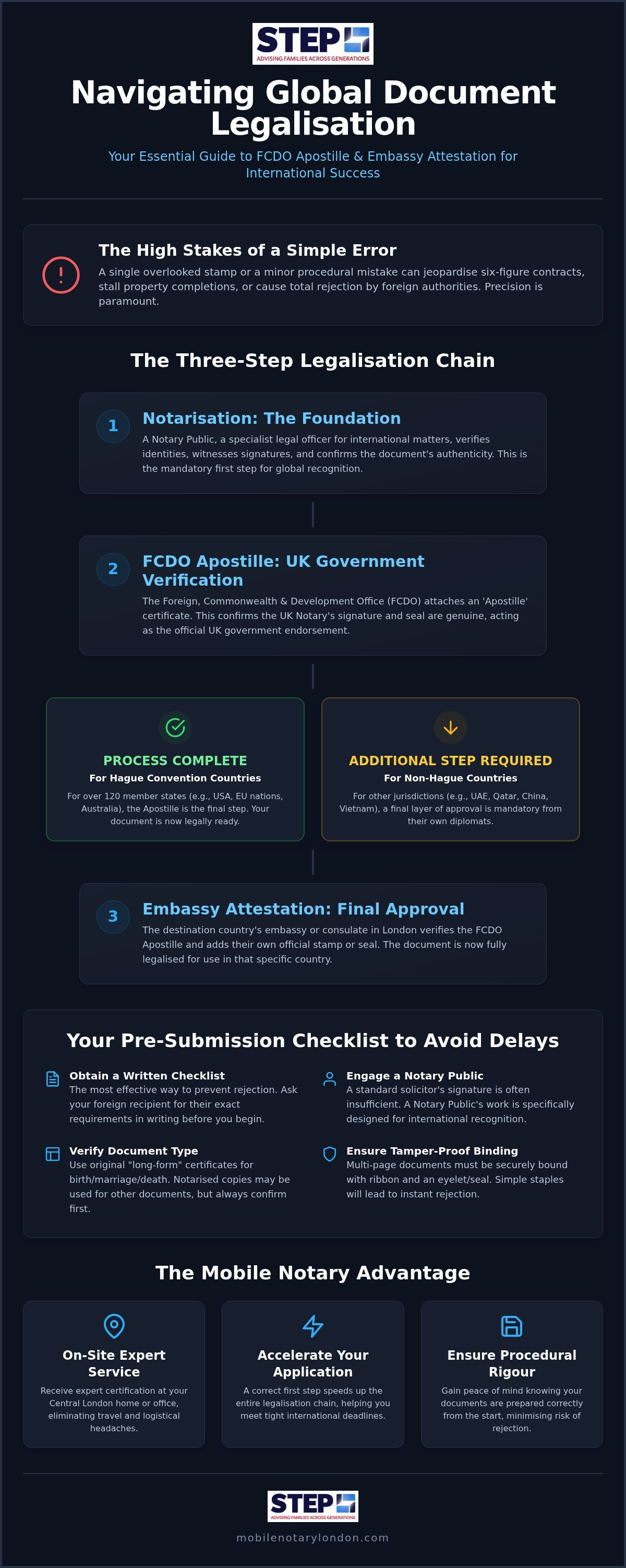
The process follows a strict, non-negotiable hierarchy. First, Notarisation provides the essential foundation of validity, where a Notary verifies identities and witnesses signatures. Second, the FCDO Apostille acts as the UK government's verification of that Notary's standing. For countries party to the Apostille Convention, this is often the final step. However, for non-member states, a third step of Embassy Attestation is required, adding a final layer of scrutiny from the destination country's own diplomats. You can find comprehensive support for these multi-stage requirements through our notary and apostille services.
The High Cost of Administrative Delays
Administrative errors aren't just inconveniences; they carry heavy financial and emotional weight. A stalled corporate merger or a missed property completion can result in forfeited deposits or the total collapse of a deal. For individuals, the stress of a rejected visa or a delayed marriage certificate whilst relocating amongst different jurisdictions is immense. If your international requirements involve family law or succession in Israel, you can discover משרד עו"ד רות גבריאל for specialist guidance. Avoiding delays with document legalisation requires a proactive approach to these administrative hurdles, ensuring that precision is maintained at every stage of the process to protect your international interests.
Meticulous preparation is the most effective strategy for avoiding delays with document legalisation. Before the FCDO or an embassy even sees your paperwork, it must pass a rigorous internal audit. A primary point of failure is the confusion between original documents and certified copies. Whilst the FCDO accepts notarised copies for many commercial papers, they typically require original "long-form" certificates for births, deaths, and marriages. Reviewing the official UK government guidance is a vital first step to ensure you aren't submitting a copy when an original is mandatory.
Verification of academic and professional credentials before notarisation is another essential hurdle. Notaries often need to contact the issuing university or professional body directly to confirm the document's authenticity. This verification process can take several days depending on the institution's responsiveness, so it's wise to initiate these checks well in advance of your deadline.
Tamper-proofing is equally critical for multi-page contracts or powers of attorney. A simple staple is rarely sufficient for international use. Professional notaries use specialised binding methods, often involving eyelets and silk ribbons, to ensure pages cannot be substituted. If a foreign authority suspects any level of tampering, they'll reject the document instantly. Additionally, ensure that the names featured on your documents are identical to those on your current valid passport. Even a missing middle name can trigger a rejection in conservative jurisdictions, causing significant setbacks.
Corporate Document Specifics
For businesses, the stakes of procedural errors are high. Certifying board resolutions, articles of association, or certificates of good standing requires more than just a signature. A notary must verify the signatory’s authority to act on behalf of the UK company, often by checking Companies House records. This level of due diligence is a prerequisite for FCDO acceptance and successful international trade. For a deeper dive into these requirements, consult our London Notary: Corporate Document Certification Guide 2026.
Private Wealth and Personal Documents
Handling powers of attorney for property transactions in Spain, Portugal, or India requires a nuanced touch. Many of these jurisdictions still mandate "wet ink" signatures, viewing digital signatures with suspicion. This precision is fundamental to avoiding delays with document legalisation when managing cross-border assets. When dealing with personal certificates, such as birth or marriage records, ensure they're recent official copies. Some foreign registries won't accept certificates issued more than six months ago. If you're unsure about the specific requirements for your destination, seeking bespoke guidance can save weeks of wasted time.
Choosing the Correct Route: Apostille vs. Embassy Attestation
Identifying the correct legalisation pathway is the most significant hurdle when avoiding delays with document legalisation. The route you take depends entirely on whether the destination country is a member of the Hague Convention. As of September 2026, there are 129 member countries, with Vietnam being the most recent addition. For these nations, a single Apostille from the UK government's legalisation office is typically sufficient. However, for non-member states such as the UAE, Qatar, or China, you must navigate a multi-layered process involving both the FCDO and the destination's specific embassy or consulate.
Hague Convention vs. Consular Legalisation
The complexity of your journey is determined by these three key entities: the FCDO, the Hague Convention protocols, and Consular Attestation offices. The following table outlines the primary differences between the two routes:
| Factor | Hague Convention Route | Consular/Embassy Route |
|---|---|---|
| Process Steps | Notarisation + Apostille | Notarisation + Apostille + Embassy Attestation |
| Timeline | Standard (10 days) or Next-Day | Often 2 to 3 weeks total |
| Complexity | Streamlined and predictable | High; varies by embassy rules |
| Cost Factors | Standard FCDO fees only | FCDO fees plus variable embassy charges |
Certain jurisdictions impose additional preliminary steps that catch many applicants off guard. For instance, Saudi Arabia often requires commercial documents to be certified by a Chamber of Commerce before the FCDO will even consider them. Failing to sequence these steps correctly is a primary cause of rejection, making it vital to understand the "mood" and current regulations of each specific embassy before submission.
The Rise of the Digital Apostille
In 2026, the FCDO has expanded its e-Apostille capabilities, offering a faster, digital-only verification for £35 per document. Whilst this is a significant technological leap, it isn't a universal solution. Many foreign banks and land registries still refuse digital certifications, insisting on a physical "Paper Apostille" with a wet-ink signature and embossed seal. If you're working against a tight deadline, our Fast Track Apostille Service London: The 2026 Premium Legalisation Guide explains how to choose between digital speed and physical certainty.
Translation requirements add another layer of complexity. If your document must be translated, it's essential that the translation is performed by a certified professional whilst maintaining its notarised status. Often, the translation itself must be notarised and apostilled alongside the original to be accepted. Coordinating these moving parts is essential for avoiding delays with document legalisation and ensuring your paperwork remains valid once it crosses borders.
Practical Steps to Accelerate the FCDO and Embassy Process
Accelerating the legalisation timeline requires a proactive approach that begins long before your documents reach the FCDO. Your first priority is obtaining a written checklist from the foreign receiving authority. Verbal instructions are notoriously unreliable and often lead to rejection. Once you have clear requirements, engage a notary who understands the specific embassy's current mood and rules. Embassy protocols in Mayfair and Kensington can shift without warning; a practitioner who visits these offices frequently will know, for instance, if a specific consulate has suddenly changed its payment methods or appointment system.
Strategic planning is the cornerstone of avoiding delays with document legalisation. Whilst the public often relies on standard postal services, registered businesses can access the FCDO's next-day service for a £40 fee. This professional-tier access is indispensable for urgent corporate matters where every hour counts. Relying on the standard 10-day postal turnaround is a gamble that few high-stakes transactions can afford. For expert assistance in navigating these logistical hurdles, you can book an urgent consultation with our mobile team.
Tracking and Managing Timelines
In 2026, the FCDO portal provides real-time tracking for your apostille application, allowing you to monitor its progress from receipt to dispatch. However, tracking doesn't account for embassy "queue" times, which can fluctuate wildly based on local holidays or administrative backlogs in jurisdictions like Saudi Arabia or the UAE. We always advise clients to establish a "buffer zone" in their schedule. Never book international flights or commit to completion dates before your legalised documents are physically in your hands. This caution ensures that unexpected bureaucratic hitches don't result in expensive travel cancellations.
Avoiding Common Postal Pitfalls
Standard international post is a significant risk for original legal documents. Loss or damage whilst in transit can set your application back by weeks as you wait for replacements. Royal Mail Special Delivery is the absolute minimum standard for UK-based runs, but for truly urgent matters, hand-delivered submissions are the gold standard. Hand delivery eliminates the uncertainty of the sorting office and ensures your paperwork reaches the correct desk immediately. This is particularly vital for avoiding delays with document legalisation when dealing with sensitive corporate mergers or property sales amongst multiple international parties.
- Secure Couriers: Always use tracked, signature-required services for embassy submissions.
- Hand Delivery: Utilise professional couriers for the "last mile" to embassies in Central London.
- Digital Backups: Keep high-resolution scans of all documents before they enter the legalisation chain.
How a Mobile Notary in Central London Eliminates Bottlenecks
Time is the ultimate luxury in international business and private wealth management. When you're managing high-value transactions amongst various time zones, the traditional model of visiting a static office is a significant bottleneck. A mobile notary eliminates this friction by bringing the expertise directly to your boardroom or residence. This on-site approach is the most effective method for avoiding delays with document legalisation, as it allows for immediate certification whilst you remain focused on your core priorities.
A STEP-qualified Private Wealth Lawyer offers a level of insight that standard notaries often lack. This qualification signifies a deep understanding of the complex legal frameworks governing international estates and corporate structures. Whether you're dealing with the rigorous requirements of the UAE, the specific sequencing for Saudi Arabia, or the nuanced expectations in India and the USA, having a seasoned expert handle the entire chain ensures your documents are fit for purpose from the outset. For those requiring specific legal assistance in California, such as trust administration or probate, the Law Offices of Robert P. Bergman provides specialised support for complex estate matters. This "white-glove" approach manages every step from the initial signature to the final embassy stamp, providing a sense of security that your paperwork is in expert hands.
In London’s most prestigious districts, such as Belgravia, Chelsea, and Mayfair, discretion and speed are paramount. We provide tailored notarisation for private wealth matters, ensuring that powers of attorney or property deeds are executed with meticulous precision. Our same-day mobile appointments are designed to meet urgent international business deadlines that would otherwise be missed due to administrative backlogs. For more on how we support these high-stakes needs, explore our guide on Mobile Notary Central London: Premium On-Site Notarisation & Legalisation.
Seamless Embassy Liaison
Direct proximity to the diplomatic hubs of Central London is a strategic advantage. By operating within minutes of major embassies, we can facilitate faster attestation runs and react instantly to shifting consular requirements. We maintain up-to-date knowledge of specific embassy fees and payment methods, which are frequent sources of delay for the uninitiated. This proximity, combined with a deep immersion in international protocols, ensures a fluid progression through the legalisation chain. To ensure your paperwork is handled with elite care and precision, book your mobile notary appointment today to avoid legalisation delays and secure your international interests.
Securing Your Global Interests with Precision and Speed
Mastering the complexities of international certification is the only way to protect your cross-border transactions from bureaucratic failure. Aligning your paperwork with the specific checklists of foreign authorities and selecting the correct legalisation route eliminates the common pitfalls that stall corporate mergers and property completions. Success lies in meticulous preparation and a deep understanding of the FCDO's evolving 2026 protocols.
The most effective strategy for avoiding delays with document legalisation is engaging a specialist who combines legal depth with logistical agility. As a STEP-qualified Private Wealth Lawyer and expert in urgent international legalisation, I provide a white-glove service that handles the entire chain of validity on your behalf. Whether you require on-site certification in Mayfair or urgent embassy attestation for a Middle Eastern jurisdiction, my specialist Central London mobile notarisation ensures your documents are accepted without hesitation.
Don't let administrative hurdles jeopardise your international objectives. Secure your premium mobile notary appointment in Central London today and proceed with total confidence in your global affairs.
Frequently Asked Questions
How long does document legalisation usually take in 2026?
Standard postal applications via the FCDO in 2026 typically take approximately 10 working days, though this timeframe is not guaranteed and can fluctuate during peak periods. Registered businesses can access a premium next-day turnaround for a £40 fee, which is essential for urgent corporate matters. If your document requires embassy attestation, you should factor in an additional two to three weeks depending on the specific consulate's current administrative backlog and their internal processing mood.
Can I get an apostille on a photocopy of my document?
You can obtain an apostille on a photocopy, provided it has been certified as a true copy by a Notary Public. However, certain "public" documents, such as UK birth, marriage, or death certificates, must always be submitted as original long-form versions issued by the General Register Office. Submitting a photocopy of these specific government-issued documents will lead to an immediate rejection, so verifying the document type is essential for avoiding delays with document legalisation.
What is the difference between a notary public and a solicitor for legalisation?
A Notary Public is a specialist legal officer whose seal and signature are recognised by international authorities and the FCDO, whereas a standard solicitor's authority is primarily domestic. Whilst many solicitors can certify documents for use within the UK, most foreign jurisdictions and embassies specifically require the intervention of a Notary for cross-border validity. Using a Notary ensures your paperwork enters the legalisation chain with the necessary global standing and procedural rigor required by foreign registries.
Do I need a translation if my document is for a non-English speaking country?
Most non-English speaking countries require a certified translation to be bundled with the notarised original document. The receiving authority in the destination country will typically provide a checklist stating whether the translation itself must also be notarised and apostilled. It is critical to confirm these requirements with your foreign lawyer beforehand, as failing to provide a recognised translation is a frequent cause of procedural rejection at the embassy level, especially for jurisdictions with conservative administrative standards.
Why would the FCDO reject my document for an apostille?
The FCDO often rejects documents if the certifying official's signature is not on their current database or if the document hasn't been prepared according to strict guidelines. Common reasons include using a standard solicitor instead of a Notary for international deeds or submitting photocopies of government-issued certificates. Ensuring your Notary is properly registered and understands the FCDO's 2026 standards is the most reliable way of avoiding delays with document legalisation and ensuring a seamless certification process.
What countries are part of the Hague Convention for apostilles?
There are currently 129 member countries in the Hague Apostille Convention as of September 2026. Recent additions include China, Canada, and most recently Vietnam, which joined in September 2026. For these nations, a single FCDO Apostille is sufficient for legal recognition. If your destination country is not on this list, you must undergo the more complex multi-step process of embassy attestation after the initial apostille is granted by the UK government's legalisation office.
How can a mobile notary help speed up the legalisation process?
A mobile notary accelerates the process by providing on-site certification at your Central London office or home, eliminating the need for you to travel to a static clinic. By witnessing signatures and verifying identities immediately, the notary can initiate the FCDO and embassy stages without delay. This proactive approach is particularly beneficial for corporate clients in Mayfair or the City who are working against tight international deadlines and require a premium, white-glove service.
Can you notarise a power of attorney for India or the UAE?
I specialise in the notarisation of powers of attorney for complex jurisdictions including India and the UAE. These countries have very specific requirements, such as "wet ink" signatures and multi-stage attestation through the Indian High Commission or the UAE Embassy. As a STEP-qualified Private Wealth Lawyer, I ensure your document is drafted and certified to meet these exact standards, preventing costly errors during the final legalisation stages and ensuring your interests are protected abroad.
Article by
Sheikh Najam
Sheikh Najam LLB, TEP, MCIArb is a Notary Public and Commissioner for Oaths based in Central London, offering notary services to corporate, commercial and private clients across the City of London and beyond. His work includes notarising board and shareholder resolutions, powers of attorney, and certified copies of constitutional documents for use with foreign registries, banks and courts, with apostille and legalisation arranged as part of the same instruction. Alongside his notarial practice, he is a STEP-qualified international private wealth lawyer advising on cross-border transactions, company formation, trust drafting and succession planning. He is regulated by the Faculty Office (Court of Faculties) of the Archbishop of Canterbury and is a member of The Notaries' Society of England and Wales, STEP, and The Association of European Attorneys.


