

A digital scan of your signature is no longer enough to secure a cross-border transaction in 2026. While the transition to paperless systems offers unprecedented speed, it also introduces a layer of technical rigour that often catches even seasoned professionals off guard. If you're feeling pressured by a looming international deadline or confused by the conflicting requirements of foreign authorities, you aren't alone. It's a common concern that a minor oversight in the e-Apostille UK process might lead to a costly rejection abroad.
This guide provides the definitive roadmap to mastering the UK's electronic legalisation framework, ensuring your digital documents carry the same weight as their traditional counterparts. You'll gain a clear understanding of the specific PDF standards required by the FCDO and learn how to navigate the system with precision. We will examine the essential criteria for document eligibility, the necessity of qualified electronic signatures from a registered notary, and the logistical steps to achieving a successful digital authentication in as little as 48 hours.
Key Takeaways
- Understand the fundamental shift from physical stamps to the e-Apostille UK system, where digitally-signed PDF certificates provide the same international legal validity as traditional paper versions.
- Learn the precise sequence for a successful application, including how digital-first notarisation can reduce processing times from several weeks to as little as 48 hours.
- Identify which documents qualify for the electronic route and which, such as GRO birth or marriage certificates, still require a physical, paper-based apostille.
- Evaluate the logistical advantages of digital legalisation, focusing on the significant reduction in courier requirements and the lower FCDO administrative fees for electronic submissions.
- Discover why the quality of the initial digital notarisation by a qualified professional is the most critical factor in preventing document rejection by foreign authorities.
Understanding e-Apostille UK: The Digital Evolution of Legalisation
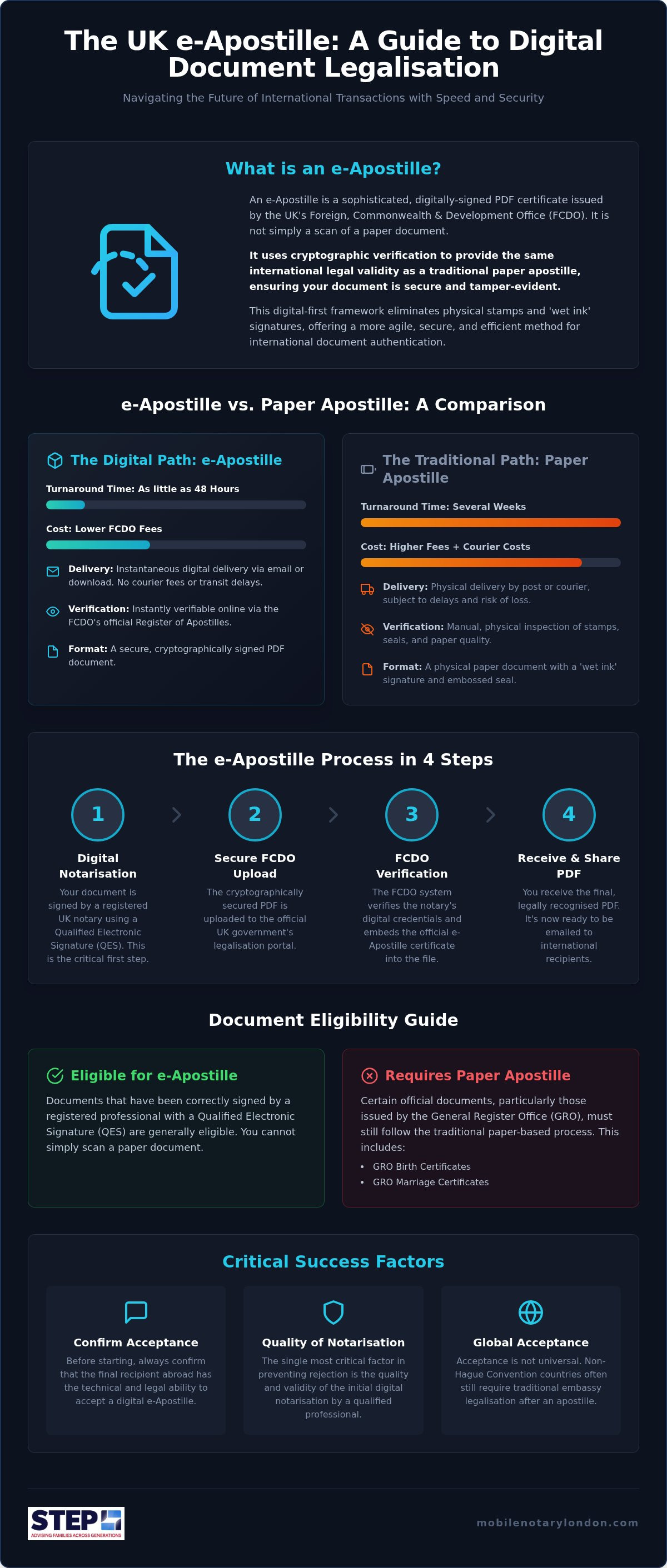
The traditional image of document legalisation involves embossed seals, colourful ribbons, and thick parchment. However, the legal landscape has shifted. An e-Apostille UK is not merely a scanned version of a paper certificate; it is a sophisticated, digitally-signed PDF issued by the Foreign, Commonwealth & Development Office (FCDO). This digital-first framework relies on cryptographic verification to ensure that your documents remain tamper-evident and legally robust as they cross international borders. It represents a fundamental move away from physical embossing towards a more agile, secure, and environmentally conscious method of authentication.
This transition is underpinned by the Electronic Apostille Programme (e-APP), an initiative designed to modernise the Apostille Convention for the digital age. By 2026, the UK's commitment to this system has significantly reduced the administrative burden on both individuals and corporations. The move was driven by a need for speed and transparency; where paper applications often languish in postal queues, the digital alternative operates with a methodical efficiency that matches the pace of modern global commerce. This system eliminates the risk of documents being lost in transit whilst providing a clear, verifiable trail of validity.
What Makes an e-Apostille Different?
The most striking difference is the total absence of physical 'wet ink' signatures. Instead of a manual stamp, the FCDO applies a digital certificate that is unique to the document. Verification no longer requires a physical inspection of the paper's texture or seal. Instead, receiving authorities use the FCDO's online Register of Apostilles to instantly confirm the document's authenticity. This portability is a significant advantage. A single PDF file can be sent to multiple recipients simultaneously, replacing the need for expensive, multi-layered courier envelopes and reducing the logistical complexity of international legal transactions.
Global Acceptance in 2026
As we navigate 2026, the majority of Hague Convention member states have fully integrated digital verification into their domestic legal frameworks. However, acceptance isn't universal. Whilst the e-Apostille carries the same legal weight as a paper one under international law, individual receiving authorities may still have specific internal policies. A common misconception is that a digital apostille is automatically accepted in non-Hague countries; in reality, these jurisdictions often still require traditional embassy legalisation. It is critical to confirm with the end recipient that they have the technical capability and the legal mandate to accept a digital PDF before you begin the application process.
Ensuring your documents are prepared correctly is the first step toward a successful application. For those requiring expert assistance with digital-first legalisation, exploring professional notary and apostille services can provide the necessary technical oversight to avoid common pitfalls.
How the e-Apostille Process Works: A Step-by-Step Guide
The e-Apostille UK journey begins with a technical prerequisite that many applicants overlook. Unlike the traditional route, where a physical document is couriered to the FCDO, the electronic path requires a document that is either "digitally native" or has been certified with a specific type of electronic signature. You cannot simply upload a standard PDF scan of a paper certificate. The Legalisation Office requires a file that has been cryptographically secured by a registered professional to ensure its integrity remains intact during transmission.
Once the document is prepared, it's uploaded to the official UK government guidance portal. Here, the system cross-references the notary's digital seal against its internal records. If the credentials align and the document meets the FCDO's strict PDF standards, the electronic certificate is issued. This certificate is then embedded into the file, creating a single, legally recognised PDF that you can download and email to international recipients immediately. The entire process is designed for high-stakes environments where physical post is too slow or unreliable.
The Role of the Notary Public
A Notary Public acts as the critical gatekeeper in this digital ecosystem. To facilitate an e-Apostille UK, the notary must use an Advanced Electronic Signature (AES). This isn't a mere image of a signature; it's a high-security digital credential that proves the document hasn't been altered since it was signed. The FCDO maintains a digital signature roll, a database of verified signatures from authorised practitioners. If your notary isn't registered on this roll or fails to use the correct AES protocol, the FCDO will reject the application, causing significant delays to your international transaction.
Processing Times and Urgent Requirements
In 2026, the efficiency of the electronic system is its greatest asset. Standard digital processing often concludes within 48 hours, but many applications are finalised even sooner. For those facing immediate deadlines, an Urgent Apostille London service can accelerate the initial certification phase. By instructing a mobile notary to handle the digital notarisation at your location, you ensure the document is "e-Apostille ready" the moment it hits the FCDO portal. This proactive approach is the fastest way to navigate the legalisation queue.
If you are unsure whether your specific corporate or private documents meet the technical requirements for this digital route, it may be beneficial to discuss your requirements with an expert to ensure a seamless application.
E-Apostille vs. Paper Apostille: Which Path Should You Choose?
Deciding between a digital and a physical certificate depends entirely on the requirements of your receiving authority. The e-Apostille UK service offers a significant advantage in velocity, with processing times often measured in hours or days rather than the weeks typically associated with the paper-based route. Beyond the primary speed benefit, the digital format eliminates the logistical friction of international couriers. You won't need to worry about a physical document being delayed at customs or lost in the post; the authenticated PDF reaches its destination instantly via email.
Security protocols also differ fundamentally between the two formats. Whilst a paper apostille relies on physical seals and watermarks that can be vulnerable to sophisticated forgery, digital certificates use cryptographic signatures to guarantee document integrity. These electronic signatures are nearly impossible to tamper with without leaving a detectable trace. From a cost perspective, the FCDO fee for an e-Apostille is £35, making it more economical than the £45 standard paper service. When you factor in the absence of courier fees, the digital route is the clear choice for efficiency.
When to Opt for a Paper Apostille
Despite the benefits of digitisation, certain scenarios necessitate the traditional paper route. If you're dealing with a country that isn't a signatory to the e-Apostille Programme (e-APP), a physical certificate remains mandatory. Many foreign banks, property registries in traditional jurisdictions, or embassy legalisation processes still require "wet ink" signatures. These institutions often lack the technical infrastructure to verify digital signatures, meaning a PDF would be rejected upon arrival. Always verify the recipient's capability before choosing the digital path.
The Hybrid Approach for Corporate Clients
High-stakes corporate transactions often require a belt-and-braces strategy. Many firms in the City and Mayfair opt for a hybrid approach, using the e-Apostille UK for immediate transactional needs whilst simultaneously processing paper copies for long-term physical archives. This ensures that a deal can proceed without delay, even if a secondary registry later requests a physical file. Professional guidance on London Notary: Corporate Document Certification can help you manage these dual requirements effectively, ensuring compliance across all jurisdictions involved in your project.
Eligible Documents: What Can Be Legalised Electronically?
Determining whether your paperwork qualifies for the e-Apostille UK service is the first hurdle in the legalisation process. The FCDO draws a sharp distinction between 'Public' documents and 'Notarised' documents. Whilst many believe any government-issued file is eligible, the reality is more nuanced. For instance, documents issued by the General Register Office (GRO), such as original birth, marriage, or death certificates, are currently excluded from the electronic system and require a traditional paper apostille. Similarly, ACRO police certificates and DBS certificates remain ineligible for the digital route as of late 2026. These specific exclusions mean you must plan for a physical application if your requirements involve civil registry or criminal record data.
To be suitable for an e-Apostille, a document must be a PDF that has been electronically signed by a UK-registered solicitor or notary public using a qualified electronic signature. Rejections often occur due to technical oversights. Low-resolution scans, incorrect PDF formatting, or signatures placed in areas that overlap with critical text can all lead to a failed application. Ensuring your file is clean and formatted to the FCDO's strict standards is essential for a first-time success. The document must be a digitally native file or a high-quality scan that a notary has certified as a true copy using their encrypted digital credentials.
Personal and Academic Documents
Academic credentials, including degree certificates and transcripts, are amongst the most common documents processed via the digital route. These cannot be uploaded directly to the portal by the student. They must first be certified by a notary or solicitor who applies their Advanced Electronic Signature to verify the document's authenticity. Private wealth management also benefits significantly from the e-Apostille UK system. Powers of Attorney can be notarised and legalised digitally, allowing for the rapid execution of international property transactions or financial mandates without the need for international courier services.
Corporate and Commercial Documents
For the corporate sector, digital legalisation provides a fast-track solution for time-sensitive filings. Certificates of Incorporation and Articles of Association are prime candidates for this service, provided they are certified by a registered professional. This efficiency also extends to internal governance documents, such as:
- Board Resolutions and Minutes of Meetings
- Trademark assignments and intellectual property filings
- Certificates of Good Standing
- Commercial contracts and distribution agreements
By utilising the digital route, companies can bypass the logistical delays of physical post, allowing for the rapid execution of cross-border contracts and corporate restructures.
If you are uncertain about the eligibility of your specific paperwork or require a technical review of your PDF files, you can contact a specialist for a document review to ensure your application meets all technical criteria.
Expert Notarisation: The Foundation of a Successful e-Apostille
The success of an e-Apostille UK application is entirely dependent on the technical precision of the initial certification. In 2026, the FCDO's automated verification systems are unforgiving; a single discrepancy in the notary's digital seal or a failure to adhere to the latest encryption standards will trigger an immediate rejection. This makes the choice of practitioner the most significant variable in your legalisation timeline. For complex international private wealth matters, instructing a STEP-qualified professional ensures that your documents are not only technically compliant but also structured to meet the high-level expectations of foreign jurisdictions and private banks. This level of procedural rigour is essential for maintaining the dignity and validity of your legal affairs abroad.
A meticulous notary acts as the critical link in the chain of authority. They don't just sign a document; they verify the identity of the signatories and the capacity in which they act, then seal the file with a cryptographic certificate that the FCDO recognises instantly. This ensures compliance with the most recent 2026 standards for digital certificates, which require a high degree of security to prevent tampering. When the foundation is solid, the subsequent electronic legalisation becomes a matter of calm efficiency rather than bureaucratic uncertainty.
Premium Mobile Notary Services in Central London
Time is the most valuable commodity for busy professionals in the City and Mayfair. Traditional notary appointments often require disruptive travel, which is why a "white-glove" mobile service is the preferred choice for urgent corporate filings. By bringing the expertise of a mobile notary directly to your desk in Belgravia, Chelsea, or Mayfair, you can complete the digital notarisation process without leaving your office. This agile approach allows for the immediate upload of documents to the FCDO portal, effectively turning your workspace into a high-stakes facilitator for international business.
Organising Your Fast-Track Legalisation
Securing a same-day appointment is essential when deadlines are tight and international transactions hang in the balance. To ensure your e-Apostille UK is processed without friction, you should prepare a clear digital copy of the document and have your original identification ready for verification. A proactive practitioner will review your files for FCDO compatibility before applying the Advanced Electronic Signature, mitigating the risk of technical errors that lead to rejection. This methodical sequence ensures that your documents move from certification to legalisation with maximum speed and minimum stress.
If you're facing a critical deadline, don't leave your compliance to chance. Book your mobile notary appointment now to secure expert certification that meets the highest international standards.
Navigating the Digital Future of International Legalisation
The transition to digital legalisation represents a significant leap in procedural efficiency for international transactions. By adopting the e-Apostille UK system, you replace weeks of postal delays with a secure, cryptographically verified process that meets the highest global standards. Success in this digital landscape requires more than just a scan; it demands a precise foundation of notarisation that adheres to the FCDO’s rigorous technical criteria. Ensuring your documents are prepared correctly from the outset is the most effective way to guarantee acceptance by foreign authorities and financial institutions.
Navigating these requirements can be complex, especially when dealing with high-stakes corporate structures or private wealth mandates. As a STEP-qualified Private Wealth Lawyer and expert in complex corporate notarisation, Sheikh Najam provides a premium mobile service across Central London to facilitate your urgent legal needs. Whether you are based in the City or Mayfair, you can secure your urgent e-Apostille with a Premium Mobile Notary in Central London to ensure your documents are handled with the utmost professional rigour. Taking the right steps today ensures your global interests remain secure and your transactions move forward with confidence.
Frequently Asked Questions
What exactly is an e-Apostille in the UK?
An e-Apostille UK is a digital certificate issued by the Foreign, Commonwealth & Development Office (FCDO) to authenticate UK documents for use abroad. It takes the form of a PDF file protected by a cryptographic signature rather than a physical paper attachment or embossed seal. This electronic format allows for immediate transmission to international recipients, provided they have the technical capability to verify the digital signature against the UK's official register.
Is the e-Apostille as legally binding as a traditional paper apostille?
Yes, the electronic version carries the same legal weight as a traditional paper apostille under the framework of the Hague Apostille Convention. It's specifically designed to meet international standards for legalisation through the Electronic Apostille Programme (e-APP). Whilst it's legally equivalent, you must always confirm that the specific receiving authority, such as a foreign bank or registry, is equipped to accept and verify a digital PDF certificate.
Can I get an e-Apostille for my UK birth certificate?
No, original civil registry documents issued by the General Register Office (GRO) are currently ineligible for the electronic service. This includes birth, marriage, death, and adoption certificates. These documents must still be legalised using the traditional paper-based apostille route. If you require urgent assistance in Central London for these physical applications, a professional notary can help manage the logistics and courier requirements to ensure your documents reach the FCDO safely.
How long does it take to receive an e-Apostille from the FCDO?
The official processing time for an electronic application is up to 48 hours, though many are completed on the same day if submitted early. This is significantly faster than the standard paper service, which can take several weeks during peak periods. For professionals in Central London facing tight deadlines, using a mobile notary to certify the document digitally first is the most reliable way to ensure a rapid turnaround from the Legalisation Office.
Do I still need a Notary Public if I am applying for an e-Apostille?
Yes, a Notary Public is essential for the vast majority of electronic applications. To be eligible for an e-Apostille UK, your document must be digitally signed by a registered professional using a qualified electronic signature. A simple scan of a handwritten signature won't suffice. Sheikh Najam provides premium mobile notarisation across Central London, ensuring your documents meet the strict technical standards required by the FCDO for successful digital legalisation.
What happens if a foreign country refuses to accept my digital apostille?
If a receiving authority refuses a digital certificate, you'll likely need to re-apply for a traditional paper-based apostille. Some jurisdictions or specific institutions, particularly in non-Hague member states, still mandate physical "wet ink" signatures and embossed seals. To avoid the cost and delay of a rejected document, it's vital to verify with the recipient beforehand whether they have the mandate and infrastructure to accept an electronic PDF.
Can I convert a paper document into an e-Apostille?
You can legalise a paper document electronically if a notary public certifies it as a "true copy" and applies their digital signature to a high-quality scan. This process transforms the physical original into a "digitally native" file that the FCDO can then authenticate. This is a common requirement for academic transcripts or corporate records where the original was issued on paper but the international recipient requires a fast, digital transmission.
Is there a difference in price between paper and digital legalisation?
Yes, the government fees differ between the two formats. As of 2026, the FCDO charges £35 for an electronic certificate, whereas the standard paper-based apostille for the public costs £45. Beyond the government fee, the digital route often proves more economical because it eliminates the need for expensive international courier services. You should also factor in the service fees for the notary who must provide the mandatory digital certification.

Article by
Sheikh Najam
Sheikh Najam LLB, TEP, MCIArb is a Notary Public and Commissioner for Oaths based in Central London, offering notary services to corporate, commercial and private clients across the City of London and beyond. His work includes notarising board and shareholder resolutions, powers of attorney, and certified copies of constitutional documents for use with foreign registries, banks and courts, with apostille and legalisation arranged as part of the same instruction. Alongside his notarial practice, he is a STEP-qualified international private wealth lawyer advising on cross-border transactions, company formation, trust drafting and succession planning. He is regulated by the Faculty Office (Court of Faculties) of the Archbishop of Canterbury and is a member of The Notaries' Society of England and Wales, STEP, and The Association of European Attorneys.


