

Last Tuesday, a client in Mayfair faced a familiar crisis: a property completion in Alicante was scheduled for Friday, yet the Spanish Consulate in London had no appointments for months. This scenario is increasingly common as British buyers remain the top foreign purchasers in Spain, accounting for nearly 7% of all transactions in early 2026. When time is of the essence, the traditional route often fails to meet the urgency of international property law.
We understand the pressure of navigating complex Spanish legal terminology while facing rigid completion dates. You're likely looking for a solution that bypasses consular delays without compromising on the procedural rigor required for a 'Poder Notarial' to be valid. This expert guide demonstrates how to notarise power of attorney for Spain from the heart of London with precision and speed. We will detail the essential three-tier protocol, including the critical role of the FCDO Apostille and why a mobile notary service is often the most reliable path to securing your Spanish assets. By the end of this article, you'll have a clear roadmap to achieving a legally binding document that Spanish authorities will accept without hesitation.
Key Takeaways
- Understand why a Spanish 'Poder Notarial' must strictly adhere to the Spanish Civil Code to ensure its validity for international transactions.
- Discover how to efficiently notarise power of attorney for Spain in London by utilising mobile notary services that offer a faster alternative to consular appointments.
- Master the three-tier protocol for document legalisation, from identity verification to the attachment of a formal Notarial Certificate and the Hague Apostille.
- Identify the specific documentation you must collate before your appointment, including draft documents from your Spanish lawyer and your NIE.
- Gain the confidence to meet tight property completion deadlines by following a proven path to seamless legal compliance in Spain.
Understanding the Spanish 'Poder Notarial' in a UK Context
A 'Poder Notarial' is the indispensable bridge between your legal intentions in London and their execution in Spain. It's a formal instrument of 'public faith' that allows a third party, such as a Spanish lawyer or a trusted relative, to act on your behalf. Unlike informal letters of authority used in the UK, this document must strictly adhere to the Spanish Civil Code to be recognised by local banks, tax offices, and land registries. Without a correctly executed power of attorney, your Spanish legal affairs can grind to a costly halt.
British citizens frequently require these documents for several critical reasons. Whether you're finalising a property purchase on the Costa del Sol, accepting a complex inheritance, or simply applying for your NIE (Foreigner Identity Number), the 'Poder Notarial' provides the necessary legal weight. It's a common misconception that a signature from a standard UK solicitor is sufficient. Spanish authorities operate under a civil law system where only a Notary Public possesses the specific authority to verify international documents. This requirement is underpinned by the Apostille Convention, which ensures that documents notarised in the UK are legally valid across the Spanish border.
Common Types of Spanish Powers of Attorney
The scope of authority you grant depends entirely on your specific needs. Selecting the correct type of power is vital for security and efficiency:
- Poder General: This provides broad authority to manage all legal and financial acts in Spain. It's often used by those with extensive business interests or multiple properties.
- Poder Especial: This is a limited authority restricted to a single transaction. For example, it might only permit your lawyer to complete the sale of a specific villa in Marbella and nothing else.
- Poder para Pleitos: A specific power granted to Spanish lawyers (abogados) and court procurators (procuradores) to represent you in court proceedings or litigation.
The Language Requirement: Bilingual vs. Spanish Documents
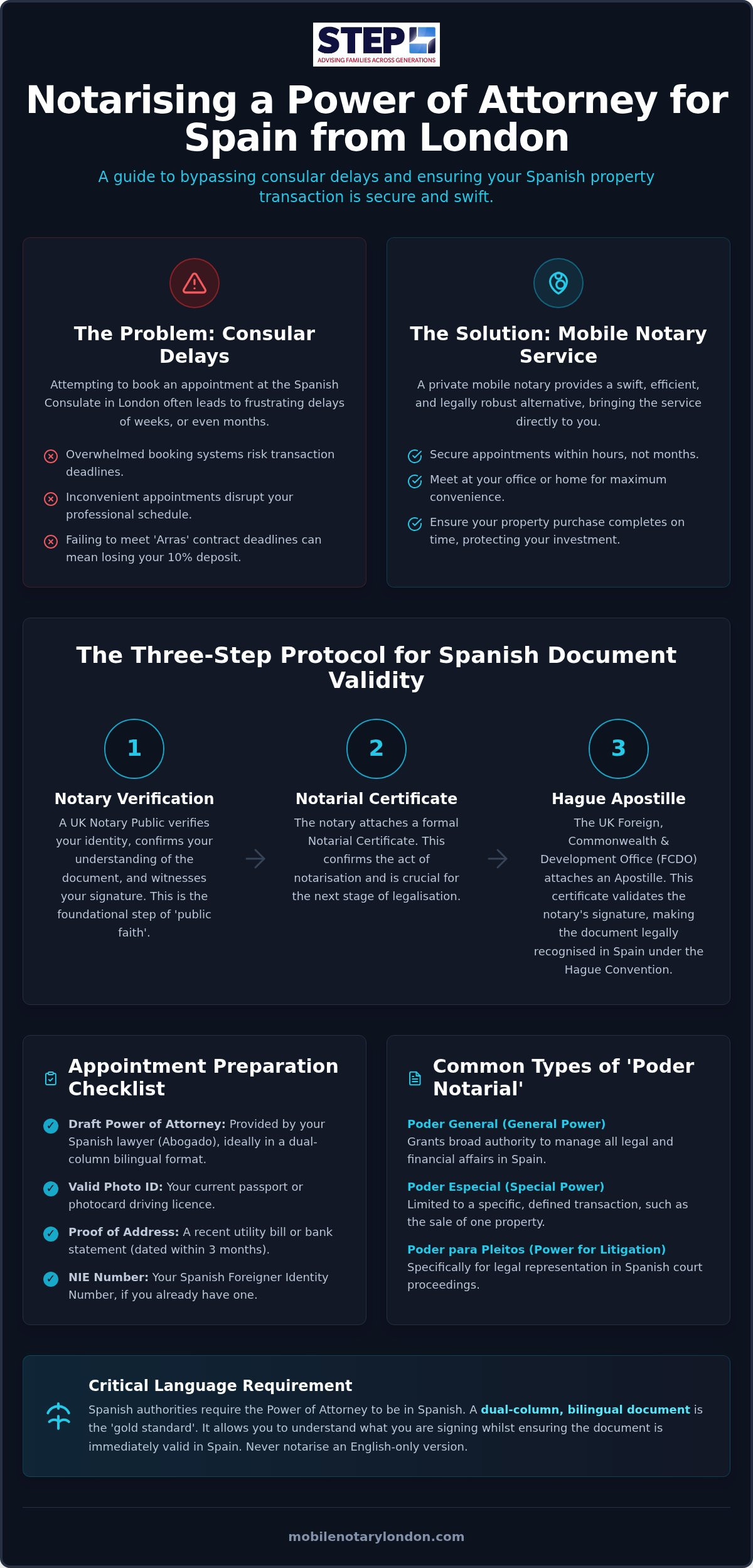
Spanish law is prescriptive about language. Most Spanish notaries and registries will reject any document that isn't drafted in Spanish or presented in a dual-column bilingual format. When you decide to notarise power of attorney for Spain, the document must be clear to both the signatory in London and the recipient in Madrid. A bilingual format is the 'gold standard' because it allows the UK notary to verify that you fully understand the powers you're delegating.
Avoid the common mistake of notarising an English-only document with the intent of translating it later. This often leads to rejection by Spanish officials who require the notarial seal to be applied directly to the Spanish text. A specialist notary ensures the foreign text is handled correctly from the outset, providing the procedural rigor needed for seamless acceptance abroad. If you need to notarise power of attorney for Spain, ensuring the linguistic and legal structure is correct at the first appointment is the only way to avoid expensive delays.
Consular Delays vs. Private Mobile Notarisation: The Case for Speed
Attempting to secure an appointment at the Spanish Consulate in London often reveals a frustrating administrative reality. While it's a valid legal route, the booking system is frequently overwhelmed, with slots sometimes unavailable for weeks or even months. For a London professional, spending half a day in a waiting room isn't just inconvenient; it's often a risk to the transaction itself. This is where private notarisation offers a distinct advantage, providing a swift alternative that respects the gravity of your legal obligations.
Consider a recent case involving a client in Westminster. They had a 48-hour window to submit a signed 'Poder Notarial' to their lawyer in Valencia. Waiting for a consular opening would've meant missing the completion date entirely. By choosing to notarise power of attorney for Spain through a mobile service, they secured the necessary signatures in their own office within hours. This agility is the hallmark of a premium service designed for high-stakes legal needs.
Why Time is of the Essence in Spanish Property Transactions
Property deals in Spain typically rely on 'Arras' contracts. These preliminary agreements require the buyer to pay a substantial deposit, often 10% of the purchase price. If you fail to complete by the strict deadline because your paperwork isn't ready, you risk losing that entire sum. A mobile notary Central London acts as a critical safeguard against these financial penalties. Once the signature is captured, the document must still be processed through the UK government's Legalisation Office to receive its Apostille. Speed at the notarisation stage buys you essential time for this final legalisation step.
The Premium Notary Experience for Busy Professionals
Efficiency shouldn't come at the expense of expertise. For clients in Mayfair, Kensington, or the City of London, a home or office visit provides a level of discretion that a public consulate cannot match. It allows for a calm, thorough review of the document in your own environment, ensuring you're comfortable with every clause. Having a STEP-qualified Private Wealth Lawyer conduct the appointment ensures that complex inheritance or high-value property matters are handled with the necessary legal precision. This white-glove service prioritises your confidentiality whilst ensuring every procedural requirement is met. If you need to notarise power of attorney for Spain for an urgent property completion, this direct approach is often the most reliable path to success.
The Three-Step Protocol for Spanish Document Validity
To ensure your Spanish legal affairs proceed without interruption, you must follow a precise three-step protocol. This isn't merely a suggestion; it's a mandatory requirement for any UK document intended for use in Spain. The process begins with identity verification. The Notary Public must confirm your identity through valid government-issued documents and witness the physical act of signing. This provides the 'public faith' that Spanish authorities demand for high-stakes transactions.
Once the signature is witnessed, the Notary issues a formal Notarial Certificate. This is typically a bilingual document that confirms the validity of the signature and your legal capacity to delegate powers. The final layer of validity is the Apostille, obtained through the official UK document legalisation service provided by the Foreign, Commonwealth & Development Office (FCDO). Spain strictly adheres to the Hague Apostille Convention, meaning no UK document is legally recognised by a Spanish Notary or Land Registry without this specific stamp. This protocol bridges the gap between the UK's common law system and Spain's civil law requirements.
Securing the Hague Apostille in London
An Apostille is effectively a certificate of authenticity for the Notary's own seal. It tells the Spanish authorities that the professional who witnessed your signature is a genuine, registered official in the United Kingdom. For many property buyers, the standard postal service is simply too slow to meet completion deadlines. Opting for an urgent apostille London service can reduce wait times from several days to a same-day or next-day turnaround. Navigating the FCDO requirements involves precise physical document submission, as digital e-Apostilles are currently not accepted for Spanish property deeds that require a physical signature and seal.
Ensuring Spanish Notarial Acceptance
The physical presentation of your document is just as critical as the legal text. A specialist notary will securely bind the Notarial Certificate to the Spanish Power of Attorney using legal ribbon and a professional seal. This prevents any suspicion of tampering or document substitution. Furthermore, the Notary's signature must already be registered on the FCDO database. If you use a practitioner whose signature isn't on file, the FCDO will reject the application, causing a total collapse of your timeline. When you notarise power of attorney for Spain, this final verification ensures the document is ready for your Spanish lawyer or 'Gestor' to present to the local authorities immediately. This methodical approach guarantees that your 'Poder Notarial' meets every rigorous standard expected by Spanish officials in 2026.
Preparing for Your Power of Attorney Appointment
Meticulous preparation is the foundation of a successful notarial appointment. Before you arrange for a practitioner to visit your home or office, you must ensure that your Spanish lawyer (abogado) has provided a finalised draft of the document. This draft should ideally be in a bilingual, dual-column format to satisfy both the UK notary and the Spanish recipient. If you're acting for a property in a specific autonomous community, such as Catalonia or the Basque Country, tell your legal team to account for any local civil law nuances that might differ from the national Spanish Civil Code.
Efficiency also depends on the synchronisation of all parties involved. If there are multiple principals, such as a husband and wife buying a property together, everyone must be physically present to sign at the same time. This collective approach prevents the need for multiple certificates and ensures the entire 'Poder Notarial' is executed as a single, cohesive legal instrument. When you're ready to notarise power of attorney for Spain, having every element in place ensures the appointment proceeds with the calm efficiency our clients expect.
Required Identification for Spanish Notarisation
Identity verification is a non-negotiable step in the notarial process. You'll need to present a valid, original Passport or a Spanish DNI. Along with your primary ID, you must provide your NIE (Número de Identidad de Extranjero), as this tax number is essential for almost every legal act in Spain. If your NIE isn't explicitly written into the draft document, have it ready for the notary to record separately.
The notary is also required by law to verify your current residential address in London. A utility bill, council tax statement, or bank statement dated within the last three months is usually sufficient. These details are recorded in the notary's formal register, a protocol that provides an additional layer of security and transparency for the transaction. This rigorous record-keeping is part of why a specialist mobile notary in Central London is trusted with high-value international private wealth matters.
Drafting and Translation Advice
Collaborating closely with your Spanish legal team is the best way to avoid rejection at the land registry. Ensure the draft includes specific powers for the intended transaction, whether that involves opening bank accounts, signing deeds, or handling tax declarations. A 'Poder Notarial' is a document that must be both notarised and apostilled to be valid. Relying on power of attorney notarisation London experts ensures that the final document adheres to the strict formatting standards required for international recognition. Once the draft is approved and your identification is gathered, you can notarise power of attorney for Spain with total confidence in the outcome.
Conclusion: Achieving Seamless Legal Compliance in Spain
The Westminster client mentioned at the beginning of this guide achieved their goal with time to spare. Their property contracts were exchanged in Alicante without a hitch, proving that the geographical distance between London and Spain is no barrier when the correct protocol is followed. This success illustrates a vital truth: when you need to notarise power of attorney for Spain, the priority is always the document's ultimate acceptance by the Spanish Land Registry. By bypassing the months-long wait for a consulate appointment, they secured their investment and avoided the loss of a significant deposit.
Once the Apostille is secured, the process enters its final, critical phase. We strongly recommend using a tracked courier service to ensure the document reaches your lawyer in Spain safely. Research indicates that a reliable courier typically costs approximately £50 + VAT, a small price to pay for the security of high-stakes legal papers. Standard post is often too slow and unreliable for time-sensitive property completions. This final step completes the journey from a London office to a Spanish notary's desk, providing the total peace of mind that comes from professional handling.
The Advantage of an International Private Wealth Lawyer
Sheikh Najam's status as a STEP-qualified Private Wealth Lawyer provides a level of insight that goes beyond simple witness signatures. For high-net-worth individuals, a Spanish property is frequently one component of a complex cross-border portfolio. We ensure that your 'Poder Notarial' doesn't just work for a single transaction but remains integrated with your broader UK legal standing and inheritance planning. This expert oversight prevents future conflicts between your Spanish assets and your UK estate, ensuring your global interests are protected with procedural rigour.
Next Steps for Your Spanish POA
Securing your mobile notary visit is a straightforward, efficient process. You can contact Sheikh Najam directly for an immediate quote and to check availability for a same-day visit anywhere in Central London, from Mayfair to the City. Before the document departs for Spain, we conduct a final checklist to ensure every seal and signature is in the correct position. If you're ready to notarise power of attorney for Spain, our agile mobile service is ready to facilitate your transaction with the precision and speed your property completion demands. Don't let administrative backlogs jeopardise your Spanish legal affairs; choose a path of calm efficiency instead.
Securing Your Spanish Interests from London
Navigating the complexities of international property law requires a blend of legal precision and procedural speed. We've explored how the three-step protocol, ranging from identity verification to the essential Hague Apostille, ensures your document is ready for immediate acceptance by Spanish authorities. By opting for a private mobile service, you bypass the persistent backlogs at the consulate and meet critical completion deadlines with total confidence.
The right professional expertise makes a significant difference when you need to notarise power of attorney for Spain. As a STEP-qualified Private Wealth Lawyer, Sheikh Najam provides a premium service that combines deep legal insight with the convenience of same-day mobile appointments across Central London. We specialise in the expert handling of Spanish legalisation requirements, ensuring your cross-border assets are protected with meticulous care. Book your mobile notary appointment for your Spanish Power of Attorney today and take the final step toward seamless legal compliance. Your Spanish property goals are well within reach.
Frequently Asked Questions
Can I notarise a Power of Attorney for Spain at any UK solicitor's office?
No, you cannot use a standard solicitor for this requirement. Only a registered Notary Public possesses the specific legal authority to verify documents for international use. Spanish officials require the seal of a notary to establish 'public faith' in the document. A solicitor's signature lacks the necessary standing for the Foreign, Commonwealth & Development Office to issue an Apostille.
How long does it take to get an Apostille for a Spanish Power of Attorney in London?
Processing times vary based on the service level you choose. The standard postal service often takes several working days. However, you can opt for an urgent Apostille in London through registered service providers to achieve a same-day or next-day turnaround. This is particularly vital when property completion dates in Spain are fixed and non-negotiable.
Do I need to visit the Spanish Consulate if I use a private notary?
No, a consular visit isn't required if you choose a private notary. Private notarisation followed by an FCDO Apostille provides the same legal validity as a document issued by the Spanish Consulate. Many clients prefer this route because it avoids months of waiting for an appointment and allows for a same-day mobile notary service at their own convenience.
What is the difference between a General and a Special Power of Attorney for Spain?
A General Power of Attorney grants your representative broad authority to manage all your legal and financial affairs in Spain. Conversely, a Special Power of Attorney limits their authority to specific tasks, such as buying a single property or handling an inheritance. Choosing the special version offers greater security by restricting exactly what your agent is permitted to do.
Is a bilingual Power of Attorney document required for use in Spain?
While not strictly mandatory in every single case, most Spanish notaries and registries insist on a bilingual format. Using a dual-column document ensures that both the signatory in London and the recipient in Spain clearly understand the powers being granted. It's the most reliable way to notarise power of attorney for Spain and avoid rejection due to language barriers.
What happens if my Spanish Power of Attorney does not have an Apostille?
Without an Apostille, your document will be legally unrecognised by Spanish authorities. The Apostille is the only internationally accepted method to verify that the notary's signature and seal are genuine. If you present a document in Spain that lacks this certificate, the local notary or land registry will refuse to process your transaction, potentially causing significant financial loss.
Can a mobile notary visit me at my office in the City of London for this service?
Yes, a mobile notary can visit your office in the City of London or any other Central London location. This service is designed for busy professionals in districts like Mayfair, Westminster, and the City who require immediate assistance. It allows you to notarise power of attorney for Spain without leaving your desk, ensuring your legal affairs don't interrupt your working day.
How much does it cost to notarise a Power of Attorney for Spain?
Fees for notarial services in London are generally based on the complexity of the document and the time required. For a ready-to-sign Power of Attorney, you'll pay a professional fee plus the cost of the FCDO Apostille and any courier charges. Whilst prices vary amongst practitioners, choosing a specialist ensures the document is correct the first time, preventing expensive redrafting later.

Article by
Sheikh Najam
Sheikh Najam LLB, TEP, MCIArb is a Notary Public and Commissioner for Oaths based in Central London, offering notary services to corporate, commercial and private clients across the City of London and beyond. His work includes notarising board and shareholder resolutions, powers of attorney, and certified copies of constitutional documents for use with foreign registries, banks and courts, with apostille and legalisation arranged as part of the same instruction. Alongside his notarial practice, he is a STEP-qualified international private wealth lawyer advising on cross-border transactions, company formation, trust drafting and succession planning. He is regulated by the Faculty Office (Court of Faculties) of the Archbishop of Canterbury and is a member of The Notaries' Society of England and Wales, STEP, and The Association of European Attorneys.


