
What if the missing signature on your international property deed wasn't a matter of ink and paper, but a digital certificate verified in seconds? For many Central London professionals, the transition to an e-Notary UK service represents the end of frantic courier runs and the beginning of a more secure, streamlined era of global commerce. You've likely felt the pressure of a looming deadline whilst worrying whether a digital signature will actually hold up in a foreign court or land registry. It's a common anxiety, especially when the distinction between an Advanced Electronic Signature (AES) and a Qualified Electronic Signature (QES) feels more like a technical riddle than a legal standard.
You deserve the certainty that your documents are beyond reproach. This article explains how electronic notarisation and e-Apostilles work in the UK to accelerate your international legal requirements without compromising on validity. We'll explore the specific requirements for successful legalisation via the FCDO e-Apostille service and show you how to navigate the complexities of digital identity verification with absolute confidence. By the end of this guide, you'll understand exactly how to secure a legally binding, remote notarisation that satisfies both UK regulations and international expectations.
Key Takeaways
- Understand the transition from physical ink to digital certification and how secure video links allow for robust identity verification in a remote environment.
- Learn why the e-Notary UK landscape prioritises Qualified Electronic Signatures (QES) as the gold standard for ensuring international legal validity.
- Identify which global jurisdictions currently accept electronic legalisation and when you must still rely on traditional paper-based apostille processes.
- Discover the specific technical requirements for your documents, including the necessity of high-quality PDFs and biometric identification, to avoid rejection by foreign authorities.
- Explore how a STEP-qualified private wealth lawyer provides the rigorous oversight needed for complex corporate and high-value international transactions.
What is e-Notary UK? Understanding Digital Notarisation in 2026
The traditional image of a notary involves wax seals and heavy parchment, but the reality for Central London's commercial hubs in 2026 is vastly different. An e-Notary UK service is the digital evolution of this ancient office. It involves the certification of documents using advanced electronic signatures rather than physical ink. To understand what is an electronic signature in this context, one must distinguish between a simple scanned image and a cryptographically secure digital certificate. These digital tools ensure that the document's integrity is preserved from the moment of signing until it reaches its final destination.
Regulation remains the cornerstone of the process. Digital doesn't mean unregulated. Every act follows strict Faculty Office guidelines, ensuring that the Notary Public performs the same rigorous identity checks as they would in person. Through secure, encrypted video links, the notary verifies your identity and witnesses the digital signing process. This ensures the act is legally binding and robust enough for international scrutiny. It's a precise legal tool designed for an era where business moves at the speed of light.
The Rise of Electronic Legalisation in the UK
The Foreign, Commonwealth & Development Office (FCDO) has fully modernised its infrastructure to support digital-first documentation. We've seen a decisive shift from physical embossing to cryptographically secure digital stamps. Central London businesses, particularly those in the tech and financial sectors, are leading this adoption. They recognise that in a global market, the speed of a digital seal often dictates the success of a transaction. The e-Apostille service is now a central pillar of this modernised framework, allowing for a seamless transition from notarisation to international legalisation.
Key Benefits of Going Digital
Transitioning to an e-Notary UK workflow offers more than just convenience; it provides a level of procedural rigour that matches the demands of modern trade. The benefits are clear and measurable:
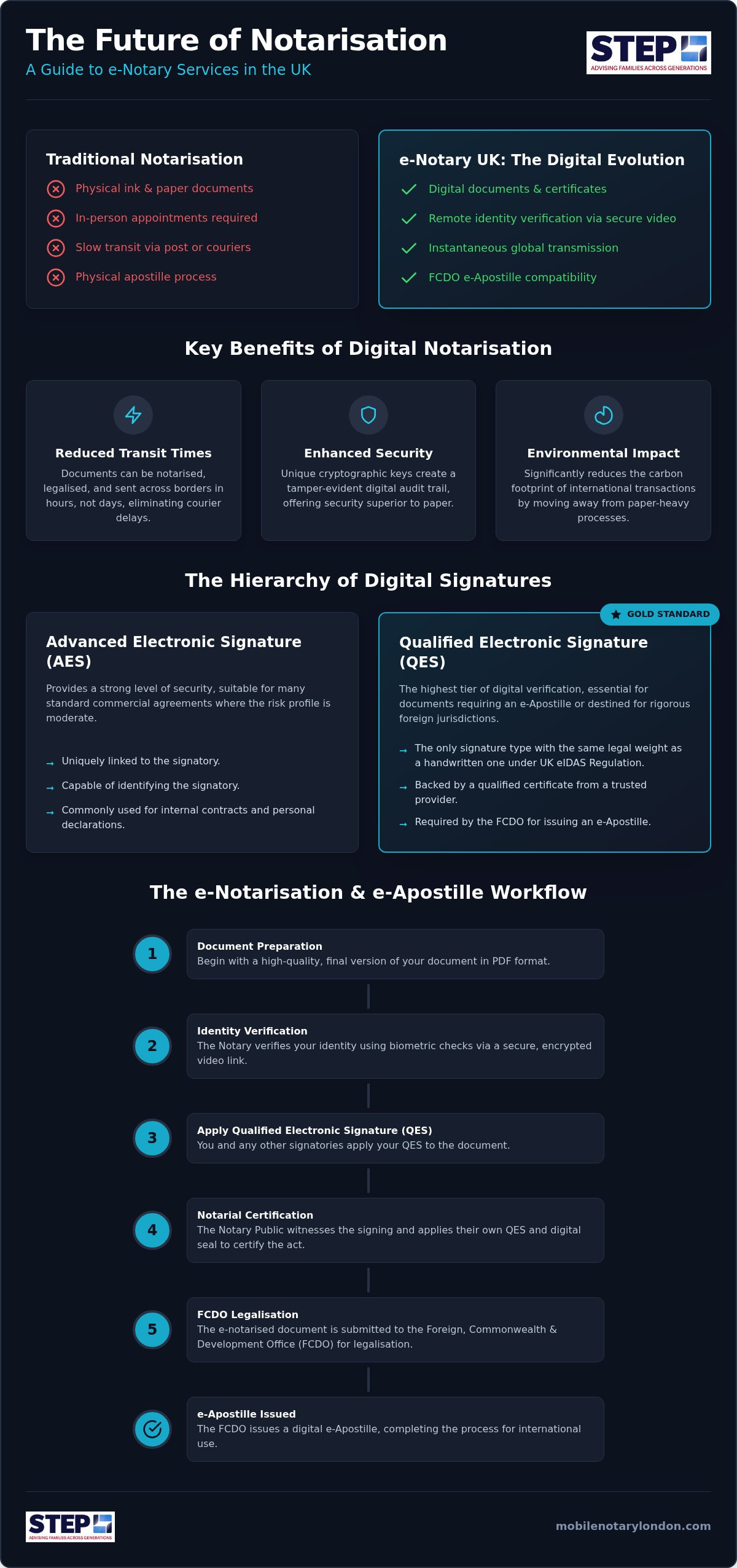
- Reduced Transit Times: Documents that once took days to courier across borders can now be legalised and sent in a matter of hours.
- Enhanced Security: Digital signatures use unique cryptographic keys that make tampering virtually impossible to hide, providing a digital audit trail.
- Environmental Impact: Moving away from paper-heavy legal processes significantly reduces the carbon footprint of international transactions.
In 2026, these efficiencies are no longer optional. They're the baseline for any firm or individual operating on the international stage who requires valid, legally binding results without the delays of traditional post; similarly, for those who demand peak performance in their digital pursuits, Apevie Simulators offers the premium hardware required for professional-grade simulation.
The Science of Security: AES, QES, and the e-Apostille Process
The transition to a digital workflow requires a sophisticated understanding of electronic security standards to ensure your documents remain beyond reproach. At the heart of every e-Notary UK transaction is a hierarchy of digital signatures. Whilst many platforms offer basic signatures, professional legalisation requires a more robust framework. Advanced Electronic Signatures (AES) provide a strong level of security by being uniquely linked to the signatory and capable of identifying them. These are frequently utilised for standard commercial contracts or personal declarations where the risk profile is moderate. However, for higher stakes, we must look toward the highest tier of digital verification.
The "Gold Standard" for 2026 legalisation is the Qualified Electronic Signature (QES). This standard is essential for documents intended for the most rigorous foreign jurisdictions. A QES is a signature backed by a qualified certificate and created by a secure device. Under the UK eIDAS Regulation, a QES is the only electronic signature type that carries the same legal weight as a handwritten signature. This level of cryptographic rigour is what allows the Foreign, Commonwealth & Development Office (FCDO) to issue an e-Apostille, effectively a digital certificate that verifies the authenticity of the notary's own signature.
AES vs. QES: Which Signature Does Your Document Need?
Choosing the correct signature level depends entirely on the destination country and the document type. AES is typically sufficient for general business agreements or affidavits where the receiving party has a flexible digital policy. Conversely, QES is often mandatory for high-value property transactions, corporate deeds, or specific court documents. A specialist notary will determine the required level of security by assessing the specific demands of your destination jurisdiction. If you're unsure which standard your transaction requires, consulting a notary public in Central London can provide the necessary clarity before you begin the process.
Navigating the FCDO e-Apostille System
The path from digital notarisation to FCDO approval is a methodical, multi-step sequence. Once the notary has applied their QES to your document, it's uploaded to the Government's digital fast-track service. It's vital to remember that an e-Apostille is only issued on documents that already bear a valid digital notary signature. In 2026, the turnaround times for this service are impressively efficient, with most e-Apostilles processed within 24 to 48 hours. This digital-first approach eliminates the need for physical postage, making it the preferred route for clients facing tight international deadlines.
E-Notary vs. Traditional Notarisation: Choosing the Right Path
The choice between a digital and a physical notarial act isn't merely a matter of convenience; it's a strategic decision based on the specific requirements of the receiving jurisdiction. Whilst the e-Notary UK framework offers unparalleled speed, it's not a universal solution. The legal foundation for these digital acts traces back to The Electronic Signatures Regulations 2002, which established the validity of electronic signatures in the UK. However, the international landscape remains a patchwork of varying acceptance levels. You must weigh the immediate efficiency of a digital certificate against the risk of document rejection by a conservative foreign land registry or government body.
In many cases, the most effective strategy involves a hybrid approach. If a foreign authority insists on a "wet-ink" signature, the digital route will simply not suffice. This is where the flexibility of a mobile notary Central London becomes invaluable. By facilitating physical signatures at your office or home, you ensure that your documents satisfy traditional bureaucratic standards whilst still benefiting from a premium, on-demand service. Understanding when to pivot between these two methods is the key to navigating complex international legal requirements without unnecessary delays.
When Digital is the Best Choice
Digital notarisation excels in scenarios where time is the primary constraint and the destination is tech-forward. Urgent corporate board resolutions for jurisdictions that have fully embraced digital transformation are ideal candidates. Similarly, if you're applying for a digital nomad visa or opening an online bank account, a certified passport copy via an e-notary is often the most efficient route. These transactions typically occur within countries that have ratified the Hague e-APP protocol, ensuring that the electronic apostille is recognised and accepted without further physical verification.
When to Stick with Traditional Mobile Notarisation
Preparing Your Documents for a Seamless Digital Notarial Act
Preparation is the bridge between a digital file and a legally binding document. To ensure your e-Notary UK appointment proceeds without technical friction, you must view your documentation through a digital lens. This begins with the file itself. Every document must be provided in a high-quality PDF format. Avoid scanned images or photographs of pages; these often lack the underlying text layer and metadata required for a notary to apply a secure digital seal. If the document's structure is compromised, the cryptographic link between the signature and the content may fail.
Beyond the file, your physical preparation is equally vital. You'll need your original identity documents ready for real-time verification. Typically, this involves a valid Passport or a Biometric Residence Permit. Before booking, it's essential to confirm with the 'relying party', the person or institution receiving the document, that they'll accept an e-notarised format. Whilst acceptance is growing, some conservative institutions still lag behind. Once confirmed, ensure you have access to a secure video call platform as instructed by your notary to facilitate the witnessing process.
The Digital Identity Verification Process
The law requires you to 'appear' before the notary, even in a remote setting. Modern e-Notary UK services utilise biometric technology to verify your passport's authenticity by comparing the chip data with a live scan of your face. This process demands a clear, well-lit environment. Shadows or glare can interfere with the software's ability to match your features against your ID. By ensuring your digital presence is professional and your connection is stable, you satisfy the legal rigour required for a remote notarial act. It's a precise digital handshake that mirrors the security of an in-person meeting.
Technical Requirements for Your Files
The technical structure of your PDF can dictate the success of an e-Apostille application. Password-protected or heavily encrypted PDFs often cause critical failures within the FCDO's automated systems. The government's digital fast-track service requires files that are accessible for the application of their own digital certificate. You must also ensure there is sufficient 'white space' at the end of the text. This area is reserved for the digital notary seal and the subsequent FCDO certificate. If a document is too cluttered, the audit trail may become obscured, potentially leading to rejection by foreign authorities.
If you're ready to proceed with a secure, remote transaction, you can book a consultation with a Notary Public in Central London to review your document's eligibility and technical readiness.
Premium Notarial Support: Bridging the Gap Between Digital and Mobile Excellence
The e-Notary UK landscape is often viewed as a purely technical exercise, yet for high-stakes international transactions, technicality is only half the battle. Sheikh Najam – Mobile Notary Central London provides a unique approach that synthesises deep legal expertise with digital agility. As a STEP-qualified Private Wealth Lawyer, he brings a level of rigour to the process that generic automated platforms cannot replicate. This specialised background is particularly vital when dealing with complex corporate structures, international trusts, or high-value powers of attorney that require more than just a verified signature. It's about ensuring the underlying legal logic of your document is sound before the digital seal is ever applied.
Whether you require a remote video consultation or a physical meeting in Mayfair, the commitment remains a premium, white-glove service. This holistic approach extends to our urgent apostille London service, which handles both digital e-Apostilles and traditional paper-based legalisation. We understand that your requirements might shift; a transaction that starts as a digital draft might ultimately require a physical "wet-ink" signature to satisfy a specific foreign consulate. Having a practitioner who can pivot between these mediums without losing momentum is a significant advantage for any Central London client.
Tailored Advice for Complex International Matters
Our service goes beyond the mere act of signing. We provide international private wealth legal advice to ensure your documents are fit for purpose in their destination country. Managing the interface between UK law and foreign legal requirements is a delicate task. We work to "future-proof" your documentation, anticipating potential hurdles in foreign jurisdictions that may have specific, non-standard requirements for digital acts. This proactive oversight minimises the risk of rejection and ensures that your corporate or personal legal matters proceed without a hitch.
A Solution-Oriented Approach to Your Deadlines
Speed is vital. However, speed without technical accuracy is a liability. We handle the intense pressure of same-day notarisation for Central London clients by maintaining a methodical, solution-oriented workflow. You gain the peace of mind that comes from working with a practitioner who understands the commercial urgency of your transaction. Whether it's a multi-million pound property deal or a time-sensitive corporate resolution, we help you decide the best path forward. Contact us to discuss whether an e-Notary UK act or a mobile visit is best suited for your specific legal needs.
Securing Your Global Transactions with Digital Precision
The shift toward digital legalisation offers a decisive advantage for those navigating the fast-paced requirements of international trade. By embracing an e-Notary UK workflow, you eliminate the logistical delays of physical couriers whilst maintaining the highest level of cryptographic security through Qualified Electronic Signatures. Success hinges on precise preparation and a clear understanding of whether your destination jurisdiction accepts electronic certificates or still demands traditional "wet-ink" seals.
Navigating these complexities requires more than just software; it demands the oversight of a seasoned professional. Sheikh Najam, a STEP-qualified Private Wealth Lawyer, provides the rigorous legal depth necessary for Central London’s most sensitive corporate and private legalisation matters. It's a premium service that prioritises both procedural validity and your peace of mind, offering specialised support for same-day mobile or digital needs. Your international legal requirements don't have to be a source of stress when handled with elite care and authoritative expertise.
Book your premium e-notary consultation with Sheikh Najam today to ensure your global documents are processed with expert precision. You can move forward with total confidence in your legal standing.
Frequently Asked Questions
Is an e-Notary signature as legally binding as a physical one in the UK?
Yes, it's absolutely as legally binding. The UK eIDAS Regulation ensures that a Qualified Electronic Signature (QES) has the same legal standing as a handwritten one. This is the standard used for the e-Notary UK process to ensure validity in courts and registries. It's a robust legal framework that provides security and transparency for all international transactions.
Which countries currently accept the UK FCDO e-Apostille in 2026?
Most countries that are members of the Hague Apostille Convention and have implemented the e-APP (Electronic Apostille Programme) will accept them. This includes several EU member states, the USA, and many jurisdictions in Latin America and Asia. You should always verify the current 2026 status with the specific registry or authority in the destination country before proceeding with your application.
Can I get a power of attorney notarised online for use in Spain?
Spain generally requires a physical "wet-ink" signature and a paper apostille for powers of attorney related to property transactions. Whilst digital adoption is growing, Spanish Land Registries remain conservative regarding digital certificates. In this instance, a mobile visit from a Notary Public in Central London is usually the safer and more reliable option to avoid the risk of rejection.
How much does an e-notary service cost compared to a mobile visit?
The cost for digital services and mobile visits varies based on the complexity of the document and the urgency of the requirement. Generally, an e-Notary UK service removes the travel fee associated with a mobile visit, but it involves specific software and identity verification costs. You'll receive a transparent breakdown of the fees tailored to your specific transaction during your initial consultation.
What happens if my digital document is rejected by the receiving party?
If a document is rejected, we immediately assess the reason provided by the foreign authority. Often, rejections occur because the receiving party's internal policies haven't yet updated to accept digital certificates. If this happens, we can pivot to a traditional paper-based notarisation and apostille to ensure your transaction is completed successfully. We prioritise finding a solution that meets the specific demands of the destination.
Do I need to be physically located in London for an e-notary appointment?
You don't need to be physically located in London to use our remote services. As long as you have a stable internet connection and valid biometric identification, the appointment can take place from anywhere in the world. This flexibility is a primary benefit for international clients who need the authority of a UK-qualified notary without the need for time-consuming travel or courier services.
Can a commissioner for oaths also provide e-notarisation services?
No, a commissioner for oaths cannot provide e-notarisation for international documents. Their powers are limited to certain domestic UK documents and don't carry the international recognition required for foreign legalisation. Only a qualified Notary Public has the authority to certify documents for use abroad and interface with the FCDO for the issuance of e-Apostilles.
How long does the entire e-notary and e-apostille process take?
The entire process is remarkably swift, often completed within 24 to 48 hours. The notarisation itself happens during a short video call, and the FCDO typically processes e-Apostilles within one to two working days. This is significantly faster than the traditional paper route, which depends on physical post and manual handling times. It's the ideal solution for clients facing tight commercial deadlines.
Article by
Sheikh Najam
Sheikh Najam LLB, TEP, MCIArb is a Notary Public and Commissioner for Oaths based in Central London, offering notary services to corporate, commercial and private clients across the City of London and beyond. His work includes notarising board and shareholder resolutions, powers of attorney, and certified copies of constitutional documents for use with foreign registries, banks and courts, with apostille and legalisation arranged as part of the same instruction. Alongside his notarial practice, he is a STEP-qualified international private wealth lawyer advising on cross-border transactions, company formation, trust drafting and succession planning. He is regulated by the Faculty Office (Court of Faculties) of the Archbishop of Canterbury and is a member of The Notaries' Society of England and Wales, STEP, and The Association of European Attorneys.


