

While the digital revolution suggests that a few clicks can legalise any document from your sofa, the reality for London professionals dealing with international jurisdictions is far more nuanced. You're likely facing immense pressure to finalise a property deal in Spain or a corporate merger in Dubai; the prospect of finding a physical office during standard hours feels like an impossible hurdle. The search for a Remote Notary UK service often stems from a need for speed, yet the fear remains: will an electronic signature actually be accepted by a foreign land registry or a strict overseas bank? It's a valid concern, as the intersection of English law and international protocol is rarely straightforward.
This guide clarifies the legal standing of remote notarisation in 2026 and demonstrates why a mobile, concierge-style service is often the superior choice for high-stakes documents. You'll discover the legal realities of remote notarisation in the UK and how mobile services provide the ultimate convenience for your urgent documents. We'll explore the current regulations governing digital signatures, identify which specific documents still require a physical seal, and explain how a mobile notary ensures your paperwork remains beyond reproach in any global jurisdiction.
Key Takeaways
- Understand the legal nuances of a Remote Notary UK in 2026, including the specific conditions under which electronic seals and video witnessing are recognised.
- Learn why high-stakes documents, such as international powers of attorney, often still necessitate the "gold standard" of physical presence to ensure acceptance by foreign jurisdictions.
- Discover how mobile notary services provide a pragmatic, "white-glove" alternative by bringing expert legalisation directly to your Central London home or office.
- Identify the essential identification documents and verification steps required to ensure your notarised paperwork is accepted by overseas land registries and banks without delay.
- Explore the benefits of a premium concierge service that offers same-day appointments for busy professionals facing tight international deadlines.
What is a Remote Notary in the UK and Is It Legal?
The concept of a Remote Notary UK has evolved significantly since the early 2020s. Historically, notarisation demanded a physical meeting in a static law office; however, current regulations now permit a more agile approach. Whilst the UK hasn't adopted the fully automated, platform-based Remote Online Notarisation (RON) seen in many US states, it does recognise the validity of electronic signatures under specific conditions. To understand the broader context of these digital shifts, one might ask: What is an eNotary? and how does it apply within the British legal framework? In England and Wales, the law focuses on the 'Qualified Electronic Signature' (QES), which provides a high level of security and identity verification for domestic transactions. This conservative stance ensures that the integrity of the document remains paramount, even as technology advances.
The Rise of Digital Legalisation in the UK
Digital legalisation is no longer a futuristic concept. The Foreign, Commonwealth & Development Office (FCDO) now supports e-Apostilles for many documents, allowing for a purely digital chain of certification. This is particularly useful for corporate documents or certificates that don't require a physical 'wet ink' seal. These digital signatures are gaining ground for domestic UK transactions because they offer a clear audit trail and reduce the risk of document loss. However, the UK's approach remains more structured than international counterparts. Each notarial act must still adhere to the strict conduct rules set out in 2026, ensuring that the notary has properly identified the signatory and verified their capacity to sign before any electronic seal is applied.
Why 'Remote' Doesn't Always Mean 'Digital'
For many Central London residents, the term 'remote' describes the notary's location rather than a screen-based ceremony. A mobile notary provides a remote service by travelling to your home or boardroom, bridging the gap between digital convenience and legal necessity. This method satisfies the 'physical presence' rule that many foreign jurisdictions still strictly enforce. It's a pragmatic solution because it ensures you receive a legally robust 'wet ink' signature whilst avoiding the frustration of traditional office hours or travel time. Many overseas land registries and banks still refuse to accept documents signed via video link, making the mobile notary visit the most reliable way to guarantee your paperwork is accepted abroad without delay. By bringing the expertise to you, the service maintains the dignity of a legal practice whilst respecting the pace of modern life.
Remote vs. In-Person: Choosing the Right Method for Your Documents
Choosing between a digital interaction and a face-to-face meeting depends entirely on where your document is heading. While the Law Commission report on electronic signatures provides a solid domestic foundation for digital execution in England and Wales, foreign authorities often operate under stricter traditional codes. If you're managing an overseas property sale or a high-value corporate deal, the "Physical Presence" rule usually prevails. This requirement ensures that a notary has physically verified the identity of the signatory and confirmed they're signing of their own free will without any external coercion. Physical verification remains the most robust defence against identity fraud, as it allows a notary to inspect security features on original passports that a webcam simply cannot capture with the same precision.
Relying on a purely digital Remote Notary UK carries significant risks for documents destined for non-Hague Convention countries. Nations such as the UAE often require a multi-stage legalisation process involving embassy stamps; these almost universally demand a physical, wet-ink signature. Even within the Hague Convention, jurisdictions like Spain or certain US states may have specific local land registry requirements that digital notarisation cannot yet satisfy. You must always verify with the receiving party whether they accept a digital seal before proceeding, as a rejection at the final stage can lead to costly delays in your transaction.
The Apostille Factor: Why Physical Presence Often Wins
Securing an urgent apostille London frequently requires a physical signature that the Foreign, Commonwealth & Development Office (FCDO) can verify against its existing database of registered notaries. While the e-Apostille service exists, its adoption is not universal amongst foreign embassies, which often still require paper-based documents for their own internal records. The Hague Apostille Convention facilitates the international recognition of documents but does not override a specific country's right to demand a physical seal over a digital one. In these instances, having a notary visit you ensures the document is prepared to the highest standard of validity from the outset.
Common Documents Requiring In-Person Mobile Visits
Certain high-stakes documents are rarely suitable for purely digital remote interaction due to the complexity of international property laws. These include:
- Property transfer deeds and mortgage documents for overseas real estate.
- Corporate board resolutions and certificates of incumbency intended for foreign banks.
- Personal affidavits and oaths for use in international court proceedings.
For Central London residents, arranging a mobile notary visit provides the necessary physical verification whilst maintaining the speed and efficiency of a digital service. It offers the same-day turnaround you might expect from a Remote Notary UK but with the added security of a qualified lawyer handling your original paperwork in person.
The Mobile Notary: The Pragmatic Alternative to Remote Notarisation
While the theoretical appeal of a purely digital Remote Notary UK service is undeniable, it often clashes with the rigid procedural requirements of foreign land registries and financial institutions. For those operating within the high-stakes environments of Mayfair or Westminster, the solution isn't necessarily a screen-based interaction but a service that moves with them. A mobile notary Central London provides the ultimate pragmatic alternative, offering the convenience of an on-demand service whilst satisfying the strict legal requirement for physical presence. This is particularly critical when executing deeds, as the Law Commission report on electronic execution confirms that a witness must be physically present for the valid execution of a deed. By choosing a mobile visit, you eliminate the risk of your document being declared void due to a technicality regarding video witnessing.
High-net-worth individuals and corporate directors often prioritise privacy and security above all else. A mobile visit allows for the notarisation of sensitive private wealth documents within the secure confines of a private residence or a protected boardroom, avoiding the exposure of a traditional law office waiting room. It's a "white-glove" experience that treats legal compliance as a concierge service rather than a bureaucratic hurdle. It ensures that the gravity of the legal act is matched by the professionalism of the delivery.
Managing Urgent Legal Documents on the Move
Time is the most valuable commodity for professionals in the City of London. Booking a same-day mobile appointment allows you to manage urgent legal documents without derailing your schedule. A mobile practitioner acts as a high-stakes facilitator, often handling multiple documents, from powers of attorney to complex company resolutions, in a single, efficient visit. This approach maximises productivity, ensuring that international deadlines are met without the need for you to leave your desk. It's a seamless transition from identifying a legal need to achieving a comprehensive solution, mirrored by the pace of the on-demand economy.
The STEP-Qualified Advantage
The complexity of cross-border inheritance or international property deals requires more than just a signature and a seal. Choosing a notary who is also a STEP-qualified Private Wealth Lawyer provides an essential layer of expertise that a standard Remote Notary UK platform cannot replicate. This dual qualification ensures that the practitioner understands the broader legal implications of the documents being signed, offering a level of procedural rigor that safeguards your global assets. Such legal expertise prevents document rejection abroad by ensuring every nuance of the receiving jurisdiction's requirements is met. Expert legal oversight at the point of signing acts as a definitive safeguard, providing peace of mind that your international interests are meticulously protected.
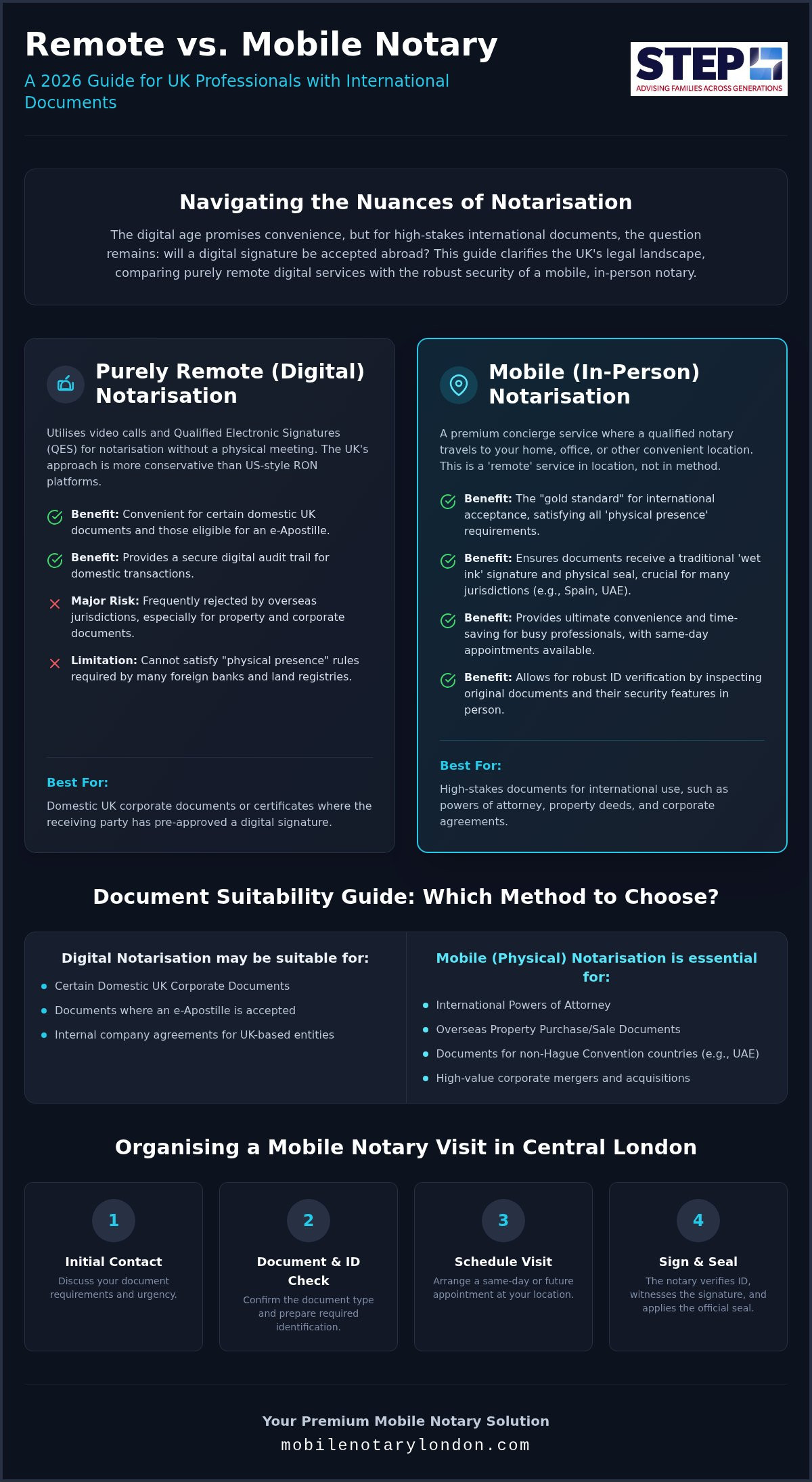
How to Organise a 'Remote' Notary Visit in Central London
Organising a professional notary visit should be a seamless process that prioritises both legal precision and your personal schedule. Whilst you might initially search for a Remote Notary UK to save time, the most efficient route often involves a structured mobile appointment that handles the physical requirements at your convenience. This methodical approach ensures that every detail, from identity verification to the final apostille, is executed without the risk of procedural errors that could derail an international transaction.
To ensure a smooth experience, follow these five essential steps:
- Step 1: Verify Requirements. Confirm with the receiving party overseas whether they require a physical "wet ink" signature or if they accept a digital seal. This prevents wasted effort.
- Step 2: Prepare Identification. Gather your original passport and a recent proof of address, such as a utility bill or bank statement dated within the last three months.
- Step 3: Pre-appointment Review. Send drafts of your documents to the notary via email in advance. This allows for a thorough review to ensure the wording meets both UK and foreign legal standards.
- Step 4: Customised Scheduling. Arrange a mobile visit at a location that suits you, whether it's a private residence in Mayfair or a corporate office in the City.
- Step 5: Secure Completion. Once the signing is complete, the notary can handle the Urgent Apostille London process, returning your legalised documents via secure courier.
If you are ready to begin, you can arrange your mobile notary visit today to ensure your documents are handled with expert care.
Identification Requirements for Notarisation
Rigorous identity verification is the cornerstone of notarial practice. You must present original identification documents during the appointment; digital copies or scans are never sufficient for high-stakes legalisation. The notary performs a critical role in verifying your identity for Companies House or foreign registries, often acting as a Commissioner for Oaths to witness formal declarations. This physical verification provides the high level of assurance that international banks and government bodies demand, a standard that a purely digital Remote Notary UK may struggle to meet for certain complex deeds.
Reviewing Foreign Language Documents
When dealing with documents written in a foreign language, the notary must ensure you fully comprehend the nature of the act you are performing. If you aren't fluent in the document's language, a professional translation is usually necessary. The notary's duty is to verify that you understand the legal obligations you are undertaking before they apply their seal. This pre-visit review ensures the document is fit for purpose and prevents the frustration of a document being rejected by an overseas authority due to a lack of clarity or a failure to follow specific local protocols.
Sheikh Najam: Your Premium Mobile Notary Solution
Sheikh Najam – Mobile Notary Central London operates a specialised mobile practice designed specifically for Central London's elite professionals and high-net-worth individuals. This service bridges the gap between the gravity of traditional law and the practical urgency of modern life. Whilst many seek a Remote Notary UK for its perceived speed, Sheikh Najam provides a superior alternative: the efficiency of a digital service combined with the unshakeable validity of a physical notarial act. This commitment to same-day service and premium legalisation handling ensures that your most time-sensitive documents are never delayed by administrative friction. Whether you are in a Mayfair boardroom or a private residence in Westminster, the expertise comes directly to you.
Time is often the enemy of international deals. Sheikh Najam understands this pressure, offering a methodical yet agile response to urgent requests. He acts as a high-stakes facilitator for clients who require more than just a signature. By choosing a practitioner who is both a Notary Public and a qualified lawyer, you ensure that every procedural nuance is addressed before the document leaves your sight. This proactive problem-solving approach is the hallmark of a "white-glove" concierge service.
Expertise in International Private Wealth
Sheikh Najam is a STEP-qualified Private Wealth Lawyer. This specific background allows him to provide tailored services for property transactions in Spain, France, and the Middle East. He understands the intricacies of cross-border inheritance and the specific demands of foreign land registries. For global entities, he handles complex corporate documentation with a level of procedural rigour that prevents the costly rejection of paperwork. Each client receives a bespoke approach that respects their unique legal requirements and the specific protocols of the receiving jurisdiction. This legal oversight is a critical safeguard that a standard Remote Notary UK platform simply cannot offer.
Seamless Apostille and Legalisation Integration
The service extends far beyond simple notarisation. Sheikh Najam manages the entire FCDO and Embassy chain, providing a single point of contact for global compliance. This end-to-end management offers profound peace of mind, as you don't have to navigate the bureaucratic complexities of various government departments yourself. By integrating the convenience of a mobile presence with expert legal knowledge, the practice ensures that every document is both legally robust and handled with maximum efficiency. For urgent enquiries, our team remains responsive to the fast-paced needs of the City.
Book your premium mobile notary visit in Central London today to secure your international documents with absolute confidence.
Secure Your International Documents with Expert Precision
The transition toward digital legalisation in 2026 offers significant opportunities for efficiency, yet the complexities of international law demand a cautious approach. While the search for a Remote Notary UK service reflects a modern need for speed, the physical presence of a notary remains the definitive standard for ensuring documents are accepted by foreign land registries and banks. By choosing a mobile service that brings expertise directly to your location, you satisfy strict legal witnessing requirements without sacrificing your valuable time. This pragmatic approach ensures your paperwork is robust enough to withstand the scrutiny of any overseas jurisdiction.
Sheikh Najam provides a bespoke concierge experience across Mayfair, Westminster, and the City. As a STEP-qualified Private Wealth Lawyer, he offers more than just a signature; he provides the meticulous legal oversight necessary to protect your global interests. Whether you require same-day notarisation or specialist help with urgent apostille legalisation, our practice is designed to handle high-stakes paperwork with absolute procedural rigor. You don't have to choose between convenience and compliance when an expert can facilitate both at your doorstep.
Arrange your premium mobile notary appointment in Central London today and ensure your documents are prepared to the highest professional standards.
Frequently Asked Questions
Is a remote online notary legal for UK documents in 2026?
Remote Online Notarisation (RON) is legally recognised in England and Wales under the Notaries (Conduct and Discipline) Rules 2026. Whilst the Electronic Communications Act 2000 validates digital signatures, the final acceptance of a Remote Notary UK act depends entirely on the laws of the country where the document will be used. You must verify if the foreign jurisdiction accepts electronic seals before proceeding, as many still demand traditional wet-ink signatures for high-value transactions.
Can a UK notary certify a document via a WhatsApp or Zoom call?
UK notaries cannot typically certify Oaths, Affidavits, or Statutory Declarations via video calls like WhatsApp or Zoom. These specific legal documents require the physical presence of the notary to be valid. Whilst some domestic transactions allow video witnessing, most international authorities and the UK Land Registry maintain strict requirements for face-to-face interaction. Relying on a video call often leads to document rejection at the final stage of legalisation.
What is the difference between a remote notary and a mobile notary?
A remote notary performs the act via secure video link and electronic signatures, whereas a mobile notary travels to your physical location. The primary advantage of a mobile notary is that it satisfies the "physical presence" rule required by many foreign jurisdictions and for all deeds. This makes mobile services a more reliable, pragmatic alternative for complex international documents that a purely digital Remote Notary UK service cannot legally facilitate.
Do I need an apostille if my document was signed remotely?
Yes, documents destined for overseas use usually require an apostille regardless of how they were signed. Whilst the UK offers an e-Apostille service for certain digitally notarised documents, many foreign embassies and registries still demand a physical paper apostille. You should confirm the requirements of the receiving country, as a digital signature may not be eligible for the traditional legalisation process required by non-Hague Convention nations.
How much does a mobile notary visit in Central London cost?
Fees for a mobile notary visit in Central London vary based on the complexity of the documents and the urgency of the appointment. Our practice provides transparent, fair fees that are always agreed upon in advance, ensuring there are no hidden costs. Whether you require a single document notarised or a full suite of corporate papers legalised, we provide a bespoke quote tailored to the specific nature of your international requirements.
Can a notary public sign documents with a digital seal?
A notary public can sign documents with a digital seal using a Qualified Electronic Signature (QES) to ensure high-level security. This digital seal is increasingly accepted for domestic UK corporate transactions and by some forward-thinking international jurisdictions. However, you must ensure the receiving party has the technical capability and legal framework to accept a digital seal, as many still prioritise the traditional physical embossed seal for security.
What documents are commonly rejected when notarised remotely?
Documents such as property transfer deeds, mortgage papers, Oaths, and Affidavits are frequently rejected when notarised remotely. Documents destined for countries that are not members of the Hague Apostille Convention, such as the UAE or China, almost always require physical notarisation. These jurisdictions typically demand a wet-ink signature to complete the multi-stage embassy legalisation process, making a purely digital remote act unsuitable for these specific regions.
How quickly can a mobile notary arrive at my London office?
We specialise in providing same-day mobile notary appointments across Mayfair, Westminster, and the City. Depending on current availability and your specific location in Central London, a practitioner can often arrive at your home or office within hours of your initial enquiry. This rapid response is designed to meet the tight deadlines of international property deals and corporate mergers, providing a concierge service that prioritises your urgent legal needs.
Article by
Sheikh Najam
Sheikh Najam LLB, TEP, MCIArb is a Notary Public and Commissioner for Oaths based in Central London, offering notary services to corporate, commercial and private clients across the City of London and beyond. His work includes notarising board and shareholder resolutions, powers of attorney, and certified copies of constitutional documents for use with foreign registries, banks and courts, with apostille and legalisation arranged as part of the same instruction. Alongside his notarial practice, he is a STEP-qualified international private wealth lawyer advising on cross-border transactions, company formation, trust drafting and succession planning. He is regulated by the Faculty Office (Court of Faculties) of the Archbishop of Canterbury and is a member of The Notaries' Society of England and Wales, STEP, and The Association of European Attorneys.


