

You have finally secured a dream villa in Provence, but your French Notaire has just sent a complex "Procuration" that must be notarised and returned to France by the end of the week. For many London professionals, this is where the excitement of a cross-border purchase meets the reality of administrative friction. Finding a specialist notary for French property purchase London is often the final, most time-sensitive hurdle in your property journey. It's common to feel confused by the conflicting roles of UK and French legal professionals or the daunting requirement of a Foreign Office apostille.
We understand that your schedule in Mayfair or the City doesn't always allow for cross-town travel to a physical office. This 2026 guide provides a clear roadmap for managing French property law from the heart of the capital. You'll learn how to secure expert notarisation that meets strict French Land Registry standards without leaving your desk. We will detail the essential steps for legalising your Power of Attorney, the latest 2026 tax incentives for private landlords, and how a mobile service ensures your documents are accepted the first time.
Key Takeaways
- Understand the distinct jurisdictional roles between a French Notaire and a London Notary Public to ensure your signatures are witnessed according to French civil law.
- Learn how to correctly notarise a 'Procuration' (Power of Attorney), which is the vital document allowing you to complete your French property transaction without leaving London.
- Discover why the FCDO apostille is a mandatory legalisation step that transforms a UK notarised document into a valid legal instrument for the French Land Registry.
- Secure a specialised notary for French property purchase London who offers mobile services across Mayfair and the City to fit your demanding professional schedule.
- Identify and avoid frequent procedural errors, such as incorrect document formatting or missing legalisation, that can cause costly delays in international property completions.
The Essential Role of a London Notary in French Real Estate
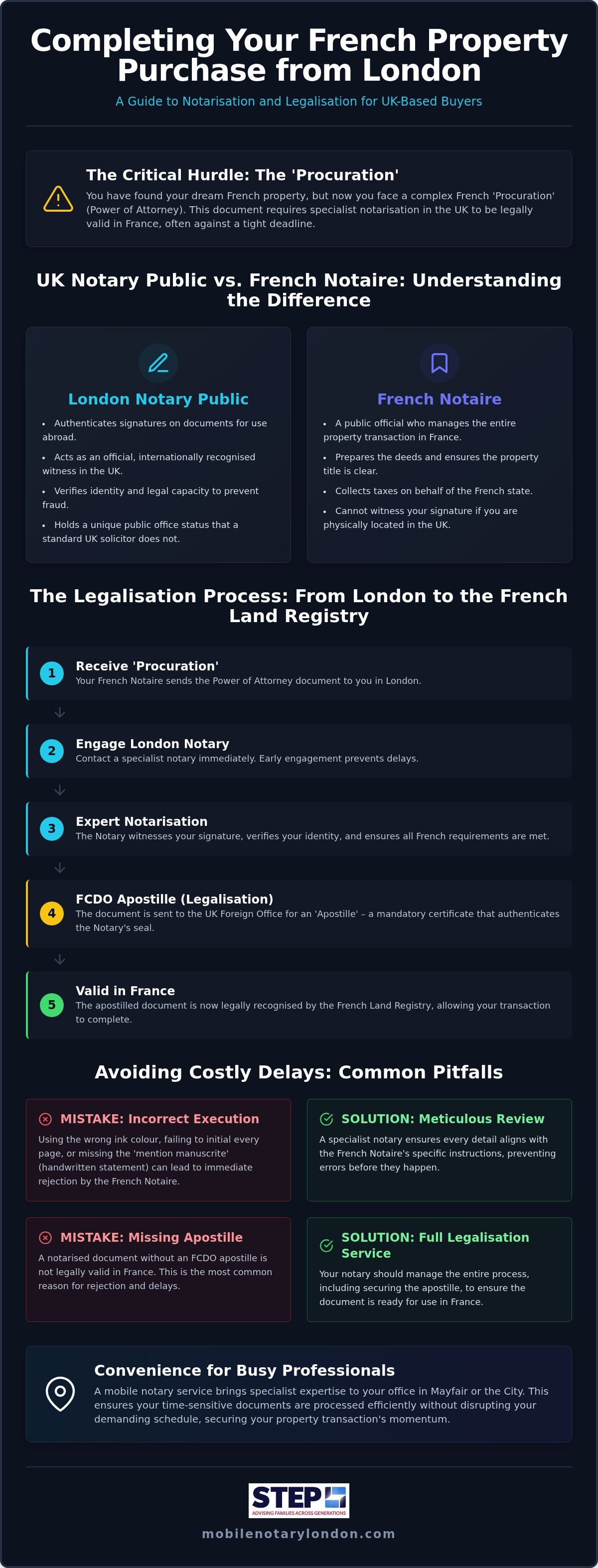
Buying property in France involves a civil law system that differs significantly from the English common law tradition. Whilst the French Notaire manages the overall transaction and collects taxes, they cannot witness your signature if you are physically located in the UK. This is where a specialised notary for French property purchase London becomes indispensable. They serve as the official witness whose seal is recognised internationally, ensuring your documents satisfy the rigorous requirements of the French Land Registry.
The role goes beyond simple witnessing. A notary acts as a vital legal bridge, verifying that you have the legal capacity to enter into a high-value international contract. In the context of 2026's active market, where transaction volumes are high and scrutiny on non-EU residents has increased, this verification is a primary defence against property fraud. It provides the French system with the certainty it requires to transfer title securely.
UK Notary Public vs French Notaire: Key Differences
It's a common misconception that a French Notaire and a British Notary Public perform identical roles. In France, the Notaire is a government-appointed official who prepares the deeds and ensures the property title is clear. Conversely, a Notary Public in London is a highly qualified legal professional, often with a background in international private wealth, who authenticates the execution of those deeds. A standard UK solicitor cannot fulfil this role because they lack the specific public officer status required by the French system. By engaging a STEP-qualified private wealth lawyer to act as your notary for French property purchase London, you gain an additional layer of scrutiny. We don't just witness a signature; we verify your capacity and identity to protect your assets at a global level.
When to Contact a Notary for Your French Purchase
Timing is critical when managing cross-border transactions. You should ideally engage a notary as soon as the Compromis de Vente (the initial sales agreement) is signed. French property law moves quickly, and the Procuration (Power of Attorney) often has a narrow window for return. You'll need a notary at several key trigger points:
- Upon receipt of the draft Procuration from your French Notaire to ensure it meets UK witnessing standards.
- During preparation for the final Acte de Vente if you cannot travel to France for completion.
- When verifying corporate documents if the purchase is being made through a Société Civile Immobilière (SCI).
Early engagement allows for the seamless coordination of the legalisation process under the Apostille Convention. This treaty ensures that once we've notarised your document, the UK Foreign Office can affix an apostille to confirm the notary's authority. Without this specific sequence, the French system will reject your paperwork, potentially stalling your completion and risking your deposit.
Navigating the French Procuration: Notarising Your Power of Attorney
A 'Procuration' is essentially a Power of Attorney specifically drafted for your property transaction. For the majority of buyers based in the UK, it's the most practical way to complete a purchase without making multiple trips to France. This document authorises a representative, typically a member of the French Notaire's staff, to sign the final deed of sale on your behalf. However, because this involves the transfer of real estate, the French system demands a high level of formal validity that only a qualified notary for French property purchase London can provide.
The technical requirements are rigorous. French Notaires often provide these documents in a bilingual format, and they must be executed with precise attention to detail. Common pitfalls include using the wrong ink colour, failing to initial every page, or neglecting the specific "mention manuscrite" (handwritten statement) sometimes required by certain offices. Any deviation from the Notaire’s instructions can lead to the document being rejected, causing significant delays and potentially jeopardising your completion date. Ensuring your paperwork is handled by a professional who understands these nuances is the best way to maintain your transaction's momentum.
Understanding the 'Procuration pour Acquérir'
The 'Procuration pour Acquérir' is the specific document used for acquisition. It outlines the property details, the purchase price, and any mortgage conditions. Your notary must be familiar with this French legal terminology to ensure the notarisation clause is compatible with the requirements of the Hague Apostille Convention. This international framework is what allows a UK notarised document to be recognised in France, provided it carries the necessary government certification. You can check the current requirements for this process via the official UK government legalisation service.
The Signing Process with a Mobile Notary
During a mobile notary visit, the process is designed for both security and speed. You'll need to present valid identification, typically a current passport and a recent utility bill to confirm your address. The notary will then witness your signature on the bilingual document, ensuring you fully understand the powers you are granting. Beyond simple witnessing, the notary performs a critical check on your 'capacity'. This means they must be satisfied that you are acting of your own free will and possess the mental capacity to enter into a binding contract. If you are working within a tight deadline, arranging a mobile notary for French property purchase London allows this vital step to be completed at your home or office in Mayfair or the City, saving you hours of travel time.
Apostille and Legalisation: Making London Documents Valid in France
Notarisation is merely the first stage of document authentication. To ensure your Power of Attorney or title deed is legally enforceable in a different jurisdiction, it must undergo 'legalisation'. In the context of a French transaction, this means obtaining an Apostille from the Foreign, Commonwealth & Development Office (FCDO). This certificate acts as a secondary layer of verification, confirming to the Notaires de France that the notary's signature and seal are genuine and recorded on the official register. Engaging a notary for French property purchase London who understands this requirement is critical; without this specific government endorsement, the French Land Registry will not recognise your London-signed documents as valid legal instruments.
The FCDO remains the sole authority for this process in 2026. Speed is often the primary concern, as French completion deadlines are notoriously strict. While the standard postal service is available for a fee of £45 per document, many buyers require a more expedited approach to avoid the risk of a deal falling through. Differentiating between standard, next-day, and same-day services is essential for managing your completion timeline effectively. For a notary for French property purchase London, coordinating this legalisation step is a core part of the service that ensures your paperwork is ready for immediate use across the Channel.
The 2026 Apostille Process for France
The workflow for legalising your property documents follows a strict three-step sequence. Precision at each stage is vital to prevent administrative rejection:
- Step 1: Notarisation – Your document is first witnessed and sealed by a qualified notary in London.
- Step 2: FCDO Submission – The notarised original is sent to the FCDO where an Apostille certificate is permanently attached.
- Step 3: Verification – The finalised document is then presented to French authorities, who verify the signature and seal against international standards.
If you are facing an imminent deadline, utilising an urgent apostille London service can reduce the turnaround time from several days to a matter of hours. This fast-track capability is particularly valuable for Mayfair and City professionals who cannot afford procedural delays.
E-Apostilles vs Paper Certificates
A significant development in 2026 is the wider availability of digital e-Apostilles. However, caution is required when dealing with French real estate. Whilst some administrative documents are now accepted in digital format, most French Notaires still regard physical paper certificates as the 'gold standard' for property deeds. The tactile nature of a wet-ink signature and an embossed notary seal provides a level of security that digital counterparts sometimes struggle to match in the eyes of conservative land registries. We generally recommend the paper-based route for all property-related legalisation to ensure 100% acceptance by your Notaire. Once the Apostille is attached, we arrange secure, tracked courier delivery back to France, providing a complete chain of custody for your sensitive documents.
Avoiding Common Delays in Cross-Border Property Transactions
Administrative errors cost time. A single formatting discrepancy in a French deed can halt a multi-million pound completion in its tracks. Most delays occur because the UK documentation doesn't perfectly align with the expectations of the French Land Registry. By engaging a specialist notary for French property purchase London, you ensure that every margin, ink colour, and initial complies with the Notaire's specific requirements. This is particularly vital for clients using complex private wealth structures, such as a Société Civile Immobilière (SCI). As a STEP-qualified lawyer, I provide the high-level oversight needed to verify that corporate authorities and trust deeds are correctly interpreted for the French system, preventing the back-and-forth that often plagues international deals.
The Importance of Certified Translations
Precision is your protection. The French legal system is rigorous regarding language. If your documents require translation, using a standard agency isn't enough. You often need a 'Traducteur Assermenté' (Sworn Translator) whose work is recognised by the French courts. We coordinate directly with your French legal team to ensure that the UK notarial certificate is presented in a way they fully understand. This proactive communication eliminates the danger of using non-notarised or unofficial translations that the French Notaire would be forced to reject upon receipt.
Managing Tight Completion Deadlines
Logistics matter. Managing the workflow of a notary for French property purchase London involves more than just a signature. You must account for time-zone differences and the physical transit of documents. A mobile notary Central London service provides a significant 'Premium' advantage by coming to your location in Mayfair or the City, often on the same day. This speed is frequently the difference between meeting a completion deadline and losing a preferred mortgage rate. To ensure a smooth visit, follow this essential checklist:
- Valid original photo ID (Passport) and proof of current address.
- The final draft of the document exactly as sent by your French Notaire.
- Clear instructions on any specific witnessing requirements or handwritten statements.
If you are facing a tight deadline for your French property documents, contact us today for a mobile notary appointment to ensure your transaction remains on track.
Premium Mobile Notary Services for Central London Property Buyers
Time is the most valuable asset for professionals operating within London's financial and legal hubs. When a French property transaction reaches its critical final stages, the requirement to visit a traditional office can be an unnecessary burden. A mobile notary for French property purchase London eliminates this friction by bringing high-level legal expertise directly to your location. Whether you are finalising a purchase from a boardroom in the City or a private residence in Mayfair, the service is designed to integrate seamlessly into a demanding schedule. This on-site approach doesn't just offer convenience; it provides the discretion and focused attention that high-value private wealth transactions require.
Discretion is paramount. By choosing a mobile service, you ensure that your legal affairs remain private and are handled in an environment where you feel most secure. Our practice is accustomed to the nuances of premium property acquisitions, providing a "white-glove" experience that prioritises your peace of mind. We understand the urgency of French completion deadlines and offer same-day appointments to ensure your documents are notarised and ready for legalisation without a moment's delay. This agile response is vital when dealing with the time-sensitive nature of international real estate.
Service Areas: From Mayfair to the City of London
Our practice is strategically positioned to serve the core districts of Central London. We provide tailored support across key business and residential centres, including:
- Mayfair and St James's: Catering to private clients and family offices.
- The City of London: Meeting professionals in corporate settings for streamlined execution of deeds.
- Westminster and Belgravia: Offering flexible home visits for residents managing international portfolios.
We recognise that the standard working day doesn't always align with international property law requirements. To accommodate this, we offer the flexibility of early morning or evening appointments. This ensures that whilst you manage your professional commitments, your French property purchase remains a priority.
The Sheikh Najam Advantage
What sets our service apart is the depth of specialised knowledge brought to every appointment. Sheikh Najam is a STEP-qualified Private Wealth Lawyer as well as a Notary Public. This dual qualification is rare and provides a significant advantage when dealing with the complex bureaucratic requirements of the French system. Every transaction is handled with a solution-oriented perspective, ensuring that even the most intricate corporate or trust-based property structures are correctly authenticated. You deal directly with a senior practitioner who understands the gravity of legal compliance and the practical need for speed. When you book a notary for French property purchase London through our practice, you aren't just hiring a witness; you are engaging a trusted advisor who can navigate the complexities of cross-border law with ease and precision.
Securing Your French Property Completion with Confidence
Navigating a cross-border purchase requires more than just a signature. It demands a meticulous approach to document formatting and a deep understanding of how the FCDO and French Land Registry interact. By ensuring your 'Procuration' is notarised correctly and legalised with an urgent apostille, you remove the administrative friction that often stalls international deals. This process provides the legal certainty your French Notaire requires to transfer title securely.
Choosing a specialist notary for French property purchase London provides the technical rigor necessary for high-value transactions. As a STEP-qualified Private Wealth Lawyer, I offer a level of scrutiny that protects your interests whilst providing the speed your schedule requires. Whether you are in Mayfair, Westminster, or the City, our mobile service brings elite legal expertise directly to you. Don't let procedural delays jeopardise your investment.
Book Your Premium Mobile Notary Appointment in Central London today to ensure your French property documents are handled with precision. We offer same-day mobile appointments and specialise in urgent apostille and embassy legalisation. Your transition to French property ownership should be seamless, and we are here to facilitate every legal step with professional authority.
Frequently Asked Questions
Do I need to visit a notary in person in London for my French property purchase?
Yes, you must meet with a notary in person to execute your French property documents. A notary's primary duty is to verify your identity and ensure you are signing the document of your own free will. Whilst digital solutions are evolving, the French Land Registry still requires a physical wet-ink signature witnessed by a public officer. Our mobile service simplifies this requirement by visiting your office or home in Central London.
How long does it take to get an apostille for French documents in 2026?
The turnaround time for an apostille depends on the service level you select. In 2026, the standard FCDO postal service typically takes up to twenty working days. However, for time-sensitive transactions, we offer an urgent apostille service that can reduce this to twenty-four hours. This is often essential for meeting the strict return deadlines set by French Notaires during the final stages of a property completion.
Can a UK solicitor notarise my French Procuration?
No, a standard UK solicitor cannot notarise a French Procuration. In the UK, a Notary Public holds a specific public office that is recognised internationally, whereas a solicitor's powers are generally limited to domestic legal matters. French authorities require the seal of a notary to ensure the document is valid for use abroad. Using a specialist notary for French property purchase London ensures your paperwork meets these strict jurisdictional standards.
Is a mobile notary more expensive than a fixed-office notary in London?
Mobile notary services typically involve an additional travel fee compared to visiting a fixed office. However, many professionals find this a cost-effective choice when considering the value of their time and the convenience of avoiding cross-town travel. Our premium service provides on-site notarisation at your convenience, ensuring your high-value French property documents are handled with total discretion and efficiency without disrupting your busy London schedule.
What documents do I need to provide to the London notary for a French purchase?
You must provide your original, valid passport and a recent proof of address, such as a utility bill or bank statement dated within the last three months. Additionally, you should have the draft document provided by your French Notaire ready for review. Having these items prepared ensures that the notarisation process is seamless and that all identity verification requirements satisfy both UK regulations and French legal standards.
Will the French Notaire accept an English-only Power of Attorney?
Most French Notaires require the Power of Attorney to be drafted in French or a bilingual French-English format. This ensures that the representative in France and the Land Registry officials can fully understand the powers being granted. If you only have an English version, it may require a certified translation by a "Traducteur Assermenté" before it can be used, which can cause significant delays in your property transaction.
What happens if my French property documents are not legalised with an apostille?
If your documents lack an apostille, the French Notaire and the Land Registry will reject them. The apostille is the only internationally recognised method of proving that the notary's seal and signature are authentic. Without this mandatory legalisation step, your Power of Attorney will be considered invalid in France. This could lead to a breach of contract or the loss of your preferred completion date and deposit.
Can you help with notarising company documents for a French commercial property purchase?
Yes, we specialise in authenticating corporate documents for commercial acquisitions. This involves verifying the company's standing at Companies House and confirming that the directors have the authority to sign on behalf of the entity. As a STEP-qualified lawyer, I provide the expert oversight required for these complex structures, ensuring that your corporate notary for French property purchase London requirements are met with the highest level of professional rigor.

Article by
Sheikh Najam
Sheikh Najam LLB, TEP, MCIArb is a Notary Public and Commissioner for Oaths based in Central London, offering notary services to corporate, commercial and private clients across the City of London and beyond. His work includes notarising board and shareholder resolutions, powers of attorney, and certified copies of constitutional documents for use with foreign registries, banks and courts, with apostille and legalisation arranged as part of the same instruction. Alongside his notarial practice, he is a STEP-qualified international private wealth lawyer advising on cross-border transactions, company formation, trust drafting and succession planning. He is regulated by the Faculty Office (Court of Faculties) of the Archbishop of Canterbury and is a member of The Notaries' Society of England and Wales, STEP, and The Association of European Attorneys.


