
The era of waiting weeks for postal document legalisation is officially over, yet the transition to digital standards has left many professionals more confused than ever. Whilst the e-Apostille UK service offers a modern solution to urgent international deadlines, the fear of document rejection remains a significant hurdle for those unfamiliar with the Foreign, Commonwealth and Development Office’s specific requirements.
You're likely balancing the pressure of a fast-approaching deadline with the uncertainty of whether a digital signature carries the same weight as traditional wet-ink. It's a stressful position to be in when your corporate or private wealth matters depend on flawless execution. This article clarifies exactly how the digital legalisation process works and how it provides a significantly faster turnaround than traditional postal methods.
You'll discover the essential steps to ensure your documents are eligible for electronic certification. We also look at how a mobile notary can facilitate your application directly from your office in Mayfair or Westminster, providing the expert confirmation needed to navigate complex bureaucratic landscapes with absolute confidence.
Key Takeaways
- Understand the transition from physical wet-ink stamps to secure, PDF-based digital legalisation issued by the FCDO.
- Identify which academic and corporate documents are eligible for the e-Apostille UK service to ensure your application is processed without rejection.
- Learn how the application of an Advanced Electronic Signature (AES) by a qualified notary is essential for the validity of your digital submission.
- Evaluate the significant speed advantages of digital legalisation when managing tight international deadlines in Central London.
- Discover the convenience of on-site digital notarisation for complex corporate and private wealth documents across Mayfair and the City.
Understanding the e-Apostille UK: Digital Legalisation Explained
The e-Apostille UK represents a fundamental shift in how the Foreign, Commonwealth & Development Office (FCDO) verifies the authenticity of documents for use abroad. For decades, the process relied on physical "wet-ink" signatures and embossed paper certificates. Today, legalisation has evolved into a secure, PDF-based format. This digital certificate is electronically signed by the FCDO, ensuring it carries the same weight as a traditional paper apostille whilst eliminating the logistical friction of physical handling. It's a sophisticated solution for a digital age.
The introduction of this digital service in 2026 responds to a surging international demand for speed and security. As global business moves at an increasingly rapid pace, the FCDO has modernised its framework to ensure the UK remains a leading jurisdiction for international trade and private wealth management. This isn't just about convenience; it's about maintaining the integrity of UK documents in a landscape where speed is often a prerequisite for success.
How the e-Apostille Differs from Traditional Legalisation
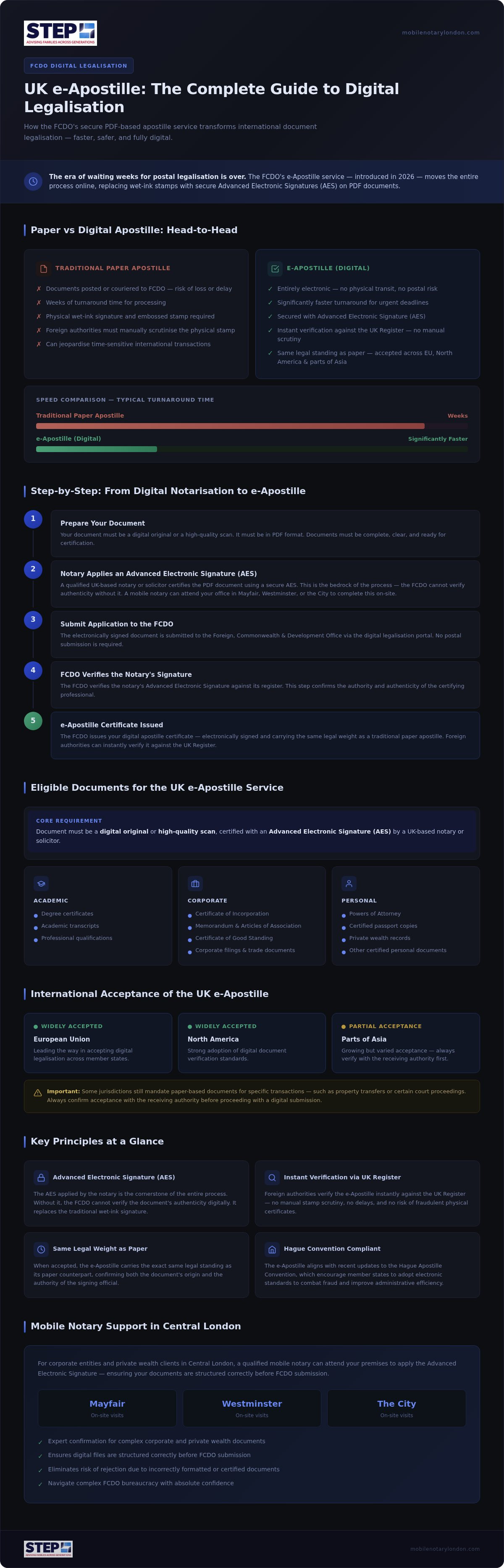
The most immediate difference is the removal of physical transit. Traditional legalisation requires documents to be posted or couriered to the FCDO, often leading to delays that can jeopardise time-sensitive transactions. With an e-Apostille, the entire process is handled electronically. Once a notary applies a secure Advanced Electronic Signature (AES) to your document, the FCDO verifies that signature and issues a digital apostille certificate. This process removes the risk of documents being lost in the post, a common fear amongst those handling sensitive corporate records.
Verification is equally streamlined. Foreign authorities no longer need to scrutinise a physical stamp; they can verify the digital signature instantly against the UK Register. This shift aligns with recent updates to the Hague Apostille Convention, which have encouraged member states to adopt electronic standards to combat fraud and improve administrative efficiency.
The Legal Validity of Digital Certificates Overseas
Whilst the technology is robust, legal validity depends on the recipient country's readiness. Many nations, particularly within the EU, North America, and parts of Asia, are leading the way in accepting digital legalisation. However, it's vital to check with the receiving authority before you proceed. Some jurisdictions still mandate paper-based documents for specific types of transactions, such as property transfers or certain court proceedings.
When accepted, the e-Apostille maintains the exact same legal standing as its paper counterpart. It confirms the origin of the document and the authority of the official who signed it, providing a seamless bridge for UK documents to be recognised globally. This digital-first approach ensures that whether you are dealing with corporate documentation or private wealth matters, your legalisation process is as agile as your business requirements. It provides a level of certainty that is essential for high-stakes international dealings.
Eligible Documents for the UK e-Apostille Service
Not every document is automatically suitable for digital legalisation. The FCDO maintains strict criteria regarding the format and certification of files submitted for an e-Apostille UK. The fundamental requirement is that the document must be either a digital original or a high-quality scan that has been certified with an Advanced Electronic Signature (AES) by a UK-based notary or solicitor. This digital signature is the bedrock of the process; without it, the FCDO cannot verify the document's authenticity in a virtual environment.
Commonly accepted documents include academic certificates, such as degrees and transcripts, alongside a wide array of corporate filings. Personal records, such as Powers of Attorney and certified passport copies, are also eligible, provided they've been correctly prepared. If you're managing a time-sensitive international matter, a Mobile Notary in Central London can ensure your digital files are structured correctly before you begin the application process.
Business and Corporate Document Requirements
Corporate entities operating out of Mayfair, Westminster, and the City of London are increasingly prioritising the digital route for international trade. Documents such as Certificates of Incorporation, Memorandum and Articles of Association, and Certificates of Good Standing are frequently legalised via the e-Apostille UK service. These documents are often pulled directly from Companies House as digital originals, making them ideal candidates for electronic legalisation.
A corporate notary plays a vital role here. They must verify the digital records and apply their own electronic seal. This professional oversight is particularly important for complex international private wealth structures where the validity of a signature can impact high-value transactions. Using a digital format allows these firms to bypass the delays associated with physical couriers, ensuring that board resolutions or appointment letters reach foreign jurisdictions in hours rather than days.
Academic and Professional Qualifications
For individuals seeking work permits or visas abroad, legalising UK degrees and professional qualifications is a standard hurdle. To be eligible for an e-Apostille, your degree certificate or transcript must be uploaded as a PDF. It's a common pitfall to assume a simple scan is sufficient. In reality, the document must be notarised digitally to confirm its authenticity to the FCDO.
The FCDO won't accept documents that are password-protected or contain embedded links that require external verification. Ensuring your educational documents are in the correct, flat PDF format is essential. By securing a professional digital certification first, you avoid the frustration of document rejection, which is especially critical when dealing with strict embassy deadlines for overseas placements.
The Step-by-Step Process: From Digital Notarisation to e-Apostille
Securing an e-Apostille UK is a precise administrative sequence. Whilst the government portal is user-friendly, the technical requirements for the underlying document are stringent, requiring a specific type of digital validation that only a qualified professional can provide. You can't simply upload a standard PDF scan and expect a successful result. The process follows a logical path from initial verification to final digital issuance.
- Step 1: Consultation: A mobile notary reviews your document to confirm it's eligible for digital legalisation.
- Step 2: Digital Certification: The notary applies a secure Advanced Electronic Signature (AES) to the file.
- Step 3: FCDO Upload: You or your notary upload the AES-certified PDF to the official FCDO legalisation portal.
- Step 4: Statutory Payment: The government fee is paid online to initiate the official review.
- Step 5: Digital Receipt: Once processed, you receive your e-Apostille via email as a secure digital download.
The Notary’s Role in Digital Certification
The Advanced Electronic Signature (AES) is the mandatory technical standard for any document submitted for an e-Apostille UK. This isn't a simple typed name or a scanned image of a signature. It's a cryptographically secure certification that links the notary's identity to the document. Sheikh Najam organises this digital certification during a mobile visit to your London office, using specialised software to ensure the file meets the FCDO’s exact specifications. He ensures the PDF remains "flat" and unencrypted, as the government portal will automatically reject files with password protection or complex embedded metadata.
FCDO Submission and Turnaround Times
Current FCDO processing times for e-Apostilles in 2026 typically range from 24 to 48 hours. This is significantly faster than the postal service, which can take several business days plus transit time. Once the application is submitted, you can track its progress through the government’s digital dashboard. If a document is rejected, it's usually because the digital signature wasn't applied correctly or the file format was incompatible. Having a professional manage the initial certification drastically reduces this risk, providing the peace of mind that your international deadlines will be met without administrative hitches. It's a fast-paced system designed for modern, on-demand legal needs.
Paper vs Digital Apostilles: Choosing the Right Format
Deciding between a physical stamp and an e-Apostille UK often comes down to the requirements of the receiving authority rather than personal preference. Whilst the digital format is undeniably superior in terms of speed and durability, the paper-based apostille remains a necessity for several key jurisdictions. Understanding these distinctions is crucial to avoiding costly delays in your international transactions. Digital legalisation removes the logistical friction of physical handling, ensuring that your documents cannot be lost or damaged in the post, a risk that persists with traditional paper certificates.
From a cost perspective, the FCDO applies different fee structures for digital and paper-based services. Whilst the statutory fee for an e-Apostille is often comparable to the standard postal service, the real saving is found in the elimination of courier costs and the reduction in administrative downtime. For London-based professionals managing urgent corporate matters, the ability to bypass physical transit is a significant operational advantage. If your deadline is measured in hours, you can Book an Urgent Apostille in London to ensure your digital certification is handled with the necessary precision.
When to Stick with a Paper Apostille
The primary reason to opt for a traditional "wet-ink" apostille is the requirement for embassy legalisation. Many nations, particularly across the Middle East, including the UAE and Qatar, still mandate physical stamps and embossed seals. These authorities often require a chain of legalisation that involves their own consulates, most of which are not yet equipped to process digital certificates. If your document is destined for a country that has not fully modernised its administrative framework, the digital route may lead to rejection.
Some clients adopt a hybrid approach. This involves securing a paper apostille for the primary transaction whilst maintaining an e-Apostille UK for their digital archives or for secondary authorities that accept electronic formats. This dual-track strategy provides a safety net, ensuring you're prepared for any bureaucratic contingency. It's a prudent move for high-net-worth individuals managing assets across multiple international jurisdictions with varying standards of digital adoption.
The Future of Legalisation: Is Paper Becoming Obsolete?
The trend in international private wealth and corporate law is moving decisively toward digital-first standards. The Hague Apostille Convention continues to advocate for universal electronic acceptance, and the number of member states adopting e-Apostille registries is growing annually. This shift is driven by the need for enhanced security and the ability to verify documents instantly online, which significantly reduces the risk of fraud compared to physical certificates that can be tampered with.
Managing your digital document archive is becoming a critical component of international compliance. An e-Apostille provides a permanent, verifiable record that can be shared instantly with legal teams or financial institutions globally. As more jurisdictions align their legal frameworks with these digital standards, the reliance on physical paperwork will naturally diminish. For now, the key is knowing which format your specific recipient requires to ensure a seamless transition of your legal documents across borders.
Expert Mobile Notary Support for e-Apostilles in Central London
Whilst the e-Apostille UK is a digital-first product, the legal foundation remains a physical, face-to-face verification. Busy professionals in Westminster, Mayfair, and the City often find the logistics of traditional office visits a significant drain on their time. Sheikh Najam bridges this gap by providing a premium mobile service that brings expert digital certification directly to your boardroom or private residence. As a STEP-qualified lawyer, he understands the gravity of international private wealth and corporate compliance, ensuring that every digital key and electronic signature is applied with meticulous precision.
The on-site nature of this service is particularly beneficial for high-net-worth individuals who require a discreet and efficient solution for sensitive documentation. By coming to you, we eliminate the downtime associated with London traffic and administrative queues. This approach allows for an immediate review of your documents, ensuring they meet the FCDO’s 2026 standards before the digital submission is even initiated. It's a proactive way to manage your international legal requirements whilst maintaining your focus on your core business activities.
Premium Service in Central London
Choosing a mobile notary is about more than just convenience; it's about security and professional oversight. When handling high-stakes documentation, you shouldn't have to worry about the technicalities of Advanced Electronic Signatures or specific file formatting. Having an expert manage these elements on-site ensures that your digital application is flawless from the start. This specialised support integrates seamlessly with our broader corporate notary services in London, providing a holistic solution for firms that require both agility and legal rigour.
We handle the entire digital chain of custody. From the moment we verify your identity in person to the application of the secure digital seal, every step is designed to satisfy the strict verification protocols of foreign authorities. This level of "white-glove" service is why many of London's leading legal and financial firms rely on our expertise for their most urgent international matters.
Navigating Urgent International Requirements
Time is frequently the most critical factor in international legalisation. We specialise in facilitating urgent apostille London requests, often resolving potential bottlenecks before they impact your timeline. For example, consider a recent overseas property transaction where a client in Mayfair needed to legalise a Power of Attorney within 48 hours to meet a completion deadline. By providing on-site digital notarisation and immediate FCDO submission, we ensured the deal remained on track without the need for physical couriers or postal transit.
If you're facing a tight deadline or a complex corporate requirement, don't leave your document's validity to chance. The e-Apostille UK system is fast, but its success depends on the quality of the initial notarisation. Contact Sheikh Najam to organise your mobile appointment today. We provide the expert confirmation and technical precision needed to ensure your documents are accepted by foreign authorities on the first attempt, giving you total peace of mind in an increasingly digital legal landscape.
Secure Your Digital Legalisation with Expert Precision
The e-Apostille UK has fundamentally changed international document verification, offering a level of speed and security that traditional methods simply cannot match. By eliminating physical transit and providing instantaneous verification, this digital framework ensures your most critical deadlines are met with absolute certainty. You now understand the technical necessity of Advanced Electronic Signatures and the specific criteria that determine whether a digital or paper-based format is appropriate for your recipient.
Navigating these evolving digital requirements shouldn't be a source of administrative stress. As a STEP-qualified Private Wealth Lawyer, Sheikh Najam provides the premium oversight needed to ensure your application is processed without delay. Whether you are managing complex corporate filings or private international assets, our on-site service in Central London brings expert legalisation directly to your office or home. Book a Mobile Notary Appointment for your e-Apostille today to secure the professional support your international matters deserve. Efficiency and peace of mind are just one appointment away.
Frequently Asked Questions
What exactly is an e-Apostille in the UK?
An e-Apostille is a digital version of the traditional paper certificate issued by the Foreign, Commonwealth & Development Office (FCDO). It's a secure PDF file that confirms the authenticity of a signature, seal, or stamp on a UK document for use in another country. Unlike the physical sticker attached to paper documents, this digital version uses an electronic signature to provide the same level of legal validity for international transactions.
How long does it take to get an e-Apostille in 2026?
Processing times for the e-Apostille UK typically range from 24 to 48 hours. This timeframe is considerably shorter than paper-based applications, as it removes the need for postal transit to and from the legalisation office. For professionals in Central London, this digital turnaround provides an essential advantage when managing urgent international deadlines that require immediate verification.
Can any document be legalised with an e-Apostille?
Not all documents are eligible for this digital service. Whilst academic qualifications and corporate filings are commonly accepted, certain government-issued originals, such as birth, death, or marriage certificates, currently still require a physical paper apostille. It's vital to ensure your document is in a PDF format and has been correctly certified by a notary before you attempt the digital application.
Do I still need a notary public for an e-Apostille?
Yes, a notary public is almost always essential for digital applications. A notary must first verify the document's authenticity and apply a secure Advanced Electronic Signature (AES) to the file. This specific type of digital signature is a mandatory requirement for the FCDO, as it allows them to verify the identity of the professional who certified the document in a virtual environment.
Which countries accept the UK e-Apostille?
Most member nations of the Hague Apostille Convention accept digital certificates, including many jurisdictions across Europe and North America. However, acceptance is not universal. You must verify the required format with the specific recipient or authority abroad, as some countries still mandate traditional wet-ink signatures and embossed paper seals for certain types of legal transactions.
How much does the FCDO charge for a digital apostille?
The FCDO applies a standard statutory fee for each digital certificate issued. This fee is paid directly through the government's online portal during the submission process. It's distinct from the professional fees associated with notarisation or the convenience of a mobile notary visit, so you should account for both the government charge and the professional certification costs.
What happens if my e-Apostille is rejected by a foreign authority?
Rejection usually occurs if the receiving authority is not yet equipped to verify digital signatures or if they specifically require a paper original for their records. In these instances, you'll need to re-apply for a traditional paper-based apostille. To avoid this frustration, we recommend obtaining written confirmation from the recipient that they accept electronic legalisation before you begin the process.
Is an e-Apostille more secure than a paper one?
Digital certificates offer enhanced security through cryptographic technology that prevents unauthorised tampering. Because the e-Apostille UK is linked to a digital register, foreign authorities can instantly verify its validity online. This provides a level of transparency and fraud prevention that physical stamps cannot match, making it a preferred choice for high-stakes corporate and private wealth matters.


