

The traditional requirement to sit across a desk from a legal official has finally been superseded by a more agile, secure reality. With the Notaries (Conduct and Discipline) Rules 2026 now in full effect, the permanent provision for evidence via simultaneous videoconference has modernised how we approach international law. If you're managing high-stakes corporate documents or private wealth matters, you likely don't have the luxury of time to navigate Central London traffic for a physical appointment. Utilising a Virtual Notary UK service allows you to meet your legal obligations with precision and speed, without compromising on the procedural rigor your transaction demands.
It's natural to feel some trepidation regarding the acceptance of digital signatures or the specific requirements of the UK eIDAS Regulation. You need to know that your documents will be valid for international use and that your privacy is protected by the highest encryption standards. This guide will show you how to legally notarise your documents remotely using secure video technology and Qualified Electronic Signatures. We'll outline the current limitations on remote notarisation, the latest technology standards, and how to ensure your digital documents are ready for the apostille process.
Key Takeaways
- Understand the updated 2026 legal framework that confirms the validity of a Virtual Notary UK service for remote document authentication.
- Identify which documents are eligible for digital seals and when the physical presence of a notary remains a legal necessity for international transactions.
- Learn the technical requirements for Qualified Electronic Signatures (QES) to ensure your remote notarisation meets rigorous UK eIDAS standards.
- Access a practical checklist to prepare your hardware and identity documents for a swift, secure 15-minute remote session.
- Discover how to navigate complex international requirements by choosing a premium facilitator who offers both virtual and mobile solutions.
Understanding Virtual Notary Services in the UK: Legal Validity and Scope
The evolution of the legal landscape has turned what was once a digital convenience into a regulated standard. Virtual notarisation is the process of authenticating documents using secure audio-visual technology, allowing a notary to witness a signature in real-time without being in the same room as the signatory. This shift represents a significant move away from traditional "wet-ink" requirements toward a more agile framework. For international business and private wealth management, this isn't just about saving time. It's about maintaining momentum in a global market that doesn't stop for courier delays or travel logistics. By utilising eNotary services, professionals can ensure their cross-border transactions remain secure and compliant.
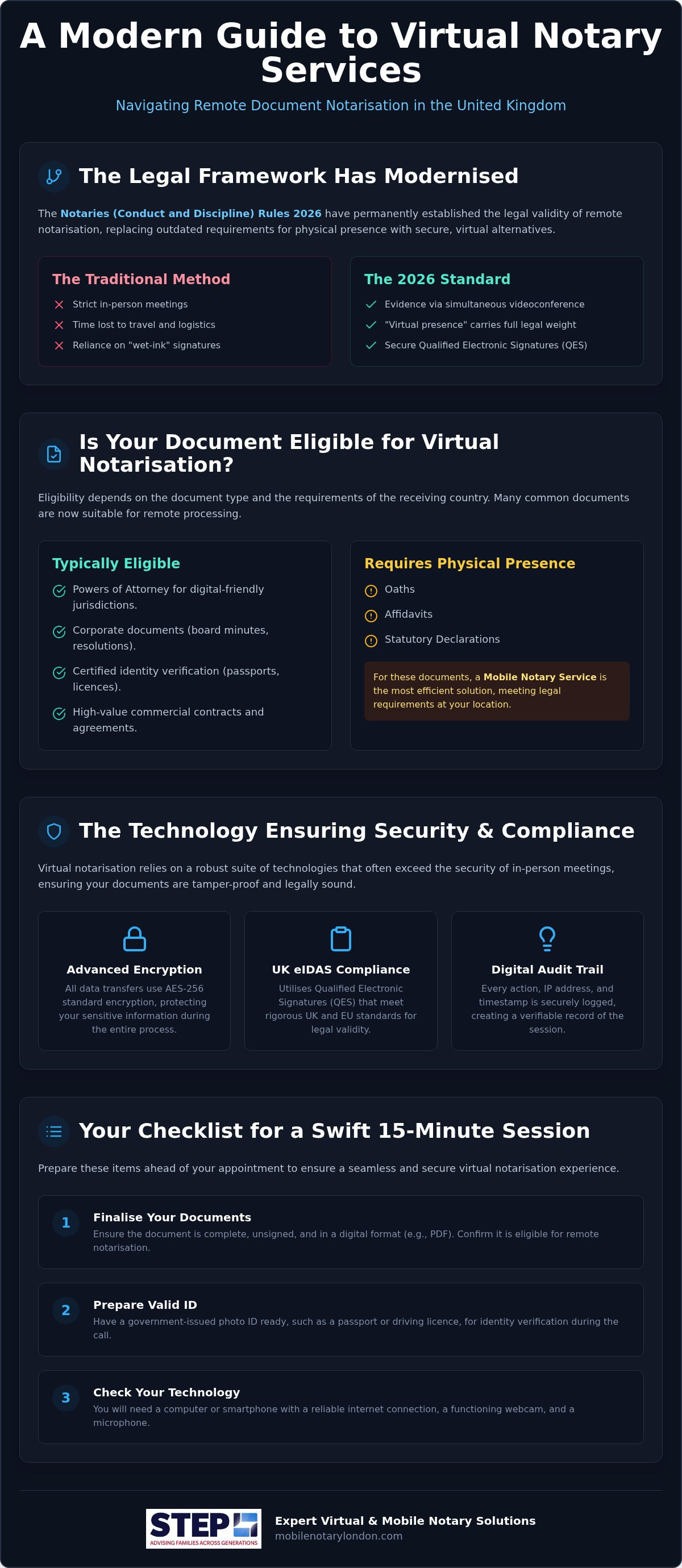
Current legal validity in 2026 is anchored by the Notaries (Conduct and Discipline) Rules 2026, which came into force on 28 April 2026. This framework replaced the older 2015 rules and solidified the provision for evidence to be taken via simultaneous videoconference. Whilst the concept of "physical presence" historically required the notary and the client to be in the same space, the modern interpretation focuses on "virtual presence." This means the notary can verify your identity and witness your digital signature through a encrypted video link, provided the process adheres to the strict standards set by the Faculty Office of the Archbishop of Canterbury. For those seeking a Virtual Notary UK, this regulatory clarity provides the necessary assurance that remote acts carry the same weight as in-person ones.
Is Remote Notarisation Legally Binding in the UK?
For a document to be properly executed remotely, the notary must follow a precise protocol. The Notaries Society and the Faculty Office provide the guidelines that ensure these acts are robust enough to withstand scrutiny in foreign jurisdictions. A critical requirement is that the notary themselves must be physically located within England or Wales during the session, even if the client is abroad. This maintains the jurisdictional integrity of the act. We ensure that every digital interaction meets the UK eIDAS Regulation standards, which were further refined by the Data (Use and Access) Act 2025 to ensure the highest level of trust in electronic signatures.
Common Documents Eligible for Virtual Attestation
While the technology is advanced, eligibility depends on the document type and the receiving country's requirements. Many corporate and personal documents are now routinely handled through virtual channels:
- Powers of Attorney: Particularly for jurisdictions that have adopted digital-friendly protocols.
- Corporate Documents: This includes board minutes, resolutions, and certificates of incorporation.
- Identity Verification: Certified copies of passports or driving licences for international bank accounts.
- Commercial Contracts: High-value agreements requiring neutral third-party witnessing.
It's vital to note that certain documents, such as Oaths, Affidavits, and Statutory Declarations, currently still require the signatory to be physically present with the notary under specific UK regulations. In these instances, a mobile notary service remains the most effective solution to meet urgent deadlines.
The Technology Behind Secure Remote Online Notarisation (RON)
The transition to digital notarisation represents a sophisticated leap in legal security rather than a mere change in medium. While traditional methods rely on physical observation, a Virtual Notary UK session employs a suite of cryptographic and biometric tools that offer a level of verification often surpassing in-person meetings. This technological rigor ensures that every document remains tamper-proof throughout its lifecycle, providing a robust defence against fraud in an increasingly digital global economy.
Central to this security is the digital audit trail. Every interaction during a remote session is logged with precision, including the signatory's IP address, time-stamping, and the specific sequence of actions taken. This transparency provides a verifiable record that far exceeds the simple entry in a physical register. All data transfers occur over encrypted channels, typically utilizing AES-256 standards, ensuring that private wealth documents and sensitive corporate resolutions remain confidential from the moment they are uploaded until they reach their final destination.
Qualified Electronic Signatures (QES) and Digital Seals
Not all digital signatures carry the same legal weight. Under the UK eIDAS framework, the Qualified Electronic Signature (QES) is the gold standard, providing the highest level of assurance. Unlike a standard e-signature, a QES is backed by a digital certificate issued by a Trust Service Provider who has verified the signatory's identity. The Electronic Communications Act 2000 provided the initial foundation for this, but modern QES protocols have refined the process into a seamless, high-security experience. When a digital seal is applied, it uses Public Key Infrastructure (PKI) to make the document tamper-evident. If any part of the file is altered after the seal is fixed, the certificate immediately becomes invalid, alerting any receiving party to the breach of integrity.
Biometric ID Verification and Video Protocols
To ensure the person signing is exactly who they claim to be, we utilise AI-driven biometric verification. This technology analyses the security features of a passport or national ID card and compares them against a live video feed of the client. This "liveness check" prevents the use of static images or deepfakes. High-definition video is a strict requirement, as the notary must clearly witness the act of signing to satisfy regulatory standards. These sessions are recorded and stored in accordance with strict data protection laws, creating a permanent record of the transaction. This level of precision is why many international clients now prefer the efficiency of a Notary Public Central London who can navigate these complex digital protocols with ease.
Virtual vs. Mobile Notary: Choosing the Right Service for Your Needs
Deciding between a digital session and a physical meeting is no longer just a matter of personal preference. It's a strategic choice based on the specific requirements of your transaction. Whilst the convenience of a Virtual Notary UK service is undeniable, the decisive factor is often the "Acceptance Factor." This refers to whether the receiving country, government department, or financial institution will accept a digital seal and an e-Apostille. Many modern jurisdictions have fully digitised their workflows, yet several others still cling to the traditional "wet-ink" signature and physical ribbon seals as the only valid forms of authentication.
The cost-benefit ratio also differs between these two models. A virtual appointment typically offers a faster turnaround because it eliminates the logistics of travel, making it an ideal solution for professionals with demanding schedules. Conversely, a mobile visit involves the notary travelling to your home or office in Central London, providing a higher level of personal oversight for complex, multi-party signings. Turnaround times for virtual services can be as short as 15 minutes for the session itself, whereas a mobile visit requires a coordinated window of time but ensures that physical documents are handled with meticulous care from start to finish.
When Virtual Notarisation is the Optimal Choice
Virtual notarisation is the superior option when you are facing urgent deadlines and a physical meeting is logistically impossible. If your documents are destined for a jurisdiction that embraces digital legalisation, the entire process can be completed without a single piece of paper changing hands. This is particularly effective for standardised corporate documents, board resolutions, and identity verifications. The legal foundation for this agility is rooted in the UK Electronic Communications Act 2000, which ensures that electronic signatures carry the same weight as their physical counterparts when executed correctly within the current 2026 regulatory framework.
Situations Requiring a Physical Mobile Notary Visit
There are instances where the digital route is simply not an option. Certain countries still require traditional "wet-ink" signatures followed by a physical apostille from the Foreign, Commonwealth & Development Office (FCDO). Complex property transactions or high-value private wealth matters often necessitate physical witnessing to satisfy the strict requirements of overseas land registries. In these cases, clients often prefer the Mobile Notary Central London experience. This "white-glove" service ensures that the notary is present to guide you through the intricacies of the paperwork, providing a sense of security that a screen simply cannot replicate. If you're unsure which path to take, we can quickly assess your document's destination and advise on the most reliable method.
How to Prepare for Your Virtual Notary Appointment: A Step-by-Step Process
Efficiency defines the premium experience. When you engage a Virtual Notary UK service, the goal is a seamless interaction that concludes within 15 minutes. This rapid turnaround is only possible through meticulous preparation. Your hardware is the bridge to legal validity. You'll need a device with a high-definition camera and a stable internet connection to ensure the notary can clearly observe the signing act without pixelation or lag. Any interruption in the audio-visual feed can compromise the integrity of the witnessing process, potentially requiring the session to be restarted to meet strict regulatory standards.
It's also essential to understand the nature of the "original" document in a digital context. Once a document is notarised using a digital seal and a Qualified Electronic Signature, the electronic file itself becomes the legally valid original. Printing this document often strips away the cryptographic certificates and tamper-evident features that prove its authenticity. You should always share the digital file directly with the receiving party or the FCDO for an e-Apostille to maintain the document's legal weight. Preparation is vital, so ensure you have your original identity documents, such as a passport or driving licence, physically present for the biometric scan during the session.
Pre-Appointment Requirements and Document Uploads
The process begins well before the video call. You'll be asked to upload your documents in a high-resolution PDF format. This allows for a thorough review to ensure the wording meets the requirements of the destination jurisdiction. During this phase, you'll also complete preliminary KYC (Know Your Customer) checks. As a STEP-qualified Private Wealth Lawyer, I ensure these checks are exhaustive yet efficient, protecting you from potential fraud. Once the documents are approved and your identity is pre-verified, you'll receive a secure, encrypted link for the scheduled video conference.
What Happens During the Video Conference Session
During the live session, the notary will first confirm your identity using the biometric data captured during your upload. They'll also verify your willingness to sign the document and ensure you understand its legal implications. The signing itself occurs on a secure QES platform where you'll apply your digital signature in real-time. Finally, the notary applies their own digital seal and certificate. This multi-layered process ensures the document is ready for immediate international use. To begin this streamlined process, you can book your session with a Notary Public Central London today to meet your urgent deadlines with total confidence.
Expert Virtual and Mobile Notary Solutions with Sheikh Najam
Sheikh Najam provides more than a mere administrative stamp. As a STEP-qualified Private Wealth Lawyer, he brings a specialised understanding of international protocols to every engagement. This expertise is particularly vital for high-net-worth individuals and corporate entities navigating the complexities of cross-border transactions. By offering a hybrid model that blends the speed of a Virtual Notary UK session with the on-site reliability of a mobile visit, he ensures that your legal needs are met regardless of the document's destination or the urgency of the deadline. This bespoke approach transforms a standard procedural requirement into a strategic legal asset.
The value of this service lies in the ability to pivot. If our initial assessment reveals that a digital seal might not be accepted by a specific overseas registry, we can immediately transition to a mobile appointment at your Central London office. This agility prevents costly delays and ensures that your documents are never rejected due to technicalities. Every session is handled with the composure and precision expected of a premium, "white-glove" legal practice, providing you with total peace of mind in high-stakes scenarios.
The Advantage of a STEP-Qualified Private Wealth Lawyer
Legal expertise matters far more than the notarial seal itself when dealing with private wealth. Being STEP-qualified means Sheikh Najam possesses a deep immersion in the laws governing trusts, estates, and international property. During a Virtual Notary UK appointment, he provides an authoritative presence that reassures both the client and the receiving institution of the document's validity. He doesn't just witness a signature; he understands the intricacies of the cross-border matters at hand, ensuring that every statutory declaration or power of attorney is executed with procedural rigour.
Seamless Integration with Apostille and Legalisation
Notarisation is rarely the final step in an international transaction. Most documents require subsequent legalisation to be recognised abroad. We provide a streamlined pathway by integrating our notarial acts with Urgent Apostille London services. For documents notarised virtually, we can process e-Apostilles directly through the FCDO, often within the same business day. If your destination country requires traditional embassy legalisation for physical documents, our team manages the entire bureaucratic landscape on your behalf. This ensures your paperwork is "ready for use" the moment it arrives at its destination, allowing you to focus on your commercial or personal objectives without administrative friction.
Securing Your Global Transactions with Digital Precision
The transition to remote authentication is no longer a temporary measure but a permanent, regulated standard. By understanding the 2026 legal framework and the technical rigor of Qualified Electronic Signatures, you can ensure your international documents are executed with total validity. Whether you're managing complex private wealth matters or urgent corporate resolutions, a Virtual Notary UK service provides the agility required in a fast-paced legal environment without sacrificing procedural security.
Success in cross-border law depends on choosing a facilitator who understands the intricacies of both digital and physical requirements. As a STEP-qualified Private Wealth Lawyer, Sheikh Najam specialises in Central London corporate requirements, offering the expert oversight needed for high-stakes documentation. If your transaction requires an immediate turnaround, same-day urgent services are available to keep your projects on track. We're here to ensure your documents are accepted wherever they are needed.
Book Your Virtual or Mobile Notary Appointment with Sheikh Najam today to experience a seamless, secure, and professional service tailored to your specific needs.
Frequently Asked Questions
Is a virtual notary legal in the UK for all documents?
No, remote notarisation is not yet universal for all legal acts. Whilst the Notaries (Conduct and Discipline) Rules 2026 have expanded the scope for digital authentication, specific documents such as Oaths, Affidavits, and Statutory Declarations still legally require your physical presence before a notary. It's essential to confirm the document type and the requirements of the receiving jurisdiction before opting for a digital session.
Do I need a special app or software for a remote notary session?
You don't need to install any specialised software or proprietary applications. Most Virtual Notary UK sessions are conducted through a secure, encrypted link accessed directly via your web browser. However, you must ensure your device has a functioning high-definition camera and microphone, as clear audio-visual communication is a strict regulatory requirement for witnessing the signing act.
How much does a virtual notary service cost compared to a mobile visit?
The cost structure for these services reflects the different logistical requirements of each delivery model. A virtual appointment eliminates the travel surcharges associated with an on-site visit in Central London, but it involves fees for the secure digital platforms and Qualified Electronic Signature (QES) certification. We provide a clear breakdown of costs based on your specific document requirements and the level of legalisation needed.
Can I get an apostille on a document that was notarised virtually?
Yes, digitally notarised documents are eligible for an e-Apostille issued by the Foreign, Commonwealth & Development Office (FCDO). This process is entirely electronic, resulting in a digitally signed certificate that is attached to your document. You should always verify that the receiving country accepts e-Apostilles, as some jurisdictions still demand a physical paper certificate with a traditional embossed seal.
What happens if the receiving country rejects my digitally notarised document?
If a digital seal is not accepted by your destination country, we can immediately pivot to a physical mobile notary visit. This hybrid approach is a cornerstone of our premium service, ensuring that your transaction continues without delay. We often advise on the "Acceptance Factor" before your session to minimise the risk of rejection by foreign registries or government departments.
Is the biometric ID verification safe for my personal data?
Your personal data is handled with the highest level of security and in full compliance with UK data protection laws. The biometric verification platforms we utilise employ advanced encryption to protect your identity documents during the "liveness check." These systems are designed specifically for high-stakes legal authentication, ensuring your private information is only used for the purpose of verifying your identity for the notarial act.
Can I use a virtual notary if I am currently outside the UK?
You can use our remote services regardless of your global location. The critical legal requirement is that the notary public must be physically located within England or Wales at the time of the session. This allows you to have your documents authenticated whilst you are travelling or based abroad, provided you have a stable internet connection and your original identity documents to hand.
How long does a remote online notarisation session typically take?
A typical Virtual Notary UK session takes approximately 15 minutes to complete. This efficiency is achieved through our pre-appointment review process, where your documents and identity are checked before the video call begins. Once the live session starts, the focus is entirely on the formal witnessing and the application of the digital seals, ensuring a swift and professional experience.


