

Imagine you are hours away from finalising a critical international property sale, only to discover that your signature is legally worthless in the destination country without a specific embossed seal. It's a stressful realisation that many face when dealing with foreign jurisdictions, where the nuances of English law don't always translate directly. If you are wondering how to get a document notarised UK requirements can often seem opaque, particularly when you are facing the immense time pressure of an urgent global transaction.
You likely feel the weight of this complexity; the fear of document rejection by foreign authorities is a valid concern that requires a meticulous, professional approach. This complete 2026 guide provides the exact steps, current costs, and specific legal requirements needed to make your paperwork bulletproof for overseas use. We will preview the entire legalisation chain, covering everything from the initial notarial act to the latest 2026 FCDO apostille regulations and the intricate process of embassy legalisation for non-Hague Convention countries.
Key Takeaways
- Learn the precise 5-step checklist for how to get a document notarised UK so you can navigate the legalisation chain with absolute confidence.
- Understand why only a Notary Public possesses the specific international authority required for overseas transactions, distinguishing their role from a standard solicitor.
- Discover how to manage the post-notarisation process, including FCDO Apostilles and embassy legalisation, to ensure your documents are legally bulletproof.
- Recognise why providing your documentation for advance review is the single most effective way to prevent rejection by foreign authorities.
- Explore the logistical advantages of premium mobile notary services that bring professional legal certification directly to your office or residence in Central London.
Understanding the Notarisation Process in the UK (2026)
Notarisation serves as the primary mechanism for validating documents for use in foreign jurisdictions. It ensures that a piece of paperwork is accepted as authentic by overseas courts, registries, and government bodies. In England and Wales, a Notary Public is a specialist legal officer whose primary duty is to the transaction itself and the receiving jurisdiction. This international focus is what sets them apart from other legal professionals.
Many people initially approach a solicitor for these needs. However, UK solicitors often cannot provide the required certification for overseas use because their authority is primarily domestic. If you are handling a Power of Attorney for an overseas property sale, complex property deeds, or corporate resolutions for a foreign subsidiary, the receiving authority will almost certainly demand a notary's seal. It's a procedural requirement that ensures the document's validity across borders.
Why a Notary is Essential for International Documents
Foreign authorities rely on a notary’s seal because it carries a global "presumption of authenticity." This means the receiving country trusts that the signer's identity, authority, and capacity have been verified to an exacting standard. It's a high-stakes verification. This authority is regulated by the Faculty Office of the Archbishop of Canterbury, which ensures that every practitioner adheres to strict professional standards as of 2026. Without this specific seal, your documents risk immediate rejection, potentially stalling urgent international transactions or property transfers.
Notarisation vs. Certification: Knowing the Difference
It's easy to confuse a solicitor's "certified copy" with a formal notarial act. Whilst many solicitors can certify a copy of a passport for domestic use, this is rarely sufficient for high-stakes international matters. Certification is often rejected abroad because it doesn't involve the same level of rigorous identity and capacity checks. When you are looking for how to get a document notarised UK regulations require a more formal procedure. A notary doesn't just witness a signature; they confirm the signer understands the legal implications of the document and has the authority to sign it. For those requiring a premium, efficient solution, choosing specialised notary and apostille services ensures your paperwork meets every international standard.
How to Get a Document Notarised UK: Step-by-Step Requirements
Success in international transactions hinges on meticulous preparation. When considering how to get a document notarised UK practitioners emphasise that the process begins long before the actual signing. Providing your documents for advance review is the most critical step; it allows the notary to identify potential issues with the drafting or foreign legal requirements that could lead to rejection abroad. This proactive approach ensures a seamless experience during the appointment itself.
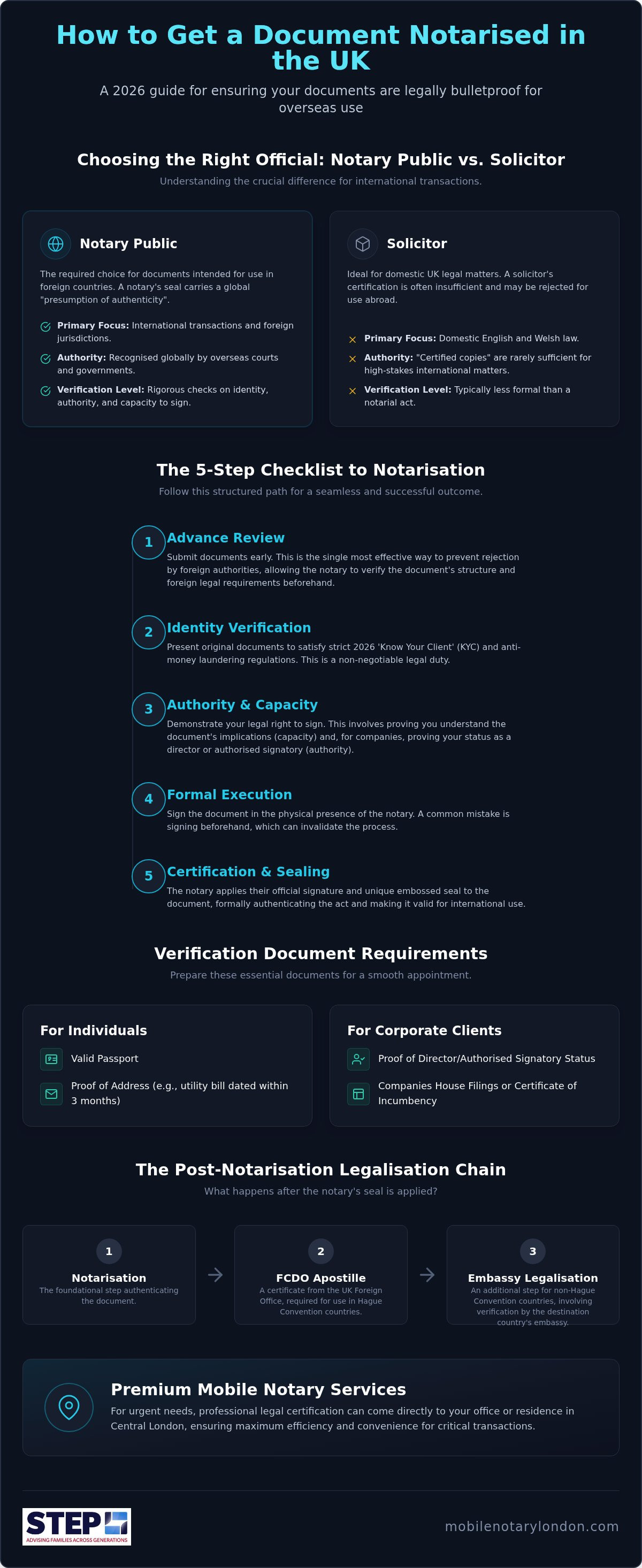
The journey to a legally bulletproof document follows a structured five-step path:
- Advance Review: Submit drafts early so the notary can verify the document's structure and intended use.
- Identity Verification: Present original documents to satisfy 2026 KYC (Know Your Client) and money laundering regulations.
- Authority and Capacity: Demonstrate your legal right to sign, particularly when representing a corporate entity.
- Formal Execution: Sign the document in the presence of the notary, either via traditional wet-ink or a secure digital link.
- Certification: The notary applies their signature and official embossed seal to authenticate the act.
Verifying Your Identity and Authority
Identity verification is a non-negotiable legal duty. You must provide a valid passport and recent proof of address, such as a utility bill or bank statement dated within the last three months. For corporate clients, the rigour increases significantly. You will need to provide Companies House filings, such as a Certificate of Incumbency, to prove your status as a director or authorised signatory. Beyond mere identification, the notary performs a "capacity" check. This ensures you fully comprehend the legal weight of the document and are signing without any external pressure.
Document Preparation and Drafting
A common mistake is signing your document before the appointment. This renders the notarisation impossible, as the notary must personally witness the act of signing to attest to its validity. If your document is in a foreign language, you will likely require a professional translation to ensure both the notary and the signer understand the obligations involved. For multi-page deeds, the notary will ensure the pages are securely bound and initialled to prevent any subsequent tampering. Once the notarial act is complete, you may still need to get your document legalised to satisfy the destination country's specific requirements. For complex international private wealth matters, you can request a professional consultation to ensure every detail is addressed with precision.
As of 2026, the legal landscape has evolved to include remote notarisation using Qualified Electronic Signatures (QES) for specific documents like UK affidavits. However, many foreign jurisdictions still strictly require traditional wet-ink signatures for property deeds and powers of attorney. When determining how to get a document notarised UK requirements must be matched to the specific rules of the receiving country to avoid costly delays.
Notary Public vs. Solicitor: Choosing the Right Official
Choosing between a solicitor and a notary is often the first point of confusion for those researching how to get a document notarised UK wide. While both are qualified legal professionals, their spheres of influence are fundamentally different. A solicitor primarily manages domestic matters under English law, such as litigation, probate, or local conveyancing. Conversely, a Notary Public is a public officer whose primary function is to authenticate documents for use in international jurisdictions. Their seal is recognised globally, bridging the gap between different legal systems.
The distinction extends to regulatory oversight and professional indemnity. Notaries are regulated by the Faculty Office of the Archbishop of Canterbury and must maintain specific insurance that covers the complexities of private international law. This specialised expertise is why notarial services command a premium compared to standard solicitor fees. When you are selling property in Spain, establishing a corporate branch in Dubai, or utilising RPL support services Australia to validate your professional experience, a solicitor's signature simply won't be recognised by foreign land registries, government departments, or skills assessment bodies. The risk of document rejection is too high to rely on anything less than a formal notarial act.
In the world of international law, notaries perform what are known as "Public Acts." These carry a high level of evidentiary weight abroad because the official has verified the facts behind the document. Most solicitor certifications are "Private Acts," which are suitable only for domestic use within the UK. The principle of Lex Loci, or the law of the place where the document is used, dictates the requirements. Crucially, a notary's seal and signature are registered with the Foreign, Commonwealth & Development Office. This registration is a prerequisite for the UK government legalisation process, as the FCDO can only issue an apostille if they can verify the official's credentials against their database.
The Role of the Commissioner for Oaths
A Commissioner for Oaths has a much narrower scope of authority. They are authorised to administer oaths, affirmations, and statutory declarations, but their powers are generally limited to documents intended for use within the UK. They don't perform the rigorous verification of identity, capacity, and understanding that defines a notarial act. If your paperwork is destined for an overseas authority, relying on a Commissioner for Oaths often leads to immediate rejection. For those facing tight deadlines, engaging professional notary and apostille services ensures that every international standard is met, providing a fast and stress-free path to global compliance.
Post-Notarisation: Apostilles and Embassy Legalisation
Securing a notary's seal is rarely the final step in the legalisation journey. For most international transactions, notarisation is merely the first link in a three-part chain. Once the notary has authenticated your document, it must typically be verified by the Foreign, Commonwealth & Development Office (FCDO). This verification, known as an Apostille, is an official certificate that confirms the signature and seal of the notary are genuine. When you are researching how to get a document notarised UK standards require this extra layer to ensure the document is accepted by foreign government bodies without question.
For modern, paperless transactions, the e-Apostille UK offers a streamlined alternative for digital documents. This is particularly useful for corporate resolutions or affidavits that don't require a physical wet-ink signature. However, the choice between digital and paper legalisation depends entirely on the requirements of the receiving authority in the destination country. Understanding how to get a document notarised UK wide is only half the battle; ensuring that document survives the scrutiny of a foreign embassy is the ultimate goal.
The FCDO Apostille Process
The FCDO offers several routes for legalisation. As of September 2026, the standard paper-based apostille fee is £45 per document, whilst the e-Apostille is slightly lower at £35. For those facing urgent deadlines, registered businesses can access a next-day service for £79, or a restricted urgent service for £100. Whilst the standard service can take up to 25 working days, a professional notary often facilitates these submissions through specialised channels to ensure speed and accuracy. This integrated approach removes the administrative burden from the client, providing a seamless transition from notarisation to full legalisation.
Consular and Embassy Requirements
Documents destined for countries that are not members of the Hague Apostille Convention require an additional layer of "super-legalisation." This involves submitting the document to the relevant embassy or consulate in London, such as those for China, Qatar, or the UAE. Navigating embassy requirements is notoriously complex; it often involves specific fee structures, varying processing times, and logistical hurdles that can delay a transaction by weeks. An integrated notary and legalisation service manages this entire sequence on your behalf. To ensure your documents are prepared for any jurisdiction, you can book an urgent legalisation consultation to secure a priority timeline.
Securing Urgent and Mobile Notary Services in Central London
For high-net-worth individuals and corporate executives, time is often the most significant constraint in any international transaction. When considering how to get a document notarised UK regulations and logistics often conflict with the fast-paced demands of the City of London. A mobile notary service bridges this gap by bringing elite legal expertise directly to your location, whether that is a private residence in Belgravia or a boardroom in Mayfair. This "white-glove" approach ensures that critical paperwork is handled with the precision and discretion required for high-stakes legal matters.
Expertise in private wealth is a cornerstone of this premium service. Sheikh Najam’s STEP qualification provides an additional layer of assurance for clients dealing with complex international estates and private wealth structures. Unlike a generalist practitioner, a STEP-qualified lawyer understands the intricate tax and succession implications that often surround the documents being notarised, ensuring your global interests are protected with the highest level of professional rigor. This specialised background is particularly valuable when navigating the 2026 Money Laundering and Terrorist Financing Regulations, which require meticulous compliance during the identity verification process.
The Benefits of a Mobile Notary for Corporate Clients
Corporate transactions often involve multiple signatories and tight deadlines. By utilising a mobile service, firms can minimise downtime and ensure that directors aren't required to leave the office for routine certifications. This is particularly effective when notarising a power of attorney for a company, where the notary can verify board minutes and corporate authority on-site. This model prioritises discretion and privacy, ensuring that sensitive corporate resolutions are executed in a secure, familiar environment. For businesses operating in the City, this on-demand availability is a critical facilitator of global trade.
Same-Day Services for Time-Critical Matters
When a transaction is at risk due to a missing seal, same-day service becomes a necessity rather than a luxury. Booking an urgent mobile appointment in Central London allows for immediate action, often within hours of the initial request. The efficiency is further enhanced by a practitioner who manages the entire legalisation chain, from the initial notarial act to the final apostille. This holistic approach eliminates the risk of courier delays or administrative errors that often occur when multiple agencies are involved. If you require immediate certification for an overseas matter, you should contact Sheikh Najam for urgent assistance to ensure your documents are legally bulletproof without delay.
Securing Your International Legal Standing
Understanding how to get a document notarised UK requires navigating a precise legalisation chain that extends far beyond a simple signature. You've learned that a Notary Public provides the global validity that standard solicitors cannot, bridging the gap between English law and foreign jurisdictions. By ensuring your paperwork is meticulously reviewed and correctly legalised with an FCDO Apostille, you eliminate the risk of rejection by overseas authorities. This procedural rigor is the foundation of every successful international transaction.
For those facing urgent deadlines in the City or Mayfair, expert assistance is essential to maintain momentum. Sheikh Najam is a STEP-qualified Private Wealth Lawyer and a specialist in same-day mobile notarisation, providing elite expertise in complex international legalisation. You don't have to navigate these bureaucratic landscapes alone; professional support ensures a fast, stress-free process tailored to your specific needs. Book a Mobile Notary Appointment in Central London today to ensure your documents are legally bulletproof and ready for global use. Your international transactions deserve the precision of a trusted advisor who understands the gravity of your deadlines.
Frequently Asked Questions
Can I get a document notarised online in the UK?
Yes, online notarisation is a regulated and legally binding procedure for specific documents, such as UK affidavits, as of 2026. This involves using real-time video conferencing and Qualified Electronic Signatures (QES) to meet digital security standards. While this offers a modern alternative, it's vital to check if the receiving country accepts digital signatures. Many foreign registries still strictly require traditional wet-ink signatures for property deeds and powers of attorney.
How much does it typically cost to notarise a document in London?
Industry rates for notarising a single document in the UK typically range between £60 and £250 as of 2026. In Central London, standard fees often begin at approximately £90, though complex corporate resolutions or multi-page deeds may incur higher costs based on an hourly rate. Mobile services, which offer the convenience of boardroom or home visits, generally command a premium starting fee to account for travel and the specialised nature of the on-demand delivery.
What is the difference between a Notary Public and a Commissioner for Oaths?
A Notary Public is a specialist legal officer whose primary function is to authenticate documents for use in foreign jurisdictions, carrying international recognition. In contrast, a Commissioner for Oaths has a more limited scope, typically administering oaths and affirmations for documents intended solely for use within the UK. If your paperwork is destined for an overseas authority, a standard commissioner's signature will likely be rejected. You must ensure the official has the specific international authority required.
How long does the notarisation process take?
The actual notarial appointment usually takes between 15 and 30 minutes, provided all identity checks and documents are prepared in advance. For those wondering how to get a document notarised UK professionals often provide same-day mobile appointments across Central London to meet urgent business deadlines. However, the total timeline increases if your document requires an FCDO Apostille or embassy legalisation, which can range from twenty-four hours to several weeks depending on the service level chosen.
Do I need to provide a translation for my document?
If your document is written in a foreign language, a professional translation is usually mandatory. The Notary Public must be satisfied that you fully comprehend the legal obligations you are undertaking before they can authenticate the signature. Providing a certified translation ensures the notary can verify the document's content and intent accurately. This step is crucial for preventing future legal challenges and ensuring the document is legally bulletproof for its intended use overseas.
Can a solicitor notarise a document for use abroad?
No, a standard solicitor cannot notarise a document for international use unless they are also a qualified Notary Public. While many solicitors are authorised to certify copies for domestic purposes, they lack the specific public office and registered seal required by foreign government bodies and the FCDO. When considering how to get a document notarised UK wide, you must engage a practitioner whose signature is registered with the Foreign, Commonwealth & Development Office to ensure successful legalisation.
What happens if I sign the document before meeting the notary?
You should never sign your document before your appointment. A notary's primary duty is to personally witness the act of signing to attest to its authenticity and the signer's identity. If a document arrives already signed, the notary will typically require you to sign it again in their presence or acknowledge the signature formally, which can complicate the certification. To ensure a stress-free process, wait until the notary is physically or digitally present before applying your signature.
What is an Apostille and do I always need one?
An Apostille is an official certificate issued by the Foreign, Commonwealth & Development Office that authenticates the signature and seal of the notary. You typically require one if the destination country is a member of the Hague Apostille Convention. While some private entities abroad might accept a notarised document on its own, most foreign government departments, registries, and courts mandate this additional layer of legalisation to verify the notary's credentials against the official UK registry.

Article by
Sheikh Najam
Sheikh Najam LLB, TEP, MCIArb is a Notary Public and Commissioner for Oaths based in Central London, offering notary services to corporate, commercial and private clients across the City of London and beyond. His work includes notarising board and shareholder resolutions, powers of attorney, and certified copies of constitutional documents for use with foreign registries, banks and courts, with apostille and legalisation arranged as part of the same instruction. Alongside his notarial practice, he is a STEP-qualified international private wealth lawyer advising on cross-border transactions, company formation, trust drafting and succession planning. He is regulated by the Faculty Office (Court of Faculties) of the Archbishop of Canterbury and is a member of The Notaries' Society of England and Wales, STEP, and The Association of European Attorneys.


