

A single missing stamp on a commercial invoice can stall a multi-million pound shipment at a foreign border for weeks, turning a routine export into a logistical nightmare. You've likely experienced the mounting pressure of a shipping deadline whilst facing the opaque, multi-stage bureaucracy of the Foreign, Commonwealth & Development Office and various London embassies. We understand that for Central London businesses, time isn't just money; it's reputation. Navigating the legalisation of commercial invoices London requires more than just a signature; it demands a precise understanding of 2026 procedural rigor and international standards.
This guide provides a definitive roadmap to master the notarisation and legalisation process without leaving your office. We'll demystify the current FCDO apostille fees, explain the nuances of embassy attestation for jurisdictions like Qatar and the UAE, and show you how to avoid the common pitfalls that lead to document rejection. By the end of this article, you'll know exactly how to secure premium mobile notary support to ensure your export documents are valid, verified, and ready for the global market with calm efficiency.
Key Takeaways
- Understand why specific jurisdictions require the legalisation of commercial invoices London to verify corporate authority before goods can clear customs.
- Learn the critical distinction between a standard solicitor’s certification and a full Notarial act to ensure your documentation meets rigorous international standards.
- Master the two-step verification sequence involving the FCDO Apostille and subsequent Embassy Attestation to prevent costly shipping delays.
- Discover how to utilise premium mobile notary services across Mayfair and the City to complete urgent notarisation without leaving your boardroom.
- Access the latest 2026 procedural updates for the FCDO "Next Day" premium service and current embassy requirements for accurate export planning.
Understanding Legalisation of Commercial Invoices in London
Legalisation serves as the bridge between UK corporate records and foreign regulatory acceptance. It's the formal process of authenticating a document's origin so it can be recognised by a foreign government or customs authority. For businesses operating in the capital, the legalisation of commercial invoices London is a prerequisite for international commerce, particularly when dealing with non-EU markets. This procedure confirms to overseas officials that the signatures and seals on your export paperwork are genuine. Without this verification, your goods may be held at a port of entry, leading to mounting storage fees and breached contracts.
The Foreign, Commonwealth & Development Office (FCDO) acts as the primary UK authority in this chain. They verify the signature of the notary or solicitor who first certified the invoice. This isn't just about red tape; it's a critical financial safeguard. Most international trade with the Middle East relies on Letters of Credit. Banks often refuse to release payments unless they receive a fully legalised commercial invoice that meets the strict standards of the destination country's central bank. Precision at this stage ensures that your capital remains fluid and your shipments stay on schedule.
Why Export Documents Require Legalisation
Foreign customs officials use legalised invoices to calculate import duties and verify the country of origin. If a document lacks the necessary stamps, it's essentially a private piece of paper with no legal standing in a foreign court or customs house. Ensuring your paperwork is beyond reproach is the core of the Urgent Apostille London process. It transforms a standard corporate record into a globally recognised instrument of trade. This level of validation prevents the administrative friction that often derails time-sensitive shipments in competitive global markets.
Common Jurisdictions Requiring Attestation
The level of legalisation required depends entirely on the destination. Many countries are signatories to the Apostille Convention, which simplifies the process to a single FCDO stamp. However, major trading partners such as the UAE, Qatar, Kuwait, and Saudi Arabia are not members. For firms managing the legalisation of commercial invoices London, understanding this distinction is vital. These jurisdictions require "consular legalisation," meaning after the FCDO has issued an apostille, the document must be physically presented to the relevant embassy in London for final attestation. South American and South East Asian markets also frequently demand this multi-layered approach to verify the value of high-stakes cargo.
The Role of a Notary Public in Export Documentation
A notary public is the cornerstone of international trade documentation. Whilst a commercial invoice is a private corporate document, it must be transformed into a public instrument to be recognised by foreign customs authorities. This transformation is achieved through a formal Notarial Act. For businesses managing the legalisation of commercial invoices London, the notary provides an essential layer of verification that simple corporate signatures lack. They don't just witness a signature; they certify the authenticity of the document and the legal capacity of the person signing it. This ensures that the invoice carries the necessary weight when it reaches a foreign jurisdiction.
Notarisation vs. Solicitor Certification
It's a common misconception that any solicitor can certify export documents. Whilst a solicitor can verify a "true copy" for domestic use, most Middle Eastern embassies, including those for Qatar and the UAE, specifically require the seal of a Notary Public. A Notary is an internationally recognised legal officer whose signature is on file with the FCDO. This distinction is critical for compliance with the London Notary: Corporate Document Certification Guide 2026. Using a solicitor when a Notary is required will lead to immediate rejection at the embassy stage, causing significant delays to your shipping schedule and potential breach of contract with your overseas buyers.
Verifying Signatory Authority for Companies
A Notary’s duty extends beyond verifying an individual's identity. They must ensure the signatory has the specific authority to bind the company to the transaction. This involves a meticulous check of Companies House records to confirm directorships or reviewing formal Board Resolutions. For complex corporate structures, the Notary may also examine a Power of Attorney. This procedural rigor is what gives the document its validity abroad. If you're managing tight deadlines, arranging a mobile notary in Central London can streamline these checks by allowing the practitioner to verify original records on-site at your office, ensuring the legalisation of commercial invoices London is handled with precision.
The physical manifestation of notarisation is equally important. A Notary typically uses a secure embossing seal, often accompanied by silk ribbons and a formal Notarial Certificate. This robust presentation is designed to prevent tampering and is a prerequisite for the UK government legalisation service. Once the Notary has applied their seal, the document is ready for the FCDO to apply the apostille, confirming the Notary's own standing. This multi-layered approach ensures that your paperwork is beyond reproach before it leaves the country.
Navigating FCDO Apostille and Embassy Legalisation
The legalisation of commercial invoices London follows a rigid, two-step sequence that begins once the Notary Public has applied their seal. For exporters targeting markets in the Middle East, an apostille alone is rarely sufficient. The process requires a combined effort involving the Foreign, Commonwealth & Development Office (FCDO) and the consular section of the destination country's embassy. In many instances, the London Chamber of Commerce also acts as a preliminary verifier, particularly for Certificates of Origin that frequently travel alongside the commercial invoice. Managing these moving parts requires a methodical approach to prevent administrative bottlenecks.
The FCDO Apostille Process
The FCDO is the sole UK authority authorised to issue an apostille, which confirms the signature and seal of the notary. In 2026, the standard postal application for the public takes approximately 15 to 20 working days. This timeline is often incompatible with the fast-paced nature of international trade. Registered service providers can access a "Next Day" premium service at a rate of £40 per document, ensuring your paperwork moves through the system with speed. Whilst a digital e-Apostille exists at a lower cost of £35 with a 2-day turnaround, it's vital to note that most Middle Eastern embassies still require a physical, paper-based apostille. This makes the Fast Track Apostille Service London the preferred choice for physical goods exportation.
Embassy Attestation for the Middle East
Once the FCDO has issued the apostille, the document must be presented to the relevant embassy in London for "consular legalisation" or attestation. Each mission, from the UAE Embassy to the Qatar Embassy, maintains its own specific workflow and fee structure. Embassy legalisation fees are set by the individual nations and vary significantly, typically ranging from £30 to over £150 per document. This stage adds an additional 5 to 15 working days to the process. According to The Notaries Society, the role of the notary in this chain is to ensure the document is perfectly prepared for these high-stakes submissions. A single error in the initial certification can lead to a rejection at the embassy gate, potentially costing your business weeks of delays and thousands of pounds in port storage fees.
Success in this arena depends on understanding these specific 2026 timelines and requirements. Navigating the legalisation of commercial invoices London is not merely about following a checklist; it's about anticipating the needs of foreign officials who demand absolute procedural rigor. By ensuring your documents are handled by a seasoned professional, you eliminate the risk of rejection and ensure your export operations remain seamless and efficient.
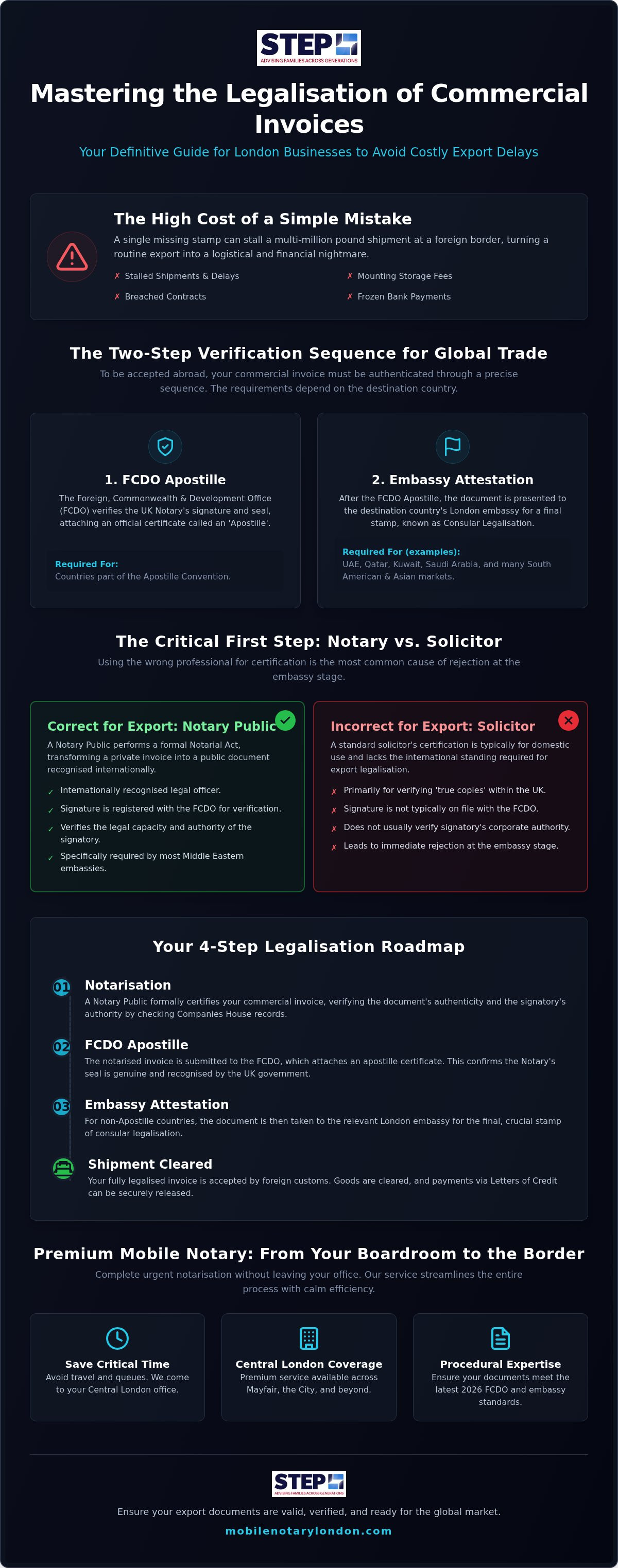
Step-by-Step Guide to Legalising Your Invoice
Execution is where many export strategies falter. Whilst the theoretical process of legalisation seems straightforward, the physical preparation of the document determines whether it passes through the FCDO and various embassies without friction. The legalisation of commercial invoices London begins in your own office. You must ensure the original invoice is printed on high-quality company letterhead, featuring your registered office address and VAT number exactly as they appear on official records. Any discrepancy between your invoice header and your Companies House filing is a primary cause for rejection at the embassy stage.
Document Preparation Checklist
Precision in the invoice content is non-negotiable. Foreign customs authorities, particularly in the Middle East, require a clear breakdown of goods, including unit values, total amounts, and a definitive statement of origin. You should ensure that the signatory is a registered director or a senior officer with documented authority. If a third party or a junior staff member is signing on behalf of the firm, you'll need to prepare a Power of Attorney Notarisation London to bridge the gap in signatory authority. This additional step verifies that the individual has the legal right to bind the company to the transaction, providing the necessary security for the Notary Public to proceed.
Once your paperwork is ready, the most efficient way to maintain momentum is to arrange a mobile notary appointment at your London office. During the session, you'll need to have original identification for the signatory and the company’s constitutional documents available for inspection. The Notary will then apply their seal and certificate, effectively "locking" the document for the next stages of the legalisation chain.
Managing the Legalisation Timeline
Timing your submission is a strategic exercise. You must calculate the total lead time by combining the notarisation session, the FCDO apostille window, and the specific embassy’s processing duration. For an urgent export to Qatar or the UAE, you should account for approximately 10 to 15 working days if using standard channels. If your shipment is already at the port, you'll need to utilise premium "Next Day" services to compress this timeline. Tracking your document through these departments is essential; always ensure you have the FCDO submission reference and embassy receipt numbers to monitor progress. This proactive management ensures that the legalisation of commercial invoices London doesn't become the bottleneck in your supply chain.
Successful exporters don't leave these steps to chance. They treat document legalisation with the same procedural rigor as the manufacturing of the goods themselves. By following this structured approach, you ensure that your commercial invoices are treated as valid legal instruments the moment they arrive at their destination.
Premium Mobile Notary Services for London Exporters
Efficiency in international trade is often dictated by the speed of your local administrative support. For firms based in the heart of the capital, the legalisation of commercial invoices London doesn't have to involve the logistical burden of transporting sensitive documents across the city. By utilising a premium mobile service, you bring the legal authority directly to your boardroom. This on-site approach ensures that your original commercial data never leaves your possession until it is ready for the FCDO, maintaining the highest levels of confidentiality and procedural integrity. Integrating your export workflow with Mobile Notary Central London services allows for a seamless transition from document signing to international legalisation.
Corporate Support in Mayfair and the City
Financial institutions and trading houses in Mayfair and the City operate on razor-thin margins and even tighter deadlines. When an urgent export requirement arises, the traditional model of visiting a static notary office is often an unacceptable drain on executive time. Sheikh Najam provides same-day mobile appointments specifically tailored to these high-stakes environments. As a STEP-qualified practitioner with a background in international private wealth, he offers a level of professional rigour that extends beyond simple certification. Whether you're based in the Westminster corridors of power or the commercial hubs of Marylebone, our mobile service prioritises your schedule, ensuring that your commercial invoices are notarised with calm efficiency.
A Holistic Solution for International Trade
Exporting goods to complex jurisdictions like Qatar or the UAE rarely involves a single piece of paper. A successful shipment typically requires a suite of documents, including Certificates of Origin, Packing Lists, and potentially Powers of Attorney. Dealing with these individually can lead to fragmented timelines and an increased risk of error. Our mobile service offers a holistic solution, allowing you to have multiple documents verified in a single visit. This consolidated approach doesn't just save time; it ensures that your entire document set is consistent and ready for the two-step legalisation process. You benefit from expert advice on international corporate requirements whilst remaining focused on your core business operations.
For businesses seeking to eliminate delays and secure their global trade routes, the choice of facilitator is paramount. You can contact Sheikh Najam for urgent commercial invoice legalisation in London to ensure your next shipment meets every regulatory standard without the need to leave your office.
Secure Your Global Trade Routes
Mastering the 2026 legalisation landscape requires absolute precision from the initial corporate signature to the final embassy stamp. By prioritising the meticulous verification of signatory authority and utilising "Next Day" FCDO services, London exporters can effectively eliminate the risk of customs rejections and payment delays. The legalisation of commercial invoices London is no longer a bureaucratic hurdle when managed by a seasoned practitioner who understands the nuances of international trade protocols. Your documentation should be a facilitator of trade, not a bottleneck.
As a STEP-qualified Private Wealth Lawyer and specialist in corporate notary services, Sheikh Najam provides the procedural rigour required for high-stakes exports. You don't need to navigate the complexities of embassy attestation alone or waste valuable time travelling to notary offices. Book a Mobile Notary Appointment in Central London to access a premium, same-day mobile service that brings elite legal expertise directly to your boardroom. Your export success depends on documentation that is beyond reproach; we ensure your paperwork meets the highest global standards with calm efficiency.
Frequently Asked Questions
Do I need a notary or a solicitor for commercial invoice legalisation?
You generally require a Notary Public for this process. Most Middle Eastern embassies, including those for the UAE and Qatar, specifically demand a Notarial Act rather than a basic solicitor's certification. A Notary's seal is globally recognised and on file with the FCDO, which is a mandatory prerequisite for the subsequent legalisation stages. This distinction ensures your document isn't rejected by foreign officials who require a higher level of international authentication.
How long does the legalisation of a commercial invoice take in London?
The total timeline depends on the service level you select. A standard postal application through the FCDO currently takes approximately 15 to 20 working days. However, by utilising a registered service provider for the premium "Next Day" apostille followed by embassy attestation, the process typically takes between 7 and 12 working days. You should always account for specific embassy processing times, which can add up to 15 days during busy periods.
Can I legalise a copy of my commercial invoice or must it be the original?
You must almost always legalise the original commercial invoice. Foreign customs authorities and embassies require the original wet-ink signature of your company's authorised signatory to be notarised directly. Whilst some jurisdictions might occasionally accept a notarised "true copy," the vast majority of Middle Eastern trading partners insist on original documents to prevent fraud. Always verify the specific requirements of your destination port before beginning the notarisation process to avoid costly re-submissions.
Why does the UAE Embassy require my invoice to be notarised first?
The UAE Embassy requires notarisation to verify the authenticity of a private corporate document. Because a commercial invoice isn't a government-issued paper, it lacks an inherent official seal. A Notary Public provides this by certifying the signatory's identity and legal authority. This certification allows the FCDO to issue an apostille, which the UAE Embassy then recognises as valid proof that the invoice is a legitimate legal instrument from a verified UK business.
What are the FCDO apostille fees for commercial documents in 2026?
In 2026, the FCDO charges £45 per document for a standard paper-based apostille submitted by the public. For those using registered next-day service providers, the FCDO rate is £40. Digital e-Apostilles are available for £35, although these are rarely accepted for physical export documentation in the Middle East. It's important to remember that these government fees are separate from the costs of professional notarisation and the specific attestation charges set by individual embassies.
Is a mobile notary service more expensive than visiting an office?
A mobile notary service involves a travel fee, typically around £250 + VAT in London, in addition to the standard notarisation costs. Whilst the upfront cost is higher, the value lies in the significant time savings for your senior executives. For businesses managing the legalisation of commercial invoices London, the ability to have documents certified in a Mayfair or City boardroom prevents the logistical delays and risks associated with transporting original, sensitive commercial data.
What information must be present on the invoice for successful legalisation?
The invoice must be on company letterhead and include a clear description of goods, unit values, and total amounts. It must also state the country of origin and include your registered office address. Discrepancies between the invoice details and Companies House records are a frequent cause of rejection. For the legalisation of commercial invoices London, ensuring the signatory's name and position are clearly printed alongside their signature is vital for the notary’s verification process.
Do you provide legalisation services for the Qatar Embassy in London?
Yes, we specialise in the comprehensive legalisation chain for the Qatar Embassy. This includes the initial notarisation of the commercial invoice, obtaining the FCDO apostille, and managing the final consular attestation. We understand the specific fee structures and procedural requirements unique to the Qatari mission. Our mobile service ensures that your export paperwork is handled with the precision and speed necessary to meet urgent shipping deadlines for the Doha market and beyond.

Article by
Sheikh Najam
Sheikh Najam LLB, TEP, MCIArb is a Notary Public and Commissioner for Oaths based in Central London, offering notary services to corporate, commercial and private clients across the City of London and beyond. His work includes notarising board and shareholder resolutions, powers of attorney, and certified copies of constitutional documents for use with foreign registries, banks and courts, with apostille and legalisation arranged as part of the same instruction. Alongside his notarial practice, he is a STEP-qualified international private wealth lawyer advising on cross-border transactions, company formation, trust drafting and succession planning. He is regulated by the Faculty Office (Court of Faculties) of the Archbishop of Canterbury and is a member of The Notaries' Society of England and Wales, STEP, and The Association of European Attorneys.


