

Did you know that a standard UK Apostille is virtually worthless for a property transaction or visa application in Dubai without two further layers of verification? Because the UAE isn't a member of the Hague Convention, your paperwork requires a rigorous, three-tier legalisation protocol that often catches even seasoned professionals off guard. Finding a qualified notary for UAE documents London is the first critical step in avoiding the confusion between standard certification and full Embassy attestation. You're likely facing a tight deadline and cannot afford the risk of a document being rejected at the UAE Embassy after waiting days for processing.
This 2026 guide masters the complexities of the current legalisation landscape to ensure your paperwork is accepted the first time. We will explore the precise steps required for both personal and corporate papers, whilst detailing how a premium mobile service brings this expertise directly to your desk in Mayfair or the City. You'll gain a clear understanding of the total timeline, the new digital attestation process, and the procedural rigour necessary to secure your international interests with calm efficiency and total peace of mind.
Key Takeaways
- Understand why a standard Apostille is insufficient for the UAE and how to navigate the mandatory three-step legalisation chain correctly.
- Learn the critical distinctions between personal and commercial document requirements, including the UAE Embassy’s strict rules on separate certifications.
- Discover how a specialist notary for UAE documents London can streamline your application through premium mobile appointments in Mayfair or the City.
- Avoid common rejection pitfalls, such as improper document bundling or the use of a solicitor when a Notary Public is strictly required.
- Gain insights into the 2026 digital attestation protocols and VFS submission requirements to ensure your paperwork remains valid and compliant.
Understanding UAE Document Legalisation: Why an Apostille is Not Enough
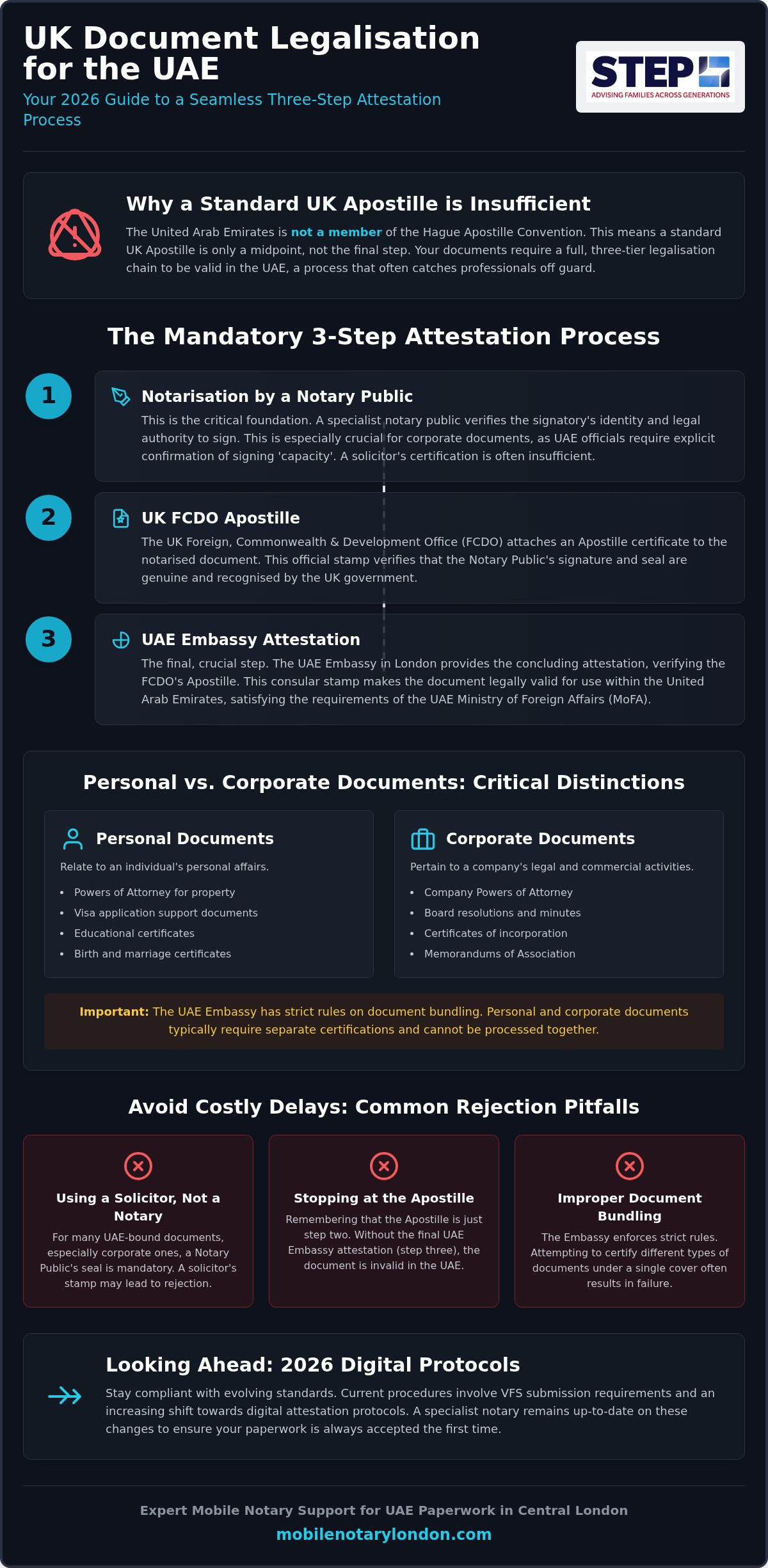
Document legalisation for the United Arab Emirates follows a rigorous protocol that differs significantly from European or North American standards. UAE Attestation is essentially a multi-layered verification chain designed to confirm a document's authenticity at every level of government. Because the UAE is not a signatory to the Apostille Convention, a standard UK apostille is merely a midpoint rather than the conclusion of the process. Securing a qualified notary for UAE documents London is the essential first step in this chain, providing the foundational verification upon which all subsequent government stamps rely.
The process functions as a series of administrative handshakes. The chain of authority moves through three distinct stages:
- The Notary Public: Verifies the identity of the signatory and their legal authority to sign the document.
- The FCDO: Attaches an Apostille to verify that the Notary's seal and signature are genuine.
- The UAE Embassy: Provides the final attestation, verifying the FCDO's signature for use in the Emirates.
A common pitfall for many professionals is assuming a solicitor's certification is sufficient. Whilst solicitors can certify documents for domestic UK use, the UAE Embassy frequently mandates the involvement of a Notary Public, particularly for corporate instruments and property matters. A Notary's seal carries a level of international recognition and "public faith" that a standard solicitor's stamp does not, often making it the only acceptable form of certification for UAE officials.
The Role of the Notary Public in UAE Transactions
UAE officials scrutinise the "capacity" of the signatory with high precision. They require absolute certainty that the individual signing a Power of Attorney or a board resolution actually possesses the legal right to bind a company or dispose of an asset. A specialist notary ensures this capacity is explicitly stated and verified against official registers. This is the difference between a simple certified copy and a notarised original; the latter involves a deep dive into the signatory's authority, which is essential for high-stakes international transactions.
Apostille vs. Attestation: Key Differences
It's vital to understand what is an apostille UK in the context of global standards. An Apostille is a certificate of authenticity recognised by countries within the Hague treaty. However, for the UAE, this is merely a prerequisite. The transition from UK jurisdiction to UAE legal validity only occurs after the "consular" step at the London Embassy. This final layer of scrutiny ensures the document meets the specific regulatory requirements of the UAE Ministry of Foreign Affairs (MoFA).
The Three-Step Attestation Process for UK Documents
The journey of a document from a London boardroom to a UAE government office is a meticulously choreographed sequence. It's a chain of trust where each authority verifies the previous one, ensuring that your paperwork carries the necessary legal weight upon arrival. This process is mandatory because the UAE requires a higher level of scrutiny than countries within the Hague treaty. Failing to follow these steps in the precise order often results in immediate rejection and costly delays for your visa or commercial contract.
Step 1: Notarisation and Verification
The entire legalisation chain rests on the quality of the initial notarisation. A specialist notary for UAE documents London performs rigorous identity checks, ensuring that signatories possess the legal capacity to execute the document. This is particularly vital for corporate instruments like Powers of Attorney. The notary doesn't simply sign the page; they draft a bespoke Notarial Certificate that adheres to the specific structural preferences of the UAE authorities. This professional foundation ensures the document is fit for purpose for the broader apostille and embassy legalisation London workflow.
Step 2 & 3: The Legalisation Chain
Once the notary has sealed the document, it must be presented to the UK document legalisation office (FCDO). The FCDO attaches an Apostille, which serves as the British government's confirmation that the notary's seal and signature are genuine. Without this, the UAE Embassy cannot proceed.
The third step involves submitting the document to the UAE Embassy in London. Currently, this submission is handled through VFS Legalisation Centres. As of 2026, the Embassy has fully integrated a digital attestation process, where a verifiable electronic copy is often issued alongside the physical stamp. Standard processing through VFS typically takes 7–10 working days. However, if you're navigating a tight deadline for a property transaction or a new executive appointment, utilising urgent apostille London services can significantly compress the UK side of the timeline.
It's important to remember that the process only concludes once the document reaches the Emirates. A final, fourth step, which is the attestation by the UAE Ministry of Foreign Affairs (MoFA), is required in-country before the document is legally recognised by local banks or government entities. To ensure your paperwork is prepared with the precision these authorities demand, consider engaging a premium mobile notary who can facilitate the initial verification at your convenience.
Personal vs. Corporate Documents: Navigating UAE Embassy Requirements
The UAE Embassy in London applies a strict binary classification to all paperwork. Whether you are relocating for a high-profile executive role or expanding a business venture into the Gulf, understanding this distinction is vital for accurate budgeting and procedural success. A specialised notary for UAE documents London will categorise your files immediately, ensuring you don't pay commercial rates for personal matters or, conversely, face rejection for mislabelling corporate instruments. The cost disparity is significant, as commercial attestation requires a much higher level of administrative verification and carries substantially larger embassy fees.
Common Personal Documents for the UAE
Personal documents typically relate to an individual’s legal status, family ties, or professional qualifications. These are the foundational requirements for residency visas and family sponsorship. When preparing these, a notary for UAE documents London must often verify the source of the document before certification can proceed. Common examples include:
- Educational certificates, including degrees, diplomas, and professional transcripts.
- Marriage, birth, and death certificates required for residency and inheritance.
- Personal Powers of Attorney for the sale of property or management of private assets.
It is essential to consult the UAE Embassy in London's attestation requirements early in your timeline. For educational degrees, the embassy often mandates a verification letter from the issuing university, a step that must be completed before the notary can finalise the certification.
Corporate and Commercial Document Requirements
Corporate requirements are notably more complex and demand a higher degree of transparency to prevent international fraud. When preparing company documents London based firms must navigate the "separate certification" rule with absolute precision. The UAE Embassy typically refuses to accept "bundled" documents where various corporate instruments are grouped under a single notarial certificate. Instead, each of the following usually requires standalone notarisation and apostille:
- Certificates of Incorporation and Articles of Association.
- Board Resolutions and Corporate Powers of Attorney for company representatives.
- Commercial Invoices, Certificates of Origin, and Agency Agreements.
For all commercial attestations, the notary must conduct a thorough search of Companies House records. This step confirms the company is in good standing and that the directors or authorised signatories possess the requisite capacity to bind the firm. Businesses should also note that the UAE Embassy treats the Memorandum and Articles of Association as distinct documents for fee purposes. This procedural rigour serves as a safeguard, ensuring that UK corporate entities are recognised as legitimate and legally compliant when operating within the Emirates' regulatory framework.
Avoiding Delays: Common Reasons for UAE Document Rejection
The legalisation process for the Emirates is unforgiving of administrative oversight. Even a minor technical discrepancy can lead to a document being returned at the final stage, forcing you to restart the entire three-step chain. One of the most frequent causes for failure is the attempt to use a solicitor's certification where the UAE Embassy specifically mandates a Notary Public. Whilst solicitors can witness certain UK-based transactions, their authority is often unrecognised by the UAE Consular section for high-stakes international matters. Engaging a specialist notary for UAE documents London ensures your paperwork meets the international standard of "public faith" required for Gulf-bound legal instruments.
Incorrectly bundled documents represent another significant hurdle. Many applicants attempt to save on fees by grouping several corporate documents under a single Notarial Certificate. However, the UAE Embassy typically rejects this practice, requiring each distinct instrument, such as a Certificate of Incorporation and a separate Board Resolution, to carry its own certification and Apostille. Similarly, photocopies must be meticulously certified as "True Copies" of the original. If the Notary fails to explicitly state they have inspected the original document, the FCDO or the Embassy will likely decline the application at the point of submission.
Technical Errors in Notarisation
The Foreign, Commonwealth & Development Office (FCDO) maintains a database of authorised signatures and seals. If a notary’s signature has changed or their seal has become illegible through wear, the document will be rejected immediately. The FCDO also requires specific mandatory wording in the notarial act; without these precise phrases, the Apostille cannot be issued. For complex private wealth matters, working with a STEP-qualified professional is essential, particularly for power of attorney notarisation London where the capacity of the donor must be verified with clinical precision.
Administrative Pitfalls in the Legalisation Chain
A common administrative error is attempting to bypass the FCDO step. You cannot present a document directly to the UAE Embassy without the UK government’s Apostille first verifying the Notary's authority. Additionally, corporate documents must be supported by evidence of authority, such as current Companies House filings. If you fail to clearly identify the "country of use" as the United Arab Emirates on the application, the entire chain of verification may be invalidated. To avoid these expensive setbacks and ensure your paperwork is processed with calm efficiency, you should secure a premium mobile notary appointment to review and certify your documents on-site.
Expert Mobile Notary Support for UAE Paperwork in Central London
Time is the most valuable asset for London’s professional elite. When navigating the complexities of Gulf-bound legalisation, the traditional model of visiting a physical office is often incompatible with a high-stakes schedule. Securing a specialist notary for UAE documents London who can attend your location ensures that critical transactions move forward without the friction of travel or administrative delays. This "white-glove" approach is designed specifically for those who require precision and discretion at their convenience, ensuring that legal compliance never comes at the cost of operational momentum.
Convenience for High-Net-Worth Individuals and Corporates
A mobile notary Central London provides a seamless bridge between your desk and the UAE Embassy. Whether you are situated in a boardroom in the City, a private office in Mayfair, or a residence in Westminster, on-site verification eliminates the logistical burden of transporting sensitive original documents across the capital. This service is particularly vital for urgent corporate requirements where board resolutions or powers of attorney must be executed and notarised on the same day to meet international banking or property deadlines. By bringing the notary’s seal directly to you, the practice ensures that the first, most critical step of the legalisation chain is completed with clinical accuracy while you remain focused on your core business.
Why Choose Sheikh Najam for Your UAE Documents?
Choosing the right practitioner is about more than just a stamp; it is about securing the advice of a seasoned expert who understands the nuances of cross-border law. As a STEP-qualified Private Wealth Lawyer, Sheikh Najam brings a level of technical depth that standard notary services often lack. This background is essential when drafting or certifying documents for the UAE, where the scrutiny of signatory capacity and corporate authority is exceptionally high. The practice doesn't just witness a signature; it provides a holistic, solution-oriented service that manages the entire attestation chain with professional authority.
Meticulous attention to detail is the hallmark of this premium service. By overseeing every stage from the initial notarial act to the final embassy delivery, the practice ensures that your paperwork adheres to the latest 2026 digital attestation protocols. For professionals who require a trusted advisor to navigate complex bureaucratic landscapes with speed and dignity, this bespoke support provides the ultimate peace of mind. Engaging a specialised notary for UAE documents London ensures that your international interests are protected by a facilitator who is as agile and responsive as the global markets you operate in.
Securing Your International Interests with Precision
Navigating the 2026 legalisation landscape for the Emirates requires more than just administrative effort; it demands a deep understanding of procedural rigour and international standards. Success hinges on ensuring your documents follow the mandatory three-tier chain without technical errors or improper bundling. By engaging a specialised notary for UAE documents London, you eliminate the risks of embassy rejection and costly delays that often plague standard applications. Whether you are managing complex corporate resolutions or personal residency visas, the quality of the initial notarisation determines the validity of the entire process.
Sheikh Najam provides a premium, "white-glove" mobile service across Central London. As a STEP-qualified Private Wealth Lawyer, he brings technical depth to every appointment. This specialist approach to urgent UAE legalisation ensures your paperwork is handled with clinical precision. It's the most efficient way to manage cross-border requirements whilst remaining focused on your priorities. Don't leave your international transactions to chance. Book a Mobile Notary Appointment for Your UAE Documents today and move forward with total confidence in your global ventures.
Frequently Asked Questions
Does the UAE Embassy in London accept e-Apostilles for UK documents?
The UAE Embassy generally requires a physical "wet ink" Apostille for the final attestation step in 2026. Whilst the UK offers digital options for Hague Convention countries, the non-Hague status of the Emirates means paper-based verification remains the mandatory standard. Your notary for UAE documents London must provide a physical certificate to ensure the Embassy can apply its own physical stamp, as electronic versions are currently unrecognised for this specific consular chain.
How much does it cost to attest a degree certificate for the UAE in 2026?
Official UAE Embassy fees for personal documents, such as degree certificates, are approximately £70 per document. Commercial documents carry a significantly higher fee of around £490. These figures represent the Embassy's charges and do not include mandatory VFS administration processing fees, FCDO Apostille costs, or professional fees for notarisation. It is essential to factor in each stage of the three-step process when budgeting for your relocation or business expansion.
Can a solicitor attest my documents for use in Dubai or Abu Dhabi?
A solicitor's certification is often insufficient for documents bound for the UAE. The Embassy specifically mandates the seal of a Notary Public for most international instruments, especially corporate powers of attorney and property deeds. A Notary holds a unique level of international recognition that a standard solicitor does not. Using a specialised notary for UAE documents London ensures your paperwork meets the rigorous standards of "public faith" required by Gulf authorities.
How long does the full UAE attestation process take in London?
The entire legalisation chain typically takes between 10 and 15 working days to complete. This timeline accounts for the initial notarisation, FCDO Apostille processing, and the final Embassy attestation via VFS Global. Standard VFS processing alone is estimated at 7 to 10 working days, though this can fluctuate during periods like Ramadan or Eid. For urgent business matters, securing a same-day mobile notary appointment is the most effective way to compress the start of this timeline.
Do I need to have my documents translated into Arabic before attestation?
Arabic translation is not usually required for the attestation steps performed within the United Kingdom. The London Embassy verifies the UK authority's signature on the English document. However, you will almost certainly require a legal translation once the document arrives in the Emirates for the final Ministry of Foreign Affairs (MoFA) stamp. It is generally recommended to have this translation performed by a UAE-licensed translator after the London-based legalisation chain is fully finished.
What happens if the UAE Embassy rejects my notarised document?
If the UAE Embassy rejects a document, you must typically restart the entire process from the beginning. Rejections often stem from technical errors, such as improper document bundling or using a solicitor instead of a Notary Public. Because the Embassy stamp is the final verification, a rejection there invalidates the previous FCDO and Notarial work. This underscores the necessity of professional oversight at the start of the chain to avoid expensive and frustrating administrative failures.
Can you attest documents issued in British Overseas Territories like the BVI?
Documents issued in British Overseas Territories, including the BVI or Cayman Islands, can be attested in London, but they follow a specific legalisation route. These instruments must usually be verified by the government of the territory of issue or through the FCDO’s specialized Overseas Territories department before the UAE Embassy will accept them. This adds a layer of complexity to the chain, requiring precise coordination to ensure the paperwork is acceptable for Gulf-bound transactions.
Do I need to visit the UAE Embassy in person for my documents?
You are not required to visit the UAE Embassy in person. All document submissions for attestation are currently managed through VFS Global Legalisation Centres in London. This intermediary system handles the logistics of submission and collection on your behalf. By engaging a premium mobile notary service, you can have your documents verified at your office or residence, with the entire administrative chain managed professionally to ensure successful delivery without you ever needing to visit a physical centre.
Article by
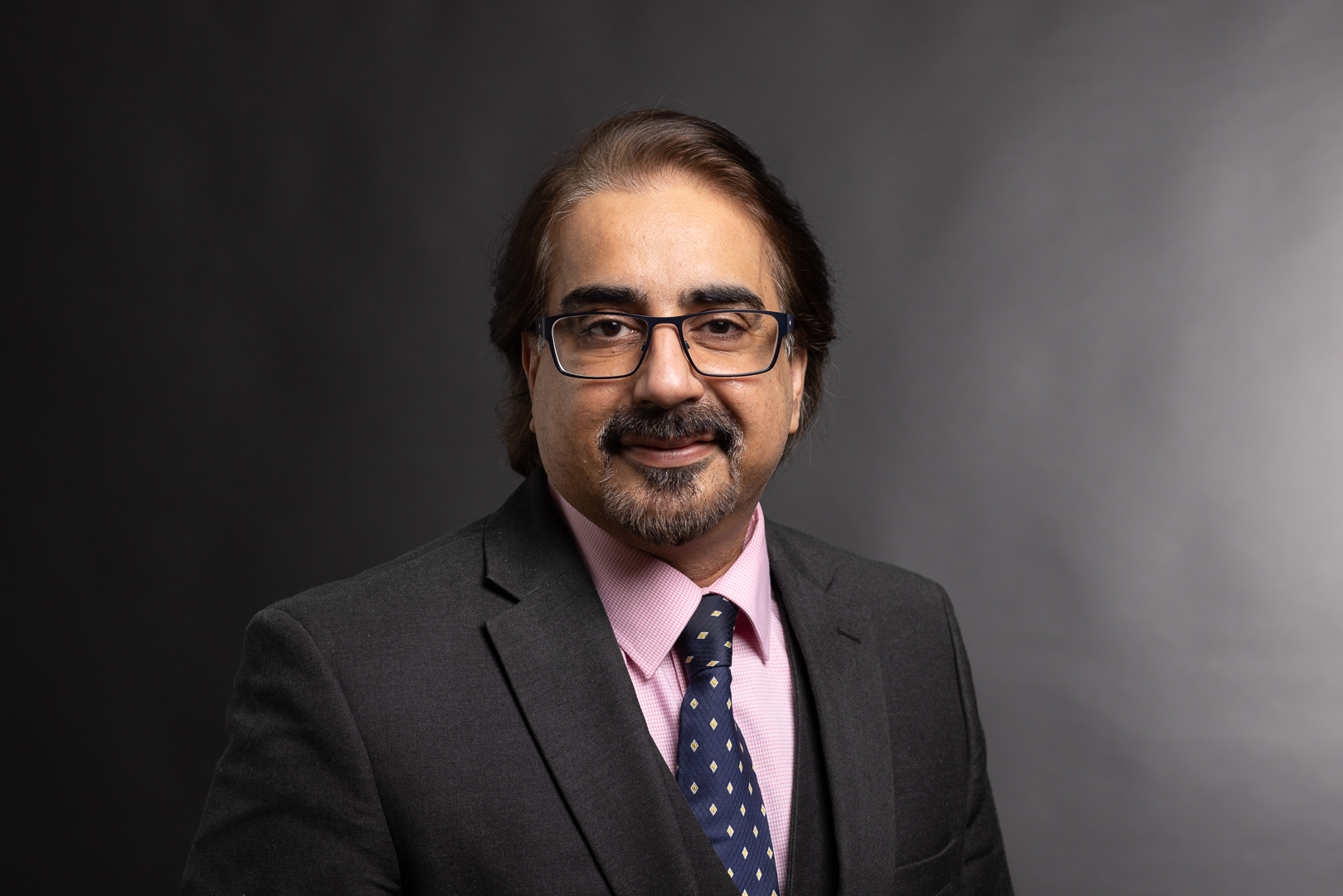
Sheikh Najam
Sheikh Najam LLB, TEP, MCIArb is a Notary Public and Commissioner for Oaths based in Central London, offering notary services to corporate, commercial and private clients across the City of London and beyond. His work includes notarising board and shareholder resolutions, powers of attorney, and certified copies of constitutional documents for use with foreign registries, banks and courts, with apostille and legalisation arranged as part of the same instruction. Alongside his notarial practice, he is a STEP-qualified international private wealth lawyer advising on cross-border transactions, company formation, trust drafting and succession planning. He is regulated by the Faculty Office (Court of Faculties) of the Archbishop of Canterbury and is a member of The Notaries' Society of England and Wales, STEP, and The Association of European Attorneys.


