

Imagine standing at a foreign consulate on the final day of a multi-million-pound property deal, only to have your power of attorney rejected because of a missing stamp you didn't know you needed. For many professionals, managing apostille and embassy legalisation London feels like a high-stakes race against an invisible clock. The distinction between a standard FCDO apostille and the multi-layered requirements of non-Hague countries is often the difference between a successful international transaction and a costly administrative failure.
It's understandable that you feel anxious about the shifting landscape of international document validity, especially when your reputation or assets are on the line. This guide promises to demystify the process, providing you with a clear, step-by-step roadmap to ensure your documents are accepted without hesitation across the globe. We'll explore the critical differences between Hague Convention protocols and embassy attestation, whilst detailing how expert mobile verification can save you hours of administrative hurdles. By the end of this article, you'll have the professional insight required to handle the bureaucratic labyrinth of Central London with absolute confidence and precision.
Key Takeaways
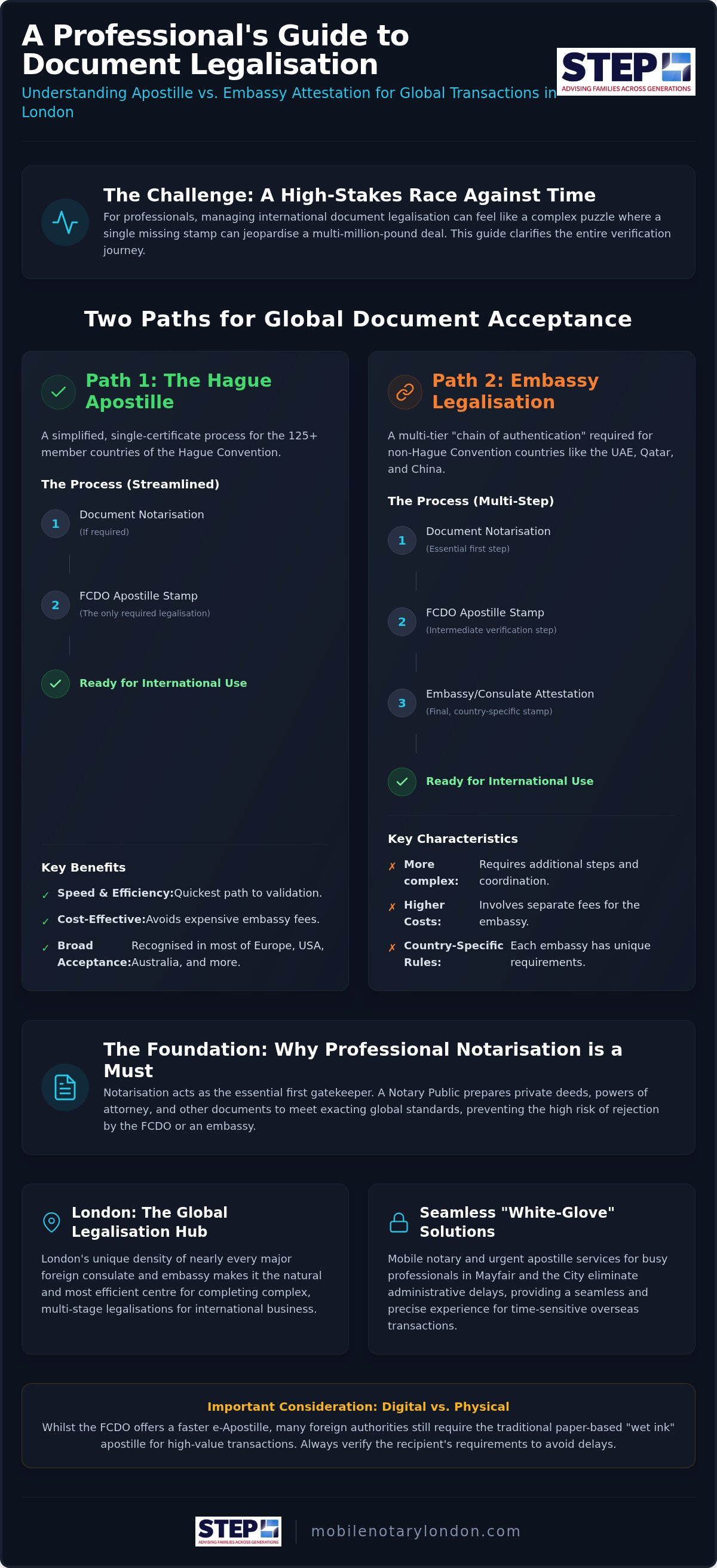
- Understand the fundamental distinction between the simplified Hague Apostille process and the multi-tier "chain of authentication" required for non-member states like the UAE or China.
- Master the specific steps required for apostille and embassy legalisation London, ensuring your corporate or property documents meet exact global standards before submission.
- Learn why professional notarisation serves as the essential first gatekeeper, preventing the risk of document rejection at the FCDO or embassy level.
- Discover how a mobile notary service provides a seamless, "white-glove" solution for busy professionals in Mayfair and the City, eliminating administrative delays.
- Gain the expertise to navigate varying international requirements with precision, securing successful document acceptance for urgent overseas transactions.
Understanding the Basics: Apostille and Embassy Legalisation in London
London is the gateway for global mobility. For those requiring apostille and embassy legalisation London, the city's unique density of diplomatic missions makes it an unparalleled resource. An apostille is a formal certificate issued by the Foreign, Commonwealth & Development Office (FCDO). It verifies the authenticity of a UK public official's signature or seal on a document. This is a standard requirement for over 120 countries. However, embassy legalisation is a more rigorous process. It's required by nations not part of the Hague Apostille Convention, such as the UAE, Qatar, or China. Because London hosts nearly every major foreign consulate, it's the natural hub for these administrative tasks. A Notary Public is essential here; they prepare your private deeds and powers of attorney to meet these exacting global standards.
Apostille vs Legalisation: What is the Difference?
Legalisation is the umbrella term for the entire verification journey. Whilst many people use these terms interchangeably, they aren't identical. An apostille is often just the first step in a two-part process. For private wealth clients dealing with international inheritance or offshore property, you might find that a document needs an FCDO stamp followed by a specific consular seal. This is common when setting up foreign branches or executing high-value property purchases in jurisdictions that demand the highest levels of document security.
Why Document Origin Matters for Londoners
The UK Legalisation Office has a strict rule of jurisdiction. They only legalise documents issued in the United Kingdom. This presents a challenge if you're an international professional in London with foreign-issued certificates. In these cases, a Notary Public can often notarise a signature on a fresh declaration or a certified copy, making the document eligible for apostille and embassy legalisation London. It's vital to check the receiving country's specific rules first. Rejection is common if the sequence of stamps is incorrect, which is why expert verification is the safest path for your time-sensitive legal papers.
The Hague Apostille Convention: Simplifying Global Compliance
The 1961 Hague Convention fundamentally transformed apostille and embassy legalisation London by simplifying how we validate documents across borders. Before its inception, every document required a tedious "chain of authentication" involving multiple government departments and foreign embassies. Today, for over 125 contracting parties, this burden is replaced by a single certificate. By obtaining an apostille from the FCDO, you ensure your UK documents are legally recognised in member states including most of Europe, the USA, Australia, and much of South America. Canada’s accession on 11 January 2024 further expanded this network, simplifying matters for those with transatlantic interests. According to The Notaries Society, the notary's verification remains the vital precursor for many documents entering this system.
Innovation continues with the FCDO’s e-Apostille service. This digital alternative offers a streamlined path for modern corporate requirements, particularly for documents that are already digitally signed. However, caution is necessary. Whilst the digital version is faster, many foreign registries and local authorities still insist on a traditional paper-based "wet ink" apostille. This physical stamp remains the gold standard for high-value property transactions or when the recipient authority lacks the infrastructure to verify digital signatures. If you are managing a tight deadline, an Urgent Apostille London service ensures your documents move through the FCDO without unnecessary delay.
Benefits of the Hague Convention Process
- Speed and efficiency: Documents are typically ready for international use immediately after the FCDO applies the apostille.
- Cost-effectiveness: It removes the necessity for secondary embassy fees, which can often be substantial, and avoids complex courier loops between consulates.
- Broad acceptance: With over 120 member countries as of 2026, the process is globally recognised and standardised.
Common Documents Requiring a Hague Apostille
The scope of apostille and embassy legalisation London services often covers three primary categories. Personal papers, such as birth, marriage, or death certificates issued by the General Register Office, are frequently processed for those moving abroad. Academic qualifications, including degrees and transcripts, require notarisation before the FCDO will issue an apostille. Finally, corporate filings like Certificates of Incorporation or Good Standing from Companies House are essential for businesses expanding into Hague member jurisdictions. Each document type has specific preparation rules that must be followed to avoid rejection at the final stage.
Embassy Legalisation: Navigating Non-Hague Jurisdictions
If your destination country isn't a member of the Hague Convention, the process of apostille and embassy legalisation London becomes significantly more complex. Nations such as the UAE, Qatar, Kuwait, and Thailand require a rigorous "Chain of Authentication". This involves three distinct tiers: first, notarisation by a Notary Public; second, an apostille from the UK Government Legalisation Office; and finally, attestation by the relevant consular section. This multi-layered security check ensures that your UK documents are recognised as valid by foreign government departments that don't subscribe to the simplified apostille system.
London’s geography provides a distinct advantage for this intricate process. Most foreign embassies are concentrated in elite enclaves like Mayfair, Kensington, and Belgravia. This proximity allows for a faster logistical turnaround, yet the requirements themselves are notoriously volatile. Consulates frequently update their fee structures or submission protocols without notice. A document layout accepted yesterday might be rejected today. This volatility makes professional oversight a necessity rather than a luxury for high-stakes transactions.
Spotlight on Middle Eastern Requirements (UAE and Qatar)
In the Middle East, the term "Attestation" is often preferred over "Legalisation". For those relocating to Dubai or Doha, educational documents face extra scrutiny. The UAE Embassy, for example, often requires degree certificates to be verified by the British Council before they will grant their final stamp. Fee structures at these consulates are tiered; commercial documents often attract significantly higher costs than personal papers. Understanding these nuances prevents unexpected delays in your relocation or corporate expansion, ensuring your paperwork is compliant from the outset.
Managing Documents for China and South East Asia
The landscape for China has shifted following its accession to the Hague Convention in late 2023. Whilst this has simplified many processes, legacy requirements still exist for certain document types or specific regional authorities. For other South East Asian nations like Thailand, strict translation rules apply. Documents must often be translated into the local language by an approved translator before the embassy stage. Consulates in this region are particularly meticulous regarding document layout. Even a minor misalignment of a notary's seal or an incorrect margin can result in a summary rejection, restarting your timeline and increasing costs.
Step-by-Step: How to Legalise Your Documents in London
Success in international affairs depends on a logical sequence of verification. For apostille and embassy legalisation London, the process begins with identifying the nature of your document. You must first determine if you hold an original "Public Document" or if your paperwork requires notarisation. Original certificates issued by the General Register Office or Companies House can often proceed directly to the FCDO. Conversely, private deeds, such as a power of attorney or a corporate contract, require a Notary Public to witness signatures or certify copies. This creates the essential legal link between the document and its intended purpose. Once notarised, the document is submitted to the FCDO for the apostille certificate. If your destination is a non-Hague state, you must then present the apostilled document to the relevant London embassy. Finally, arrange for a secure, tracked courier to deliver the completed papers to their final destination abroad.
The Crucial Role of Notarisation
Securing a mobile notary Central London is the most efficient starting point for busy professionals in Mayfair or the City. This service ensures that a qualified practitioner witnesses your signature or certifies your corporate copies on-site, eliminating the need for you to travel. Crucially, an experienced notary’s signature is already on file with the FCDO, which prevents the delays caused by signature verification queries. The notarial act is the foundation of international trust. By establishing this foundation correctly, you eliminate the risk of your documents being rejected at the embassy stage.
Fast-Track vs Standard Processing
Time is often your most valuable asset during a property transaction or corporate merger. Whilst the standard FCDO service for the public can take 15-20 working days, opting for an urgent apostille London service provides a significant advantage. Registered business providers can access next-day processing for critical needs, ensuring your timeline remains intact. You must also account for embassy turnaround times, which are notoriously variable. Some consulates offer 24-hour attestation, whilst others require up to two weeks. Managing these expectations early in your project timeline is essential for a seamless outcome.
For expert assistance with your international paperwork, book a Premium Notary Central London service today.
Why Professional Assistance in London is Essential
Rejection is a significant hurdle in international law. A single oversight during the notarisation phase can derail an entire application at the FCDO or embassy level, forcing you to restart a process that is often time-sensitive. Entrusting your apostille and embassy legalisation London to a professional isn't merely about outsourcing a task; it's about securing the validity of your global transaction. For high-net-worth individuals and corporate entities, the stakes often involve multi-million-pound property acquisitions or sensitive international inheritances. Integrating international private wealth legal advice into the administrative process ensures that your documents aren't just stamped, but legally robust. Having a STEP-qualified practitioner who understands the underlying "why" behind your document provides a level of security that a purely transactional service cannot match.
Managing Complex Corporate and Property Deeds
Instructing a specialised notary for company documents London is vital when setting up foreign subsidiaries or managing offshore assets. Each jurisdiction has nuanced civil law standards that must be reflected in the drafting of Powers of Attorney. A professional facilitator acts as a proactive gatekeeper, identifying potential discrepancies in document layout or certification before they reach the FCDO. This "white-glove" approach is particularly beneficial for busy professionals in Mayfair and the City, where a mobile notary can visit your office to finalise papers between meetings, maintaining your momentum whilst ensuring total compliance.
Secure Handling of Sensitive Personal Papers
Handling original birth, marriage, or academic certificates requires a methodical approach to security. Professional facilitators understand that these papers are often irreplaceable. By utilising insured couriers like DHL or Royal Mail Special Delivery, the risk of loss during international transit is significantly mitigated. The unique advantage of being based in Central London is the ability to hand-deliver documents directly to embassies in Belgravia or Kensington. This eliminates the uncertainty of postal delays and ensures that sensitive personal data remains within a secure chain of custody until the final attestation is secured. When you manage apostille and embassy legalisation London through an expert, you aren't just buying a stamp; you're buying the peace of mind that your most important papers are in the safest possible hands.
Securing Your Global Interests with Precision
Navigating the intricacies of international document validity requires a meticulous approach to compliance. Whether you're managing a corporate expansion into the Middle East or a private property acquisition in Europe, understanding the specific tier of verification needed is the first step toward success. By correctly identifying the requirements for apostille and embassy legalisation London, you eliminate the administrative friction that often stalls urgent transactions. This methodical preparation ensures that your documents are accepted by foreign authorities without hesitation or costly delays.
As a STEP-qualified Private Wealth Lawyer and expert in urgent Central London apostille requests, Sheikh Najam provides a specialised mobile service designed for the discerning corporate or private client. This "white-glove" facilitator approach ensures your sensitive papers are handled with the highest degree of procedural rigour and transparency. You can save valuable time and gain absolute peace of mind by choosing a practitioner who understands the gravity of your legal needs. Book a Mobile Notary Appointment for Your Legalisation Needs today to ensure your paperwork meets the most exacting global standards. Your international ambitions deserve a seamless path to completion.
Frequently Asked Questions
Do I always need an apostille for my UK documents to be used abroad?
Not always, but it's the global standard for cross-border recognition. The necessity depends entirely on the destination country and the specific requirements of the receiving authority. Whilst some jurisdictions may accept documents without a stamp for informal purposes, high-stakes transactions such as property purchases or corporate mergers almost universally require this verification. It's essential to confirm with your overseas lawyer whether they demand an apostille to ensure your documents are legally binding.
How long does embassy legalisation usually take in London?
Turnaround times for embassy legalisation in London vary significantly depending on the consulate's internal protocols. Whilst some consulates offer a 24-hour service, others may require up to 14 working days to process documents. For instance, Middle Eastern embassies in Belgravia often have specific submission windows and varied processing speeds. You should always factor in both the FCDO processing time and the specific embassy’s schedule when managing tight deadlines for international deals.
Can a solicitor provide the same service as a notary for an apostille?
Whilst solicitors can certify certain documents, they cannot provide the same level of international recognition as a Notary Public. Most foreign jurisdictions and the FCDO specifically require a notary’s seal for private deeds, powers of attorney, and corporate papers. Notaries are internationally recognised public officers whose signatures are held on file by the Legalisation Office. Using a notary ensures your documents meet the rigorous standards required for successful apostille and embassy legalisation London.
What happens if the country I am sending documents to is not part of the Hague Convention?
If the destination country is not a Hague Convention member, you must undergo a multi-stage process known as attestation. This requires your document to be notarised, then apostilled by the FCDO, and finally legalised by the destination's embassy in London. Countries like the UAE, Qatar, and Thailand follow this "chain of authentication". This path is more complex and requires meticulous attention to detail to avoid rejection at the final consular stage.
Can I get an apostille for a document that was not issued in the UK?
The UK Legalisation Office only issues apostilles for documents issued by UK public authorities or those notarised within the United Kingdom. If your document originated abroad, it must usually be legalised in that specific country. However, a London notary can sometimes notarise a fresh declaration or a certified copy of the foreign document. This act creates a new UK document, which can then proceed through the standard apostille and embassy legalisation London channels.
How much does it cost to get a document legalised at an embassy?
Consular fees are determined by the specific embassy and vary based on the document's nature, with commercial papers often attracting higher costs. For example, UAE commercial legalisation can cost several hundred pounds, whilst personal documents like birth certificates are significantly cheaper. These fees are separate from notary or FCDO charges. Because consulates often update their pricing without notice, it's vital to verify the current rates before submitting your documents for final attestation.
What is the difference between an apostille and a certified copy?
A certified copy confirms that a document is a true likeness of the original, whereas an apostille verifies the authenticity of the official signature. You might have a solicitor certify a degree certificate, but that doesn't prove the certificate's origin to a foreign government. The apostille provides that final layer of international trust by confirming the signatory’s authority. Most overseas authorities require both the certification and the apostille to accept the document as valid.
Do I need to attend the embassy in person for legalisation?
You rarely need to attend an embassy in person as most consulates allow submission via professional agents or secure couriers. This is particularly beneficial given that many embassies in Kensington and Mayfair have restricted opening hours for public submissions. Utilising a professional service ensures your documents are hand-delivered and collected correctly. This reduces the logistical burden on you and ensures that sensitive papers are managed within a secure, professional chain of custody throughout.

Article by
Sheikh Najam
Sheikh Najam LLB, TEP, MCIArb is a Notary Public and Commissioner for Oaths based in Central London, offering notary services to corporate, commercial and private clients across the City of London and beyond. His work includes notarising board and shareholder resolutions, powers of attorney, and certified copies of constitutional documents for use with foreign registries, banks and courts, with apostille and legalisation arranged as part of the same instruction. Alongside his notarial practice, he is a STEP-qualified international private wealth lawyer advising on cross-border transactions, company formation, trust drafting and succession planning. He is regulated by the Faculty Office (Court of Faculties) of the Archbishop of Canterbury and is a member of The Notaries' Society of England and Wales, STEP, and The Association of European Attorneys.


