

A single missing stamp can be the difference between securing a dream international property and watching the deal collapse under a mountain of bureaucratic rejection. If you've been told your paperwork requires legalisation for use abroad, it's natural to feel overwhelmed by the conflicting advice surrounding notarisation and global protocols. You're likely asking, what is an apostille UK residents need to obtain for foreign authorities, and why does the process feel so opaque?
We understand that when you're facing tight deadlines for business or private wealth matters, the last thing you need is a lesson in administrative history. You need clarity. This guide will help you master the complexities of UK document legalisation, ensuring your paperwork is legally recognised across international borders with absolute certainty. We'll clarify the vital distinction between a notary's certificate and the Foreign Office's seal, explain the 2026 processing timelines for paper and e-Apostilles, and show you how to navigate the system with professional precision. By the end of this guide, you'll know exactly which documents require a notary first and how to secure a fast-track solution in Central London to meet your international obligations.
Key Takeaways
- Understand exactly what is an apostille UK authorities issue and how it serves as a universal certificate of authenticity for your documents abroad.
- Learn why private documents, such as powers of attorney or corporate contracts, require professional notarisation before the FCDO will grant legalisation.
- Discover how the Hague Apostille Convention streamlines document recognition across over 120 member countries, removing the need for complex embassy chains.
- Identify which documents qualify for the e-Apostille service to reduce your processing wait times from weeks to just a few days.
- Find out how a premium mobile notary service in Central London provides the agile support needed for time-sensitive international property or business transactions.
Defining the Apostille in the UK Legal Landscape
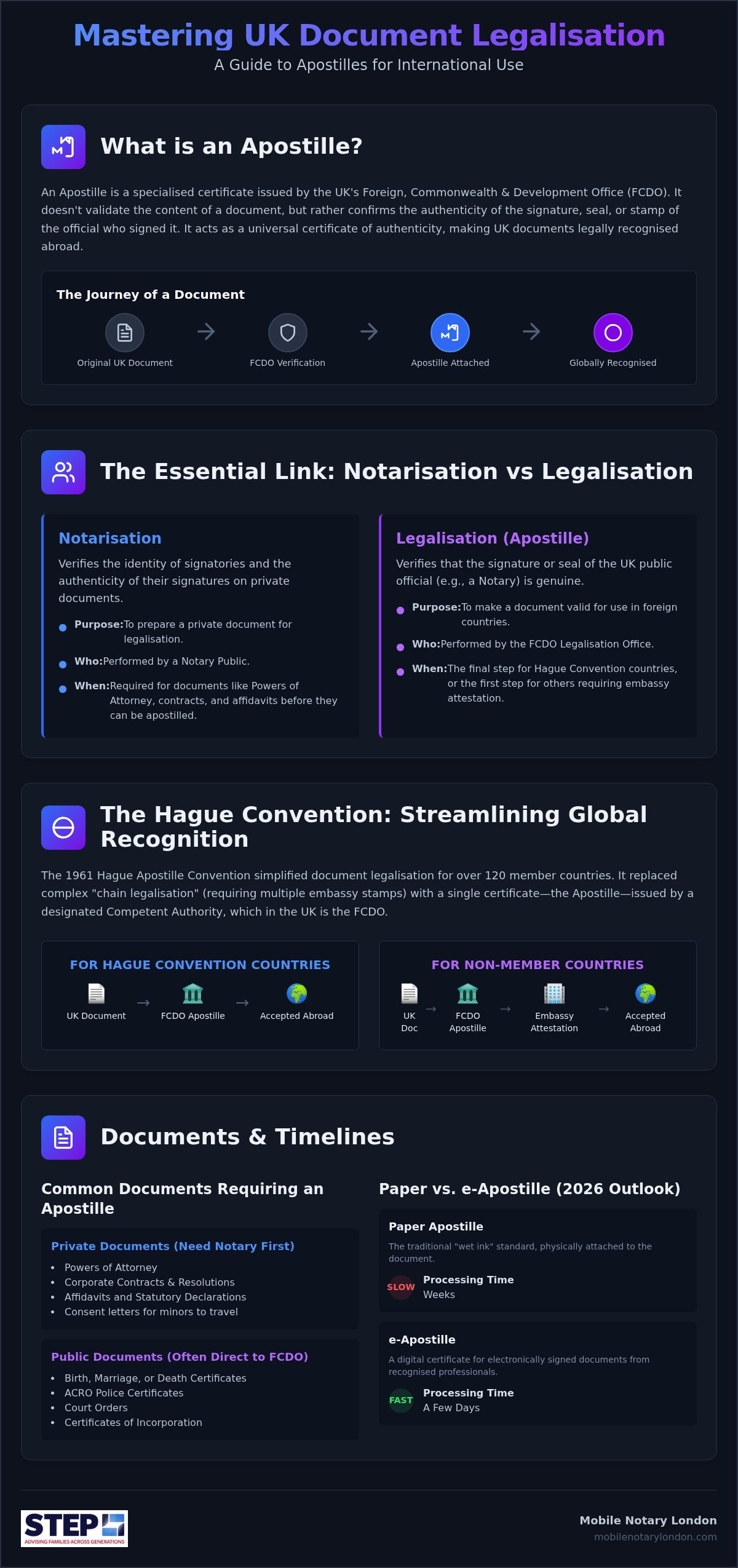
An apostille is a specialised certificate issued by the Foreign, Commonwealth & Development Office (FCDO) that confirms the authenticity of a UK document. It's not a commentary on the document's content; instead, it validates the signature, seal, or stamp of the official who signed it. If you've been asked to provide paperwork for a foreign authority, understanding what is an apostille UK citizens require is the first step in ensuring your international affairs proceed without delay. Effectively, an apostille acts as the bridge of trust between different legal systems.
Without this certificate, a standard signature from a UK solicitor or a government official holds little weight in a foreign jurisdiction. Legalisation transforms a domestic document into a globally recognised instrument. This process is governed by the Apostille Convention, which replaced the previous, more arduous requirement of individual embassy certifications with a single, standardised stamp. Knowing what is an apostille UK authorities provide is essential for any cross-border transaction, as it ensures your paperwork meets the necessary international standards.
Why is an Apostille Necessary?
Foreign authorities cannot easily verify the credentials of UK officials without a standardised system. A notary in London or a registrar in Manchester isn't necessarily known to a land registry in Spain or a bank in Switzerland. The apostille removes this uncertainty. It's a vital safeguard that prevents document fraud in high-stakes scenarios, such as:
- International property acquisitions where title deeds must be verified.
- Cross-border marriages requiring proof of single status.
- Corporate transactions where certificates of incorporation must be authenticated.
Most countries that are members of the Hague Convention will insist on this seal before accepting any UK-issued paperwork. It provides a layer of security that protects all parties involved in the transaction.
Apostille vs. Embassy Legalisation: What is the Difference?
The distinction between an apostille and embassy legalisation is primarily a matter of geography and treaty membership. Apostilles are used exclusively for countries that have signed the Hague Convention. However, for non-member states, such as the UAE or Qatar, the process becomes significantly more complex. In these instances, the apostille is often merely the first step in a multi-stage legalisation journey.
Once the FCDO has issued the apostille, the document must then be presented to the specific embassy or consulate of the destination country for further attestation. This added layer of bureaucracy demands meticulous attention to detail, as each embassy has its own specific requirements and fee structures. For busy professionals in Mayfair or the City, navigating these varying protocols can be a significant administrative burden that requires expert handling.
The Hague Convention and the Role of the FCDO
The 1961 Hague Apostille Convention was a landmark shift in international administrative law, designed to dismantle the cumbersome "chain" of legalisation that previously required multiple embassy stamps. In the United Kingdom, the Foreign, Commonwealth & Development Office (FCDO) operates as the sole "Competent Authority" designated to issue these certificates. When people ask what is an apostille UK authorities provide, they're essentially enquiring about a government-backed guarantee that a specific official's signature is genuine. This streamlined process ensures that a document stamped in Milton Keynes is just as valid in Madrid or Mexico City as it is in London.
Central to this process is a sophisticated database maintained by the UK government's Legalisation Office. This registry contains the specimen signatures and seals of thousands of authorised individuals, including notaries public, solicitors, and registrars from the General Register Office. As we move through 2026, the FCDO has further modernised this system by expanding the e-Apostille service. Whilst traditional paper certificates remain the gold standard for many jurisdictions, the digital alternative now offers a faster, more agile solution for documents that have been electronically signed by a recognised professional.
How the FCDO Verifies Your Documents
The verification process is methodical and precise. When a document arrives at the Legalisation Office, an examiner cross-references the signature or seal against the official specimen stored in their database. For many private documents, the FCDO requires a "wet ink" signature from a registered notary or solicitor. If the signature on your paperwork doesn't perfectly match the version on file, or if the official isn't yet registered with the FCDO, a "verification delay" occurs. This administrative hurdle can add days or even weeks to your timeline, which is why ensuring your paperwork is handled by an experienced notary public in Central London is a vital first step for any urgent matter.
Standard vs. Next-Day Service: A 2026 Overview
Choosing the right processing tier is critical for meeting international deadlines. In 2026, the standard postal service remains the most cost-effective option, though it often involves a wait of up to 25 working days. For corporate and private wealth clients in Westminster or the City, such a delay is rarely acceptable. Business-to-business services and registered service providers can often access expedited tiers, such as the "Next-Day" or "Restricted Urgent" services, which carry a higher government fee but provide the rapid turnaround necessary for high-stakes property deals or corporate mergers. Navigating these tiers directly can be logistically challenging for individuals, making professional facilitation a preferred choice for those with time-sensitive requirements.
Which UK Documents Require an Apostille?
The range of documents that may require legalisation is vast, but they generally fall into two distinct categories: public and private. Public documents are those issued by a government official, a court, or a registrar, whereas private documents are drafted by individuals, solicitors, or corporate entities. Identifying which category your paperwork belongs to is the first step in determining what is an apostille UK residents must obtain to satisfy a foreign authority's requirements. This distinction is critical because it dictates whether you can send your document directly to the FCDO or if you must first visit a notary.
Personal and Family Documents
For individuals moving abroad, claiming dual citizenship, or marrying overseas, the most common requirements involve documents issued by the General Register Office (GRO). These include birth, marriage, and death certificates, alongside decree absolutes for divorce proceedings. Because these are "public" documents bearing an official government signature, they can often be apostilled without prior certification. Academic qualifications, such as degree certificates and transcripts from UK universities, also frequently require legalisation for international employment. Whilst these are issued by educational institutions, they are treated as private documents and almost always require a notary's certification before the FCDO will accept them. ACRO police certificates, essential for residency visas, are another frequent requirement that can usually be apostilled directly.
Corporate and Commercial Paperwork
Businesses expanding into foreign markets or opening international bank accounts frequently encounter the need for legalised paperwork. Certificates of Incorporation and Articles of Association issued by Companies House are standard requirements for establishing a foreign branch. However, internal documents like board minutes, resolutions, or a Certificate of Good Standing require a more hands-on approach. These corporate instruments must be certified by a notary to verify the authority of the directors signing them. For a comprehensive look at how to handle these requirements, consult our London Notary: Corporate Document Certification Guide 2026. Ensuring these documents are correctly prepared prevents costly delays in high-stakes commercial transactions.
Property and Private Wealth Documents
International property transactions, such as purchasing a villa in Spain or managing an estate in Italy, almost always necessitate a Power of Attorney (PoA). Unlike public records, these are private legal instruments that must be signed in the presence of a qualified professional. These documents require a Notary Public's seal first because the FCDO cannot verify the identity or capacity of the private individual signing the document without a notary’s intervention. The Hague Conference on Private International Law (HCCH) provides the framework that allows these notarised and apostilled documents to be accepted across its member states. Wills, probate documents, and affidavits follow this same path, ensuring they carry the necessary weight of law when presented in a foreign jurisdiction.
The Essential Link: Notarisation vs. Legalisation
Confusion often arises when individuals assume that the FCDO validates the contents of a private contract or affidavit. In reality, the Legalisation Office doesn't verify the truth of the statements within your document. They only verify the identity and standing of the official who signed it. For any private instrument, a Notary Public acts as the primary verifier of identity and legal capacity. This creates a necessary double layer of security; the notary ensures the document is executed correctly, and the apostille provides the international validity required for foreign acceptance. Understanding what is an apostille UK authorities require means recognising that the certificate is only as strong as the official signature it validates.
Whilst a solicitor's signature may occasionally suffice for certain domestic matters, many high-stakes foreign jurisdictions will only accept the seal of a Notary Public. Notaries are internationally recognised legal officers whose primary duty is to the transaction itself, rather than a specific client. This impartial status is why foreign banks and land registries often reject documents certified by a standard solicitor. If you're dealing with jurisdictions in Europe, South America, or the Middle East, the "standard" solicitor's stamp is frequently seen as insufficient for legalisation. Ensuring you have the correct level of certification from the start prevents the frustration of a rejected application.
The Role of the Notary Public in the Apostille Process
A Notary Public's involvement is about far more than just witnessing a signature. They must verify the identity of the signatory using high-standard "Know Your Client" (KYC) protocols to prevent fraud and impersonation. They also ensure the document is executed correctly according to both UK law and the specific requirements of the destination country. This is particularly critical for a power of attorney notarisation London professionals often require for overseas property or business deals. By confirming your capacity to sign, the notary gives the FCDO the confidence to apply the final seal. For those facing urgent deadlines, engaging a Mobile Notary Public in Central London can bridge the gap between notarisation and legalisation with seamless efficiency.
Common Pitfalls: When an Apostille is Rejected
Even with an official stamp, the FCDO can and will reject documents that don't meet strict criteria. One of the most frequent causes for rejection is the use of photocopies when the destination country specifically requires an original. Similarly, if a document hasn't been properly certified by a recognised official, the Legalisation Office will return it without the apostille. As mentioned previously, the FCDO maintains a database of specimen signatures. If your notary or solicitor hasn't updated their records or if their signature has changed slightly over time, a verification delay is inevitable. To avoid these setbacks, it's vital to ensure your paperwork is handled by a practitioner who is fully registered and active within the FCDO's current systems.
Navigating Urgent Legalisation in Central London
For professionals operating within the square mile or the luxury enclaves of Mayfair and Westminster, time is the most valuable currency. When an international deal hinges on a single certified document, the standard postal route offered by the Legalisation Office is often inadequate. Understanding what is an apostille UK residents need is only half the battle; the other half is procurement. In the high-stakes environments of the City and Westminster, a delay of several weeks can jeopardise corporate mergers or private wealth transfers. This is where a tailored approach to document legalisation becomes essential.
Same-day turnaround is frequently a non-negotiable requirement for urgent apostille London requests. Rather than navigating the bureaucratic maze of the FCDO independently, busy clients require a "white-glove" service that handles every stage of the process. This involves more than just obtaining a stamp; it's about a seamless chain of custody from the moment a document is signed to the point it's hand-delivered with the final apostille attached. This level of service ensures that international obligations are met with calm efficiency, regardless of the complexity of the underlying paperwork.
The Benefits of a Mobile Notary for Legalisation
Mobile notary services eliminate the logistical burden of travel and the frustration of administrative delays. Appointments can be arranged at your office, home, or a Central London hotel, providing immediate identity verification and document execution in a familiar environment. This agile response allows for the instantaneous preparation of legal instruments, which can then be transitioned directly to the Legalisation Office. By combining notarisation and apostille procurement into a single, managed workflow, the risk of rejection is significantly reduced, and the path to international recognition is cleared in hours rather than weeks.
Choosing a Premium Facilitator for International Wealth
Navigating international wealth and complex corporate structures requires more than a simple administrative stamp. It demands the insight of a practitioner who understands the underlying legal instruments and the specific requirements of foreign jurisdictions. A STEP-qualified lawyer brings a deep understanding of cross-border private wealth matters, ensuring that even the most intricate trust documents, high-value property transactions, or corporate resolutions are handled with absolute procedural rigour. This expertise is vital for maintaining the integrity of international estates and business interests. For expert, on-site legalisation support, contact Sheikh Najam – Mobile Notary Central London to ensure your international paperwork is managed with the precision it deserves.
Securing Your International Future with Precision
Navigating the complexities of document legalisation doesn't have to be a source of anxiety. You now understand that what is an apostille UK authorities issue serves as the final seal of validity for your most important paperwork. Whether you're managing a corporate merger in the City or purchasing a residence in the Mediterranean, the foundation of a successful application lies in the precise coordination between professional notarisation and FCDO certification. By identifying which documents require a notary's seal first, you've already mitigated the risk of costly bureaucratic delays.
When time is of the essence, a generic approach simply isn't enough. You need an agile partner who understands the intricacies of international private wealth and corporate protocols. Secure your urgent apostille with Central London's premium mobile notary today. As a STEP-qualified Private Wealth Lawyer, Sheikh Najam provides same-day mobile notary appointments across Central London, offering specialised expertise in complex international legalisation. Don't let administrative hurdles slow your progress. With the right expert support, your paperwork will meet every global standard with absolute certainty.
Frequently Asked Questions
How long does it take to get an apostille in the UK?
When investigating what is an apostille UK residents soon discover that standard processing through the FCDO typically takes up to 25 working days, excluding postage time. However, for those requiring a faster turnaround, the digital e-Apostille service is usually completed within 2 working days. If your requirements are even more time-sensitive, premium facilitation services in Central London can often provide next-day returns for registered business documents, ensuring your international deadlines are met with precision.
Can I get an apostille on a photocopy of my passport?
You can obtain an apostille for a passport photocopy, provided it has been certified by a UK notary or solicitor as a true copy of the original. The FCDO won't legalise a photocopy that lacks this professional certification. During your mobile notary appointment, you must present the original passport for verification. Once the notary has signed and sealed the copy, it becomes eligible for legalisation through the standard or urgent apostille tiers.
Do I need a notary or a solicitor for an apostille?
The requirement depends entirely on the document type. Public records, such as birth or marriage certificates issued by the General Register Office, can be apostilled directly. Conversely, private instruments like powers of attorney or academic transcripts must be certified by a recognised professional first. Whilst a solicitor may suffice for some jurisdictions, a Notary Public is often mandatory for high-stakes international property or corporate transactions to ensure the document is accepted by foreign authorities.
What is an e-Apostille and can I use one?
An e-Apostille is a digital version of the traditional paper certificate, issued as a PDF with a digital signature from the FCDO. It is a faster, cost-effective alternative for documents that have been electronically signed by a UK notary or solicitor. However, certain documents, including birth, death, and marriage certificates, are currently excluded from this service. You should always verify that the receiving foreign authority accepts digital legalisation before choosing this route.
Is an apostille the same as notarisation?
No, these are two distinct stages of the legalisation process. Notarisation is the act of a Notary Public verifying your identity and your capacity to sign a document. In contrast, an apostille is a government certificate that verifies the credentials of the notary who performed that act. When asking what is an apostille UK residents often find that for private documents, notarisation provides the necessary foundation upon which the FCDO builds international validity.
How much does an apostille cost at the FCDO?
As of August 2026, the FCDO charges £45 per document for the standard paper-based postal service, plus courier costs. The digital e-Apostille is priced at £35 per document. For registered businesses requiring expedited processing, the "Next-Day" service costs £40, whilst the "Restricted Urgent" tier is £100 per document. These government fees are separate from any professional charges for notarisation or premium mobile notary services provided across Central London.
Does an apostille expire?
Strictly speaking, an apostille does not have an expiry date. However, many foreign authorities and banks impose their own validity windows, often requiring documents to be legalised within the last three to six months. This is particularly common for certificates of no impediment or corporate certificates of good standing. It is essential to check the specific requirements of the receiving jurisdiction to ensure your paperwork remains valid for your intended transaction.
Can I get an apostille for a document issued outside the UK?
The UK Legalisation Office can only issue apostilles for documents that were issued within the United Kingdom. If you have a document from another country, such as a birth certificate from France or a power of attorney from the USA, you must obtain the apostille from the competent authority in that specific nation. A UK notary can sometimes certify a copy of a foreign document, but the resulting apostille would only legalise the notary's signature.

Article by
Sheikh Najam
Sheikh Najam LLB, TEP, MCIArb is a Notary Public and Commissioner for Oaths based in Central London, offering notary services to corporate, commercial and private clients across the City of London and beyond. His work includes notarising board and shareholder resolutions, powers of attorney, and certified copies of constitutional documents for use with foreign registries, banks and courts, with apostille and legalisation arranged as part of the same instruction. Alongside his notarial practice, he is a STEP-qualified international private wealth lawyer advising on cross-border transactions, company formation, trust drafting and succession planning. He is regulated by the Faculty Office (Court of Faculties) of the Archbishop of Canterbury and is a member of The Notaries' Society of England and Wales, STEP, and The Association of European Attorneys.


