

Imagine the frustration of having a property deal delayed simply because your identity verification didn't meet the exacting standards of HM Land Registry. For many homeowners and investors, the prospect of notarising a land registry ID1 form feels like a bureaucratic hurdle that demands both perfect accuracy and an inconvenient trip to a solicitor's office during a busy workday. You've likely spent weeks coordinating a transfer of equity or gifting a property, and the last thing you need is a rejection letter due to a minor oversight.
We understand that navigating these legal requirements can feel daunting, particularly with the latest February 2026 updates and the strict three-month validity window for submissions. This guide provides a definitive roadmap to mastering the process, ensuring your documentation is beyond reproach. You'll discover how to secure a stress-free mobile appointment at your Central London home or office, allowing you to bypass the commute whilst maintaining absolute procedural rigor. We'll examine the acceptable identity documents for 2026 and detail how a STEP-qualified professional ensures your transaction remains on track.
Key Takeaways
- Master the multi-step process of notarising a land registry ID1 form, from completing Section A correctly to undergoing a formal identity inspection.
- Identify the specific primary and secondary documents, such as valid passports and recent council tax letters, that constitute the required standard for identity verification in 2026.
- Compare the distinct roles of notaries and solicitors to determine which professional offers the depth of verification required for your property transaction.
- Discover the efficiency of mobile notary services in Central London, which provide a seamless, premium experience at your preferred location.
- Learn how to navigate the strict three-month validity window and recent 2026 updates to ensure your application is accepted by HM Land Registry without delay.
Understanding Land Registry Form ID1: Why Professional Notarisation is Critical
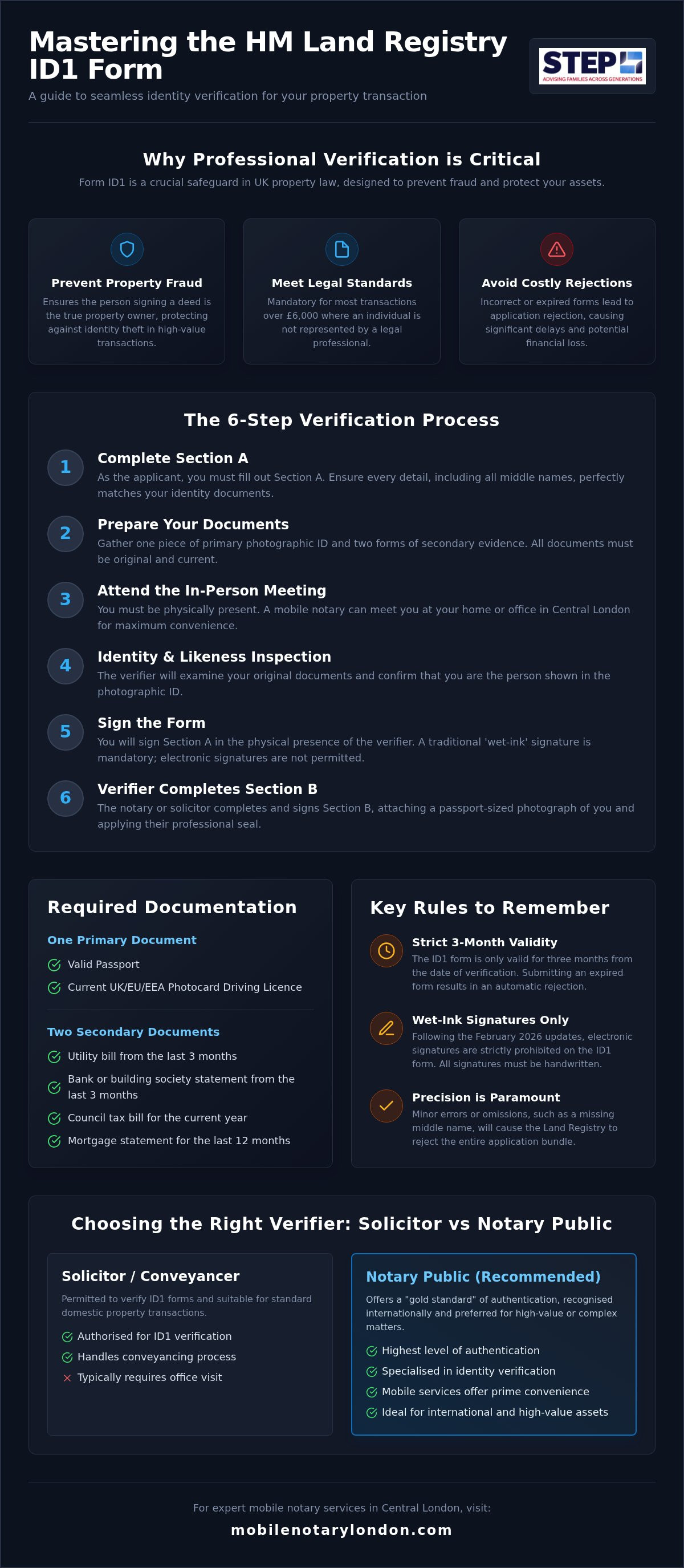
Form ID1 serves as a vital safeguard within the UK property market. It's essentially a certificate of identity for private individuals who are not represented by a legal professional in a specific transaction. When notarising a land registry ID1 form, you're participating in a process designed to protect the integrity of the national property register. This document ensures that the person signing a deed is exactly who they claim to be, preventing unauthorised changes to the title register.
The primary objective is the prevention of property fraud. Identity theft in the housing sector remains a serious concern; therefore, HM Land Registry mandates this verification for most transactions where the land's value exceeds £6,000. You'll generally need to complete this process for transfers of equity, the discharge of mortgages, or when you've chosen to manage a property transfer without a conveyancer. A Notary Public acts as a specialised authorised verifier, providing a high degree of certainty that the applicant is genuine.
The Legal Framework of Identity Verification
The Land Registry relies on the ID1 form to verify signatures on deeds before any changes are made to a property title. Following the updates on 16 February 2026, verification standards have become notably more stringent. One critical change is the absolute prohibition of electronic signatures on the form itself. Every signature must be wet-ink and witnessed in person to meet the current regulatory threshold.
Precision is paramount. If the form is completed incorrectly or if the verification is dated more than three months before submission, the Land Registry will reject the entire application bundle. For those involved in time-sensitive deals, such rejections lead to significant financial penalties or the loss of a mortgage offer. The process requires a meticulous eye to ensure every field aligns with the applicant's supporting evidence.
Who Can Authorise an ID1 Form?
Whilst solicitors and licensed conveyancers are permitted to verify these forms, the role of a Notary Public is often preferred for high-stakes or complex property matters. Notaries are legal officers whose work is recognised both domestically and internationally, offering a "gold standard" of authentication. Their involvement provides an additional layer of security that is highly valued by lenders and the Land Registry alike.
Choosing a mobile notary provides a level of accessibility that traditional high-street firms often lack. When you require notary and apostille services in Central London, it's essential to confirm that your verifier is fully qualified and regulated. You can check their credentials via the Faculty Office to ensure they possess the necessary authority. This specialised expertise is especially valuable when dealing with international private wealth or complex corporate property holdings where standard verification may not suffice.
The Step-by-Step Process of Notarising Your ID1 Form
Success in property registration hinges on procedural perfection. When you're notarising a land registry ID1 form, the process follows a strict sequence to ensure the resulting document is legally bulletproof. It begins with your preparation of Section A and concludes with the Notary’s formal seal, creating a chain of evidence that satisfies HM Land Registry’s rigorous fraud prevention standards.
Completing Section A Correctly
Section A is your responsibility as the applicant. You must ensure that every detail matches your supporting identity documents with absolute precision. A frequent cause for rejection is the omission of middle names; if your passport includes them, your ID1 form must reflect them too. You should also take care with the "Reason for application" field. Whether it's a transfer of equity or a mortgage discharge, the description must align with the specific transaction being lodged. For detailed clarity on these fields, you can consult the official Land Registry guidance before your appointment.
The sequence of events during the verification includes:
- Document Inspection: The Notary examines your original passport or driving licence to confirm validity.
- Physical Verification: You must be physically present; the Notary cannot verify your identity via a standard video call without additional forms like the ID5.
- Certification: The verifier completes Section B, detailing their professional credentials and the date of the meeting.
- Photographic Authentication: A passport-sized photo is signed and dated on the reverse by the Notary.
Section B: The Notary’s Certification
In Section B, the Notary Public provides their formal certification. This isn't merely a clerical task; it's a legal attestation that the verifier has met you in person and examined your original documents. They'll record their name, firm, and professional address clearly. A critical component of notarising a land registry ID1 form is the treatment of your photograph. The Notary must write a specific statement on the back, typically "I certify that this is a true likeness of [Your Name]", followed by their signature and the date. Finally, the Notary affixes their official seal to both the form and the photograph, a mark of authority that carries significant weight with Land Registry officials. If you're unsure about the current validity of your documents, it's wise to arrange a professional review to avoid costly delays.
Solicitor vs Notary Public: Choosing the Right Verifier
Selecting the appropriate professional is a critical decision that impacts the speed and security of your property transaction. Whilst both solicitors and notaries public are authorised to verify your identity, the depth of their scrutiny often differs. A solicitor typically verifies identity as an ancillary part of their conveyancing work. In contrast, a Notary Public is a specialist in the authentication of documents and the verification of individuals, providing a level of procedural rigor that is highly respected by HM Land Registry.
For high-net-worth individuals and international property owners, the choice often leans towards a Notary. This is particularly true when notarising a land registry ID1 form involving foreign identity documents or complex ownership structures. Notaries are uniquely trained to recognise the nuances of international passports and legal certifications, ensuring that your application isn't delayed by technical queries from the Registry. Before you begin, ensure you have the correct version of the document; you can Download Form ID1 directly from the government portal.
Why Mobile Notarisation Wins for Busy Londoners
Time is a finite resource for professionals in the capital. The traditional model of visiting a high-street law firm often requires navigating the Central London commute during standard office hours, a task that's both inconvenient and disruptive. By opting for Mobile Notary Central London services, you gain the flexibility to schedule appointments around your existing commitments. Whether you're at your office in the City or your residence in Mayfair, the verifier comes to you. This "white-glove" approach ensures that the legal necessity of identity verification fits seamlessly into your schedule rather than dictating it.
Expertise in Property Notarisation
Complex property transactions often involve more than just a simple transfer between individuals. When dealing with corporate entities, trusts, or transactions involving a Power of Attorney, the verification requirements become significantly more intricate. Utilising a STEP-qualified professional who specialises in private wealth and property law provides an added layer of security. This expertise is vital for ensuring that every aspect of the notarising a land registry ID1 form process adheres to the specific demands of the transaction. For those managing more complex arrangements, our specialised Property Notary Services offer the precision required to prevent rejection and safeguard your assets.
Essential Documentation: Preparing for Your Mobile Appointment
Preparation is the foundation of a successful mobile appointment. When notarising a land registry ID1 form, having your documentation organised ensures the process is efficient and the resulting verification is robust. HM Land Registry maintains a "gold standard" for identity documents, requiring original, valid, and undamaged evidence to prevent fraudulent submissions during the registration process.
Primary Identity Documents
A valid British passport or a current UK photocard driving licence remains the most straightforward evidence. If you're a foreign national, an original passport or a biometric residence permit is essential. One common hurdle involves name discrepancies. If your identity document reflects a maiden name whilst your property deeds use a married name, you must provide the original marriage certificate or deed poll to bridge the gap. Ensuring these documents are physically present and in good condition is vital; a damaged passport with a peeling laminate or torn pages will likely be rejected by the Registry.
Proof of Address Standards
Secondary evidence serves to anchor your identity to a specific residence. The Land Registry enforces a strict "three-month rule" for most supporting documents, such as bank statements or utility bills. It's a common misconception that all bills are equal. Whilst council tax letters and water bills are highly regarded, mobile phone bills are almost universally rejected as proof of address. If you rely on digital banking, you'll need to provide a high-quality print-out. In some cases, the notary may need to certify these print-outs as true copies of the digital originals to satisfy compliance standards.
You must also provide two identical passport-sized photographs taken within the last month. These should be in colour, against a plain background, and showing a full, clear view of your face without headgear, unless for religious or medical reasons. The quality must be professional; home-printed photos often lack the necessary resolution. As established in the previous section, the notary will certify one of these as a "true likeness" of you, a step that's integral to notarising a land registry ID1 form correctly.
To ensure your property transaction proceeds without a hitch, it's best to have all original documents laid out before your verifier arrives. If you have any doubts about the suitability of your current ID, you should contact us for a preliminary document review. This proactive step prevents the frustration of a wasted appointment and keeps your submission timeline intact.
Mobile Notary London: Efficiency for Your Property Transaction
In the high-stakes environment of London property transactions, timing is often the difference between a successful completion and a collapsed chain. Sheikh Najam provides a specialised response to this urgency by delivering expert notarial services directly to your location. When you're notarising a land registry ID1 form, the logistical burden of finding a physical office shouldn't be your primary concern. Instead, our mobile service prioritises your convenience, ensuring that legal compliance is achieved with minimal disruption to your professional or personal schedule.
This "white-glove" approach is designed for clients who demand both procedural rigor and absolute efficiency. By bringing the expertise of a STEP-qualified professional to your door, we eliminate the friction often associated with property-related bureaucracy. Whether you're navigating a complex transfer of equity or a straightforward mortgage discharge, our focus remains on providing a seamless experience that secures your transaction's momentum.
Coverage Areas and Urgency
Sheikh Najam focuses on the core districts of Central London, including Westminster, Mayfair, Marylebone, and the City. We understand that property deadlines are often non-negotiable. For clients facing critical completion dates, we offer same-day mobile appointments to ensure your documentation is lodged without delay. You can find more details on our Same Day Notary Service Westminster for a comprehensive look at how we manage urgent requests. To secure your slot immediately, you may access the Central London Notary Office booking portal.
Beyond the ID1: Integrated Notarial Support
Efficiency isn't just about speed; it's about a holistic approach to legal documentation. Often, the ID1 form is just one piece of a larger puzzle. During a single mobile visit, Sheikh Najam can handle accompanying property deeds, mortgage documents, and powers of attorney. This integrated support is particularly beneficial for international property deals where documents may also require urgent apostille services for use overseas. By notarising a land registry ID1 form alongside your other essential deeds, you ensure that the entire application bundle is consistent and ready for submission.
Before the verifier arrives, ensure you've performed a final check:
- Section A of the ID1 is completed accurately in black ink.
- Your original passport and two recent photographs are ready for inspection.
- Your proof of address documents are dated within the last three months.
- You've confirmed the exact spelling of names across all deeds and identity documents.
Secure Your Property Transaction with Professional Precision
Navigating the complexities of HM Land Registry requirements doesn't have to be a source of stress or delay. By ensuring your documentation is precise and your identity verification is handled by a specialist, you protect your property interests from the outset. We've explored the critical importance of exactness in Section A and the procedural rigour required for the Notary’s certification. Choosing a professional who understands the intersection of property law and international standards ensures your application satisfies the 2026 mandates.
Sheikh Najam provides this elite level of service as a STEP-qualified Private Wealth Lawyer and Notary Public. When notarising a land registry ID1 form, his expertise in property notary services guarantees that every detail, from the wet-ink signature to the authenticated photograph, is beyond reproach. With same-day mobile appointments available across Central London, you can achieve legal compliance without leaving your home or office. Take the proactive step to safeguard your transaction today.
Book your mobile ID1 notarisation appointment in Central London today to ensure your property deal moves forward with absolute confidence and speed.
Frequently Asked Questions
How long is a notarised ID1 form valid for with the Land Registry?
A completed ID1 form is valid for exactly three months from the date of verification. You must ensure that the form is lodged with HM Land Registry within this ninety-day window. If your property transaction is delayed and this period elapses, you'll need to arrange a new appointment for notarising a land registry ID1 form to ensure your application remains compliant with current registration standards.
Can I get an ID1 form verified online or via a video call?
Online verification is possible, but it requires a more complex procedure than a standard meeting. If you choose video verification, you must also complete a Form ID5 alongside your ID1. However, the February 2026 updates strictly prohibit electronic signatures on these documents. Most clients in Central London prefer a mobile notary visit to ensure a traditional wet-ink signature is witnessed in person, which remains the most reliable method for Registry acceptance.
What happens if the Land Registry rejects my ID1 form?
Rejection usually results in the entire application bundle being returned, which can jeopardise completion deadlines. Common reasons for rejection include minor clerical errors in Section A, an expired three-month validity window, or using a verifier who doesn't meet the Registry's professional criteria. If your form is rejected, you must correct the errors and typically undergo the verification process again, potentially incurring additional costs and significant transaction delays.
Do I need a separate ID1 form for every person involved in the transaction?
Yes, every individual who isn't represented by a conveyancer must have their identity verified on a separate form. For example, if two joint owners are transferring equity, both must complete their own ID1. A mobile notary can efficiently verify multiple applicants during a single visit to your Central London home or office, ensuring that all necessary documentation is synchronised and ready for a collective submission to the Registry.
Can a mobile notary verify my ID1 if I have a foreign passport?
A Notary Public is specifically qualified to verify international identity documents, making them ideal for applicants with foreign passports. When notarising a land registry ID1 form, the notary will inspect your original passport to ensure it meets the Registry’s "Gold Standard" for identity evidence. This expertise is particularly valuable in Central London, where property owners often hold international documentation that requires a higher level of professional scrutiny and certification.
Is there a difference between an ID1 and an ID2 form?
The distinction depends entirely on whether the applicant is an individual or a corporate entity. Form ID1 is used for private individuals, whereas Form ID2 is mandatory for corporate bodies, such as companies or local authorities. If you're acting on behalf of a business in a property deal, you'll need the ID2 variant. Both forms follow similar verification principles but require different details regarding the entity's registration and the individual’s authority to act.
What is the cost of notarising a Land Registry ID1 form in London?
Fees for this service are typically based on the professional's qualifications and the convenience of the mobile attendance. A premium service in Central London covers the verifier’s travel to your location, the thorough inspection of your identity documents, and the formal certification of your photograph. Using a STEP-qualified Private Wealth Lawyer ensures a high degree of precision, which, whilst reflecting a professional fee, significantly reduces the risk of costly application rejections.
Does the notary need to see the original documents or are copies okay?
The notary must physically inspect your original identity documents during the appointment. HM Land Registry does not accept photocopies, scans, or digital images for the ID1 verification process. You must present your original passport, driving licence, or utility bills so the verifier can confirm their authenticity. This physical inspection is a cornerstone of fraud prevention and is a mandatory requirement for the notary to sign the certificate in Section B.

Article by
Sheikh Najam
Sheikh Najam LLB, TEP, MCIArb is a Notary Public and Commissioner for Oaths based in Central London, offering notary services to corporate, commercial and private clients across the City of London and beyond. His work includes notarising board and shareholder resolutions, powers of attorney, and certified copies of constitutional documents for use with foreign registries, banks and courts, with apostille and legalisation arranged as part of the same instruction. Alongside his notarial practice, he is a STEP-qualified international private wealth lawyer advising on cross-border transactions, company formation, trust drafting and succession planning. He is regulated by the Faculty Office (Court of Faculties) of the Archbishop of Canterbury and is a member of The Notaries' Society of England and Wales, STEP, and The Association of European Attorneys.


