

A single administrative oversight in your document legalisation can derail a multi-million pound residency application before it even reaches a foreign consulate or the Home Office. For high-net-worth investors in Mayfair or Belgravia, the technicalities of certifying documents for golden visa application often represent the most frustrating bottleneck in an otherwise seamless investment strategy. You've likely dedicated months to due diligence and capital allocation; yet the prospect of navigating the labyrinth of FCDO apostilles and embassy attestations feels like an unnecessary burden on your time.
This expert guide ensures you master the complexities of document legalisation for global residency programmes, providing a clear roadmap for Central London professionals who require absolute precision. We'll clarify the confusing distinctions between notarisation and apostille requirements, whilst outlining how to secure same-day results without leaving your home or office. By the end of this article, you'll understand how to navigate the 2026 regulatory landscape with the calm efficiency that your international portfolio demands.
Key Takeaways
- Understand why international residency programmes demand rigorous document legalisation and how to meet these global standards with precision.
- Identify the specific personal and financial records that require professional notarisation to ensure your application remains entirely error-free.
- Navigate the essential steps of certifying documents for golden visa application, including the critical transition from the notarial act to the final FCDO apostille.
- Utilise our 2026 checklist to avoid common pitfalls, such as expired document validity windows or inconsistent naming across your property deeds and passports.
- Learn how to secure same-day, "white-glove" notary support at your Mayfair or Belgravia office to meet tight investment deadlines with total discretion.
The Critical Role of Certifying Documents for Golden Visa Application Success
The success of a residency application often hinges on the smallest details of administrative compliance. In the context of global residency by investment, certifying documents for golden visa application refers to the formal process of verifying that a UK-issued document is authentic and legally valid for use in a foreign jurisdiction. Whilst many investors assume a standard solicitor’s signature is sufficient, foreign governments amongst the EU and the Middle East typically demand the intervention of a Notary Public. This is because a notary’s seal carries international weight that a general legal practitioner’s does not.
The distinction is vital. A solicitor may certify a copy for domestic use, but a Notary Public performs a "notarial act" that confirms the identity of the signatory and the capacity in which they sign. As of 2026, regulatory scrutiny has intensified, particularly as the UK transitions fully to digital eVisas and updated compliance standards. Many jurisdictions now enforce a strict 90 to 180-day validity window for certified documents. If your proof of funds or criminal record check is even a day outside this window, the entire application may be summarily rejected. Navigating the technicalities of certifying documents for golden visa application requires a deep understanding of both UK law and foreign decree.
Understanding International Legal Recognition
The exchange of public documents between the UK and Golden Visa jurisdictions is largely governed by the Apostille Convention. This treaty simplifies the process, yet it still requires a foundational notarial certificate before an apostille is issued by the Foreign, Commonwealth & Development Office (FCDO). Foreign authorities require this multi-layered verification to mitigate fraud. They need absolute certainty that the person signing a declaration is who they claim to be. Standard certification often fails because it lacks the rigorous identity protocols inherent in a notarial act.
The Consequences of Incorrect Legalisation
Errors in the certification process are expensive. A mismatch in names across passports and deeds, or an incorrectly applied stamp, leads to immediate rejection at the consulate level. This doesn't just result in lost fees; it forces you to restart the process whilst facing a closing investment window. Ensuring documents are fit for purpose before they leave Central London is essential. Professional notary and apostille services provide the precision required to avoid these costs, ensuring your move to a new jurisdiction remains on schedule.
Core Documents Required for Global Residency and Citizenship by Investment
Preparing the requisite paperwork for an international relocation is a meticulous undertaking. Whilst each jurisdiction maintains its own specific criteria, the foundation of every successful application rests on a core set of verified UK records. When certifying documents for golden visa application, the primary focus is often on personal identification. This includes notarising passports and birth certificates for all family members, ensuring that every "true copy" meets the exacting standards of foreign immigration departments. These authorities require absolute certainty that the digital or paper records presented are authentic and unaltered.
Criminal record checks, such as ACRO or DBS certificates, represent a unique challenge. These documents must be original and often require specific legalisation paths involving both a Notary Public and the Foreign, Commonwealth & Development Office (FCDO). You should consult the latest UK government guidance on legalising documents to ensure your specific certificate type is eligible for an apostille. Without this secondary verification, even a perfectly notarised document may be rejected by a foreign consulate. Financial evidence forms the backbone of any investment-based visa. You'll need to provide certified bank statements, tax returns, and comprehensive proof of funds. For High-Net-Worth Individuals (HNWIs), this often extends to complex corporate and trust documents to satisfy stringent Anti-Money Laundering (AML) protocols.
Personal and Vital Records Certification
Foreign authorities rarely accept simple photocopies. Each vital record must be certified as a true copy of the original by a qualified professional. If you're moving to a non-English speaking country, your documents will likely require professional translation. These translations must be correctly bound and notarised to be legally recognised. We also frequently assist clients with child travel consents; these are essential if one parent is relocating ahead of the family and needs to prove the other parent's permission for the children to travel. If you are also managing complex legal matters regarding family status or security authorities, you can find out more about specialised legal services. Ensuring these personal records are handled with discretion is a hallmark of a premium service.
The scrutiny of wealth is particularly intense in 2026. You must provide clear, notarised declarations regarding the source of your investment capital. If your investment capital is held within a company, you'll need to provide notarised shareholder agreements and board resolutions. For those utilising corporate vehicles, our Corporate Document Certification Guide 2026 offers detailed insights into handling multi-layered ownership structures. Ensuring these documents are prepared with precision at your Mayfair or Belgravia office saves weeks of potential delays. If you require urgent assistance with these complex requirements, you can book a mobile notary appointment to review your documentation portfolio.
Navigating Legalisation: Notarisation, Apostilles, and Embassy Consular Services
The legalisation journey follows a strict hierarchy of verification. It begins with the Notarial Act. During this stage, a Notary Public witnesses signatures and confirms the authenticity of the original records. This foundational step is governed by official UK government guidance; it ensures that the person signing a declaration has the legal capacity and identity to do so. Once the notary has applied their seal and certificate, the document moves to the Foreign, Commonwealth & Development Office (FCDO) for an apostille. This second layer of verification is mandatory when certifying documents for golden visa application within Hague Convention countries. It confirms that the notary's own signature and seal are recorded on the national register, providing the necessary validity for international use.
For jurisdictions outside the Hague agreement, such as the UAE, Qatar, or Kuwait, a third step is required: Consular Legalisation. This involves the specific embassy of the destination country adding their own attestation to the document. By 2026, the adoption of e-Apostilles has increased, offering a faster digital alternative for certain document types. However, many Golden Visa jurisdictions still demand physical, paper-based legalisation for high-value items like property deeds or powers of attorney. Whilst e-Apostilles are efficient, traditional paper legalisation remains the gold standard for certifying documents for golden visa application in many high-scrutiny jurisdictions. You must verify which format your target consulate accepts before you begin the process.
The FCDO Fast-Track Process in London
London-based investors hold a distinct geographical advantage. Proximity to the FCDO’s premium service counters allows for same-day results that are simply impossible to achieve from other UK regions. When investment deadlines are measured in hours, navigating this system requires absolute precision. For a deeper look at managing these compressed timelines, see our Urgent Apostille London: A 2026 Buying Guide. This fast-track route is essential for maintaining the momentum of your residency application without administrative delay.
Embassy and Consular Requirements
Each embassy maintains unique, often opaque, procedural requirements. Countries like Thailand or Vietnam may require prior Chamber of Commerce certification before they will accept a document for legalisation. A specialist notary coordinates this entire chain, acting as a liaison between your Mayfair office and the various London-based consulates. This ensures a secure chain of custody for high-value documents, preventing the loss or delay of original certificates during transit amongst different administrative bodies. It's this level of oversight that guarantees your documents are fit for purpose upon arrival at their final destination.
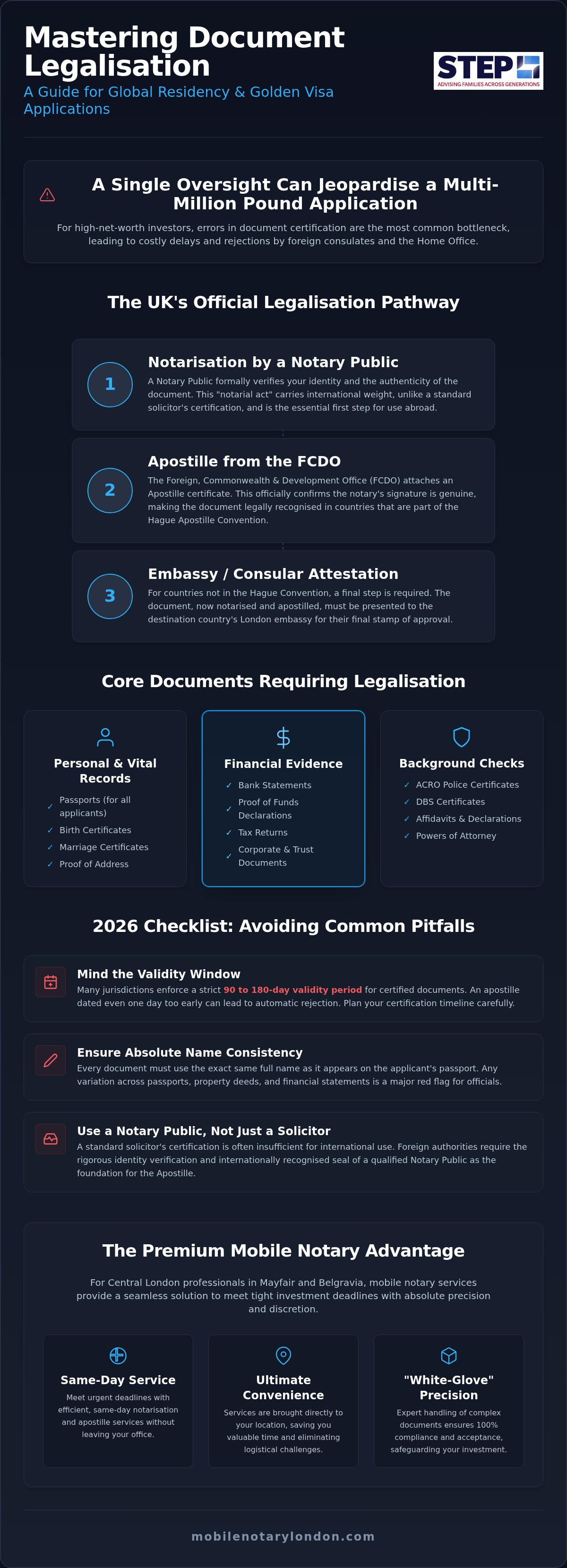
Preparation Checklist: Avoiding Common Pitfalls in the Certification Process
Administrative precision is the hallmark of a successful residency application. When certifying documents for golden visa application, a systematic approach prevents the minor errors that frequently lead to consulate rejection. To ensure your file is beyond reproach, follow this rigorous preparation checklist:
- Validate Document Dates: Ensure all criminal record checks and bank statements are issued within the required 3 to 6 month window. Many jurisdictions in 2026 will reject certificates that are deemed "stale" by their specific immigration rules.
- Verify Exact Name Matches: Align every character of your name across passports, financial records, and property deeds. Middle names or suffixes like "Junior" must be consistent across all notarised sets to avoid identity queries.
- Check Signature Requirements: Confirm if your destination requires a "wet-ink" signature. Whilst digital signatures are gaining ground, high-value investment documents often still mandate physical signing for full legal recognition.
- Organise Translations Early: Secure certified translations before your notary appointment. This allows the notary to verify the translator's professional credentials and bind the translation to the original document correctly in a single act.
Pre-Appointment Document Audit
Success starts before we meet. We strongly advise scanning and sending digital drafts of your documentation for review prior to our mobile appointment in Mayfair or Belgravia. This proactive audit identifies missing clauses or formatting issues that could cause delays at the FCDO or embassy level. You must also confirm the exact number of copies required by the destination authority; it's common for investors to require three or four sets of notarised originals. Identifying which documents require original signatures versus those that can be certified as "true copies" is a critical distinction. It prevents the frustration of having to re-issue documents from your bank or local police force during a tight visa window.
Coordinating with Private Wealth Advisors
A specialist notary acts as a high-stakes facilitator, working seamlessly alongside your family office, private banker, or personal legal counsel such as Tosolini, Toniutti & Partners when managing US-Italy cross-border immigration and business operations. This collaborative approach ensures that every notarised act aligns perfectly with your broader International Private Wealth Legal Advice. For those managing complex portfolios or offshore trust structures, our Mobile Notary for Private Banking Clients guide provides a tailored 2026 checklist for HNWIs. We understand the gravity of these transactions and the need for absolute procedural rigor. To ensure your documentation is handled with the precision and discretion your investment demands, contact our specialist team to arrange a discreet consultation at your residence or Mayfair office.
The Advantage of Premium Mobile Notary Services for London-Based Investors
High-net-worth investors often face the paradox of complex international requirements paired with an extreme scarcity of time. When certifying documents for golden visa application, the traditional high-street model of legal service delivery often falls short. It lacks the urgency and personalised attention required for high-stakes residency transitions. A premium mobile notary service bridges this gap by bringing elite legal expertise directly to your Mayfair boardroom or Belgravia residence. This eliminates the logistical friction of transporting sensitive original documents across the city, allowing you to focus on your investment strategy whilst we handle the administrative rigor.
Beyond mere convenience, the value lies in the practitioner’s background. Direct access to a STEP-qualified Private Wealth Lawyer ensures that your documentation isn't just stamped, but reviewed with an eye for international wealth compliance. We provide comprehensive management of the entire legalisation chain. This includes the physical "runs" to the FCDO for urgent apostilles and the subsequent visits to various London-based embassies. You receive a finished, legalised product without ever having to step foot in a government office. This "white-glove" approach is designed to provide calm efficiency in the face of tight investment deadlines.
Why Mobile Services Outperform High-Street Offices
Standard notary offices operate on restricted hours that rarely align with the fast-moving investment windows of 2026. Choosing a mobile solution allows for same-day notarisation at a time that suits your schedule. Understanding why mobile notary services are superior for HNWIs is essential; it's about agility and the mitigation of risk. For those based in SW1, our Notary Public Belgravia: A 2026 Guide details how we support local residents with immediate, on-site certification. We prioritise your privacy, ensuring that sensitive financial records and personal identification never leave your secure environment until they are ready for official legalisation.
Securing Your Global Future with Confidence
Entrusting your residency application to a specialist provides the peace of mind that your legal foundation is flawless. The process of certifying documents for golden visa application is too critical to be left to generalist providers. Our bespoke service respects the discretion that high-value transactions demand, providing a seamless transition from UK-based wealth to international residency. To ensure your documents are prepared to the highest global standards, you can book your Premium Notary Central London appointment through our secure portal. Start your residency journey today with the confidence that every seal and signature is meticulously applied to meet 2026's rigorous standards.
Securing Your Residency Future with Flawless Legal Foundations
Navigating the 2026 residency landscape requires more than just capital; it demands procedural perfection. We've explored how a meticulous audit of your personal and financial records prevents costly delays at the consulate level. Success hinges on understanding the multi-layered legalisation process, from the initial notarial act to the final embassy attestation. The technicalities of certifying documents for golden visa application shouldn't be a barrier to your global mobility.
As a STEP-qualified Private Wealth Lawyer, I provide the specialised oversight needed for complex international legalisation. My premium, same-day mobile service across Central London ensures your paperwork is handled with absolute discretion at your Mayfair or Belgravia residence. By choosing a white-glove solution, you eliminate administrative friction and secure your future with confidence. This tailored approach ensures that your documents meet every regulatory standard before they even reach a foreign official's desk.
Secure your Golden Visa documents today with a Premium Mobile Notary appointment. Your international residency journey deserves a seamless, error-free start. We're here to facilitate your transition with the precision and speed that your investment portfolio demands.
Frequently Asked Questions
How long does it take to certify documents for a Golden Visa application?
Notarisation typically takes less than an hour during a mobile appointment. However, the total time for certifying documents for golden visa application depends on whether you require an apostille or embassy legalisation. Using the FCDO's premium service in Central London allows for same-day results, whilst standard postal routes take significantly longer. We manage the entire process, including the physical runs to government offices, to ensure your deadlines are met with precision.
Do I need a Notary Public or can a solicitor certify my documents?
Foreign governments almost exclusively require a Notary Public for international residency applications. Whilst a solicitor can certify copies for use within the UK, their signature carries no weight at an embassy or the FCDO. A Notary Public performs a "notarial act" that is recognised globally under international law. This distinction is critical for Golden Visa jurisdictions that demand high levels of verification for your personal and financial records.
What is an Apostille and is it mandatory for my residency application?
An apostille is an official certificate issued by the Foreign, Commonwealth & Development Office that verifies the signature and seal of the notary. It's mandatory for countries that are members of the Hague Convention. Without this secondary verification, your UK documents won't be legally recognised by foreign immigration authorities. We facilitate urgent apostille services to ensure your documents are fit for purpose before they leave Central London.
Can a mobile notary come to my office in Central London for same-day service?
Yes, we specialise in providing same-day mobile notary services at your Mayfair office or Belgravia residence. We understand that high-net-worth investors often have restricted schedules; therefore, we bring our expertise directly to you. This "white-glove" service ensures that your documents are notarised in a secure environment without the need for you to visit a high-street office. We then handle any subsequent legalisation requirements immediately.
Which UK documents usually need notarisation for a Golden Visa?
Most applications require a combination of personal and financial records. Common documents include notarised copies of passports, birth certificates, and marriage certificates. You'll also likely need certification for bank statements, proof of funds, and ACRO criminal record checks. For investors using corporate vehicles, we frequently notarise board resolutions and shareholder agreements. Each jurisdiction has unique requirements, so it's essential to verify the list with your residency advisor.
How much does it cost to legalise documents for international use?
Total costs vary depending on the number of documents and the specific legalisation path required. Expenses typically include the notary’s professional fee, FCDO apostille charges, and any applicable embassy attestation fees. Complex corporate structures or documents requiring translation may incur higher costs. We provide a transparent breakdown of all disbursements before commencing work, ensuring you understand the financial requirements of certifying documents for golden visa application.
Is an e-Apostille accepted for Golden Visa applications in 2026?
Acceptance of e-Apostilles varies significantly between jurisdictions in 2026. Whilst the digital format is increasingly popular for its speed, many Golden Visa consulates still mandate physical, paper-based legalisation for high-value documents like property deeds or powers of attorney. You must confirm the specific requirements of your destination country's embassy. We provide both digital and traditional paper-based legalisation to ensure your application meets the necessary technical standards.
What happens if my notarised documents are rejected by an embassy?
Rejection typically occurs due to administrative errors, such as "stale" document dates or inconsistent naming across your portfolio. If an embassy rejects your papers, you'll likely need to re-notarise and re-legalise the entire set, which adds significant time and cost. We mitigate this risk by performing a pre-appointment audit of your drafts. This ensures that every seal and signature adheres to the latest 2026 regulatory requirements.

Article by
Sheikh Najam
Sheikh Najam LLB, TEP, MCIArb is a Notary Public and Commissioner for Oaths based in Central London, offering notary services to corporate, commercial and private clients across the City of London and beyond. His work includes notarising board and shareholder resolutions, powers of attorney, and certified copies of constitutional documents for use with foreign registries, banks and courts, with apostille and legalisation arranged as part of the same instruction. Alongside his notarial practice, he is a STEP-qualified international private wealth lawyer advising on cross-border transactions, company formation, trust drafting and succession planning. He is regulated by the Faculty Office (Court of Faculties) of the Archbishop of Canterbury and is a member of The Notaries' Society of England and Wales, STEP, and The Association of European Attorneys.


