
Missing a statutory filing window for an international intellectual property transfer doesn't just stall a deal. It can strip a new owner of their right to recover legal costs in future infringement claims under Section 25 of the Trade Marks Act 1994. Securing a notary for trademark assignments is the critical bridge between executing a deed in a Mayfair boardroom and gaining recognition from foreign registries like the USPTO, EUIPO, or WIPO. You likely recognise the intense pressure of meeting strict deadlines whilst facing conflicting advice on whether a solicitor’s signature is sufficient or if a full notarial seal is mandatory for your specific jurisdiction.
This article explains how to secure your IP assets with professional notarisation that meets the exact standards of international registries. We'll look at why a notary is indispensable for cross-border transfers, how significant shifts like China's accession to the Hague Apostille Convention have accelerated timelines, and the way mobile services in Central London prevent business disruption. You'll learn how to ensure your corporate documents are legally robust, allowing for a seamless transition of ownership across global markets.
Key Takeaways
- Understand why international IP registries like WIPO and EUIPO require a formal notarial seal rather than a standard solicitor's signature to validate global brand ownership transfers.
- Learn how to navigate the specific execution formalities for major foreign IP offices, including the USPTO and CNIPA, by engaging a specialist notary for trademark assignments.
- Discover the procedural differences between a standard UK apostille and full embassy legalisation for non-Hague jurisdictions to ensure your deeds remain legally robust.
- Streamline your filing process by following a precise preparation checklist, from verifying corporate "Good Standing" to collecting compliant identity documents for all signatories.
- Benefit from the efficiency of premium mobile notary services that attend your office in Mayfair or the City, allowing high-stakes IP transactions to be finalised without business disruption.
The Critical Role of a Notary for Trademark Assignments in 2026
A trademark assignment represents the absolute transfer of intellectual property rights from one entity to another. It's much more than a simple administrative update; it's a permanent shift in legal title that carries immense commercial value. When preparing these deeds, engaging a notary for trademark assignments ensures the transition meets the rigorous standards required by global registries. Within the specialised field of intellectual property, notarisation acts as the ultimate verification of execution for global recognition.
International bodies like the World Intellectual Property Organization (WIPO) and the European Union Intellectual Property Office (EUIPO) frequently mandate a notarial seal over a standard solicitor’s signature. This preference stems from the specific functions of a notary public, who acts as an impartial officer of the law to authenticate the facts of execution. Beyond merely witnessing a signature, a notary verifies the corporate capacity and authority of the directors involved. This is particularly vital in 2026, where registries demand proof that a signatory possesses the specific power to alienate company assets under current UK corporate transparency regulations.
Trademark Assignment vs. Licensing: Notarial Requirements
It's vital to distinguish between a temporary licence and a permanent assignment. Whilst a licence grants usage rights for a set period, an assignment constitutes a full change in ownership. Because of this permanence, foreign IP offices require higher levels of formal attestation. If a deed is executed improperly, the resulting delays in registry updates can stall multi-million-pound acquisitions or leave brands vulnerable to infringement. Utilising professional notary and apostille services ensures that the transfer is recognised as legally binding from the moment of filing.
Why a Solicitor’s Signature Often Falls Short Abroad
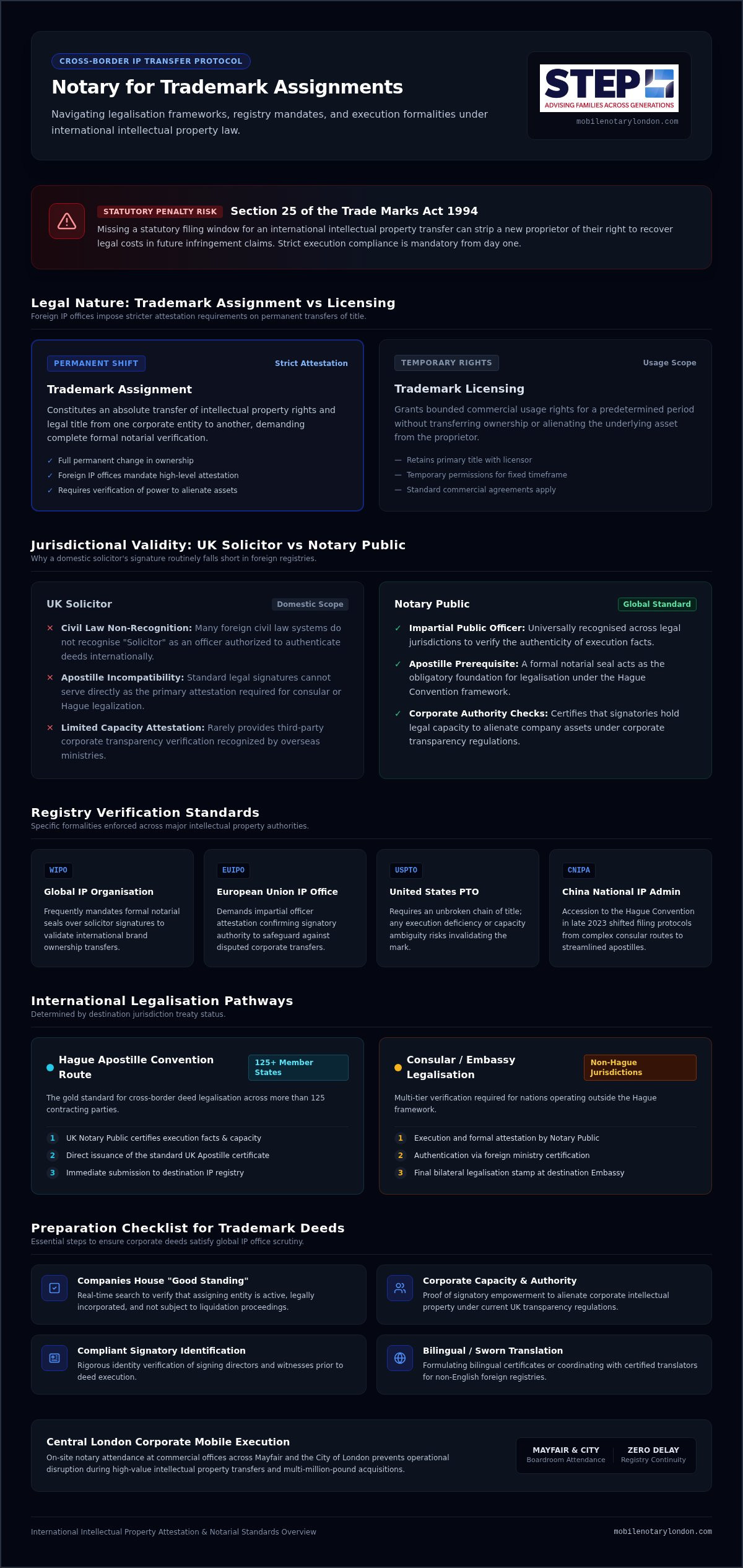
Whilst a solicitor is highly qualified to provide legal advice within the United Kingdom, their signature often lacks the necessary weight in foreign jurisdictions. Many civil law countries don't recognise the title of "Solicitor" as having the authority to authenticate deeds for international use. A Notary Public, however, holds a globally recognised office that bridges the gap between different legal systems. Under the framework of the Hague Convention, a notary’s seal is the prerequisite for an Apostille, which is the gold standard for verifying trademark documentation across more than 125 contracting parties.
Navigating International Intellectual Property Protocols
Global brand protection requires more than just a signed piece of paper. Each national registry operates under its own specific procedural rigor, often necessitating a specialised notary for trademark assignments to bridge the gap between UK execution and foreign acceptance. For example, the United States Patent and Trademark Office (USPTO) requires a clear chain of title; any break can jeopardise the validity of the mark. Similarly, the China National Intellectual Property Administration (CNIPA) has historically demanded intensive consular legalisation, though its accession to the Hague Apostille Convention in late 2023 has significantly streamlined the process for UK entities.
A key component of this verification is the notary’s ability to certify the "Good Standing" of the assigning company. This involves a real-time search of Companies House to confirm the entity is active, properly incorporated, and not in liquidation. You can find more detail on these corporate requirements in our London Notary: Corporate Document Certification Guide 2026. When dealing with non-English speaking jurisdictions, a notary must also manage the complexities of bilingual certificates or coordinate with sworn translators to ensure the target registry accepts the filing without delay. This meticulous approach aligns with the UK Intellectual Property Office trademark transfer guidance for recording changes in ownership.
WIPO and the Madrid System: Notarial Standards
The Madrid Protocol offers a centralised way to manage international registrations, yet administrative hurdles remain at the recordal stage. When submitting WIPO Form MM5 to record a change in ownership, the International Bureau requires absolute certainty regarding the authenticity of signatures. Engaging a notary for trademark assignments is a vital component of this filing process, as the notary certifies the execution of the form for a multi-jurisdictional portfolio. This standardisation prevents the need for separate, costly filings in every member state, provided the initial notarial act is executed with precision.
Dealing with Civil Law Jurisdictions
Jurisdictions such as Brazil, Italy, and France operate under civil law systems that place a higher burden of proof on the physical act of signing. In these regions, a notary doesn't just verify a document; they witness the specific moment of execution to ensure it complies with local statutes. This level of scrutiny is non-negotiable for high-value IP deeds. If your business is managing a complex transfer across these territories, it's often beneficial to discuss your specific registry requirements with an expert who understands these nuances. A specialist can facilitate these meetings at your London headquarters to maintain momentum and ensure compliance with foreign laws.
Beyond the Seal: Legalisation and Apostille for Trademark Deeds
Securing a notarial seal is only the first phase of a valid international IP transfer. For a deed of assignment to be recognised by a foreign registry, it must typically undergo legalisation. This process involves the official UK document legalisation service provided by the Foreign, Commonwealth & Development Office (FCDO). An Apostille is a government-issued certificate attached to your document that verifies the authenticity of the notary’s signature and seal. Without this second layer of verification, most international registries will reject the filing, regardless of how well the deed itself is drafted.
In 2026, managing these timelines is a critical component of brand protection. Standard paper-based Apostille applications currently take between 15 and 25 working days to process. For urgent corporate matters, an e-Apostille can often be completed within 48 hours, provided the target jurisdiction accepts digital certification. When you engage a notary for trademark assignments, they don't just witness a signature; they facilitate this entire chain of validity. This ensures that your high-stakes IP assets move through the FCDO system without the administrative errors that frequently cause weeks of delay.
When is an Apostille Mandatory for IP Transfers?
The necessity of an Apostille depends on whether the destination country is a member of the Hague Apostille Convention. Over 125 nations, including major markets like China (since November 2023) and Canada (since January 2024), now accept a single Apostille as sufficient proof of authenticity. If you are transferring assets to a Hague member state, the process is streamlined. However, for non-Hague countries such as the UAE, Qatar, or Kuwait, a "chain of legalisation" is required. This involves notarisation, FCDO certification, and subsequent attestation by the relevant London embassy. Before proceeding, you should verify if your destination registry requires this tiered approach to avoid filing failures.
Urgent Embassy Legalisation for Global Brand Launches
High-stakes transactions, such as global brand launches or corporate mergers, often require embassy stamps on a same-day or next-day basis. This "white-glove" workflow is complex, requiring physical attendance at various consulates across London. Professional notary and apostille services manage this entire journey, ensuring your trademark deeds are moved from the notary’s desk to the FCDO and then to the embassy with methodical efficiency. For a deeper dive into expedited timelines, consult our Urgent Apostille London: A 2026 Buying Guide to understand how to bypass standard postal delays during critical business windows.
Checklist: Preparing Trademark Assignment Deeds for Notarisation
Efficiency in IP transfers relies on meticulous preparation. Before booking a notary for trademark assignments, you must ensure the administrative groundwork is flawless to prevent rejection by foreign registries. Use the following checklist to organise your documentation for a seamless execution.
- Step 1: The Trademark Assignment Deed must be fully drafted but must remain unsigned. The notary must witness the physical act of signing to certify the document's validity.
- Step 2: Collect valid proof of identity, such as a passport, and recent proof of residential address for all signatories.
- Step 3: Gather evidence of corporate authority. This includes a certified Board Resolution or a Power of Attorney that specifically authorises the individual to execute the assignment.
- Step 4: Double-check that the trademark registration numbers and international classes in the deed match the official registry records exactly. Even a minor typo can lead to a filing failure.
- Step 5: Arrange a mobile appointment at your headquarters or a preferred location in the City to minimise disruption to your executive team.
Corporate Authority and the Notary’s Duty
A notary's primary duty is to verify that the person signing the deed has the legal capacity to bind the company. This involves a detailed review of the company’s Articles of Association to determine the required signing protocols. Whether the company requires two directors, or one director and a witness, the notary ensures the execution complies with both UK law and the specific requirements of the destination registry. For specialised assistance with high-value transactions, our Corporate Notary Services Mayfair provide the premium support needed for global brand transfers.
Common Pitfalls to Avoid in IP Notarisation
The most frequent error is signing the document before the notary arrives. A notary cannot certify a signature they did not witness in person. Similarly, "copy-paste" digital signatures or scans are almost universally rejected by foreign IP registries, which demand wet-ink signatures on the original deed. Ensure the name on the provided identification matches the name on the deed exactly; discrepancies in middle names or titles often trigger administrative delays. To secure your assets without procedural errors, book your mobile notary appointment today.
Premium Mobile Notary Services for London’s IP Professionals
London's corporate landscape moves with a speed that does not allow for administrative bottlenecks. For IP professionals managing global portfolios, the requirement for a notary for trademark assignments often arises at the final stage of a transaction, where timing is everything. Sheikh Najam – Mobile Notary Central London serves as a trusted, high-stakes facilitator for the capital’s most demanding legal and corporate sectors. Led by Sheikh Najam, a STEP-qualified Private Wealth Lawyer and Notary Public, this premium mobile practice ensures that the execution of trademark deeds is handled with the precision and urgency required to meet international registry deadlines.
The benefits of choosing why a mobile notary is essential become clear during complex brand transfers. Busy executives in the City or West End should not have to navigate cross-town traffic to attend a notary’s office. Instead, the notary attends your boardroom, allowing directors to remain focused on their core operations whilst the legal formalities are completed. This same-day availability is a cornerstone of our service, designed specifically to prevent IP filing windows from being missed. High-value asset transfers demand a high level of discretion and professional composure, qualities that define our white-glove approach to corporate document certification.
Serving Mayfair, the City, and Central London
Our mobile practice is strategically focused on the primary business districts of Central London. We provide comprehensive coverage across EC, WC, and W postcodes, bringing our services directly to your private office in Mayfair, the City, or Canary Wharf. This on-site attendance allows us to handle multiple documents in a single corporate session, which is particularly useful during large-scale IP restructuring or mergers. Whether you require the notarisation of a single assignment deed or a suite of powers of attorney for multiple jurisdictions, the process is executed with methodical efficiency and procedural rigour.
Securing Your IP Strategy with Expert Certification
Engaging an expert notary for trademark assignments who is also a STEP-qualified lawyer provides an added layer of security for your intellectual property strategy. You are not simply securing an official seal; you are gaining the expertise of a professional who understands the intricacies of international private wealth and corporate law. Our booking process is designed for speed and clarity, enabling you to secure an appointment through our contact page with minimal fuss. Secure your trademark assignment with professional notarisation today to ensure your global assets are protected by a legally robust and internationally recognised chain of title.
Securing Your Global Intellectual Property with Confidence
Navigating the transition of brand ownership across international borders demands more than just legal drafting. It requires a meticulous adherence to procedural standards that only a specialised notary for trademark assignments can provide. By ensuring your deeds are executed with the correct corporate authority and validated through the appropriate legalisation channels, you protect your assets from registry rejections and statutory delays. Whether you are dealing with the USPTO or navigating the post-China Hague accession landscape, the validity of your IP portfolio rests on the rigour of its certification.
As a STEP-qualified Private Wealth Lawyer and Notary Public, Sheikh Najam provides a premium, "white-glove" service tailored to the urgency of Central London’s corporate sector. With deep expertise in international legalisation protocols and the convenience of same-day mobile appointments, your high-stakes transactions are in safe hands. Don't let administrative hurdles disrupt your business momentum or jeopardise your legal standing.
Book an Urgent Mobile Notary Appointment for Your Trademark Assignment and ensure your intellectual property transfer is executed with absolute precision and speed. Your brand’s future deserves nothing less than expert certification.
Frequently Asked Questions
Do I really need a notary for a trademark assignment in the UK?
You require a notary primarily when your trademark transfer involves foreign registries or international brand portfolios. Whilst the UK Intellectual Property Office (UKIPO) may accept a solicitor's signature for domestic filings, international bodies like the USPTO or EUIPO mandate a notarial seal. A notary provides the high level of authentication needed to prove the assignor’s authority, ensuring the deed is recognised across different legal systems without the risk of rejection or costly delays.
Can a solicitor notarise my trademark assignment deed?
No, a solicitor cannot perform the specific functions of a Notary Public. Whilst solicitors are qualified to draft the deed, they lack the statutory authority to affix a notarial seal for international use. Many foreign jurisdictions don't recognise the title of "Solicitor" for the execution of deeds. You must engage a qualified notary for trademark assignments to ensure your documents meet the rigorous standards required by the FCDO and global IP registries.
What documents does the notary need to see for a corporate trademark transfer?
For a corporate transfer, you must provide valid proof of identity and residential address for all signatories. Additionally, the notary requires evidence of corporate authority, such as a Board Resolution or a Power of Attorney. We also conduct real-time searches at Companies House to verify the company's Good Standing and the director's current status. These checks ensure the person signing the deed has the legal capacity to bind the company in a high-stakes asset transfer.
How long does it take to get a trademark assignment notarised in London?
The notarisation process itself can be completed during a same-day appointment with a notary for trademark assignments. We offer a premium mobile service across Central London, attending your office to witness the execution within hours of your enquiry. However, the subsequent legalisation process at the FCDO can vary. Standard paper-based apostilles currently take between 15 and 25 working days, whilst digital e-Apostilles are typically processed within 48 hours for jurisdictions that accept them.
Is an apostille always required for international trademark assignments?
An apostille is almost always required when transferring IP rights to a country that is a member of the Hague Convention. This government-level certificate verifies the notary’s own seal and signature for international recognition. For non-Hague jurisdictions, such as the UAE or Qatar, you'll need a more complex chain of legalisation. This involves notarisation followed by FCDO certification and final attestation by the relevant embassy in London to ensure the deed is accepted by the target registry.
Can the notary come to my office in the City of London?
Yes, we provide a specialised mobile service that covers all EC, WC, and W postcodes in Central London. We don't offer in-office appointments, as our practice is designed to provide "white-glove" convenience by attending your boardroom or private office. This approach is particularly beneficial for busy executives in the City of London or Mayfair who need to execute high-value trademark deeds without the disruption of travelling to a fixed office location.
What happens if a trademark assignment is not properly notarised?
Improper notarisation can lead to the immediate rejection of your filing by foreign IP registries. Beyond the administrative failure, Section 25 of the Trade Marks Act 1994 imposes consequences for failing to record an assignment within six months. If the mark is infringed, the court may refuse to award costs to the new owner. Precise notarisation ensures your chain of title remains intact, protecting your brand’s commercial value and your ability to enforce your rights globally.
How much does it cost to notarise a trademark assignment?
The cost of notarising a trademark assignment depends on the complexity of the documents and the number of jurisdictions involved. Factors such as the requirement for corporate authority verification and the need for urgent apostille services will influence the final fee. We provide transparent, fixed quotes based on your specific requirements. This ensures you receive a premium service that reflects the high-stakes nature of international IP transfers whilst maintaining the composure and efficiency your business demands.

Article by
Sheikh Najam
Sheikh Najam LLB, TEP, MCIArb is a Notary Public and Commissioner for Oaths based in Central London, offering notary services to corporate, commercial and private clients across the City of London and beyond. His work includes notarising board and shareholder resolutions, powers of attorney, and certified copies of constitutional documents for use with foreign registries, banks and courts, with apostille and legalisation arranged as part of the same instruction. Alongside his notarial practice, he is a STEP-qualified international private wealth lawyer advising on cross-border transactions, company formation, trust drafting and succession planning. He is regulated by the Faculty Office (Court of Faculties) of the Archbishop of Canterbury and is a member of The Notaries' Society of England and Wales, STEP, and The Association of European Attorneys.


