
A single administrative error on your degree certificate can stall your entire move to Dubai or Abu Dhabi for weeks. You've likely spent hours staring at conflicting advice regarding the Foreign, Commonwealth & Development Office and the UAE Embassy. It's frustrating to balance a high-pressure career in London whilst trying to decipher whether you need an e-Apostille or a physical stamp. This guide provides a definitive 2026 walkthrough to certify university degree for UAE compliance, ensuring your documents are accepted the first time.
We will break down the multi-stage legalisation chain, from the initial solicitor certification to the final embassy attestation, and show you how to achieve this without ever leaving your office. By following this professional roadmap, you can eliminate the fear of rejection and the need for time-consuming travel across the capital. We cover everything from the latest FCDO processing times to the specific binding requirements that UAE authorities demand for 2026 visa applications. This ensures your move remains on schedule and your professional credentials meet the highest international standards.
Key Takeaways
- Master the three-tier legalisation chain required for UAE residency visas, from initial degree verification to final embassy attestation.
- Learn how to certify university degree for UAE through a professional mobile notary who can visit your Central London location.
- Understand why an FCDO Apostille remains a mandatory prerequisite for UK documents despite the UAE's status regarding the Hague Convention.
- Discover how to bypass the logistical burden of visiting multiple government offices by utilising a premium, white-glove legalisation service.
- Gain expert assurance that your degree meets strict 2026 standards, protecting your relocation timeline from administrative delays or rejection.
Understanding the UAE Degree Attestation Chain
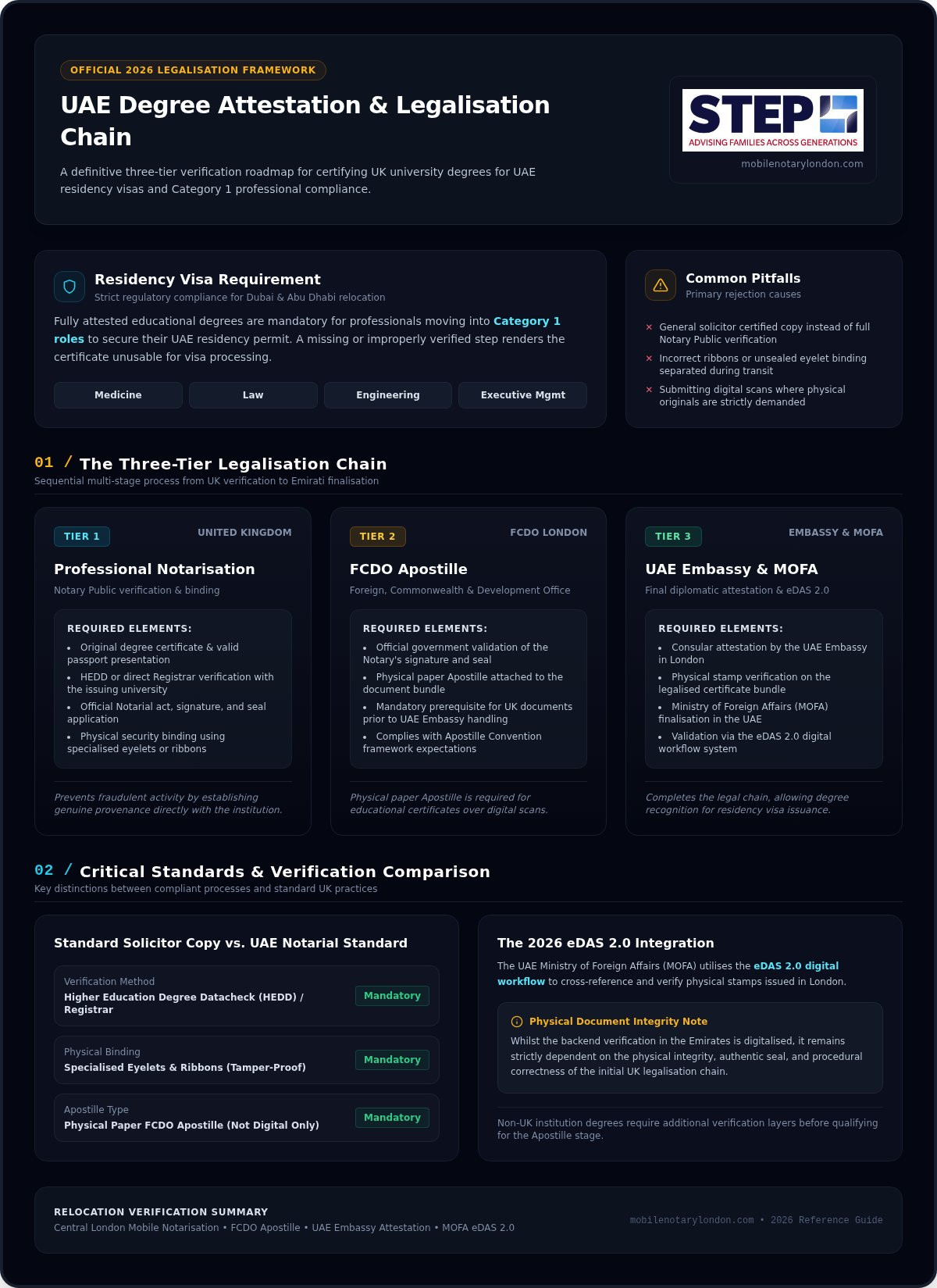
The process to certify university degree for UAE recognition is a rigorous sequence of legal validations designed to prove your academic credentials to the Emirati authorities. Unlike some jurisdictions that accept simple translations or basic solicitor copies, the UAE demands a comprehensive attestation chain. This ensures every document entering their system is authentic and legally binding. The chain consists of three non-negotiable tiers: professional notarisation within the UK, an Apostille from the Foreign, Commonwealth & Development Office (FCDO), and final attestation by the UAE Embassy in London.
Missing a single step in this sequence renders your document useless for visa purposes. The final stage typically involves the Ministry of Foreign Affairs (MOFA) within the Emirates, which now utilises the eDAS 2.0 digital workflow to verify the London-based stamps. This sophisticated system has streamlined the verification process for 2026, yet it remains entirely dependent on the physical integrity and procedural accuracy of the initial UK legalisation.
Why Your Degree Needs Special Handling for the UAE
Professionals moving into Category 1 roles, such as medicine, law, engineering, or executive management, must provide a fully attested degree to secure their residency permit. A common pitfall for London professionals is providing a certified copy from a general solicitor instead of a full notarisation. For those in these high-level categories who are also considering establishing a commercial entity, Goodhand provides comprehensive support for mainland business solutions and government liaison within the Emirates. The UAE Embassy requires a Notary Public to verify the degree's authenticity directly with the issuing university. Failure to follow this specific protocol, or using incorrect ribbons and seals during the binding process, remains the primary reason for document rejection at the embassy level.
The 2026 Legalisation Landscape
While the UK has expanded its digital-first services, the UAE typically requires a physical paper Apostille for educational certificates. This relates to the Apostille Convention, which provides the framework for international document recognition. Even though the UAE is not a member of this convention, they utilise the Apostille as a mandatory prerequisite for their own attestation process.
Navigating these shifting requirements requires meticulous precision. Our notary and apostille services are designed to bridge the gap between UK academic records and UAE government expectations. Despite the global rise of digital scans, the UAE's Ministry of Foreign Affairs still prioritises physical original documents for degree verification to prevent fraudulent activity. Ensuring your paperwork is handled by a specialist who understands these 2026 nuances is essential for a seamless relocation. This level of expert oversight guarantees that your move to the Gulf is not delayed by avoidable administrative errors.
Step 1: Professional Notarisation in Central London
The first hurdle in your relocation journey is ensuring your academic credentials are authenticated to a standard that Gulf authorities recognise. Whilst many high-street solicitors offer basic certification, the UAE frequently requires the specific seal of a Notary Public for professional visa categories. This initial stage is where the legal chain begins. To effectively certify university degree for UAE standards, a Notary must verify the document's provenance before applying their signature and seal. This isn't merely a rubber-stamping exercise; it is a formal declaration of authenticity that the UAE Embassy demands.
During your mobile appointment in Central London, you'll need to present your original degree certificate alongside a valid passport. The Notary then performs a physical binding of the document. This involves using specialised eyelets or ribbons to ensure the certificate and the Notarial act cannot be separated without detection. This level of security is a non-negotiable part of the UAE Embassy attestation requirements for 2026. It provides the necessary assurance to the Foreign Office that the document has been handled by a qualified legal professional.
Verifying Academic Credentials
A critical part of this process involves the Higher Education Degree Datacheck (HEDD) or direct university verification. Your Notary will contact the Registrar of your issuing university to confirm your award, grade, and dates of study. This direct verification eliminates any doubt regarding the document's legitimacy. For current students who aim to work abroad in the future, using a system like DormWay to centralise academic life and scheduling can help maintain the organised records needed for later certification. For those with degrees from non-UK institutions, the process involves additional verification layers to ensure the document is suitable for the subsequent Apostille stage. This meticulous attention to detail prevents the rejection of your application at later, more expensive stages of the process.
Time is often the most scarce resource for London-based professionals. Rather than navigating the City to find a fixed office, a mobile service brings the legal expertise to you. Whether you are situated in a boardroom in Mayfair, a private residence in Belgravia, or a tech hub in the City, the notarisation can be completed on-site. This mobile notary legalisation approach ensures your schedule remains uninterrupted whilst your documents are prepared with meticulous precision.
If you are facing a tight deadline for your Dubai or Abu Dhabi move, you might find it helpful to discuss your specific document requirements with a specialist who understands the nuances of international private wealth and corporate compliance. This proactive step prevents common errors that lead to embassy rejection and ensures your career transition remains seamless.
Step 2: Securing the FCDO Apostille
Once the Notary has bound your certificate, the next tier of the legalisation chain is the Foreign, Commonwealth & Development Office (FCDO). The FCDO's role is to attach an Apostille, which acts as a certificate of authenticity for the Notary's signature and seal. You might wonder why an Apostille is necessary given that the UAE is not a member of the Hague Convention. In this context, the Apostille serves as a mandatory prerequisite. The UAE Embassy in London won't accept a document for attestation unless it has first been verified by the UK government's central authority.
In 2026, the choice between paper and digital formats is crucial for your timeline. Whilst the FCDO offers e-Apostilles for certain documents, the UAE Embassy generally mandates a physical paper Apostille for educational certificates. This allows them to apply their own physical attestation stamp directly onto the document. Attempting to use a digital e-Apostille for a degree often leads to rejection at the embassy stage, causing significant delays to your visa application. To correctly certify university degree for UAE recognition, the physical route remains the gold standard for compliance.
FCDO Submission Strategies
Registered legal practitioners have access to "Next Day" business-to-business services at the FCDO. This bypasses the standard postal queues that can often stretch for several weeks during peak relocation seasons. For London professionals with urgent moves, this fast-track access is indispensable. It ensures your documents move through the government system with priority. You can find more details in our Urgent Apostille London: A 2026 Buying Guide, which explores the nuances of accelerated legalisation for time-sensitive requirements.
Document Verification Standards
The FCDO maintains a "roll" of authorised signatures. If your document was certified by a solicitor whose signature isn't registered or is illegible, the FCDO will reject the application immediately. This is why using a specialist Notary is vital. A Notary's seal is globally recognised and proactively registered with the FCDO, ensuring a smooth transition through the government verification stage. We ensure that every seal is clear and every signature matches the official records perfectly. This meticulous approach prevents the "postal delay trap" where documents are returned months later due to minor technical errors in the initial certification.
Step 3: UAE Embassy Attestation and MOFA Finalisation
The final UK-based stage to certify university degree for UAE compliance takes place at the UAE Embassy in London. This pivotal step bridges the gap between British government verification and Emirati legal requirements. Once the FCDO has applied the Apostille, the Embassy officials review the document to ensure it meets their specific 2026 standards before applying their own physical attestation stamp. This physical mark is the definitive signal to UAE employers and immigration officials that your academic credentials are legitimate. Without this stamp, your document remains legally incomplete for residency visa purposes.
A common misconception is that the recent digitisation of Gulf government services has removed the need for physical stamps. Whilst the final verification in Abu Dhabi or Dubai is now largely digital, the UAE Ministry of Foreign Affairs (MOFA) still requires the physical London Embassy stamp as a prerequisite. This multi-tier approach prevents document fraud and ensures that only verified professionals enter the Emirati workforce. Skipping the London stage and attempting to handle everything in the UAE will inevitably lead to your application being rejected, often after you have already relocated.
London UAE Embassy Protocols
The London-based attestation requires precise document grouping and the payment of specific consular fees, which must be handled through their designated portals. Current turnaround times fluctuate based on seasonal demand, but having a professional handle the submission ensures your application isn't returned due to minor administrative discrepancies. It's often more efficient to bundle your degree with other documents, such as marriage certificates or transcripts, to streamline the process. Our notary and apostille services include managing these embassy submissions on your behalf, saving you hours of transit and administrative queuing in the capital.
The Final Step: MOFA Attestation in the Emirates
Once you arrive in the Gulf, the process concludes with a final validation from the UAE Ministry of Foreign Affairs. In 2026, this stage is governed by the eDAS 2.0 system, a sophisticated digital portal designed for document verification. You or your employer must upload the London-attested document to this portal to receive the final 'In-Country' verification. This digital workflow integrates directly with the residency visa system, making the final approval much faster than in previous years. However, the eDAS 2.0 system is programmed to recognise the specific serial numbers and security features of the physical London stamps. If your move is imminent and you require professional assistance to navigate this complex chain, you should contact a specialist notary for expert guidance.
Why Choose Sheikh Najam for Your UAE Legalisation
Choosing a legal professional to certify university degree for UAE compliance is a decision that impacts the timeline of your entire international career. As a STEP-qualified Private Wealth Lawyer, Sheikh Najam provides a level of procedural rigor and legal authority that generic administrative agencies cannot match. This premium service isn't just about obtaining a stamp; it's about ensuring your documents are beyond reproach when they reach the desks of Emirati officials. By combining deep legal expertise with a proactive approach to problem-solving, we eliminate the administrative friction that often stalls high-stakes relocations.
This end-to-end management covers every tier of the legalisation chain, from initial university verification through to the final UAE Embassy attestation. Whether you need to certify university degree for UAE visa compliance or legalise corporate powers of attorney, the process is handled with the meticulous precision required for Gulf standards. This holistic oversight ensures that your paperwork is bound, sealed, and certified correctly the first time, preventing the costly rejections that can occur with less specialised services.
A Bespoke Solution for Busy Professionals
Time is the most valuable asset for London's elite professionals. Our white-glove mobile service is designed to respect your schedule by bringing the Notary Public directly to your location. We provide discreet and efficient service across the capital's most prestigious districts, including Mayfair, Kensington, and Chelsea. This on-demand availability is particularly effective for those handling complex corporate-sponsored relocation documents that require immediate attention. For a deeper look at business-specific requirements, you can review our London Notary Corporate Document Certification Guide 2026.
Secure Your UAE Visa with Confidence
Administrative delays are the primary threat to a successful relocation. By choosing to work with a sole practitioner rather than a faceless call centre, you gain a direct line of communication and a trusted advisor who understands the nuances of international private wealth. This direct relationship ensures that your specific concerns are addressed with calm efficiency and technical accuracy. If your move to Dubai or Abu Dhabi is imminent, same-day mobile appointments are available to meet urgent relocation deadlines. You can book your mobile notary appointment on Calendly today to secure your timeline and move forward with absolute confidence.
Securing Your Professional Future in the Gulf
The journey to a new career in the Middle East requires more than just a job offer; it demands absolute procedural accuracy. By mastering the three-tier attestation chain, you can navigate the path from a London boardroom to a Gulf-based role with confidence. Choosing a specialist to certify university degree for UAE compliance ensures that every seal and signature meets the rigorous 2026 standards set by the Embassy. This meticulous approach eliminates the risk of document rejection and protects your relocation timeline from administrative delays.
As a STEP-qualified Private Wealth Lawyer, Sheikh Najam provides a premium mobile service across Central London, offering expert oversight of UAE Embassy legalisation protocols. You don't have to navigate these bureaucratic hurdles alone. Secure your UAE degree certification today with a premium mobile notary appointment. Your professional transition to the Emirates is within reach, and we are here to ensure it begins with perfect legal standing.
Frequently Asked Questions
Can I certify my degree for the UAE without a Notary Public?
No, the UAE Embassy specifically requires the seal and signature of a Notary Public for academic certificates. Whilst some jurisdictions accept a standard solicitor's certification, the UAE demands the higher level of authority that a Notary provides. This ensures the document is verified directly with the issuing university and bound correctly. Attempting to bypass the Notary stage often leads to immediate rejection by the UAE Embassy in London.
How long does the entire UAE degree attestation process take in 2026?
The timeline typically ranges from ten working days to three weeks depending on the government processing speeds. Standard FCDO and Embassy queues can fluctuate, but utilising a premium service with "Next Day" FCDO access can reduce the turnaround significantly. We recommend starting the process at least four weeks before your relocation to account for any seasonal administrative delays at the London-based government offices.
Do I need to legalise my original degree or a copy?
You can legalise either the original or a notarised copy, but most Emirati employers prefer the original certificate to be attested. If you choose to certify university degree for UAE use via a copy, the Notary must still verify the original document's authenticity with the university Registrar. The final attestation involves a physical binding of the certification to the document to prevent any risk of tampering or fraud.
What is the difference between an Apostille and UAE Attestation?
An Apostille is a UK government verification of a Notary's seal, whilst UAE Attestation is the final verification by the UAE Embassy. Because the UAE isn't a member of the Hague Convention, the Apostille acts as a mandatory prerequisite rather than the final step. You must complete the Notary and FCDO stages before the UAE Embassy will apply their definitive attestation stamp for your residency visa.
Can I use an e-Apostille for my UAE visa application?
No, the UAE Embassy in London generally mandates a physical paper Apostille for educational certificates in 2026. This requirement exists because the Embassy must apply a physical attestation stamp and holographic security seal directly to the document. Digital e-Apostilles are currently incompatible with this physical stamping workflow. Choosing the traditional paper route ensures your degree is accepted by both the London Embassy and the UAE MOFA.
Does the UAE Embassy in London require my degree to be translated into Arabic?
UK degrees issued in English do not usually require an Arabic translation for the London-based attestation stages. Most UAE government departments accept English certificates once they carry the necessary London stamps. However, some specific employers or local departments in the Emirates may request a legal translation after you arrive. It's always advisable to confirm the specific internal requirements of your sponsoring company before you relocate.
What happens if my degree certificate is from a non-UK university?
If your degree was issued outside the United Kingdom, it must typically be legalised in the country of origin. A UK Notary can only certify university degree for UAE compliance if the award was granted by a British institution. For international degrees, you'll need to follow the legalisation chain in the issuing country. We can provide guidance on how to coordinate these international requirements alongside your UK-based paperwork.
How much does it cost to legalise a degree for the UAE in London?
The total cost depends on the FCDO disbursements, UAE Embassy consular fees, and the level of professional management required. Consular fees are set by the UAE government and are subject to change. A premium mobile service includes the Notary's travel to your Central London location and the handling of all government submissions. This investment ensures your documents are processed with the technical accuracy required to avoid expensive delays or rejections.
Article by
Sheikh Najam
Sheikh Najam LLB, TEP, MCIArb is a Notary Public and Commissioner for Oaths based in Central London, offering notary services to corporate, commercial and private clients across the City of London and beyond. His work includes notarising board and shareholder resolutions, powers of attorney, and certified copies of constitutional documents for use with foreign registries, banks and courts, with apostille and legalisation arranged as part of the same instruction. Alongside his notarial practice, he is a STEP-qualified international private wealth lawyer advising on cross-border transactions, company formation, trust drafting and succession planning. He is regulated by the Faculty Office (Court of Faculties) of the Archbishop of Canterbury and is a member of The Notaries' Society of England and Wales, STEP, and The Association of European Attorneys.


