

In the high-stakes environment of 2026 international trade, a single clerical error in your company's constitution can halt a multimillion-pound cross-border merger or freeze a vital foreign bank account opening. You likely recognise the frustration of managing these complex legalities whilst juggling the relentless demands of a Central London boardroom. It's a common struggle to determine whether a registry-certified copy or an original document is required for your specific destination. Mastering the process of notarising articles of association Central London requires more than just a signature; it demands a precise, mobile solution that aligns with your professional schedule.
This guide provides a definitive 2026 corporate checklist to help you navigate the certification process with absolute confidence and zero operational downtime. You'll gain a clear understanding of the latest Companies House fee structures, the mandatory identity verification rules enforced since late 2025, and the streamlined apostille protocols now available for 130 countries. By the end of this article, you'll know exactly how to secure a legally valid, notarised document that meets the highest global standards with minimal disruption to your working day.
Key Takeaways
- Understand why Articles of Association serve as the essential constitutional rulebook required by foreign banks and registries to verify your company's legal standing.
- Identify the technical distinctions between certifying original signed copies and official Companies House downloads to ensure your documents meet specific international standards.
- Discover the strategic efficiency of notarising articles of association Central London through a mobile service that eliminates the need for senior executives to leave the boardroom.
- Utilise our 2026 checklist to determine whether your destination country requires a standard notarial certificate or a further FCDO apostille for full legal validity.
- Learn how the dual expertise of a STEP-qualified Private Wealth Lawyer ensures your corporate documents are prepared with the precision required for complex cross-border transactions.
Understanding Articles of Association in an International Business Context
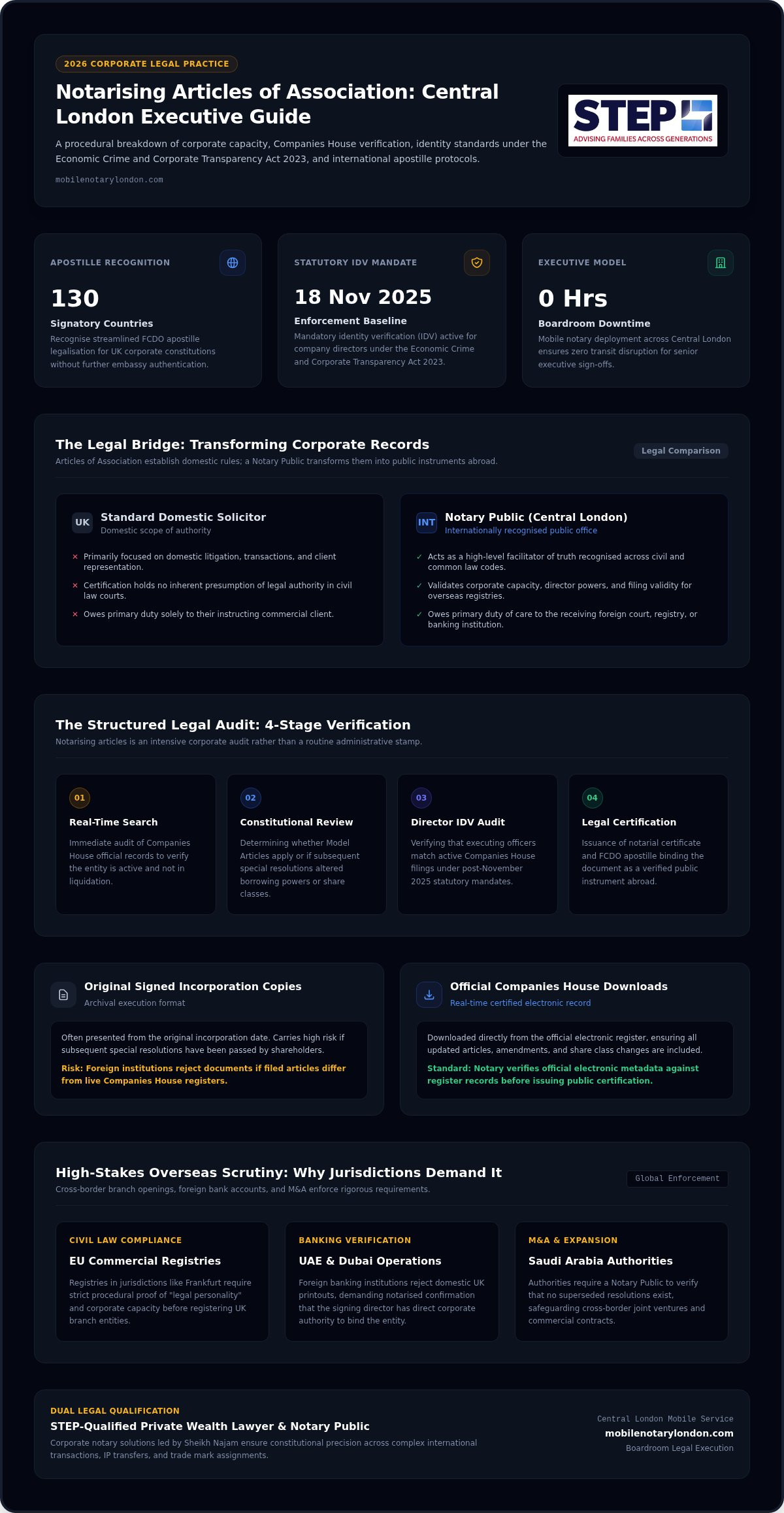
Every UK limited company operates under a specific constitutional framework known as the articles of association. This document serves as the internal rulebook, defining the relationship between the company, its shareholders, and its directors. Whilst these rules are sufficient for domestic operations, they lack inherent international recognition. When you are tasked with notarising articles of association Central London, you aren't just seeking a signature; you're securing the legal bridge between UK law and foreign commercial codes. A notary's certification transforms a private corporate document into a public instrument that foreign registries, banks, and courts can trust without further verification of the company's internal history.
The notarised document acts as definitive proof of corporate capacity. It confirms to an overseas party that the company exists, that it possesses the power to enter into a specific contract, and that the individual signing the paperwork has the delegated authority to bind the entity. Without this certification, a UK firm attempting to open a branch in Dubai or a subsidiary in Frankfurt will likely face immediate rejection from local authorities who cannot verify the validity of a standard Companies House printout.
Why Foreign Jurisdictions Demand Notarised Articles
In many civil law jurisdictions, the concept of "legal personality" is viewed with greater procedural rigour than in the UK. Authorities in the EU, Saudi Arabia, and the UAE don't simply accept a director's word on their powers. They require a Notary Public to act as a high-level facilitator of truth. The notary performs a real-time search of the official register, ensuring that no special resolutions have superseded the filed articles. This level of scrutiny is essential for compliance with the Economic Crime and Corporate Transparency Act 2023, especially as identity verification (IDV) becomes a mandatory enforcement standard for directors in late 2025 and 2026.
The Notary as a Facilitator of International Trade
It's important to distinguish the role of a Notary Public from that of a standard solicitor. Whilst solicitors handle domestic litigation and advice, a notary holds an internationally recognised public office. The notary owes a primary duty of care to the receiving party abroad, ensuring that the document is authentic and the transaction is lawful. This authority is particularly vital for complex assets. For instance, ensuring you have a specialised notary for trademark assignments is a critical step in securing international IP transfers. By utilising professional corporate notary services, businesses ensure their constitutional documents carry the necessary weight to facilitate seamless global expansion.
The Technical Verification Process for Company Constitutions
The procedure for notarising articles of association Central London is far from a mere administrative formality. It's a structured legal audit. A Notary Public must first confirm the constitutional integrity of the entity. This begins with a real-time search of the Companies House register to identify the "current" version of the articles. Many companies mistakenly present an original signed copy from their incorporation date, unaware that subsequent special resolutions may have altered their borrowing powers or share classes. The notary's role is to ensure that the document being certified is the exact version currently in force.
Verification via Companies House and Official Records
A notary doesn't just look at the document; they verify the status of the company itself. This involves confirming the company is active and not in liquidation. Since 18 November 2025, mandatory identity verification for directors has added a new layer of scrutiny to these checks. When I verify your company's constitution, I must ensure that the executing officers match the current register filings. This is particularly vital for bespoke constitutions that diverge from the standard Model Articles. If your firm has amended its rules, the notary must bundle the original articles with all subsequent resolutions to provide a complete legal picture for the recipient abroad.
Distinguishing Between Physical and Digital Notarisation
The choice between traditional wet-ink signatures and digital certification often depends on the recipient's requirements. For jurisdictions that accept electronic filing, the e-Apostille service offers a significant speed advantage. This process relies on a Qualified Electronic Signature (QES), which provides a higher level of security than standard digital marks. It's a digital-first approach that's becoming the standard for Central London firms operating in tech-forward markets.
However, many civil law jurisdictions still mandate physical notarisation. This involves a wet-ink signature, a notarial ribbon, and a wafer seal. Once the notary has certified the document, it may require further validation through the UK document legalisation service. This two-tier process ensures that the document is recognised as a valid public instrument under the 1961 Hague Convention. Understanding whether your target country accepts a digital bundle or requires a physical seal is the first step in avoiding costly delays. If you're unsure which route is appropriate for your transaction, you can reach out for a professional consultation to clarify the specific requirements for your destination.
The Advantage of Mobile Notary Services for Central London Firms
For many senior executives in the Square Mile or Mayfair, time is a non-renewable resource. Expecting a CEO or General Counsel to leave a high-stakes meeting to visit a notary's office is an inefficient use of corporate talent. The process of notarising articles of association Central London shouldn't involve a commute through heavy traffic or a wait in a traditional reception area. Instead, a mobile service brings the expertise directly to your headquarters. This approach ensures maximum discretion. Sensitive constitutional documents remain within the security of your own boardroom, avoiding the risks associated with transporting original registries across the city.
A premium mobile notary model serves as a strategic partner for firms that demand agility. As members of The Notaries Society, mobile practitioners adhere to the same rigorous authentication standards as office-based firms but with a focus on your convenience. This service is tailored for those who require immediate results without compromising on procedural rigor, as explained further in our guide on why mobile notary services are transforming corporate legal workflows.
Meeting Urgent Deadlines in the City and West End
Business deals in Central London rarely wait for administrative convenience. When a foreign bank account must be opened by close of business, a mobile notary provides the necessary speed. We facilitate same-day turnarounds by meeting you in private banks, legal chambers, or boardrooms. Local knowledge is vital here. Navigating the specific security protocols of buildings in Canary Wharf or the City requires a professional who understands the logistical landscape. This agility allows for the swift certification of company documents, ensuring that international transactions proceed without friction.
Corporate Notary Services: A White-Glove Approach
A premium service goes beyond a simple stamp. It involves a deep understanding of complex private wealth and corporate structures. Having a STEP-qualified professional handle your notarisation ensures that the nuances of your company's governance are respected and correctly reflected in the notarial certificate. This "white-glove" approach is particularly beneficial for high-net-worth individuals and boutique firms in the West End. It's a bespoke solution that is seamlessly integrated with our corporate notary services Mayfair offering. We prioritise your peace of mind by delivering elite qualifications directly to your desk, maintaining the dignity and weight of a formal legal practice whilst respecting your professional schedule.
Your 2026 Checklist for Notarising Articles of Association
Preparing for notarising articles of association Central London requires a methodical approach to ensure your documents aren't rejected at the final hurdle. In a fast-moving corporate environment, missing a single amendment or failing to verify a signatory's identity can lead to costly delays. Follow this five-step checklist to streamline your certification process.
- Step 1: Confirm Destination Requirements. Before booking, verify if the receiving authority requires a standard notarial certificate or full legalisation. As of September 2026, 130 countries are parties to the Hague Convention, but jurisdictions like the UAE or Qatar still mandate a multi-tier embassy process.
- Step 2: Retrieve the Latest Filings. Ensure you have the version of the Articles currently in force. If your company has passed special resolutions to amend its constitution, these must be bundled with the original incorporation documents.
- Step 3: Gather Signatory Identification. The appearing director or authorised signatory must provide original proof of identity and address. This aligns with the mandatory identity verification (IDV) rules enforced since November 2025.
- Step 4: Verify Corporate Standing. Confirm the company is active and that the board has authorised the specific transaction. Board minutes or a formal resolution are often required to prove the signatory's power to bind the entity.
- Step 5: Organise the Mobile Appointment. Once your paperwork is in order, schedule a visit from a mobile notary. This allows the certification to take place in your boardroom, ensuring the notarising articles of association Central London occurs without disrupting your executive schedule.
Essential Company Documentation and Director ID
Signatories must present a valid passport and a recent utility bill or bank statement, typically dated within the last three months. If your company is older than six months, the receiving party may request a Certificate of Good Standing. You can obtain a certified copy of your Articles from Companies House for a statutory fee of £22 for standard delivery or £65 for same-day service. These official documents provide the foundation for a valid notarial act.
Preparing for Apostille and Embassy Legalisation
Once notarised, documents bound for international use often require an Apostille from the Foreign, Commonwealth & Development Office (FCDO). The standard paper-based service is £45 per document, whilst the restricted urgent service is £100. For countries outside the Hague Convention, you'll need to factor in additional time for embassy attestation. For a detailed breakdown of fast-track options, consult our Urgent Apostille London buying guide. To ensure your corporate documents meet every international requirement, you can book your corporate notarisation appointment today.
Sheikh Najam: Expert Corporate Notary Solutions in Central London
Sheikh Najam TEP provides a specialised mobile service that caters to the specific demands of the London business community. As a STEP-qualified Private Wealth Lawyer, he brings a level of technical depth that standard notarial practices often lack. When notarising articles of association Central London, his dual expertise allows him to interpret complex constitutional documents with the precision of a seasoned legal advisor. This ensures that every certificate issued meets the rigorous standards of foreign registries and financial institutions alike.
The transition from booking to document delivery is handled with methodical efficiency. Clients benefit from a seamless workflow where the notary travels to their location, witnesses the necessary signatures, and manages the subsequent legalisation process. This comprehensive approach is detailed in the full range of notary and apostille services offered, providing a one-stop solution for firms with international ambitions. By integrating legal advice with notarial authentication, Sheikh Najam acts as a high-stakes facilitator for companies expanding across borders.
Bespoke Services for Private Wealth and Corporate Entities
High-value transactions require more than just a stamp; they demand absolute discretion. The practice specialises in assisting hedge funds, private equity firms, and family offices where confidentiality is paramount. Whether you're managing a complex cross-border merger or a sensitive restructuring, the service is tailored to the specific needs of your entity. For those facing immediate deadlines in the West End, the same day notary service Westminster ensures that urgent legalisations are completed without delay, maintaining the momentum of your transaction.
Securing Your Mobile Appointment Today
Efficiency is the cornerstone of this premium service. We understand that corporate schedules are subject to rapid change, which is why the booking process is designed for speed. You can secure a time that suits your board members directly through the online calendar. This system allows for immediate scheduling, ensuring that a professional is on-site exactly when needed.
The practice maintains a rapid response time across all major Central London postcodes, including W1, EC, WC, and SW. By bringing the notary's office to your boardroom, we eliminate the logistical burden of notarising articles of association Central London. Our commitment remains focused on delivering a premium, on-site experience that respects your time and protects your corporate interests. Every document is handled with the procedural rigour expected of a high-stakes legal facilitator, ensuring your company remains compliant on the global stage.
Securing Your Global Corporate Footprint
In the fast-paced environment of 2026 international business, your company's constitution is the bedrock of its global reputation. Ensuring that your Articles of Association are correctly notarised is a technical necessity that demands professional precision. By following our 2026 checklist, you've learned to navigate the nuances of Companies House filings and the specific demands of foreign jurisdictions. Choosing a STEP-qualified Private Wealth Lawyer for notarising articles of association Central London ensures that every detail is handled with the procedural rigour your transaction deserves.
Our premium mobile service is designed to integrate seamlessly with your schedule, providing same-day corporate document certification directly in your boardroom. This white-glove approach protects your time whilst securing the legal validity of your documents abroad. Don't let administrative delays hinder your international expansion. Book your urgent mobile notary appointment in Central London now to experience a service defined by calm efficiency and elite legal expertise. We're ready to facilitate your next global milestone with absolute discretion and professional authority.
Frequently Asked Questions
How long does it take to notarise Articles of Association in London?
Same-day certification is standard for urgent corporate requests. Once the documents are verified against the Companies House register, the physical act of notarising articles of association Central London takes approximately thirty minutes. The total turnaround depends on whether you require further legalisation. For firms in the City or Mayfair, mobile appointments are prioritised to ensure that international transaction deadlines are met without unnecessary delays or disruption to your executive schedule.
Can you notarise Articles of Association without me visiting an office?
No office visit is required as this is an exclusively mobile service. We provide premium, on-site notarisation at your headquarters, private bank, or legal chambers. This mobile-only model ensures maximum discretion and convenience for senior executives who cannot justify the time spent travelling to a traditional office. By bringing the notarial seal directly to your boardroom, we facilitate a seamless certification process that fits your professional schedule perfectly.
What is the difference between notarisation and an Apostille for company documents?
Notarisation is the initial act where a Notary Public authenticates the document and verifies the company's standing. An Apostille is a secondary certificate issued by the Foreign, Commonwealth & Development Office (FCDO) that confirms the notary's own authority. Whilst notarisation is the essential first step, most foreign jurisdictions under the Hague Convention require the Apostille to recognise the document as a valid public instrument for cross-border legal use.
Do I need to provide the original paper copy of my Articles of Association?
You don't necessarily need the original paper copy from your incorporation date. A notary can certify a version downloaded directly from the Companies House register. This ensures the document reflects all recent amendments and special resolutions. Companies House charges £22 for a standard certified copy or £65 for a same-day service. We verify these digital records in real-time to ensure your constitutional documents are current and legally robust.
Which Central London areas do you cover for corporate mobile notary services?
Our corporate mobile notary services cover all major business districts within Central London. This includes the financial heart of the City of London (EC postcodes), the legal hubs of Holborn and Chancery Lane (WC postcodes), and the premium corporate corridors of Mayfair and Westminster (W1 and SW postcodes). We also provide on-site certification for firms based in Canary Wharf, ensuring a rapid response for time-sensitive international transactions across the capital.
How much does it cost to notarise company documents for international use?
Fees for corporate notarisation are determined by the complexity of the company structure and the level of urgency required. Because every international transaction has unique requirements, such as the need for additional embassy attestation or a high volume of amending resolutions, we provide bespoke quotes for each instruction. This ensures transparency and reflects the specialised nature of notarising articles of association Central London for high-value corporate and private wealth clients.
Can you help with embassy legalisation after the notarisation is complete?
Yes, we manage the full legalisation chain for countries that are not members of the Hague Convention. Jurisdictions such as the UAE, Qatar, and Kuwait require a multi-tier process involving the FCDO and the relevant London embassy. We handle the logistical burden of submitting your notarised Articles of Association to these diplomatic missions, ensuring your documents receive the necessary consular stamps for full legal acceptance in the destination country without delay.
Is a mobile notary legally recognised for international bank account openings?
A mobile notary is fully recognised by international banks and regulatory bodies. The legal weight of a notarial act is derived from the notary's commission from the Court of Faculties, not the physical location where the document is signed. Whether the certification occurs in a traditional office or a corporate boardroom, the seal and signature of a registered Notary Public provide the definitive proof of validity required for overseas account openings.

Article by
Sheikh Najam
Sheikh Najam LLB, TEP, MCIArb is a Notary Public and Commissioner for Oaths based in Central London, offering notary services to corporate, commercial and private clients across the City of London and beyond. His work includes notarising board and shareholder resolutions, powers of attorney, and certified copies of constitutional documents for use with foreign registries, banks and courts, with apostille and legalisation arranged as part of the same instruction. Alongside his notarial practice, he is a STEP-qualified international private wealth lawyer advising on cross-border transactions, company formation, trust drafting and succession planning. He is regulated by the Faculty Office (Court of Faculties) of the Archbishop of Canterbury and is a member of The Notaries' Society of England and Wales, STEP, and The Association of European Attorneys.


