

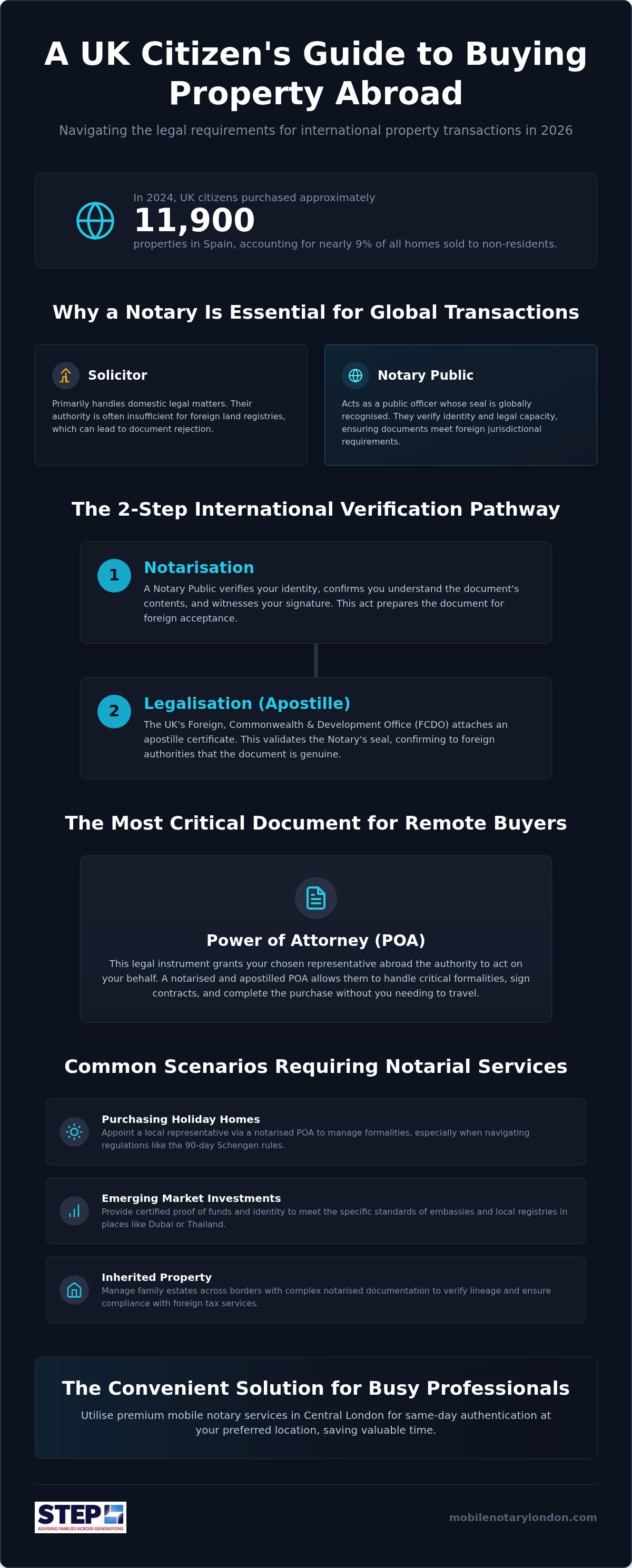
In 2024, UK citizens purchased approximately 11,900 properties in Spain, representing nearly 9% of all homes sold to non-residents. This figure highlights a growing ambition for international investment, yet many buyers find their plans stalled by the intricate demands of foreign land registries. Securing a qualified notary for UK citizens buying property abroad is no longer just a formality; it's the essential safeguard against bureaucratic rejection. You likely feel the pressure of tight deadlines and the frustration of trying to coordinate with overseas lawyers whilst managing a busy schedule in London.
We understand that the fear of a document being rejected due to a minor administrative oversight can be a significant source of stress. This guide promises to demystify the entire legalisation process for 2026, offering expert insights into notarisation and apostille requirements that ensure your paperwork is valid globally. We will explore how to efficiently handle Powers of Attorney and embassy legalisation, whilst highlighting the convenience of same-day mobile services in Central London. By the end of this article, you'll have a clear roadmap to navigate international property documentation with total confidence and precision.
Key Takeaways
- Understand the distinct role of a Notary Public as a public officer, ensuring your documents meet the specific jurisdictional requirements of foreign land registries.
- Identify the essential documentation required for remote transactions, specifically focusing on the Power of Attorney and AML compliance for UK buyers.
- Master the two-step verification process by learning how to secure a notary for UK citizens buying property abroad alongside the necessary FCDO apostille.
- Optimise your schedule by utilising premium mobile notary services in Central London, which provide same-day authentication at your preferred location.
- Benefit from specialised expertise in international private wealth to navigate the nuances of cross-border property and trust regulations with ease.
Why UK Citizens Require a Notary When Buying Property Abroad
While a solicitor is your primary advisor for domestic legal matters, they often lack the international standing required to authenticate documents for use in foreign courts or land registries. This is where a Notary Public becomes indispensable. As a public officer, a notary's seal is globally recognised; it serves as a vital bridge between the UK legal system and foreign jurisdictions. For those seeking a notary for UK citizens buying property abroad, understanding this distinction is the first step toward a successful transaction. Foreign authorities don't just want a signature. They require a high-level verification of identity and legal capacity that only a notary provides. Without this professional intervention, your international property ambitions can quickly stall due to bureaucratic friction.
A notary doesn't merely witness a signature; they verify the underlying facts of the transaction. They ensure you fully understand the document you're signing, which is especially critical if the paperwork is drafted in a foreign language. This methodical approach provides a layer of security that protects both the buyer and the foreign registry. It's about ensuring the validity of your transaction from the outset to prevent costly delays or outright rejections at the final hurdle. When you're investing significant capital across borders, the reassurance of a properly notarised deed is your best defence against procedural failure.
The Legal Weight of Notarisation in Foreign Jurisdictions
In civil law countries like Spain, France, and Italy, notarial acts carry what is known as probative value. This means the document is accepted as self-authenticating evidence of its contents. Unlike UK property transactions that might rely on simple witness signatures, foreign land registries demand that a notary independently verifies the buyer's willingness to sign and their mental capacity. This rigour prevents fraud and ensures the deed is legally binding from the moment it's presented to the foreign registrar. If you don't meet these specific standards, your documents risk immediate rejection. This can lead to missed completion dates and potential financial penalties that far outweigh the cost of professional notarial services.
Common Scenarios for UK Buyers in 2026
The landscape for international property has evolved significantly, and by mid-2026, the procedural requirements for UK citizens have become more stringent. Engaging a notary for UK citizens buying property abroad ensures these specific regional nuances are addressed before the paperwork leaves British soil. Common scenarios where you'll require specialised notarial intervention include:
- Purchasing Holiday Homes: Navigating the 90-day Schengen rules often requires appointing a local representative via a Power of Attorney notarised in London to handle on-the-ground formalities.
- Emerging Market Investments: Buyers targeting high-growth areas like Dubai or Thailand must provide certified proof of funds and identity that meet specific embassy and local registry standards.
- Inherited Property: Managing family estates across borders involves complex documentation to verify lineage and ensure tax compliance with foreign revenue services.
Whether you're handling a straightforward purchase or a complex family transfer, the role of the notary is to facilitate a seamless transition of ownership. They provide the expert advice on apostille requirements that keeps your transaction moving forward with calm efficiency.
Essential Documents for Overseas Property Transactions
Success in international property acquisition relies on the meticulous preparation of specific legal instruments. Securing a notary for UK citizens buying property abroad ensures that every document, from a simple ID certification to a complex deed, meets the exacting standards of foreign registries. Relying on an experienced notary for UK citizens buying property abroad prevents the administrative gridlock that often plagues cross-border investments. Missing a single requirement in 2026 can lead to the immediate rejection of your application, particularly in jurisdictions with digitised land registries that leave no room for clerical error.
The Power of Attorney: Giving Your Foreign Lawyer Authority
For remote buyers, the Power of Attorney (POA) is the most critical document. It allows your foreign lawyer to sign deeds, open bank accounts, and handle local taxes in your absence. You must decide between a specific POA, which limits authority to one transaction, and a general POA, which grants broader powers. Drafting these requires a delicate balance between foreign legal requirements and UK notarial standards. For a detailed breakdown of this process, see our guide on power of attorney notarisation London. Ensuring your POA is correctly witnessed and sealed is the only way to grant your representative the legal standing they need overseas.
Identity and Financial Verification (AML/KYC)
Foreign jurisdictions now demand rigorous Anti-Money Laundering (AML) and Know Your Customer (KYC) checks. This often involves notarising Land Registry ID1 forms or certifying current bank statements and proof of address. If you are applying for a "Golden Visa" or a high-value residency programme, the document legalisation process must be followed to the letter. As a STEP-qualified Private Wealth Lawyer, I specialise in verifying complex Source of Wealth (SOW) and Proof of Funds (POF) declarations. This level of professional certification is often the difference between a smooth capital transfer and a frozen transaction. Foreign banks are increasingly hesitant to accept non-notarised financial evidence, making expert verification a prerequisite for high-stakes buyers.
Beyond identity, you may need certified marital status certificates or birth certificates. These documents impact how property is held, particularly regarding inheritance laws and spousal rights in civil law countries. For those requiring urgent assistance with these complex documents, a specialist mobile notary can provide the necessary oversight at your convenience. Accurate documentation today prevents the legal headaches of tomorrow.
Notarisation vs Legalisation: Choosing the Right Service
Whilst notarisation is the foundational step in any international transaction, it is rarely the final one. Notarisation involves a notary verifying your identity and witnessing your signature on a deed or Power of Attorney. However, for a document to be legally binding in a foreign land registry, it usually requires an additional layer of verification from the UK government. This is where the distinction between a notary for UK citizens buying property abroad and the subsequent legalisation process becomes vital. Without both, your documents are merely private papers with no standing in a foreign court. The goal is to create a chain of authority that foreign officials can trust without hesitation.
Legalisation, commonly referred to as the "Apostille," is the Foreign, Commonwealth and Development Office (FCDO) certificate that confirms the notary's signature and seal are genuine. Think of it as a hierarchy of trust. The notary verifies you; the FCDO verifies the notary; and the foreign registry verifies the FCDO. For most European transactions, this two-step process is sufficient. However, for high-stakes buyers, bundling these services is the only way to ensure that deadlines are met and documents are accepted on the first submission.
The 2026 Apostille Process: Urgent vs Standard
As of 2024, the FCDO established a tiered fee structure that continues to dictate timelines in 2026. A standard paper-based apostille costs £45 per document, whilst an e-Apostille is available for £35. Property transactions, however, don't always allow for standard processing times. For buyers facing immediate completion deadlines, the urgent apostille London service is the only viable path. This fast-track option, priced at £100 per document for registered business users, ensures your paperwork is processed with the speed required to meet contractual obligations. Your choice between paper and digital certificates must be guided by your foreign lawyer's specific requirements, as not all registries have transitioned to electronic systems.
Consular and Embassy Legalisation Requirements
If you're investing in jurisdictions outside the Hague Convention, such as the UAE, Saudi Arabia, or Qatar, the process becomes more complex. These countries require embassy legalisation. This is a multi-stage marathon. First, the document is notarised. Second, it receives an FCDO apostille. Third, it is sent to the relevant embassy for a final stamp. A specialist notary for UK citizens buying property abroad will manage this entire sequence for you. Pitfalls abound here. Embassies often have specific requirements regarding document translation or the age of the document. Bundling these services ensures every stage is handled by a professional who understands the specific demands of Middle Eastern registries, preventing the rejection of high-value investment documents.
Preparing for Your Mobile Notary Appointment in Central London
Time is the most valuable asset for professionals operating in the capital. When you are coordinating a cross-border transaction, the traditional model of visiting a fixed office during business hours is often impractical. This is why a mobile notary for UK citizens buying property abroad has become the preferred choice for high-stakes buyers. By bringing the expertise of a public officer directly to your location, you eliminate the friction of travel and ensure your documents are handled with the discretion your transaction deserves. A mobile service doesn't just offer convenience; it provides the focused environment necessary to review complex international deeds without the distractions of a busy waiting room.
The process is designed for maximum efficiency. Once you have received your draft documents from your foreign lawyer, the first step is to organise a meeting at a location that suits your schedule. Whether it's a private residence in Belgravia, a corporate office in the City, or a members' club in Mayfair, the goal is to facilitate a seamless signing experience. During the meeting, the notary will verify your identity, assess your legal capacity, and ensure you understand the implications of the document. Following the appointment, the focus shifts to the administrative phase, where the notary handles the necessary legalisation and organises secure dispatch to your lawyer overseas.
What to Have Ready for the Notary
Preparation is the key to a successful appointment. To ensure your documents are processed without delay, you should have the following items ready:
- Identity Documents: Your original, valid passport and a recent proof of address, such as a utility bill or bank statement dated within the last three months.
- The Unsigned Document: It is vital that you do not sign the paperwork before the notary arrives. The notary must witness the act of signing to certify its validity.
- Specific Instructions: Foreign registries often have strict rules regarding ink colour (typically blue or black) and specific binding requirements. Ensure you have shared these instructions with the notary beforehand.
The Mobile Advantage in Central London
Our mobile notary Central London service is specifically tailored for those managing tight deadlines. We frequently facilitate same-day appointments across Westminster, Chelsea, and the City, providing a rapid response to urgent property completion dates. After the signing is complete, we can manage the secure dispatch of your documents via tracked services. Based on 2024 standards, expect courier fees to range from approximately £12 for Royal Mail within the UK to £45 for DHL to Europe. This end-to-end service ensures that your paperwork reaches its destination securely and on time. If you are facing a looming deadline, you can book a premium mobile appointment to secure your international investment today.
Sheikh Najam: Expert Facilitation for Global Property Buyers
Choosing a notary for UK citizens buying property abroad involves more than finding someone to witness a signature. It requires a professional who understands the gravity of international private wealth and the specific demands of foreign legal systems. Sheikh Najam brings a unique dual perspective to this role. As a STEP-qualified Private Wealth Lawyer and a Mobile Notary Public, he possesses the technical expertise to navigate the most complex cross-border property and trust matters. This background ensures that every document he authenticates isn't just procedurally correct but also aligns with the broader legal strategy of your transaction. He acts as a high-stakes facilitator, providing the calm efficiency required when millions of pounds in international investment are on the line.
His practice is built on a foundation of transparency, speed, and meticulous accuracy. Whether you're a first-time buyer in the EU or a seasoned investor in the Middle East, he provides the procedural rigour necessary to ensure your documents are accepted without hesitation. By specialising exclusively in mobile services across Central London, he offers a level of responsiveness that traditional, office-based practices simply cannot match. It's a premium, white-glove service designed for those who demand excellence and cannot afford the risk of document rejection.
Specialist Support for High-Net-Worth Individuals
Discretion is paramount for private wealth clients. Sheikh Najam provides a highly professional and discreet mobile service, often coordinating directly with family offices, private banks, and international legal teams. Navigating the document requirements for luxury overseas estates often involves more than just a Power of Attorney; it may require the notarisation of complex trust deeds or corporate authority documents. His immersion in the private wealth sector allows him to anticipate the questions foreign lawyers will ask, ensuring that the notarisation and legalisation process is handled with the appropriate level of sophistication. From Mayfair penthouses to villas in the Algarve, he ensures your paperwork reflects the premium nature of your investment.
Securing Your International Investment
Before your documents leave the UK, a final meticulous check is essential. Sheikh Najam provides a seamless bridge between your location in London and your final destination abroad. To secure your purchase, follow this final checklist:
- Verify Final Drafts: Ensure your foreign lawyer has approved the exact wording before the appointment.
- Confirm Legalisation Path: Double-check if the jurisdiction requires a standard apostille or full embassy legalisation.
- Secure Dispatch: Use tracked, high-priority couriers to ensure the safe arrival of your original deeds.
Securing a qualified notary for UK citizens buying property abroad is the final, critical step in your buying journey. To receive a bespoke quotation tailored to your specific transaction, contact the practice today. We specialise in providing the urgent, expert oversight needed to turn your international property ambitions into a legally secure reality.
Securing Your Global Future with Expert Notarisation
Navigating the complexities of international property law requires more than just administrative effort; it demands the precision of a specialist. By understanding the critical distinction between simple witnessing and formal legalisation, you've already taken the first step towards a successful overseas purchase. Whether you're coordinating an urgent Power of Attorney or managing high-value trust documents, the validity of your paperwork hinges on expert oversight. Relying on a dedicated notary for UK citizens buying property abroad ensures that every seal and signature meets the rigorous standards of foreign land registries.
Sheikh Najam, a STEP-qualified Private Wealth Lawyer, provides the elite level of certification needed for these high-stakes transactions. Our same-day mobile service across Central London brings this expertise directly to your door, whilst our deep knowledge of apostille and embassy legalisation prevents costly delays. Don't let bureaucratic friction stall your international ambitions. Book a same-day mobile notary appointment for your property documents to ensure your transition abroad is as seamless and secure as possible. Your international investment is within reach; let's ensure it's built on a foundation of legal excellence.
Frequently Asked Questions
Do I need a notary or a solicitor to buy property abroad?
You specifically require a notary to authenticate documents for international use. While a solicitor handles domestic conveyancing, a notary is a public officer whose seal is recognised by foreign land registries. For a notary for UK citizens buying property abroad, the role is to verify identity and legal capacity, providing the probative value required by civil law jurisdictions. A solicitor's certification is often insufficient for foreign authorities who demand a higher level of international authentication.
How much does a notary cost for property documents in London?
Professional fees for notarial services in London typically vary based on document complexity and the number of signatures required. Standard certifications for ID or passports often start at lower rates, whilst drafting and notarising a Power of Attorney involves more extensive legal work. It's advisable to request a bespoke quotation that accounts for travel if you require a mobile service. Factors like urgent processing or additional legalisation requirements will also influence the final professional investment.
Can a notary witness a signature for property in Spain or France?
Yes, a notary is specifically qualified to witness signatures on deeds and Powers of Attorney for use in Spain, France, and other European countries. These jurisdictions operate under civil law systems that mandate notarial intervention for property transfers. By engaging a notary for UK citizens buying property abroad, you ensure your signature is witnessed in a manner that complies with the foreign registry's strict evidentiary standards, preventing the risk of document rejection or costly delays.
How long does it take to get an apostille for property documents?
Processing times depend entirely on the service level chosen through the Foreign, Commonwealth and Development Office (FCDO). Standard paper-based applications currently take several working days to process. For urgent property completions, a fast-track business service can often secure an apostille within 24 hours. It's essential to factor in courier transit times when planning your completion schedule, especially if the original physical documents must reach a lawyer in a different country by a specific contractual date.
What is the difference between an apostille and embassy legalisation?
An apostille is a simplified certificate used between countries that are members of the Hague Convention, such as most EU nations. It's a single-step government verification of the notary's seal. Conversely, embassy legalisation is a multi-stage process required for non-Hague countries like the UAE or Qatar. This involves the FCDO apostille followed by a final stamp from the destination country's embassy in London, adding an extra layer of bureaucratic scrutiny to your property documents.
Can a mobile notary visit my office in the City of London?
Yes, a mobile notary can visit your corporate office in the City of London, as well as private clubs or residences in Mayfair and Belgravia. This premium service is designed for busy professionals who cannot afford to leave their desk during business hours. A mobile appointment allows the notary to verify your identity and witness your signature in a secure, convenient environment, ensuring your international property transaction stays on track without disrupting your professional schedule.
Will my notarised documents need to be translated?
Translation requirements are dictated by the foreign land registry or the receiving lawyer. Many jurisdictions require a certified translation if the document is not drafted in their official language. A notary can often certify the signature on a bilingual document, but you should confirm with your overseas representative whether the translation must be completed by a sworn translator in their country or if a UK-certified translation is acceptable for their specific local legal procedures.
Do I need to be present in the foreign country to sign the property deeds?
You don't usually need to be physically present if you have executed a notarised Power of Attorney (POA). This legal instrument allows you to appoint a trusted representative, such as a local lawyer, to sign the final purchase deeds on your behalf. This is a common solution for UK buyers who wish to complete a transaction remotely. The POA must be notarised and legalised in the UK before it is valid for use by your foreign representative.

Article by
Sheikh Najam
Sheikh Najam LLB, TEP, MCIArb is a Notary Public and Commissioner for Oaths based in Central London, offering notary services to corporate, commercial and private clients across the City of London and beyond. His work includes notarising board and shareholder resolutions, powers of attorney, and certified copies of constitutional documents for use with foreign registries, banks and courts, with apostille and legalisation arranged as part of the same instruction. Alongside his notarial practice, he is a STEP-qualified international private wealth lawyer advising on cross-border transactions, company formation, trust drafting and succession planning. He is regulated by the Faculty Office (Court of Faculties) of the Archbishop of Canterbury and is a member of The Notaries' Society of England and Wales, STEP, and The Association of European Attorneys.


