

Does a single stamp from the FCDO truly guarantee that your commercial contracts will be accepted in Jeddah or Riyadh without delay? Since Saudi Arabia joined the Hague Apostille Convention on 7 December 2022, the landscape for legalisation for use in Saudi Arabia has shifted dramatically. Whilst the removal of mandatory embassy attestation for many documents was intended to streamline international trade, the reality for London-based firms remains a maze of procedural nuances and unforgiving deadlines. You likely feel the pressure of securing high-stakes agreements whilst struggling to find the time to visit a traditional notary office during a hectic business day.
This guide provides a definitive roadmap for 2026, ensuring your documents meet every rigorous standard required by Saudi authorities. We will examine the essential steps for both personal and corporate filings, from navigating the Arab-British Chamber of Commerce requirements to utilising premium mobile notary services in Mayfair and the City for same-day results. By understanding these updated workflows, you can eliminate the risk of document rejection and move forward with absolute confidence in your international ventures.
Key Takeaways
- Understand how Saudi Arabia’s accession to the Hague Apostille Convention has simplified the verification process by removing the requirement for mandatory embassy attestation for most documents.
- Identify the specific certification requirements for different document types, including degree certificates, board resolutions, and complex Powers of Attorney.
- Learn the precise three-step workflow for legalisation for use in Saudi Arabia to ensure your paperwork is guaranteed for acceptance in Riyadh, Jeddah, or Dammam.
- Determine when commercial export documents require additional certification from the Arab-British Chamber of Commerce (ABCC) before receiving an FCDO Apostille.
- Discover how to secure same-day notarisation through a premium mobile service in Mayfair, Belgravia, or the City, overseen by a STEP-qualified Private Wealth Lawyer.
Understanding the Apostille Convention for Saudi Arabia
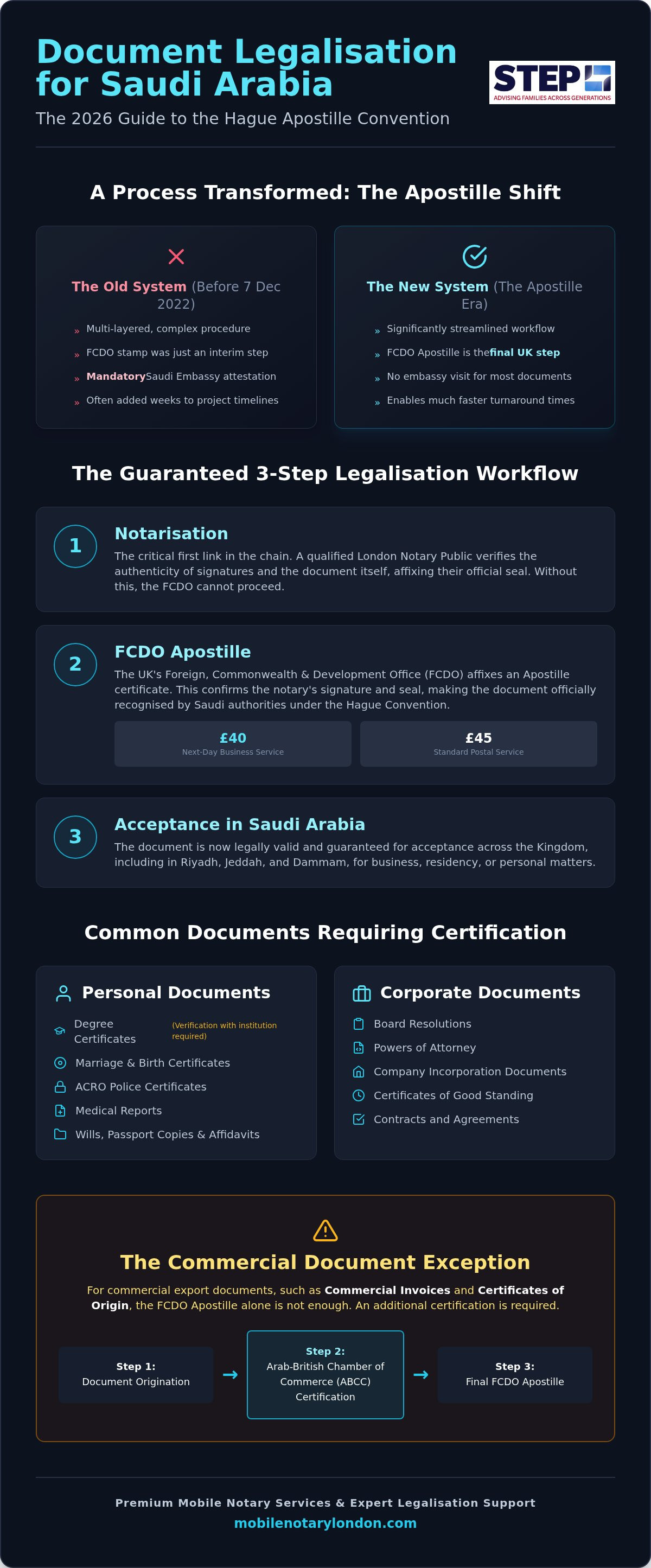
The Apostille for Saudi Arabia serves as the primary method of document verification since late 2022. This transition occurred on 7 December 2022, when the Kingdom formally joined the Apostille Convention, an international treaty that simplifies the process of authenticating documents for use abroad. Before this date, legalisation for use in Saudi Arabia was a multi-layered, often exhausting process that required physical attendance at the Saudi Embassy in London. Today, the system is significantly more streamlined, yet it remains procedural. A London notary acts as the critical first link in this chain; without a notary’s seal to verify the authenticity of a private or corporate signature, the UK government cannot issue the necessary certification.
The Legal Shift: Why the Saudi Embassy Step Changed
The move from traditional consular legalisation to Apostille certification has fundamentally altered the timeline for UK-based businesses. Under the old regime, documents had to be hand-delivered to the Saudi Embassy after being processed by the Foreign, Commonwealth & Development Office (FCDO). This often added weeks to a project's timeline. Now, the FCDO acts as the final UK authority for most personal and corporate paperwork. By affixing an Apostille, the FCDO confirms the signature and seal of the notary, making the document legally valid across all Saudi provinces. This change allows for much faster turnaround times, particularly when using the FCDO’s next-day business service, which carries a £40 fee for registered providers compared to the standard £45 postal route for the general public.
When the Apostille Alone is Not Enough
Despite the simplified treaty rules, certain high-stakes documents require more than just a government stamp. You must be aware that commercial invoices and certificates of origin typically still require involvement from the Arab-British Chamber of Commerce (ABCC). Saudi authorities often use the terms attestation and legalisation interchangeably, which creates significant confusion for those unfamiliar with Middle Eastern administrative law. If you present a commercial document in Riyadh that lacks the ABCC’s certification, it may be rejected despite having a valid Apostille. Common pitfalls include failing to account for these specific commercial requirements or using outdated templates that don't satisfy the current standards of the Saudi Ministry of Foreign Affairs. Expert oversight ensures that your specific document type follows the correct path, whether that involves a simple Apostille or a more complex multi-agency attestation.
Personal and Corporate Documents: What Needs Certification?
The range of documents requiring legalisation for use in Saudi Arabia has expanded as trade and relocation between London and the Kingdom accelerate. Whilst the Apostille simplifies the final step, the quality of the initial notarisation determines whether a document is accepted or rejected in Riyadh. Personal records such as marriage licences, Wills, and degree certificates form the backbone of residency applications. Academic documents, however, present a unique challenge. They must be verified with the issuing institution before a notary can certify them, a step that prevents the FCDO from rejecting the application. This verification confirms that the qualification is genuine, a prerequisite for the Saudi Ministry of Education.
Personal Legalisation: Visas and Residency
Securing a Saudi work permit requires meticulous attention to ACRO police certificates and medical reports. These documents must be original and recently issued to satisfy the Saudi Ministry of Foreign Affairs. For passport copies, a "true copy" certification by a notary is mandatory to prove identity for banking or property transactions. If you are managing complex family matters, such as inheritance or private wealth structures, the oversight of a STEP-qualified Private Wealth Lawyer ensures that these sensitive documents meet the highest international standards. This specialised knowledge is particularly useful when drafting documents that must be valid under both English and Saudi legal frameworks.
Corporate Legalisation: Expanding Your Business to the Kingdom
London firms frequently require the notarisation of company documents for London entities to establish branches in the Saudi market. Board resolutions, Articles of Association, and Certificates of Good Standing must be formatted precisely to align with Saudi banking regulations. A common requirement is Power of Attorney notarisation London, which empowers local representatives to sign contracts or manage assets on your behalf. Without this specific authorisation, UK directors may find themselves unable to execute critical business decisions in the Kingdom.
For export-related paperwork, you must also engage with the Arab-British Chamber of Commerce (ABCC) to certify commercial invoices before the Apostille is applied. This ensures that your trade documents bypass common pitfalls like customs delays or administrative rejections. If you are handling high-value corporate transitions, you might benefit from a premium notary Central London service that understands these specific workflows. This proactive approach ensures that every document, from a simple board minute to a complex trust deed, is prepared with the necessary procedural rigour for immediate acceptance.
The Three-Step Legalisation Process for Saudi Arabia
Achieving successful legalisation for use in Saudi Arabia requires a methodical approach that mirrors the Kingdom's own administrative rigour. The notary’s seal serves as the indispensable foundation of the entire legalisation chain, as it provides the essential verification of identity and authority that the UK government requires before it will issue a state-level certification. Without this initial professional validation, subsequent steps at the UK Government Legalisation Office cannot proceed. This three-stage workflow ensures your documents transition from a private London office to a recognised legal instrument in Riyadh with minimal friction.
Step 1: On-Site Notarisation in Central London
The process begins with a face-to-face meeting, often at a Mayfair office or a Belgravia residence, where a mobile notary witnesses the signing of your documents. This isn't merely a rubber-stamping exercise; it involves a meticulous check of your identity and, for corporate clients, a verification of your authority to bind the company to an agreement. Once satisfied, the notary applies a formal seal and silk ribbon. This physical binding is a hallmark of premium notarial practice, signalling to international authorities that the document has been handled with the highest level of professional scrutiny. It's this level of detail that prevents rejection further down the line.
Step 2: Navigating the FCDO Apostille Tiers
Once notarised, the document must be sent to the Foreign, Commonwealth & Development Office (FCDO) to receive an Apostille. For those facing tight commercial deadlines, an urgent apostille London service is the most effective way to bypass the 10 to 20 working day delays associated with standard postal applications. In 2026, whilst the FCDO offers electronic e-Apostilles, Saudi authorities still overwhelmingly prefer the traditional paper-based Apostille for high-value contracts and residency paperwork. Choosing the paper route ensures the FCDO confirms the notary's signature against their database without the queries that sometimes plague digital versions in Middle Eastern jurisdictions.
Step 3: Optional Chamber of Commerce or Embassy Attestation
Whilst most documents are finalised after the Apostille, specific sectors still require a third layer of verification. Commercial invoices and certificates of origin must be processed by the Arab-British Chamber of Commerce (ABCC). Although the 2022 Hague Convention rules removed the need for embassy legalisation for the majority of paperwork, certain niche legal instruments or older contract templates may still benefit from a final embassy check to guarantee acceptance. This final step acts as a "belt and braces" approach for high-stakes infrastructure projects or complex private wealth transfers, providing the final seal of approval for legalisation for use in Saudi Arabia.
Commercial Invoices and Export Documents: The ABCC Requirement
Trade between London and the Gulf relies on the meticulous preparation of export documentation. Whilst the Apostille provides the state's seal of approval on a signature, the Arab-British Chamber of Commerce (ABCC) remains the primary authority for validating the commercial substance of your shipment. This is where legalisation for use in Saudi Arabia takes on a dual character. For goods to clear customs, your paperwork must satisfy both international treaty standards and the specific trade protocols of the Arab League. A notary public facilitates this by providing the initial certification on commercial invoices or packing lists, ensuring that the LCCI and ABCC have a verified foundation to build upon.
Navigating the Arab-British Chamber of Commerce
The workflow for commercial documents destined for Riyadh is distinct from personal filings. Typically, a document like a Certificate of Origin must first be certified by the London Chamber of Commerce and Industry (LCCI) before it reaches the ABCC. In 2026, the ABCC fee for certifying an original document is £26.00 for members and £62.00 for non-members, excluding VAT. Rejections at this level often stem from minor clerical errors or the absence of a recognised notary's seal on supporting declarations. Working with a specialist who understands these specific "Chamber-first" routes ensures your documents don't bounce between agencies, a common cause of frustration for export managers.
Exporting Goods: Customs and Legal Compliance
Saudi Arabia's Zakat, Tax and Customs Authority (ZATCA) has implemented rigorous standards for electronic data matching and shipment verification. If your notarised packing lists and invoices do not align perfectly with your ZATCA filings, port clearance in Jeddah or Dammam can be delayed for weeks. This is why "white-glove" handling of these documents is not a luxury; it's a supply chain necessity for successful legalisation for use in Saudi Arabia. A mobile notary can visit your logistics hub or corporate headquarters to ensure all signatures are witnessed in real-time, preventing the administrative gaps that trigger customs audits.
If you are facing a tight shipment deadline, you can secure Corporate Notary Services to ensure your export documents are prioritised and prepared for immediate Chamber submission. This proactive approach eliminates the risk of supply chain bottlenecks and ensures your goods reach the Saudi market without procedural interference.
Mobile Notary Support in Central London for Saudi Legalisation
The demand for legalisation for use in Saudi Arabia often peaks during complex corporate restructuring or high-value property acquisitions. For time-poor professionals in Mayfair, Belgravia, and the City, the logistical challenge of coordinating signatures across multiple directors can be a significant bottleneck. A mobile notary eliminates the need for senior executives to leave their desks, providing a discreet and efficient solution that prioritises the client's peace of mind. This on-demand availability is essential for transactions involving high-stakes commercial contracts where timing is the difference between a successful deal and a missed opportunity.
Premium Service for the City and West End
City-based firms frequently require on-site notarisation during board meetings to ensure that resolutions are signed and sealed without delay. This proactive approach is particularly useful when handling a notary for US documents in London that may also require subsequent Saudi legalisation. By having a professional attend your premises in the West End or the City, you ensure that complex, multi-jurisdictional paperwork is handled with the necessary procedural rigour from the outset. Same-day mobile appointments are designed to meet these urgent business deadlines, ensuring that your international filings remain on track regardless of the complexity of the workflow.
Private Wealth and International Legal Advice
Sheikh Najam’s background as a STEP-qualified Private Wealth Lawyer provides a tier of expertise that goes beyond standard notarial practice. For family offices and private estates, legalisation for use in Saudi Arabia often involves sensitive trust deeds, Wills, or complex inheritance documents. This specialised legal insight ensures that every document is certified to align with both English law and the specific protocols expected by the Saudi Ministry of Foreign Affairs. Coordinating these matters requires a deep understanding of international private wealth structures, which is why a qualified lawyer’s oversight is so valuable for high-value personal transactions.
Confidentiality is a cornerstone of this premium service. Whether you are transacting at a private residence in Belgravia or a corporate suite in the City, the mobile service ensures that your sensitive legal instruments are handled with absolute discretion. This "white-glove" approach combines the gravity of legal compliance with the practical urgency of on-site delivery, providing a seamless experience for clients who require guaranteed document acceptance in Riyadh or Jeddah. By bridging the gap between London's legal requirements and Saudi Arabia's administrative standards, this service acts as a trusted facilitator for your most critical international ventures.
Securing Your Future in the Kingdom
Navigating the transition to the Hague Apostille Convention requires more than just understanding the rules; it demands procedural precision. Whether you are expanding a corporate footprint into Riyadh or managing private wealth in the West End, the foundation of successful legalisation for use in Saudi Arabia remains the quality of the initial notarisation. By ensuring your documents meet the exacting standards of the Arab-British Chamber of Commerce and the FCDO from the outset, you eliminate the risk of administrative delays at the Saudi border.
As a STEP-qualified Private Wealth Lawyer, Sheikh Najam provides a higher tier of expertise for complex international filings. If you are facing a tight deadline, you can Book a Premium Mobile Notary for Your Saudi Legalisation Today to benefit from urgent same-day mobile appointments across Mayfair, Belgravia, and the City. Your international ventures deserve the security of expert oversight. We are ready to facilitate your most critical documents with the efficiency and discretion they require, ensuring your transition to the Saudi market is seamless and professional.
Frequently Asked Questions
Do I still need to visit the Saudi Embassy in London for legalisation?
No, for the vast majority of documents, a visit to the Saudi Embassy is no longer required. Since Saudi Arabia joined the Hague Apostille Convention on 7 December 2022, a single Apostille from the FCDO is typically sufficient for legal recognition. Some specific commercial contracts or niche legal instruments might still require additional embassy attestation. It's always prudent to verify the exact requirements with your receiving authority in Riyadh or Jeddah before starting the process.
How long does it take to legalise a document for use in Saudi Arabia?
Timelines vary based on the service tier you select for your paperwork. Standard postal applications to the FCDO currently take approximately 10 to 20 working days. If your deadline is urgent, registered business providers can access a next-day service. When you factor in the initial notarisation and potential Chamber of Commerce certification, a realistic window for the complete process is often three to five business days for expedited cases or up to a month for standard postal routes.
Can I get a same-day Apostille for Saudi Arabia in Central London?
Whilst the FCDO doesn't offer a same-day walk-in service to the general public, you can achieve rapid results through a professional workflow. A mobile notary can provide same-day notarisation in Mayfair or the City, which is the essential first step. Following this, an urgent next-day Apostille can be secured through registered business agents. This combined approach is the fastest way to complete the legalisation for use in Saudi Arabia when facing tight commercial or residency deadlines.
Which documents for Saudi Arabia require notarisation before an Apostille?
Any document that isn't a direct UK government original, such as a birth or marriage certificate, requires notarisation first. This includes Powers of Attorney, corporate board resolutions, and educational certificates. The notary verifies the signature's authenticity and the signer's authority. Once the notary applies their seal, the FCDO can then affix the Apostille. Government-issued documents like ACRO police certificates can often go directly to the FCDO without a notary's involvement.
What is the difference between an Apostille and Chamber of Commerce attestation?
An Apostille is a government-level certification that validates the signature of a notary or public official. In contrast, Chamber of Commerce attestation, specifically through the Arab-British Chamber of Commerce (ABCC), is a trade-specific verification required for commercial invoices and certificates of origin. The Apostille satisfies international treaty obligations, whilst the ABCC certification ensures your export documentation meets the commercial standards required by Saudi customs authorities and the Zakat, Tax and Customs Authority.
Do I need a mobile notary if I am based in Mayfair or the City?
You aren't strictly required to use a mobile service, but it's the preferred choice for time-pressed professionals. If you're based in Mayfair or the City, a mobile notary can attend your office or residence during business hours, allowing you to witness signatures without disrupting your schedule. This "white-glove" approach is particularly beneficial for high-value transactions or board meetings where multiple directors need to sign documents simultaneously under the oversight of a qualified legal professional.
Are educational certificates treated differently for Saudi legalisation?
Yes, academic documents require a specific verification step before the process can move forward. Before a notary can certify a degree or transcript, they must verify the qualification's authenticity with the issuing UK university. This process ensures that the document is genuine before it proceeds to the FCDO for an Apostille. Because Saudi authorities are particularly rigorous regarding educational credentials for work permits, skipping this verification can lead to immediate rejection by the Saudi Ministry of Education.
What are the costs associated with Saudi legalisation in 2026?
In 2026, the FCDO charges a standard postal fee of £45 per document, whilst the business next-day service fee is £40. For commercial documents, the ABCC certification costs £26.00 for members and £62.00 for non-members, excluding VAT. Professional fees for notarisation typically start from around £80 to £125 plus VAT, depending on the complexity. You should also account for secure courier costs if you aren't using a mobile notary to handle the physical document logistics.
Article by
Sheikh Najam
Sheikh Najam LLB, TEP, MCIArb is a Notary Public and Commissioner for Oaths based in Central London, offering notary services to corporate, commercial and private clients across the City of London and beyond. His work includes notarising board and shareholder resolutions, powers of attorney, and certified copies of constitutional documents for use with foreign registries, banks and courts, with apostille and legalisation arranged as part of the same instruction. Alongside his notarial practice, he is a STEP-qualified international private wealth lawyer advising on cross-border transactions, company formation, trust drafting and succession planning. He is regulated by the Faculty Office (Court of Faculties) of the Archbishop of Canterbury and is a member of The Notaries' Society of England and Wales, STEP, and The Association of European Attorneys.


