

A single administrative oversight in a London office can result in the immediate rejection of your property transaction in Delhi or Mumbai. It's a common anxiety for those managing overseas assets; the fear that a confusing, multi-step legalisation process will lead to costly delays or document invalidity. You shouldn't have to sacrifice your professional schedule or navigate complex bureaucratic landscapes alone to ensure your affairs are in order. Finding a qualified notary for Indian power of attorney in London who understands both the Foreign, Commonwealth and Development Office (FCDO) protocols and Indian registration requirements is vital for your peace of mind.
This guide provides a comprehensive roadmap to mastering the notarisation and legalisation of your Indian Power of Attorney from the comfort of your home or office. We will detail the essential FCDO standards for 2026, explain the necessity of the Hague Apostille, and demonstrate how a premium mobile service delivers the procedural rigour required for a valid, registered document in India. By the end of this article, you'll possess the expert knowledge needed to facilitate urgent property transactions with calm efficiency and absolute legal certainty.
Key Takeaways
- Understand the essential role of a UK Notary Public in verifying your identity and signature to satisfy the rigorous compliance standards of Indian authorities.
- Distinguish between a General Power of Attorney and a Special Power of Attorney to ensure you grant the correct scope of authority for your specific property or financial matters.
- Master the three-step legalisation pathway, including how to secure a specialist notary for Indian power of attorney in London and obtain the vital FCDO apostille.
- Learn why your document must be drafted by an Indian legal expert to meet state-specific registration requirements and avoid rejection by local sub-registrars.
- Discover the advantages of a premium mobile service that facilitates same-day notarisation at your Central London home or office, ensuring you meet urgent deadlines with ease.
Understanding the Requirements for an Indian Power of Attorney in the UK
An Power of Attorney (POA) is a legal instrument that allows a person to appoint another to act on their behalf in legal or financial matters. For Indian citizens or Non-Resident Indians (NRIs) residing in the UK, this document is an indispensable tool for managing affairs in their home country without the need for international travel. Whether you're finalising a property sale in Mumbai, managing bank accounts in Delhi, or resolving complex inheritance matters across several states, the Indian legal system requires a strictly executed PoA to recognise the authority of your representative.
A UK-based NRI can't simply sign a document and post it to India for immediate use. Because the document is signed outside of Indian territory, it must be authenticated by a qualified professional to be legally binding. This is where a specialist notary for Indian power of attorney in London becomes essential. They bridge the gap between UK execution and Indian administrative requirements, ensuring that every signature is verified according to international standards and procedural rigour.
Why You Need a Notary for Indian Documents
The involvement of a Notary Public serves as a critical safeguard against fraud, particularly in high-value property transactions. Indian authorities, including the High Commission and local sub-registrars, demand a high level of verification that a standard solicitor cannot always provide. The notary's primary duty is to verify the identity of the person signing the document, confirming they have the legal capacity and the genuine willingness to grant these powers. Without this professional verification, documents are frequently rejected by Indian land registries or financial institutions, leading to missed deadlines and significant financial risk.
The Legal Framework: UK Notaries and Indian Law
India is a signatory to the Hague Apostille Convention, which simplifies the process of document legalisation between member nations. Following the latest 2026 FCDO guidelines, the process still requires a physical presence; you must sign the document in the actual presence of the notary. This physical meeting allows the notary to witness the execution first-hand, which is a non-negotiable requirement for Indian legal documents. A Notarial Act is the formal act of a Notary Public that provides a globally recognised guarantee of a document's authenticity and legal validity. Once the notary has applied their seal, the document typically proceeds to the FCDO for an apostille, completing the legal chain required for recognition by Indian officials.
GPA vs SPA: Choosing the Right Power of Attorney for India
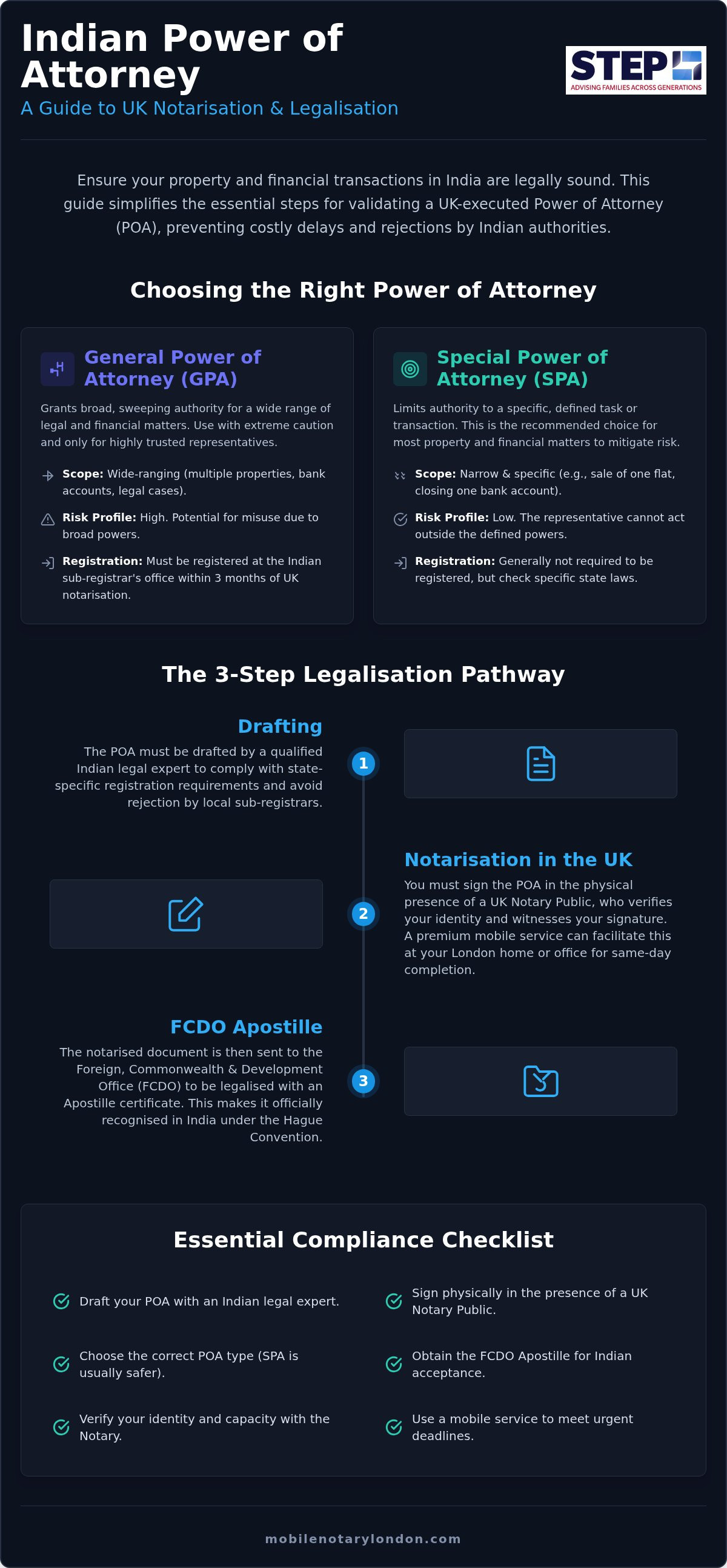
Choosing between a General Power of Attorney (GPA) and a Special Power of Attorney (SPA) is a critical decision that dictates the long-term safety of your Indian assets. A mistake here can lead to significant legal complications or, in the worst cases, the misuse of your authority. When you engage a notary for Indian power of attorney in London, they'll verify your identity for either document, but the legal weight and risk profile of each differs significantly under Indian law. It's essential to match the document's scope to your specific needs to maintain control over your affairs.
General Power of Attorney (GPA)
A GPA grants your representative broad, sweeping authority to act on your behalf across a wide range of financial and legal spectrums. It's typically reserved for scenarios where a highly trusted family member needs to manage multiple properties, handle various bank accounts, or represent you in ongoing court cases over several years. However, you must be aware that for a GPA to be valid for property transactions in India, it must be registered at the local sub-registrar office within three months of its notarisation in the UK. Because of its expansive nature, a GPA requires a high level of confidence in your chosen attorney.
Special Power of Attorney (SPA)
Most legal practitioners recommend an SPA for specific, one-off transactions. This might include the sale of a particular flat in Mumbai, the registration of a lease in Delhi, or the closure of a specific NRE bank account. By limiting the scope, you mitigate the risk of your attorney-in-fact acting beyond your intentions. You should clearly define the "expiry" or the exact completion of the task within the text of the document to ensure the power ceases once the goal is achieved. This transactional focus provides a layer of security that a broad GPA cannot offer.
Regardless of the type chosen, the document requires an apostille from the UK Government Legalisation Office after it's been notarised. This ensures the signature of the notary is recognised by international authorities and the Indian High Commission. The Supreme Court of India has previously clarified that a Power of Attorney cannot be used as a substitute for a sale deed to transfer property titles; it only allows the holder to sign the deed on your behalf. If you're unsure which document suits your upcoming property deadline, seeking expert mobile notary advice can help clarify the procedural requirements before you commit to a signature.
- GPA: Best for comprehensive, long-term management of multiple assets.
- SPA: Preferred for secure, single-transaction tasks like property sales.
- Registration: Mandatory in India for any document involving immovable property.
The 3-Step Process: From Notarisation to Indian Registration
Executing an Indian Power of Attorney from London involves a specific sequence of legalisations that must be followed with precision to ensure the document's validity in India. This chain of authentication moves from the local expertise of a notary for Indian power of attorney in London to the national authority of the UK government, and finally to the administrative offices in India. Each stage is designed to provide a layer of security that protects your interests and satisfies the rigorous standards of the Indian High Commission and local sub-registrars.
Step 1: The Notarial Appointment
The process begins with a physical meeting where the notary witnesses your signature in person. During this mobile appointment at your Central London location, you'll need to present your original passport and a recent proof of address to confirm your identity. The notary verifies your capacity and understanding before you sign the PoA. Once witnessed, the notary applies their official seal and a notarial certificate, which serves as the foundational "Notarial Act" for the entire legalisation chain. This professional verification is what transforms a private document into a public instrument capable of international recognition.
Step 2: FCDO Apostille and Legalisation
After notarisation, the document must be sent to the Foreign, Commonwealth and Development Office (FCDO) to receive an apostille. Since India is a signatory to the Hague Apostille Convention, this certificate confirms the notary's signature and seal are genuine, allowing Indian authorities to accept the document without further UK-based attestation. In 2026, the FCDO offers both standard and fast-track pathways. Whilst the standard postal service remains an option, many clients with tight property deadlines opt for a premium service to avoid lengthy delays. For those requiring immediate results, you can find detailed information in this Urgent Apostille London guide.
Step 3: Action Required in India
Once the legalised document arrives in India via secure courier, it must undergo "adjudication" or registration. This is a critical step where the document is stamped by the District Collector or Sub-Registrar in the jurisdiction where it will be used. You must complete this process within three months of the date of notarisation in the UK. Failure to meet this deadline will result in the document being rejected, requiring you to start the entire process again from London. For property-related PoAs, this registration is mandatory to ensure the document is legally valid for the transfer of immovable assets.
How to Organise Your Mobile Notary Appointment in Central London
Organising a professional legalisation service shouldn't be a source of stress. Whether you're based in the financial hub of the City or residing in the residential enclaves of Mayfair and Marylebone, the mobile service is designed to fit your demanding schedule. Securing a specialist notary for Indian power of attorney in London ensures your documents meet strict international standards without the need for you to travel to a fixed office. This "white-glove" approach prioritises your convenience whilst maintaining the procedural rigor required for high-stakes Indian property or financial matters.
Drafting and Preparation
Your journey begins long before the notary arrives at your door. It's essential to obtain your draft PoA directly from a qualified Indian lawyer who understands the specific requirements of the state where the document will be used. Indian sub-registrars are notoriously strict; a generic template often leads to rejection. You must ensure the "Donee" (your appointed attorney in India) has their details, including their full name and father's name, listed exactly as they appear on their government ID. It's vital that you leave the signature and date fields entirely blank until the notary arrives to witness the execution in person. For a deeper dive into these requirements, consult our Power of Attorney Notarisation London guide.
Identity and Residency Verification
When the notary arrives, they'll need to conduct a thorough identity check. For Indian PoA matters, your original passport is the primary requirement, though an OCI card is also highly recommended if you hold one. You'll also need to provide a recent proof of address, such as a utility bill or bank statement dated within the last three months, to confirm your London residency. If you're managing corporate assets, the requirements are more complex. For corporate matters, you'll also need to provide a Board Resolution or an Extract of Minutes authorising the signatory, alongside the company's constitutional documents. Having these ready ensures a seamless, efficient appointment that respects your time.
Don't let bureaucratic hurdles delay your overseas transactions. If you're ready to secure your legal interests in India with professional precision, you can book your mobile notary appointment today for a service that comes directly to your location.
Expert Mobile Notary Services for Indian Legal Matters in Central London
Sheikh Najam provides a bespoke solution for High-Net-Worth Individuals (HNWIs) who require a notary for Indian power of attorney in London but cannot afford the disruption of a traditional office visit. By combining his background as a STEP-qualified Private Wealth Lawyer with specialised notarial expertise, he ensures that every document is not only witnessed but also scrutinised for cross-border compliance. This dual perspective is invaluable for clients navigating the complexities of Indian succession laws or high-value real estate acquisitions in tech hubs like Hyderabad or Bangalore. It's about more than just a signature; it's about providing a sense of security that your legal instruments will withstand the scrutiny of Indian sub-registrars.
Premium Mobile Service in Central London
The service is strictly mobile, bringing elite legal certification directly to your residence or place of business in Belgravia, Knightsbridge, or Kensington. By eliminating the commute to a solicitor's office, you maintain the momentum of your transaction whilst ensuring absolute privacy. This agile approach is specifically tailored for those managing international private wealth, where the gravity of legal compliance must be balanced with the practical urgency of a mobile delivery model. Whether you're at a private club in Mayfair or a corporate headquarters in the City, the service adapts to your environment, providing a seamless "white-glove" experience that respects your professional commitments.
Urgent Legalisation and Apostille Support
In the fast-paced world of Indian property transactions, a missed deadline can lead to the immediate expiration of a PoA under the three-month adjudication rule. Sheikh Najam facilitates same-day notarisation, providing a critical advantage for clients facing tight windows for document submission in India. Beyond the initial signature, the service includes meticulous coordination of the FCDO apostille process, ensuring your original documents are handled with the highest level of security throughout the chain of legalisation. For those looking beyond the subcontinent to other jurisdictions, our guide on Notary for UK Citizens Buying Property Abroad offers further insights into managing global assets with procedural rigour. This comprehensive oversight ensures your documents are "India-ready" the moment they leave London, preventing the administrative burden and significant costs associated with document rejection by Indian authorities.
Choosing a specialist who understands both the London legal landscape and the specific demands of Indian administrative protocols is the most effective way to protect your interests. With a focus on reliability and transparency, this service provides the calm efficiency needed to navigate complex international requirements with ease. You don't just get a notary; you gain a trusted advisor capable of facilitating high-stakes transactions with precision and speed.
Securing Your Indian Property Interests with Professional Precision
Executing an Indian Power of Attorney from London requires a methodical approach to ensure cross-border validity. By selecting the correct instrument, whether a GPA for long-term management or a specific SPA for a single transaction, and adhering to the strict three-month adjudication deadline, you protect your assets from administrative rejection. Securing a specialist notary for Indian power of attorney in London is the vital first step in this complex chain of legalisation. As a STEP-qualified Private Wealth Lawyer, Sheikh Najam provides the procedural rigour and expert guidance necessary to navigate FCDO requirements and Indian property laws with absolute certainty.
You shouldn't let complex bureaucratic landscapes or rigid office hours disrupt your professional London schedule. Book your mobile notary appointment in Central London today to experience a premium, white-glove service that delivers same-day notarisation and urgent apostille support directly to your home or office. With expert oversight and elite qualifications, your transition into the Indian legal market will be seamless, efficient, and entirely secure.
Frequently Asked Questions
Does the Indian PoA need to be signed at the High Commission in London?
No, you don't need to visit the High Commission. You can execute your document before a qualified notary for Indian power of attorney in London. Because India is a signatory to the Hague Apostille Convention, a notarised document that has been legalised with an FCDO apostille is legally recognised by Indian authorities. This mobile-first approach is significantly more convenient for professionals who cannot attend the High Commission during restricted business hours.
How long does it take to notarise and apostille a PoA for India?
Notarisation via a mobile appointment is usually completed on the same day. The subsequent legalisation through the FCDO depends on the service level chosen. Standard postal applications currently take approximately 20 to 25 working days. However, using a premium legalisation agent can reduce this turnaround to between 3 and 10 working days. It's best to plan ahead to ensure you meet the three-month adjudication deadline required by Indian sub-registrars.
Can a mobile notary come to my office in the City of London?
Yes, the service is specifically tailored for Central London's professional hubs. Whether you're based in the City, Mayfair, or Belgravia, a mobile notary can visit your office or home at a time that suits your schedule. This "white-glove" delivery model ensures your Indian legal matters are handled with minimal disruption to your working day, providing a secure and efficient alternative to traditional, fixed-office solicitor appointments that require significant travel time.
Do I need an OCI card to sign a Power of Attorney for India?
You don't strictly require an OCI card to sign the document, as a valid Indian or British passport serves as your primary identification. However, Indian authorities and banks frequently request OCI details during the registration and adjudication process in India. It's advisable to have your OCI card available during the notarial appointment so the notary can include its details in their certificate, which often smoothens the acceptance of the document by officials abroad.
Is an Indian PoA valid if it is not apostilled by the FCDO?
An Indian PoA signed in the UK is generally not valid without an FCDO apostille. This certificate is the international standard that verifies the authenticity of the UK notary's seal and signature. Without it, Indian land registries, sub-registrars, and financial institutions have no way to confirm the document's legitimacy under the Hague Convention. Skipping this step almost certainly leads to the document being rejected by authorities in India, causing costly delays and missed deadlines.
What is the difference between attestation and notarisation for India?
Notarisation is the primary act where a UK Notary Public witnesses you signing the document and verifies your identity. Attestation is a secondary step often performed by the High Commission of India or VFS Global to verify the notary's credentials. However, for most modern transactions, the FCDO apostille serves as the definitive legalisation. It replaces the traditional attestation process, making your notarised document legally binding for use across all Indian states and territories.
Can I get a same-day apostille for my Indian Power of Attorney?
Whilst same-day notarisation is available through a mobile appointment, the FCDO apostille process typically takes longer. The government processing times for 2026 vary; however, you can expedite the timeline by using a premium legalisation service. These agents often secure an apostille within 24 to 48 hours. If you have an urgent property deadline in India, choosing this fast-track route is the most reliable way to ensure your Power of Attorney is legalised quickly.
How much does it cost to notarise an Indian PoA in London?
The cost depends on the complexity of the document and the specific requirements of the transaction. A standard notary for Indian power of attorney in London typically charges between £80 and £200 for notarisation. Additional costs apply for FCDO apostille fees, which range from £30 to £45 per document depending on the service level. Many clients opt for a comprehensive package that includes mobile travel, notarisation, and managed legalisation to ensure their documents are correctly handled.

Article by
Sheikh Najam
Sheikh Najam LLB, TEP, MCIArb is a Notary Public and Commissioner for Oaths based in Central London, offering notary services to corporate, commercial and private clients across the City of London and beyond. His work includes notarising board and shareholder resolutions, powers of attorney, and certified copies of constitutional documents for use with foreign registries, banks and courts, with apostille and legalisation arranged as part of the same instruction. Alongside his notarial practice, he is a STEP-qualified international private wealth lawyer advising on cross-border transactions, company formation, trust drafting and succession planning. He is regulated by the Faculty Office (Court of Faculties) of the Archbishop of Canterbury and is a member of The Notaries' Society of England and Wales, STEP, and The Association of European Attorneys.


