

Why do the most sophisticated international mergers often stall at the final hurdle because of a single missing stamp? For many London firms, the process of obtaining an apostille for Companies House documents feels like a descent into a bureaucratic maze of digital versus physical signatures and shifting FCDO requirements. You've likely felt the pressure of a looming deadline whilst waiting for a response from the Legalisation Office that doesn't arrive on time. It's a common frustration that can jeopardise high-value transactions and disrupt your core business operations.
This expert guide provides a definitive roadmap for mastering the legalisation of your UK corporate documents for international use in 2026. You'll learn how to handle the intricacies of certifying digital downloads. We'll also identify the most efficient routes to secure a valid apostille that foreign authorities will actually accept. We'll explore step-by-step strategies for urgent turnarounds, ensuring your documents are processed with the precision that London's fast-paced corporate environment demands. From understanding current FCDO processing times to leveraging professional mobile certification, you're about to gain total clarity over your international compliance needs.
Key Takeaways
- Understand the procedural necessity of FCDO legalisation under the Hague Convention for international banking and corporate compliance.
- Identify the specific corporate instruments, such as the Certificate of Incorporation and Articles of Association, that require certification for use abroad.
- Master the nuances of legalising digital PDF downloads, ensuring you obtain a valid apostille for Companies House documents without the need for traditional wet-ink originals.
- Accelerate your timeline by arranging a premium mobile notary appointment directly at your Central London office, bypassing the inherent risks and delays of the postal system.
- Optimise your administrative efficiency with secure, hand-delivered document handling tailored for the high-stakes requirements of Mayfair and City firms.
Understanding Companies House Apostilles for International Business
An apostille serves as a bridge between the UK’s corporate registry and foreign legal systems. It's a formal certificate issued by the Foreign, Commonwealth & Development Office (FCDO) under the 1961 Hague Convention. Without this specific validation, your UK corporate records are often considered mere pieces of paper by overseas authorities. When you obtain an apostille for Companies House documents, the FCDO is formally confirming that the signature, seal, or stamp on the document is genuine. This process is vital because it allows the recipient in another country to accept the document without further evidence of its origin.
The Registrar of Companies plays a central role in this chain. Most official company documents bear the signature of the Registrar or a delegated official. The FCDO maintains a comprehensive database of these signatures. By matching the signature on your document against their records, the FCDO can verify its authenticity with absolute certainty. This verification doesn't validate the business's financial health, but it does prove that the document was issued by a legitimate UK government body.
Why Corporate Documents Require Legalisation
International commerce relies on procedural rigor. If your firm is expanding into jurisdictions like Dubai, Singapore, or Switzerland, you'll encounter strict compliance requirements. To manage these complex legal frameworks, you might check out JZ Law for expert regulatory and corporate counsel. Foreign banks and government departments cannot verify the status of a UK company through a simple website search; they require a physical or digital "paper trail" that carries sovereign weight. Common scenarios where this is essential include:
- Opening overseas corporate bank accounts: Financial institutions require legalised proof of incorporation to satisfy Anti-Money Laundering (AML) and Know Your Customer (KYC) protocols.
- Establishing foreign branches: When registering a subsidiary or branch office, local authorities need to see your Memorandum and Articles of Association with a valid apostille. For firms expanding into Southeast Asian markets, protecting intellectual property through Henry Goh & Co is often a concurrent requirement.
- Proving director authority: In high-stakes international transactions, you must demonstrate that your directors have the legal capacity to bind the company to a contract.
The Role of the Foreign, Commonwealth & Development Office (FCDO)
The FCDO is the only UK body authorised to issue apostilles. They act as the final gatekeeper in the legalisation process. Whilst many agents claim to provide these services, they all eventually submit documents to the FCDO’s Legalisation Office. In 2026, the FCDO has integrated more robust digital verification processes into their workflow. This shift aims to reduce fraud but has also made the distinction between the standard postal service and the premium business service even more pronounced. For London-based firms, the premium route is often the only viable choice, as it allows for significantly faster processing than the standard postal channels, which can take weeks during peak periods.
Types of Company Documents Eligible for Legalisation
Not every document retrieved from the Companies House registry is immediately eligible for international use. Whilst the registry is a public record, foreign jurisdictions require specific, certified versions of these instruments to satisfy their local legal standards. The most fundamental document is the Certificate of Incorporation, which acts as the "birth certificate" of your business. Without an apostille for Companies House documents of this nature, you cannot prove your company's legal existence to an overseas bank or government body. Similarly, the Memorandum and Articles of Association are essential, as they define the internal governance and the limit of the company's powers.
Beyond these foundational papers, the FCDO frequently legalises filing histories. This includes historical Annual Returns and notifications regarding the Appointment of Directors. These records are vital when you need to demonstrate the historical continuity of the business or the specific timeline of executive changes. If you're unsure which specific filing is required for your transaction, you might wish to consult a specialist to avoid costly delays.
Certification of Good Standing and Confirmation Statements
There has been a notable shift in terminology at Companies House. The traditional "Certificate of Good Standing" is now often replaced by modern Certificates of Confirmation. These documents verify that a company is up to date with its filings and is not currently in the process of being struck off the register. It's a critical requirement for opening international credit lines. These certificates are notoriously time-sensitive; most foreign authorities, particularly in the Middle East and East Asia, require them to be issued less than three months prior to presentation. Engaging a notary for company documents London ensures that these downloads are correctly certified and ready for the FCDO's premium service before they expire.
Resolutions and Powers of Attorney
International expansion often necessitates the delegation of authority through board resolutions. These internal documents must be linked to your official filing history to prove that the directors signing them actually hold the power to do so. This is where a corporate notary's role becomes indispensable. By verifying the identity of the signatories and cross-referencing their status with Companies House, a notary can facilitate a power of attorney notarisation London that carries global weight. For busy executives in Mayfair or the City, a mobile notary can witness these signatures on-site, ensuring the entire legalisation chain remains secure and efficient.
Digital vs. Wet-Ink Certificates: The Certification Process
The transition from physical "wet-ink" certificates to digital PDF downloads has streamlined domestic business, but it has introduced a specific layer of complexity for international legalisation. Historically, the Registrar of Companies physically signed documents, allowing the FCDO to verify that signature directly. Today, most firms rely on electronic downloads for speed. However, the FCDO cannot issue an apostille for Companies House documents based on a standard printout of a PDF. Because the signature on the printout is merely a digital reproduction, the FCDO has no way to verify its authenticity against their database. They require a human intermediary, a notary or solicitor, to act as a bridge.
Notarial certification for electronic records involves more than just a stamp. A notary must verify that the document is a genuine download from the official Companies House registry. When a mobile notary visits your London office, they can witness the download in real-time. This provides an unparalleled level of security. By verifying the source of the digital document on-site, the notary can confidently certify that the printout is a "true and original" representation of the electronic record held by the Registrar. This procedural rigor is essential for maintaining the sovereign weight of the document abroad.
The Solicitor or Notary Certification Requirement
A public official must certify the document to give it the "official" status required by the FCDO. This isn't a generic signature. The FCDO mandates specific wording for a successful application. If the certification statement is imprecise or fails to identify the notary’s capacity, the application will be rejected. You can avoid delays with document legalisation by ensuring your notary uses the exact prescribed language that matches the 2026 FCDO standards. This meticulous approach ensures the legalisation chain remains unbroken from the registry to the foreign authority.
Verifying Electronic Signatures in 2026
As we move through 2026, the FCDO has refined its standards for accepting e-signatures on corporate documents. Whilst digital signatures are increasingly common, the notary still plays a vital role in verifying the identity of the signatory behind the screen. This is particularly important for board resolutions or powers of attorney. Beyond this verification, you must ensure the document meets the specific requirements of the receiving country. Some jurisdictions still maintain a preference for physical documents. The notary’s ability to convert a digital record into a certified physical copy is often the safest route to ensure your apostille for Companies House documents is accepted without question.
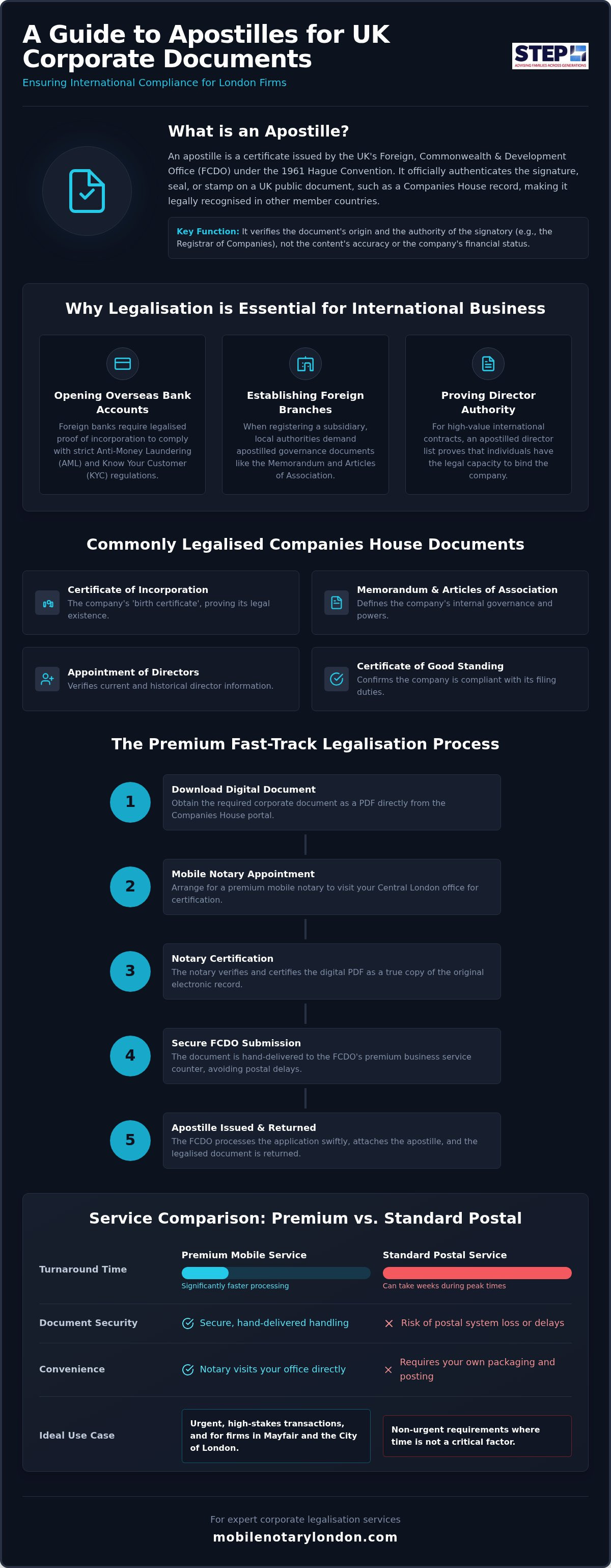
Step-by-Step Guide to Fast-Tracking Your Apostille in London
Securing an apostille for Companies House documents requires a methodical approach to avoid the common pitfalls of the standard postal route. For firms in the City or Mayfair, time is the primary constraint. Following this structured pathway ensures your legalisation is handled with the precision required for high-stakes international commerce. By integrating professional certification with a premium submission strategy, you can reduce processing times from weeks to mere hours.
- Step 1: Document Acquisition. Retrieve the necessary documents or digital downloads from the Companies House registry. Ensure these are the most recent versions, as many foreign authorities reject filings older than 90 days.
- Step 2: Mobile Coordination. Arrange a mobile notary appointment at your Central London headquarters. This eliminates the need to transport sensitive original documents across the city.
- Step 3: Professional Certification. The notary verifies the document's source and applies the required certification wording. This step is the gatekeeper for FCDO eligibility.
- Step 4: Premium Submission. Your certified documents are submitted via the FCDO premium fast-track route, which is reserved for registered business users and professional practitioners.
- Step 5: Secure Delivery. Once legalised, the documents are hand-delivered back to your office, bypassing the inherent risks of the standard postal system.
If your transaction is time-sensitive, you can book an urgent appointment today to begin this process immediately.
Using the FCDO Premium Service in Central London
The FCDO’s premium service remains the "gold standard" for urgent legalisation. Whilst the standard postal service is often subject to seasonal backlogs, the premium route offers next-day turnarounds for registered business users. A mobile notary facilitates access to these fast track apostille service London routes by ensuring every document is "submission-ready" before it reaches the Legalisation Office. Geographic proximity to the FCDO's central processing hubs allows for a level of agility that regional agents simply cannot match. This proximity is particularly beneficial when handling an apostille for Companies House documents that must be dispatched on evening flights to overseas jurisdictions.
Checklist for a Successful Application
Precision is paramount. Before submission, verify that the target country is a member of the Hague Convention; if not, you may require additional embassy legalisation. You must also ensure that no staples are removed or modifications made to the certified bundle after the notary has applied their seal. Finally, confirm that your chosen notary’s signature is already registered and on file with the FCDO database. This prevents the administrative delays that occur when the FCDO has to manually verify a practitioner’s credentials, a common issue with newly qualified or non-specialist solicitors.
Why Use a Premium Mobile Notary for Corporate Legalisation?
Many firms still rely on standard postal services, unaware of the inherent risks involved in such a choice. When you entrust high-value corporate records to the post, you're essentially relinquishing control over your company's most sensitive assets. A premium mobile service eliminates this vulnerability entirely. By having a practitioner visit your premises, you ensure that your original documents never leave your sight until they're ready for legalisation. This isn't just about security; it's about administrative efficiency. Instead of dispatching staff to a physical office, your legal team can remain focused on their core objectives whilst the notary handles the intricacies of obtaining an apostille for Companies House documents.
Beyond simple certification, working with a STEP-qualified professional provides a significant advantage for complex corporate structures. Sheikh Najam offers a level of insight that generic agents cannot provide, particularly regarding international private wealth legal matters. Whether you're navigating the requirements of a family trust or a cross-border merger, having a qualified lawyer certify your records ensures they meet the highest standards of international scrutiny. This dual expertise ensures that every apostille for Companies House documents is not only valid but also strategically aligned with your broader legal requirements.
The Mobile Advantage for Central London Firms
For firms in Mayfair or the City, a bespoke service is a necessity, not a luxury. A mobile notary provides on-demand assistance directly in your boardroom or executive suite. This direct handling of the urgent apostille London process ensures that confidentiality is maintained at every stage. There's no risk of documents being intercepted or misdirected through third-party couriers. This personalised approach prioritises your schedule, allowing for rapid turnarounds that match the velocity of modern international finance.
Booking Your Premium Appointment
Efficiency begins with a streamlined booking process. You can schedule your mobile notary session online to secure a same-day appointment. To ensure a seamless visit, prepare your documents in advance and confirm that all necessary directors or signatories are available to meet. If you're certifying digital records, ensure you have access to the official Companies House portal so the notary can witness the download on-site. This preparation, combined with professional expertise, ensures your documents are legalised with absolute precision and minimum disruption to your business operations.
Streamline Your International Compliance Today
Navigating the legalisation of corporate records doesn't have to be a source of administrative friction. By understanding the shift towards digital verification and the specific certification requirements of the FCDO, you can ensure your apostille for Companies House documents is processed without rejection. The key lies in moving away from slow, risky postal routes and embracing a more secure, agile approach that matches the pace of the City. Professional certification of digital downloads on-site provides the definitive proof of authenticity that foreign authorities demand.
As a STEP-qualified Private Wealth Lawyer and Central London mobile specialist, Sheikh Najam provides the high-level expertise needed for complex corporate needs. Whether you require same-day corporate notarisation or a comprehensive legalisation strategy for multiple jurisdictions, a tailored mobile service brings the solution directly to your desk. Don't let bureaucratic delays stall your international expansion. Take the first step towards a seamless transition by choosing a partner who prioritises your security and your schedule.
Book Your Premium Mobile Notary Appointment for Urgent Apostilles and secure the professional validation your business deserves.
Frequently Asked Questions
Can I get an apostille for a digital Companies House document?
Yes, you can obtain an apostille for a digital Companies House download, but it requires professional certification first. The FCDO cannot legalise a standard PDF printout because they cannot verify the digital signature directly. A notary must witness the download or verify the document's source to certify it as a true representation of the registry's record. This certification makes the digital file eligible for the physical apostille process.
How long does it take to get an apostille for company documents in London?
Processing times vary based on the chosen submission route. The standard postal service often takes several weeks depending on current FCDO backlogs. However, for urgent corporate needs, the premium business service in Central London can achieve a next-day turnaround. Choosing a mobile notary who is a registered business user of the Legalisation Office is the most reliable way to ensure your apostille for Companies House documents is fast-tracked.
Does a Certificate of Incorporation need to be notarised before an apostille?
A Certificate of Incorporation often requires notarisation, particularly if it's a digital version or if the receiving country demands a higher level of verification. Whilst original "wet-ink" certificates issued by the Registrar can sometimes be sent directly to the FCDO, most modern transactions involve digital copies. A notary’s seal confirms the document is genuine, which is a prerequisite for the FCDO to apply an apostille for international use.
What is the difference between an apostille and embassy legalisation?
An apostille is a simplified form of legalisation used between countries that are members of the Hague Convention. It's a single certificate that validates the document for use in all other member states. If the target country isn't a member, you'll likely need embassy legalisation. This is a multi-step process where the document is first apostilled by the FCDO and then further stamped by the destination country’s consulate.
Can a mobile notary come to my office in the City of London today?
Yes, same-day mobile appointments are available for businesses across the City of London and Mayfair. This service is designed for executives facing tight international deadlines who cannot afford the time to visit a traditional office. A mobile notary can visit your premises to witness signatures and certify your corporate filings on-site. This ensures that the legalisation process begins immediately without the delays or risks associated with the postal system.
Is an e-apostille suitable for Companies House documents?
An e-apostille is an electronic alternative to the traditional paper certificate, suitable for certain digitally certified records. Whilst the FCDO offers this service, its suitability depends entirely on whether the foreign authority or bank accepts digital legalisation. Many jurisdictions still require a physical apostille for Companies House documents to be bound to the paper record. You should always verify the requirements of the recipient before opting for the digital-only route.
What happens if the country I am sending documents to is not part of the Hague Convention?
If the destination country isn't a member of the Hague Convention, the apostille is only the first step in a longer legalisation chain. After the FCDO applies the apostille, the document must be presented to the relevant embassy or high commission in London for further attestation. This additional layer of verification ensures the document is recognised under the local laws of that specific country. A specialist can manage this entire multi-stage process for you.
How much does the FCDO charge for a premium apostille in 2026?
The FCDO sets specific fees for their premium and standard legalisation services, which are subject to periodic adjustment by the government. These fees are separate from any professional certification or notary charges. You should check the official gov.uk website for the most current 2026 pricing for the premium business service. Utilising a professional who has a registered account with the Legalisation Office ensures your application is handled through the correct fast-track channels.

Article by
Sheikh Najam
Sheikh Najam LLB, TEP, MCIArb is a Notary Public and Commissioner for Oaths based in Central London, offering notary services to corporate, commercial and private clients across the City of London and beyond. His work includes notarising board and shareholder resolutions, powers of attorney, and certified copies of constitutional documents for use with foreign registries, banks and courts, with apostille and legalisation arranged as part of the same instruction. Alongside his notarial practice, he is a STEP-qualified international private wealth lawyer advising on cross-border transactions, company formation, trust drafting and succession planning. He is regulated by the Faculty Office (Court of Faculties) of the Archbishop of Canterbury and is a member of The Notaries' Society of England and Wales, STEP, and The Association of European Attorneys.


