

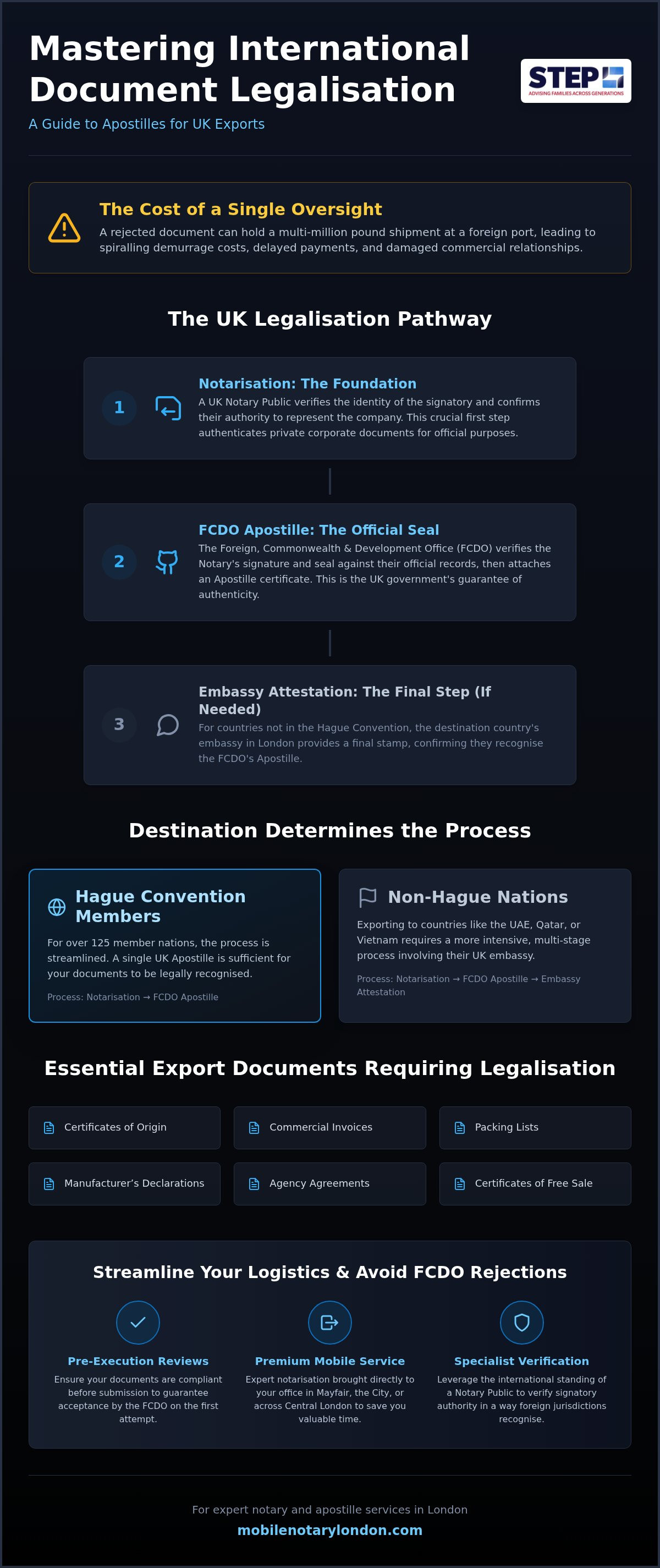
A single administrative oversight in your paperwork can hold a multi-million pound shipment hostage at a foreign port for weeks. You likely recognise that in the high-stakes environment of global trade, your logistics chain is only as resilient as your legal documentation. Securing an apostille for export documents often feels like a race against a ticking clock, especially when the distinction between a notary's seal and an FCDO apostille remains unclear.
It's frustrating to manage complex shipping manifests whilst worrying that a rejected Certificate of Incorporation might halt your entire operation. This guide provides the clarity you need to master international document legalisation, ensuring your goods move across borders with absolute certainty. We shall explore the essential 2026 procedural updates, the vital role of expert verification in preventing FCDO rejections, and how a premium, mobile approach to notarisation can secure your supply chain without requiring you to leave your London office.
Key Takeaways
- Understand why foreign customs authorities demand an apostille for export documents to validate the authenticity of your UK-issued commercial paperwork under the Hague Convention.
- Identify which specific certificates and invoices require formal notarisation before they can be submitted for FCDO legalisation to avoid costly border delays.
- Discover why the specialised international standing of a Notary Public is essential for verifying signatory authority in a way that foreign jurisdictions recognise.
- Learn how to implement fast-track strategies, such as pre-execution reviews, to ensure your documents are accepted by the FCDO on the first attempt without administrative friction.
- Explore the benefits of a premium mobile service that brings expert notarisation directly to your office in Mayfair or the City, streamlining your entire international logistics chain.
Understanding the Apostille Requirement for International Export
The apostille for export documents is a formal certification that authenticates the origin of a public document for use in foreign jurisdictions. Established under the Apostille Convention of 1961, this international protocol was designed to simplify the legalisation process by replacing the cumbersome chain of multiple attestations with a single, standardised certificate. It acts as a government-backed guarantee that the official who signed or sealed your document possesses the legal standing to do so. Without this verification, foreign customs officers cannot confirm the validity of a UK notary's seal, which often leads to administrative friction at the border.
The apostille serves as the essential bridge between UK corporate law and international customs clearance.
It's vital to distinguish between notarisation and the apostille itself. Notarisation is the initial step where a Notary Public verifies the identity of the person signing the document and confirms their authority to represent the company. The apostille is the second, higher-level verification where the FCDO confirms the standing of the notary, whilst ensuring the seal is registered on their official database. This two-tier system provides the procedural rigor required for high-value international trade.
The Legal Basis for Legalisation in Global Trade
In 2026, the Foreign, Commonwealth & Development Office (FCDO) remains the sole authority for issuing these certificates, processing all requests through its Milton Keynes facility. This strict legalisation framework is a critical safeguard against fraud within the international shipping and trade finance sectors. If your documentation is deemed invalid or lacks the necessary government seal, the consequences for your business are immediate. Banks will often refuse to honour Letters of Credit if the paperwork is not correctly legalised, and customs authorities may impound goods, resulting in spiralling demurrage costs and damaged commercial relationships.
Hague Convention vs. Embassy Legalisation
The complexity of your legalisation chain depends entirely on the destination country. For the 125 plus members of the Hague Convention, a standard UK apostille is sufficient for legal recognition. However, exporting to non-member nations, such as the UAE, Qatar, or Vietnam, requires a more intensive approach. These jurisdictions typically demand embassy or consulate attestation after the FCDO has issued the apostille. Navigating these varied requirements is a core component of Apostille and Embassy Legalisation services. We ensure that your paperwork meets the specific standards of the importing nation's consulate, as failure to account for these nuances often leads to documents being rejected at the final stage of the export process.
Essential Export Documents That Require Legalisation
The variety of paperwork involved in global trade can be overwhelming, yet obtaining an apostille for export documents is non-negotiable for most high-value transactions. Certificates of Origin are perhaps the most common requirement; they verify the source of your goods for tariff assessments and trade preference agreements. Without a verified origin, your shipment may face punitive duties or outright rejection at the port of entry. Similarly, Manufacturer’s Declarations and Agency Agreements are vital for securing your distribution rights in foreign territories, ensuring that your intellectual property and commercial interests remain protected under local law.
Commercial Invoices and Packing Lists present a unique challenge because they are private corporate documents rather than public records. Since the FCDO only legalises public signatures, these documents must be certified by a Notary Public before they are eligible for an apostille. The Hague Conference on Private International Law (HCCH) provides the framework for this recognition, but the initial notarial seal is what confirms the document's authenticity to the government. For a deeper look at this process, see our London Notary: Corporate Document Certification Guide 2026.
For businesses in the pharmaceutical, medical device, or cosmetic sectors, a Certificate of Free Sale is indispensable. This document proves that your products are already sold legally in the UK and comply with national safety standards. Importing authorities in Asia and the Middle East often insist on this being apostilled to bypass lengthy local safety trials. If you're unsure about your specific requirements, discussing your specific document list with a specialist can prevent last-minute administrative hurdles.
Certifying Company Status and Authority
Foreign customs and banking institutions often require proof that your business is a legitimate, active entity. A Certificate of Good Standing from Companies House is the standard solution, but it must be legalised to carry weight abroad. Articles of Association and Board Resolutions are also frequently requested during international tenders to prove that the individuals signing contracts have the legal authority to bind the company. You can find more detail on this in our Apostille for Companies House Documents: 2026 Guide.
Powers of Attorney for Foreign Agents
When you cannot be physically present to clear goods or sign distribution contracts, a Power of Attorney (POA) allows a local agent to act on your behalf. In civil law jurisdictions, the standards for these documents are exceptionally high. A simple signature isn't enough; the document requires precise notarisation to verify both the identity of the director and the company’s capacity to grant such powers. Our Power of Attorney Notarisation London: The Complete 2026 Guide explains how to satisfy these strict international requirements whilst maintaining your commercial momentum.
The Critical Role of a Notary Public in the Export Chain
Global commerce relies on trust, yet that trust must be codified through rigorous legal verification. Whilst many businesses assume a standard solicitor can handle their certification needs, the reality of securing an apostille for export documents is far more nuanced. A solicitor’s signature is often insufficient for international customs because their authority is primarily domestic. In contrast, a notary public is a specialist legal officer whose primary function is the authentication of documents for use abroad. A notary public acts as a high-authority witness whose seal is recognised globally. For firms whose international expansion includes physical assets or commercial projects in Australia, you may wish to check out Aquarius Lawyers for specialist property development legal guidance in New South Wales.
There are only approximately 750 Notaries Public in all of England & Wales, making them a rare and highly specialised branch of the legal profession. The FCDO often rejects commercial documents certified by solicitors because solicitors are not required to register their signatures and seals with the FCDO in the same rigorous manner as notaries. When you're managing time-sensitive logistics, a rejection at the Milton Keynes office due to an unrecognised solicitor's signature can cause weeks of delay. By engaging a STEP-qualified professional, you gain an added layer of security, ensuring that the legalisation chain remains unbroken from the moment of signature to the final customs clearance.
Verifying Corporate Capacity
A notary’s duty extends far beyond merely witnessing a signature; it involves a comprehensive verification of corporate capacity. This process ensures that the individual executing the document has the specific legal power to bind the company. We conduct thorough reviews of Companies House records and board resolutions to confirm that the signatory is authorised to act. This proactive approach is essential for preventing international legal disputes, as foreign jurisdictions often require a formal "Notarial Act" to prove the document's validity. Ensuring this capacity is correctly documented is vital when preparing an apostille for export documents, as any ambiguity in the signatory's authority can lead to the document being deemed void by a foreign court or customs authority. For those requiring Corporate Notary Services, our mobile service provides this expert verification directly at your office, maintaining both legal integrity and operational speed.
Fast-Track Strategies to Avoid Export Delays at the FCDO
Speed in global trade is rarely about rushing; it's about meticulous precision. Securing an apostille for export documents requires a methodical approach to bypass the standard 10 to 20 working day postal queue, which can otherwise cripple your logistics timeline. Your first step should always be a pre-execution review. By allowing a notary to examine your documents before they are signed, you ensure the wording meets the specific requirements of both the FCDO and the destination customs authority. This prevents the frustration of a document being rejected after it has already been dispatched to Milton Keynes.
Signatures must be original and witnessed in person to satisfy the most stringent international standards. Whilst the FCDO offers an e-Apostille service for £35, many importing nations still mandate physical, wet-ink signatures on paper certificates for commercial invoices and packing lists. For a comprehensive look at these requirements, consult our Avoiding Delays with Document Legalisation: The 2026 Essential Checklist. If your shipment is urgent, utilizing a registered business service is the most reliable strategy. These providers can access next-day or five-day turnaround windows that are unavailable to the general public.
Common Reasons for Document Rejection
Rejections often stem from minor technical oversights that are easily avoided with expert oversight. The FCDO frequently refuses documents if the notary's seal is faint or if the certification wording is deemed insufficient for the document type. Relying on unauthorised personnel to sign on behalf of the company or using expired filings from Companies House are also common pitfalls. Additionally, for non-Hague countries, failing to account for the secondary layer of embassy attestation will halt your shipment at the final hurdle. Precision at the notarisation stage is your best defence against these administrative setbacks.
Managing Urgent Timelines for Shipping
In 2026, the FCDO processing times for standard postal applications remain approximately 10 to 20 working days. Since the permanent closure of the London FCDO office in late 2023, all physical documents must be processed through the Milton Keynes hub. For London businesses, this makes the coordination of notary visits and courier collections vital. We align our mobile appointments with specific courier windows to ensure your apostille for export documents enters the legalisation chain immediately. Our Fast Track Apostille Service London: The 2026 Premium Legalisation Guide provides more detail on navigating these high-pressure deadlines. If you are facing an imminent shipping cut-off, contact our mobile team today to secure a priority appointment at your office.
Bespoke Mobile Notary Services for Central London Exporters
Managing the legalisation chain for an international shipment shouldn't require your senior directors to spend their afternoon in a waiting room across the city. Efficiency is the hallmark of a successful export operation, and our premium, white-glove service is designed to mirror that standard. By bringing the expertise of a STEP-qualified Private Wealth Lawyer directly to your boardroom, we eliminate the administrative friction that often accompanies securing an apostille for export documents. This approach allows your team to remain focused on core logistics whilst we handle the intricacies of corporate verification and government attestation.
We understand that the most demanding export deadlines often emerge without warning. To meet this urgency, we provide same-day mobile appointments across the capital, ensuring that your paperwork enters the legalisation process within hours of its execution. This is not merely a convenience; it's a strategic advantage for firms operating in high-stakes environments where a single day's delay can result in significant financial penalties or the loss of a time-sensitive contract.
Serving Key London Business Hubs
Our practitioners are a constant presence in London’s primary commercial districts. We provide dedicated Corporate Notary Services to Mayfair galleries dealing with high-value art exports and City financial firms managing complex cross-border trade finance. We also support the export-heavy enterprises and logistics hubs located within Westminster and Canary Wharf, where the volume of documentation requires a reliable, on-call legal resource. For a detailed look at our regional coverage, see our guide on Mobile Notary Central London: Premium On-Site Notarisation & Legalisation. This localised expertise ensures we're familiar with the specific signatory requirements common to the industries anchored in these hubs.
Why a Mobile Solution is Safer for Sensitive Documents
Security is paramount when handling original commercial papers that are often difficult or impossible to replace. A mobile solution significantly reduces the risk of losing vital documents in transit or through courier mishaps. By conducting the notarisation on-site, we can verify and correct any clerical errors immediately, ensuring the document is perfect before it's sent for an apostille for export documents. This face-to-face interaction also allows for direct communication regarding complex legalisation chains, providing you with the peace of mind that your international requirements are being managed with total procedural rigor. If you're ready to streamline your export documentation, you can book a mobile appointment at a time that suits your office schedule.
Secure Your Global Trade Momentum
Navigating the complexities of international trade requires more than just logistical efficiency; it demands absolute procedural excellence. By ensuring your apostille for export documents is handled with notarial precision, you eliminate the administrative risks that lead to costly customs delays and impounded goods. We have explored how expert verification, combined with fast-track FCDO strategies, provides the vital security needed for high-stakes shipments in the 2026 trade landscape.
Whether you are clearing goods through standard Hague Convention protocols or managing the more intensive requirements of embassy attestation, a proactive approach is your greatest asset. As a STEP-qualified Private Wealth Lawyer, I provide a premium mobile service across Central London, offering the specialised expertise in urgent international legalisation your business requires to maintain its competitive edge. Don't allow paperwork to become a bottleneck for your global growth.
Book an Urgent Mobile Notary Appointment for Your Export Documents and ensure your logistics chain remains uninterrupted.
Frequently Asked Questions
How long does it take to get an apostille for export documents in London?
Standard processing for an apostille for export documents through the FCDO postal service currently takes approximately 10 to 20 working days. However, for urgent business needs, registered service providers can access next-day or five-day turnaround windows. Since the FCDO's London office closed in late 2023, all documents are processed in Milton Keynes. We coordinate mobile appointments in Central London to ensure your paperwork enters the legalisation chain without a moment's delay.
Can I get an apostille for a commercial invoice without a notary?
You cannot obtain an apostille for a commercial invoice without prior notarisation. Because invoices are private corporate documents rather than public records, the FCDO requires a Notary Public to certify the signature and authority of the person who issued the document. This certification transforms the invoice into a public act that the government can then legalise. Skipping this step results in immediate rejection, potentially halting your shipment at a foreign port.
What is the difference between an apostille and embassy legalisation?
An apostille is a standardised certificate recognised by over 125 member countries of the Hague Convention. If your destination country is not a member, such as the UAE or Vietnam, you must undergo embassy legalisation. This is a multi-layered process where the document is first apostilled by the FCDO and then submitted to the relevant consulate or embassy for final attestation. We handle this entire chain for our Central London corporate clients.
Do I need to provide the original document for an export apostille?
Yes, the FCDO usually requires original documents for an export apostille, particularly for commercial invoices or certificates of origin. Whilst some documents can be processed as notarised copies, foreign customs authorities often insist on seeing the apostille attached to the original wet-ink signature. Providing the original ensures your paperwork meets the highest standard of validity, reducing the risk of administrative rejection during the customs clearance process in your destination country.
Which countries require export documents to be notarised before an apostille?
Which countries require export documents to be notarised before an apostille?
Most countries require notarisation for private business documents, but it is particularly critical for exports to civil law jurisdictions in Europe, Latin America, and the Middle East. These nations often demand that a Notary Public verifies the corporate capacity of the director signing the paperwork. Documents like Powers of Attorney or Board Resolutions must be notarised to prove they are legally binding before the FCDO will issue an apostille for export documents. For exporters expanding into the Far East, specifically, ensuring your trademark registration Malaysia is secured is also a common prerequisite for establishing local distribution and protecting your brand identity.
Our mobile service provides same-day notarisation across Central London business hubs like Mayfair and the City. Whilst the FCDO itself no longer offers a walk-in service in London, we can facilitate urgent legalisation through registered business channels. This allows us to coordinate the entire process, from witnessing your signature in your office to securing the apostille, far more quickly than standard postal routes, which is essential for time-sensitive shipping deadlines.
What happens if the FCDO rejects my export documents?
If the FCDO rejects your documents, the legalisation process must begin again from the start, often leading to missed shipping windows. Common reasons for rejection include faint notary seals, incorrect certification wording, or signatures from unauthorised personnel. Our premium mobile service includes a meticulous pre-execution review of all paperwork. This expert verification ensures your documents meet every FCDO and international standard before submission, providing total peace of mind for your logistics team.
Is an e-Apostille valid for all international export transactions?
No, the e-Apostille is not universally accepted for all export transactions. Although the FCDO offers digital certificates for certain documents, many importing nations and international banks still mandate traditional paper apostilles for commercial goods. Customs officers in many jurisdictions require physical, wet-ink signatures to verify the authenticity of shipping manifests and invoices. It is vital to confirm the specific requirements of your destination country's authorities before opting for a digital-only legalisation route.

Article by
Sheikh Najam
Sheikh Najam LLB, TEP, MCIArb is a Notary Public and Commissioner for Oaths based in Central London, offering notary services to corporate, commercial and private clients across the City of London and beyond. His work includes notarising board and shareholder resolutions, powers of attorney, and certified copies of constitutional documents for use with foreign registries, banks and courts, with apostille and legalisation arranged as part of the same instruction. Alongside his notarial practice, he is a STEP-qualified international private wealth lawyer advising on cross-border transactions, company formation, trust drafting and succession planning. He is regulated by the Faculty Office (Court of Faculties) of the Archbishop of Canterbury and is a member of The Notaries' Society of England and Wales, STEP, and The Association of European Attorneys.


