

Imagine standing in a Portuguese bank, only to find your property transaction has stalled because your paperwork lacks a specific stamp. It's a common frustration for those notarising a power of attorney for Portugal from London, where the intersection of British legal procedure and Portuguese administrative rigour often leads to costly delays. You shouldn't have to navigate the labyrinth of consulate appointments or confusing Apostille requirements alone when your assets are at stake.
Securing a legally binding Procuração can feel like a daunting task, especially when time-sensitive property deals in the Algarve or Lisbon are on the line. We understand that the fear of document rejection is a significant burden, and the traditional route of waiting weeks for a consulate slot is rarely an option for a busy professional. This guide provides a definitive 2026 checklist to ensure your documents are executed with absolute precision.
You'll discover how to streamline the process through mobile notarisation in Central London, understand the mandatory FCDO Apostille requirements, and learn the exact formatting standards required by Portuguese authorities. By following these steps, you can secure a fast-track legalisation that guarantees your document's validity without ever leaving the capital.
Key Takeaways
- Understand the critical distinction between a public consular document and a private notarised instrument to ensure your Portuguese Procuração is fit for purpose.
- Learn the mandatory preparation steps for notarising a power of attorney for Portugal, including the requirement for bilingual drafting and original identification.
- Discover the efficiency of mobile notary services that facilitate secure, in-person signing ceremonies at your Central London home or office to meet tight completion deadlines.
- Navigate the essential FCDO legalisation process to secure the physical Apostille sticker, a non-negotiable requirement for documents to be accepted by Portuguese registries.
- Gain professional insights into coordinating with your Portuguese Advogado or Solicitador to prevent document rejection and ensure a seamless property transaction.
What is a Portuguese Power of Attorney (Procuração)?
A Procuração is the essential legal instrument for Portuguese property and financial matters. It acts as a formal mandate, allowing you to delegate specific powers to a representative in Portugal without the need for you to be physically present. Whether you're acquiring a villa in the Algarve, selling assets in Lisbon, or managing a complex inheritance, this document is the bridge that keeps your international affairs moving. Without it, every signature would require a flight to Portugal, which is often impractical for busy London professionals.
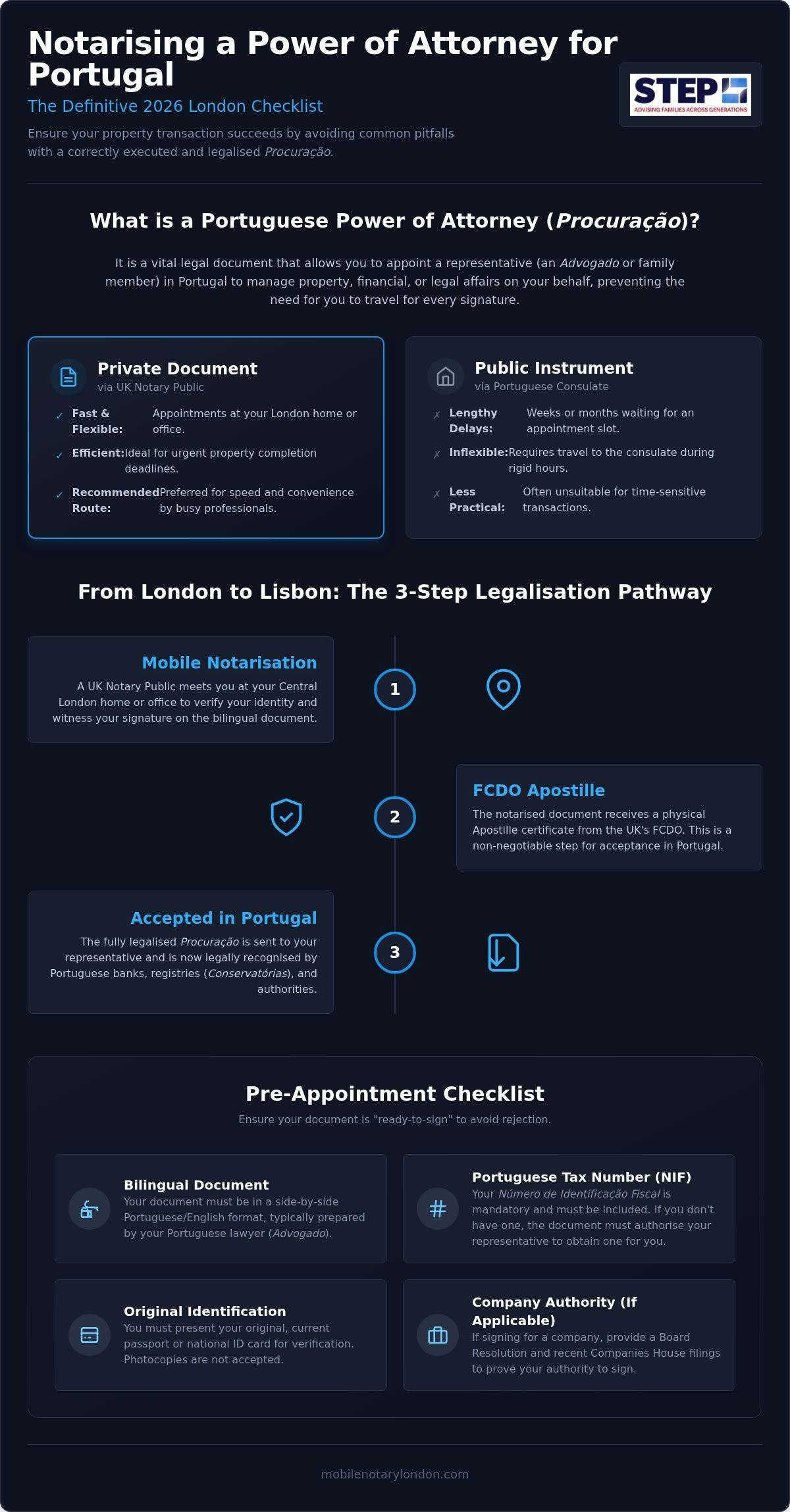
You'll generally encounter two types of this document. A "Public Instrument" is typically executed at a Portuguese Consulate, whilst a "Private Document" is the standard route when notarising a power of attorney for Portugal through a UK-based Notary Public. Both carry the same legal weight; however, the private route is frequently preferred by our clients in Mayfair and Belgravia. It offers a level of flexibility and speed that the consulate's busy appointment system simply cannot match.
Portuguese registries, known as Conservatórias, and local banks are notoriously strict about document formatting. They demand precise legal language and specific layouts to prevent fraud and ensure clarity. If your document isn't drafted correctly or lacks the necessary legalisation, these authorities will reject it immediately. This can cause significant delays in property completions, potentially leading to breach of contract or the loss of a deposit.
Key Parties Involved in the Document
Every Procuração involves three central figures who must be clearly identified to ensure the document's validity. First is the Grantor (Mandante), which is you, the individual in London granting the power. Second is the Attorney-in-Fact (Procurador), your representative in Portugal. This is usually a Portuguese lawyer (Advogado) or a trusted family member. Finally, the Notary Public serves as the professional officer who verifies your identity and witnesses your signature in the UK. This verification is a prerequisite for the Apostille Convention process, which makes the document legally recognisable in Portugal.
The Role of the NIF (Número de Identificação Fiscal)
You cannot conduct significant business in Portugal without a tax identification number. The NIF is the mandatory fiscal identifier for all Portuguese legal transactions. It's a non-negotiable requirement that your NIF is included in the Power of Attorney. If you've not yet obtained one, your document should specifically empower your representative to apply for a NIF on your behalf. Including these details when notarising a power of attorney for Portugal ensures that your representative can open bank accounts, pay property taxes, and sign deeds without hitting administrative roadblocks.
Pre-Appointment Checklist: Preparing Your Documents
Preparation is the difference between a seamless property completion and a rejected document. When notarising a power of attorney for Portugal, the groundwork starts long before the notary arrives at your doorstep. Portuguese law is highly prescriptive; you must ensure your document is "ready-to-sign" to avoid administrative friction. This involves a meticulous review of the text provided by your Portuguese legal counsel, ensuring every power granted is explicit and unambiguous.
If you're signing on behalf of a company, the evidentiary burden increases. You'll need to gather a Board Resolution specifically authorising the transaction, alongside current Companies House filings that confirm your authority as a director or secretary. These documents prove to the notary that the entity has the legal capacity to grant the power. Providing these files in advance allows for a smoother verification process during your appointment.
The Importance of Bilingual Drafting
A document drafted solely in English is essentially useless in Portugal without a certified translation. This adds unnecessary cost and significant delays to your transaction. We strongly recommend a side-by-side format where the Portuguese and English text appear on the same page. This prevents ambiguity and ensures all parties, including the Portuguese Conservatória, understand the exact scope of the mandate. Sheikh Najam can review the notarial certificate to ensure it aligns with these specific requirements and meets international standards.
Proof of Identity Standards
Identity verification is the cornerstone of the notarial act. You must present your original, valid passport at the time of signing. Whilst some jurisdictions accept national ID cards, the passport remains the global gold standard for the FCDO Apostille for Portugal process. Electronic copies or mobile phone images are never acceptable for this level of legalisation.
Additionally, you'll need proof of residence, such as a utility bill or bank statement, dated within the last three months. For non-UK citizens residing in London, ensure your documents clearly reflect your current address to satisfy both the notary and the Foreign, Commonwealth & Development Office. This level of rigour is what ensures your Procuração is beyond reproach when it reaches the registry.
Before the appointment, verify that the document explicitly mentions the specific actions required. Phrases like "property sale," "mortgage execution," or "tax representation" must be present. Portuguese banks often reject general powers if the specific transaction isn't detailed with precision. If you're unsure about the drafting, seeking expert guidance on international private wealth can prevent these common pitfalls and ensure your property deal stays on track.
The Notarisation Appointment: What to Expect in Central London
The appointment is the pivotal moment where your document gains legal force. Whilst previous steps focused on drafting and preparation, the meeting itself is about verification and formal execution. When notarising a power of attorney for Portugal, the physical presence of the grantor is a non-negotiable legal requirement. You cannot sign electronically or via a video call for this specific purpose. The notary must witness the act of signing in person to certify its authenticity for the Portuguese registries.
During the ceremony, the notary does more than just watch you sign. They are legally bound to confirm your capacity and willingness to enter into the agreement. This involves a brief dialogue to ensure you fully comprehend the scope of the powers you are granting to your representative. Once satisfied, the notary applies their official embossed seal and signature to the Procuração. This physical seal is a symbol of global trust, making the document ready for the next stage of international legalisation.
Mobile Notary Services in Mayfair and the City
Our service is designed for those who value time as their most precious asset. We provide a premium mobile notary service for executives and high-net-worth individuals who cannot afford to spend hours in a consulate waiting room. We frequently attend private residences and family offices across key postcodes, including W1 (Mayfair), SW1 (Belgravia), EC2 (The City), and WC1 (Holborn). This on-site convenience ensures that your property transaction remains a priority without disrupting your professional schedule. When notarising a power of attorney for Portugal under tight constraints, having a professional come to your office in the City provides unparalleled peace of mind.
Urgent Same-Day Appointments
Property transactions in Portugal often move with sudden urgency as the Escritura (completion) date approaches. If you've been let down by consulate delays or last-minute document changes, a mobile notary offers the agility you need. Same-day notarisation is often the only way to meet strict Portuguese property deadlines. By arranging a mobile visit on short notice, you bypass the weeks of waiting typically associated with government appointments. This reactive service ensures your documents are signed, sealed, and ready for the Apostille office within hours, rather than weeks. It is the most efficient route to ensuring your transaction proceeds without a hitch.
Post-Notarisation: The Essential FCDO Apostille for Portugal
The process of notarising a power of attorney for Portugal is only the first stage of the journey. To be legally recognised by Portuguese authorities, your document must undergo formal legalisation at the Foreign, Commonwealth & Development Office (FCDO). This is known as the Hague Apostille process. It involves the issuance of a specific certificate that verifies the signature and seal of the Notary Public, ensuring the document is authentic and fit for international use. Portugal is particularly strict about this requirement; they demand a physical Apostille sticker permanently affixed to the reverse of the original document.
There are three distinct steps to this final verification. First, the notarised document is submitted to the FCDO for inspection. Second, the office verifies the Notary’s standing against their central registry. Finally, the Apostille is issued and embossed onto the document. For those notarising a power of attorney for Portugal, the choice of legalisation speed is often the most critical decision in the entire transaction timeline, as a delay here can jeopardize your completion date.
Standard vs Urgent Legalisation
Choosing the correct processing speed is vital for high-stakes property deals. In August 2026, the standard post-based service from the FCDO typically takes between 15 and 20 working days. This timeframe is often incompatible with the practical urgency of a Portuguese property completion. Whilst an e-Apostille service exists with a two-day turnaround, Portuguese registries and banks generally demand the traditional paper-based document for property deeds. For critical matters, urgent fast-track legalisation is the only viable path. Sheikh Najam facilitates this premium service by utilising registered business channels to secure next-day turnaround times, bypassing the standard government backlogs.
Final Delivery to Portugal
Once the Apostille is secured, the original document must be dispatched to Portugal with absolute security. A digital scan might satisfy your lawyer for a preliminary review, but the final Escritura (completion deed) requires the physical paper with the embossed seal and Apostille sticker. We always advise using secure international couriers like DHL or FedEx rather than standard mail. Tracking your document from London to the Portuguese Notary’s office provides a necessary layer of transparency and peace of mind for such a sensitive legal instrument.
If your property transaction requires immediate action, you can book your urgent Apostille and legalisation service to ensure your documents reach Portugal without delay.
Why Choose a Mobile Notary for Your Portuguese Property Transaction?
Choosing a mobile notary is a strategic decision that prioritises the security of your international assets whilst respecting the value of your time. When notarising a power of attorney for Portugal, the margin for error is non-existent. A single clerical oversight or a failure to meet the specific standards of a Portuguese registry can result in expensive rejection fees and the collapse of a property chain. By engaging a specialist who understands the broader legal context of your transaction, you ensure that the document is right first time.
Our service provides seamless coordination with your Portuguese Advogado or Solicitador. We don't just witness a signature; we act as a high-stakes facilitator, ensuring the final Procuração aligns perfectly with the requirements of the local Conservatória. This proactive approach eliminates the need to fly to Portugal or navigate the often-congested consulate appointment systems, allowing you to manage your affairs with calm efficiency from the comfort of your London office or residence.
The Advantage of a STEP-Qualified Professional
Sheikh Najam’s background as a STEP-qualified Private Wealth Lawyer adds a layer of professional rigour that standard notary services often lack. This qualification is a global benchmark for practitioners specialising in inheritance and succession planning, providing a level of security that is essential for high-value transactions in Mayfair and Belgravia. Our expertise extends to various international protocols, including the specific nuances of an Indian Power of Attorney, which allows us to identify and resolve potential cross-border conflicts before they arise. This sophisticated understanding ensures that your Portuguese documents are executed with the same level of care as your domestic legal affairs.
Securing Your Mobile Appointment Today
The process for notarising a power of attorney for Portugal is designed to be as direct and transparent as possible. It begins with a simple digital review: you send a scan of your draft document to our team, and we provide a fixed-fee quote based on your specific needs and location. Once agreed, we schedule a visit to your home, office, or family office at a time that suits your diary. We maintain consistent availability across Central London to assist with urgent property matters that cannot wait for a standard office appointment.
- Step 1: Email your draft Procuração for a preliminary review.
- Step 2: Receive a clear, transparent quote for the notarisation and Apostille.
- Step 3: Confirm your mobile appointment and secure your signature.
Don't let administrative backlogs at the consulate jeopardise your investment. Contact us today to secure your mobile appointment and ensure your Portuguese property completion proceeds without delay.
Secure Your Portuguese Property Transaction with Expert Legalisation
Achieving a successful property completion in Lisbon or the Algarve depends on the precision of your documentation. By following our 2026 checklist, you ensure that every requirement, from bilingual drafting to the physical Apostille sticker, is met with absolute rigour. Navigating the complexities of international law doesn't have to be a source of stress when you have the right professional support. Notarising a power of attorney for Portugal through a specialist service ensures your Procuração is beyond reproach at the registry.
As a STEP-qualified Private Wealth Lawyer, Sheikh Najam provides a premium level of expertise tailored to high-value transactions. Our same-day mobile service across Central London eliminates the delays of consulate appointments, bringing the signing ceremony directly to your home or office. We specialise in Portuguese property and corporate legalisation, ensuring your documents are valid and ready for immediate use abroad. Don't leave your investment to chance; Book Your Mobile Notary Appointment for Portugal Today and move forward with confidence. Your international affairs are in safe hands.
Frequently Asked Questions
Does a Power of Attorney for Portugal need to be in Portuguese?
Yes, a Power of Attorney for Portugal must be drafted in Portuguese or provided as a bilingual document. Portuguese registries, known as Conservatórias, will not accept a document written solely in English. We strongly recommend a side-by-side bilingual format. This ensures that you, the grantor in London, fully understand the powers you are delegating whilst simultaneously satisfying the strict linguistic requirements of the Portuguese legal system without needing additional translations.
How long does it take to notarise a document for Portugal in London?
The notarisation itself can be completed in a single appointment, often on a same-day basis through our mobile service. However, the total time depends on the legalisation stage. Whilst the notarisation is immediate, a standard FCDO Apostille can take 15 to 20 working days in 2026. If your property completion is urgent, we can facilitate a premium fast-track service that secures the necessary legalisation within 24 hours of your signing ceremony.
Is an Apostille mandatory for a Portuguese Power of Attorney?
Yes, an Apostille is an absolute requirement for any Power of Attorney notarised in the UK for use in Portugal. Under the Hague Apostille Convention, this certificate from the FCDO is the only way to verify the notary's authority to Portuguese officials. Without this physical sticker affixed to the document, the Portuguese notary or bank will reject the Procuração, as they have no other way to verify the document's international validity.
Can a solicitor notarise my document for Portugal?
No, a standard solicitor cannot notarise your document for use abroad. Whilst solicitors can witness signatures for domestic UK matters, only a Notary Public is authorised to certify documents for international use. The FCDO will only issue an Apostille for documents signed by a registered Notary. Choosing a Notary who is also a STEP-qualified lawyer ensures that your document meets the specific international private wealth standards required for complex Portuguese property transactions.
What is the cost of notarising a Power of Attorney for Portugal?
The total cost varies based on the number of signatories, the complexity of the document, and the required speed of legalisation. Fees typically include the notary's professional time for the appointment and the mandatory FCDO disbursement fees for the Apostille. For a precise figure tailored to your specific transaction in Lisbon or the Algarve, we provide transparent, fixed-fee quotes once we have reviewed a digital scan of your draft Power of Attorney.
Can I sign the Procuração electronically for use in Portugal?
No, you cannot sign a Procuração electronically for property or financial transactions in Portugal. Portuguese law requires a "wet ink" signature witnessed in person by a Notary Public to ensure the document's authenticity. Whilst digital solutions are growing in other sectors, the Portuguese registries and banks still demand physical documents with embossed seals and original signatures. Attempting to use an electronic signature will lead to the immediate rejection of your document by Portuguese authorities.
Will the Portuguese Consulate accept a document notarised by a mobile notary?
Yes, the Portuguese Consulate in London fully recognises and accepts documents that have been notarised by a UK Notary Public and subsequently legalised with an Apostille. This is a standard legal path provided by the Hague Convention. Many clients find that notarising a power of attorney for Portugal via a mobile notary is significantly faster than waiting weeks for a consulate appointment, offering a flexible alternative that fits into a busy professional schedule.
What happens if there is an error in the Portuguese draft?
If there is an error in the Portuguese draft, the document will likely be rejected by the registry or bank in Portugal. This is why we insist on a digital review before your appointment. When notarising a power of attorney for Portugal, we check the notarial certificate for compliance, but the core powers must be drafted correctly by your Portuguese lawyer. Identifying mistakes early prevents the need for a second appointment and avoids expensive delays in your transaction.

Article by
Sheikh Najam
Sheikh Najam LLB, TEP, MCIArb is a Notary Public and Commissioner for Oaths based in Central London, offering notary services to corporate, commercial and private clients across the City of London and beyond. His work includes notarising board and shareholder resolutions, powers of attorney, and certified copies of constitutional documents for use with foreign registries, banks and courts, with apostille and legalisation arranged as part of the same instruction. Alongside his notarial practice, he is a STEP-qualified international private wealth lawyer advising on cross-border transactions, company formation, trust drafting and succession planning. He is regulated by the Faculty Office (Court of Faculties) of the Archbishop of Canterbury and is a member of The Notaries' Society of England and Wales, STEP, and The Association of European Attorneys.


