

What if the primary reason your UK documents are rejected by Brazilian authorities has nothing to do with the apostille itself, but the specific manner in which they were first certified? For many professionals and private individuals, the process of legalisation for use in Brazil from UK remains a source of significant anxiety, often clouded by complex Hague Convention protocols and the daunting reputation of Brazilian bureaucracy. It's understandable to feel overwhelmed when your property transaction or corporate expansion hinges on a single stamp. You want the certainty that your paperwork is beyond reproach without the inconvenience of visiting government offices in person.
This resource provides the definitive roadmap to mastering these complexities, ensuring your documents are 100% legally compliant for 2026. We'll examine the critical distinction between standard certification and the precise notarisation required for South American jurisdictions, whilst detailing how premium mobile services in Central London can accelerate your application. From current FCDO processing times to the essential role of Brazilian sworn translators, you'll gain the expert insight needed to transform a potential administrative hurdle into a seamless, professional success.
Key Takeaways
- Understand the streamlined requirements under the Hague Apostille Convention, which eliminates the need for consular intervention when managing legalisation for use in Brazil from UK.
- Recognise the necessity of expert UK notarisation as a prerequisite for apostilles on complex instruments like powers of attorney and corporate certifications.
- Learn why Brazilian authorities strictly require "sworn translations" completed by a registered professional within Brazil to ensure total legal validity.
- Discover how bespoke mobile notary services across Central London hubs like Mayfair and the City can bypass slow postal queues for urgent deadlines.
- Identify the specific procedural steps for 2026 to guarantee your personal or property documents meet the rigorous standards of Brazilian bureaucracy.
Understanding Brazil’s Document Legalisation Requirements
Brazil's administrative landscape underwent a significant transformation when the country acceded to the international treaty governing simplified document exchange. This shift modernised the process of legalisation for use in Brazil from UK, replacing a cumbersome, multi-week consular chain with a streamlined two-step protocol. For UK residents and businesses in 2026, this means that documents no longer require a physical visit to the Brazilian Consulate in London, provided the correct initial steps are followed with precision. Ensuring your legalisation for use in Brazil from UK is handled correctly from the outset prevents costly delays in high-stakes property or corporate transactions.
The Hague Convention and Brazil
The primary mechanism facilitating this ease of movement is the Apostille Convention. By joining this treaty, Brazil agreed to recognise documents as legally valid if they bear an "Apostille" certificate issued by the origin country's government. In the UK, this authority is the Foreign, Commonwealth & Development Office (FCDO). Whilst the convention simplifies the process, it's vital to recognise that the FCDO's role is purely to verify the seal or signature of a UK official, such as a Notary Public. It doesn't validate the content of your document. This is why the quality of the initial certification is paramount to avoid rejection by Brazilian authorities who remain meticulous about procedural rigor.
Why UK Documents Need Notarisation First
The FCDO will not issue an apostille on a private or corporate document unless it has been first certified by a recognised public official. This is where the role of a Notary Public becomes indispensable. When you present a Power of Attorney or a company resolution to a Brazilian Cartório (registry office), they require proof that the person signing had the legal capacity to do so. The Notary verifies identity, confirms authority, and ensures the document's form aligns with Brazilian expectations. Notarisation serves as the essential foundation of international document validity by confirming the authenticity of signatures and the capacity of those executing the deed. Without this initial layer of professional scrutiny, the subsequent legalisation step is impossible, and your document will likely be rejected at the Brazilian border.
The Step-by-Step Process for UK-to-Brazil Legalisation
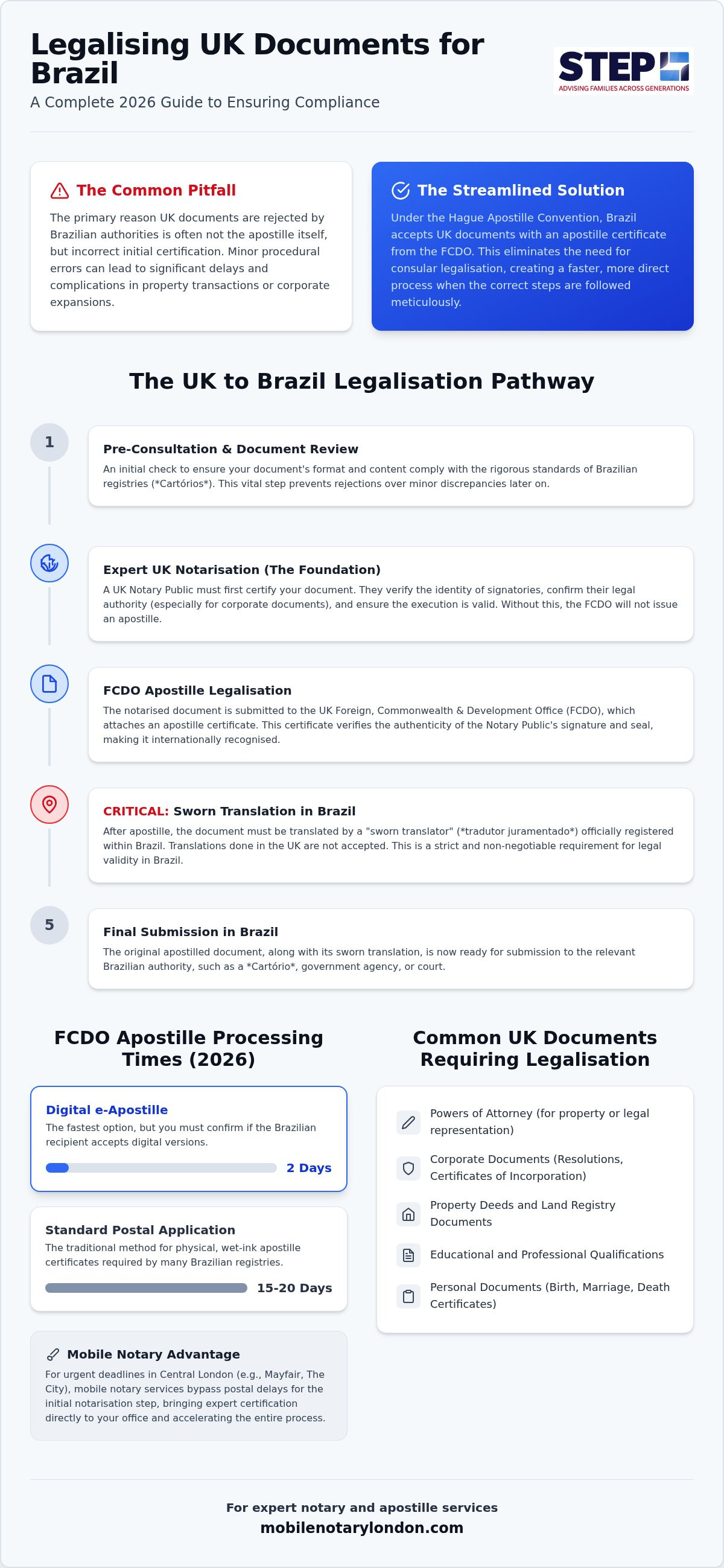
Achieving successful legalisation for use in Brazil from UK requires a disciplined, five-step sequence. It begins with a pre-consultation where your documents are reviewed for compliance with Brazilian law. This preliminary check is vital because Brazilian registries, or Cartórios, are known for rejecting documents over minor formatting discrepancies. By identifying these issues before the seal is applied, you save days of potential rework and avoid the stress of bureaucratic rejection.
Phase 1: Notarisation in Central London
For professionals based in Mayfair, Belgravia, or the City, the most efficient route is a mobile appointment. A premium mobile notary service eliminates the need to leave your office, bringing legal expertise directly to your boardroom. During this meeting, the notary verifies your identity and residential address. You'll need to present a valid passport or driving licence, along with a recent utility bill or bank statement. This step is critical for executing complex documents like a Power of Attorney or Corporate Resolutions. The notary doesn't just witness a signature; they confirm that the signatory has the specific authority granted by their corporate articles to bind the firm in international dealings.
Phase 2: The Apostille and FCDO Processing
Once notarised, your document is submitted to the UK government legalisation service. In 2026, the FCDO offers different tiers of service, including the digital e-Apostille which typically processes within two working days. However, you must verify if your Brazilian recipient accepts digital versions, as many registries still demand physical, wet-ink certificates. Standard paper-based postal applications currently take between 15 and 20 working days. If your deadline is imminent, opting for an Apostille and Embassy Legalisation specialist allows you to access expedited processing. Registered business agents can often secure next-day turnaround, a service unavailable to members of the public applying directly.
After the FCDO attaches the apostille, the final stages involve two specific protocols:
- Translation: Your document must be translated into Portuguese by a Brazilian sworn translator (tradutor juramentado) to be accepted by local authorities.
- Dispatch: The original, apostilled document is securely couriered to the Brazilian recipient to ensure it arrives in pristine condition.
This structured approach ensures your legalisation for use in Brazil from UK is handled with the precision required to satisfy even the most rigorous Brazilian authorities.
Common UK Documents Requiring Legalisation for Brazil
The variety of documents requiring legalisation for use in Brazil from UK is extensive, ranging from private family records to complex multi-national corporate structures. Whilst the underlying Hague protocol remains consistent, the specific preparation for each document type varies significantly. Brazilian authorities are particularly exacting regarding the format of UK-issued paperwork. This means a "one size fits all" approach often leads to rejection at the local registry office, or Cartório, where officials expect a high degree of procedural precision.
For personal matters, original UK birth, marriage, and death certificates are the most frequent candidates for legalisation. Because these are issued by the General Register Office, they can often be sent directly to the UK Government Legalisation Office for an apostille without prior notarisation. However, for property transactions involving deeds of sale or transfer documents, the involvement of a Notary Public is non-negotiable. Brazilian registries require a high level of assurance that the individuals involved in a property transfer have been properly identified and have the legal right to execute the transaction under UK law.
Powers of Attorney for Brazil
A Power of Attorney (Procuração) is perhaps the most critical document for UK residents managing affairs in Brazil. Whether you're handling an inheritance or selling a property in Rio de Janeiro, the wording must be precise to satisfy Brazilian legal standards. These offices often insist on specific clauses that don't appear in standard UK templates. Notarising a Power of Attorney for property sale requires the notary to verify your capacity and understanding of the document's implications before the apostille can be applied. For a deeper dive into this specific process, consult our Power of Attorney Notarisation London Guide.
Corporate and Business Document Certification
Business expansion into the Brazilian market necessitates the certification of various Companies House documents. If you're registering a branch in São Paulo, you'll likely need notarised and apostilled copies of your Certificate of Incorporation and Articles of Association. The Notary's role here is to verify the current standing of the company and the authority of the officers signing Board Resolutions. Accuracy is paramount; Brazilian banks and regulators will scrutinise these details before granting operational licences or opening accounts. You can find more detail on this in our Apostille for Companies House Documents: 2026 Guide. This rigorous verification process ensures your legalisation for use in Brazil from UK meets the highest international standards of validity.
Navigating Translation and Certification Standards
For medical organisations and practitioners establishing a presence in Brazil, Future Marketing para Saúde provides the specialised digital marketing expertise needed to navigate the local healthcare landscape successfully.
The final, and often most misunderstood, stage of legalisation for use in Brazil from UK involves the linguistic transition of your documents. Even with a valid UK apostille, a document remains inert in the eyes of Brazilian law until it is accompanied by a recognised Portuguese translation. A common error is assuming that a "certified translation" produced by a UK-based agency will suffice. In reality, Brazilian government bodies and financial institutions operate under a strict regulatory framework that typically mandates a specific category of professional: the sworn translator.
The Role of the Sworn Translator in Brazil
In Brazil, a Tradutor Público Juramentado is a public official who has passed a rigorous state examination. Their work is the only form of translation carrying the legal weight required for official registry. To ensure your legalisation for use in Brazil from UK is successful, you must follow a precise sequence. You should first complete the notarisation and obtain the FCDO apostille in London. Only once the document is fully legalised in the UK should it be sent to Brazil for sworn translation. Whilst some UK-based translators claim to offer "sworn" services, these are rarely accepted by Brazilian authorities unless the translator is also registered with a Brazilian Board of Trade (Junta Comercial).
Ensuring Compliance with Brazilian Cartórios
The Brazilian Cartório system is a network of registry offices that holds immense power over the validity of international documents. These offices are known for their uncompromising adherence to formal rules. If a notary's seal is faint or a signature is obscured, the entire legalisation chain may be questioned. It's imperative that your London notary's credentials are clearly visible and registered with the FCDO to ensure a seamless verification process. Whilst the UK process is digitalising, Brazil often requires physical stamps and seals. This preference for "wet-ink" signatures means that even as the UK moves toward e-Apostilles, the physical veracity of your paperwork remains your strongest asset in South American jurisdictions.
To avoid the common pitfalls that lead to document rejection, it's advisable to seek professional guidance before submitting your paperwork. If you require assistance with the initial certification of your documents, you can book a consultation with our mobile notary team for expert support.
Premium Mobile Notary Services for Brazil Legalisation in London
The precision required for Brazilian document acceptance demands an expert who understands both UK law and South American bureaucratic expectations. For clients managing high-value property or corporate interests, the most efficient solution is a Same-Day Notary Central London service. This approach ensures that your legalisation for use in Brazil from UK is initiated with immediate effect, bypassing the delays inherent in traditional postal routes. Having a STEP-qualified Private Wealth Lawyer handle your documents provides an additional layer of security, particularly when dealing with complex inheritance or multi-jurisdictional assets. This level of qualification ensures that every certification is robust enough to withstand the scrutiny of a Brazilian Cartório, where even minor errors can lead to total rejection of a claim.
Convenience in Central London
Executives and HNWIs operating within London's primary business hubs require a service that respects their schedule and privacy. Our mobile notary coverage extends across Mayfair, Belgravia, Chelsea, and the City of London, bringing professional certification directly to your residence or boardroom. This "white-glove" experience is specifically designed for those who cannot afford the time to navigate the city for a standard appointment. By bringing the service to your location, we ensure that corporate resolutions and powers of attorney are signed in a secure, controlled environment. You can learn more about the benefits of this on-site approach by reading about why choose a mobile notary.
Booking Your Same-Day Appointment
To facilitate a seamless visit, ensure you have your original documents and valid photographic identification ready for inspection. The notary will verify the capacity of all signatories and apply the necessary seals required for FCDO recognition. This proactive handling is the fastest route to securing an Urgent Apostille London, ensuring your paperwork is ready for the subsequent sworn translation in Brazil. The process is designed to be direct and transparent, providing you with a clear timeline for the completion of your legalisation. If you are facing a tight deadline for a property sale or corporate registration, you can book your mobile notary appointment today to guarantee professional, same-day service.
Securing Your Document Validity for Brazil in 2026
Successfully managing the legalisation for use in Brazil from UK requires more than just a government stamp; it demands a meticulous approach to initial certification. The foundation of acceptance lies in the precision of the notary's verification and the subsequent alignment with Brazilian sworn translation protocols. By ensuring your powers of attorney or corporate deeds are correctly notarised before the apostille is issued, you eliminate the risk of bureaucratic rejection at the registry office. This structured sequence is the only way to guarantee your documents carry the weight they require in South American jurisdictions.
As a STEP-qualified Private Wealth Lawyer specialising in international legalisation, I provide the expert oversight needed for these complex matters. My premium mobile service brings this specialist knowledge directly to your location in Mayfair or the City, offering a seamless alternative to standard government channels. Secure Your Same-Day Mobile Notary Appointment in Central London to ensure your international affairs are handled with absolute rigour and care. You can move forward with your Brazilian ventures with complete confidence and the peace of mind that your documentation is 100% legally compliant.
Frequently Asked Questions
Does Brazil require an Apostille for UK documents in 2026?
Yes, Brazil is a signatory to the Hague Apostille Convention, meaning UK documents only require an apostille from the FCDO to be legally recognised. This streamlined process eliminates the need for further legalisation at the Brazilian Consulate. However, most private or corporate documents must first be notarised by a Notary Public in Central London before the FCDO will issue the certificate. This ensures the document's authenticity meets international standards.
How long does it take to legalise a document for Brazil from the UK?
The timeline for legalisation for use in Brazil from UK varies based on the service tier selected. Standard postal applications to the FCDO currently take between 15 and 20 working days. For urgent matters, using a registered agent can reduce this to a next-day service. When you factor in the initial notarisation and subsequent courier times, a professional mobile notary service can typically complete the entire UK-side process within 24 to 48 hours.
Can a solicitor notarise my documents for use in Brazil?
No, a standard solicitor cannot notarise documents for international use; you must use a qualified Notary Public. Whilst solicitors can certify documents for use within the UK, Brazilian authorities require the specific seal and signature of a notary to verify the validity of the document. As a STEP-qualified Private Wealth Lawyer and Notary Public, I provide the specialised certification required for complex international instruments, ensuring they are prepared correctly for the FCDO apostille.
Do I need to visit the Brazilian Consulate in London?
No, a visit to the Brazilian Consulate is no longer necessary for most documents since Brazil joined the Hague Convention. The apostille from the UK Foreign, Commonwealth & Development Office serves as the final level of legalisation required. This change has significantly simplified the process for UK residents. Instead of navigating consular appointments, you can simply arrange a mobile notary visit in Central London to begin the certification and apostille sequence.
What is a sworn translation and is it necessary for Brazil?
A sworn translation (Tradução Juramentada) is a translation performed by a public official registered with a Brazilian Board of Trade. It's absolutely necessary for any UK document to be accepted by Brazilian government bodies or registries. It's critical to note that this translation should be completed in Brazil after the UK apostille has been attached. UK-based certified translations are frequently rejected by a Brazilian Cartório for failing to meet these specific regulatory standards.
Can I get a same-day apostille for my Brazilian documents in London?
Yes, expedited apostille services are available in London, but they are exclusively accessible through FCDO-registered business agents. Members of the public applying directly are limited to the standard postal route, which takes significantly longer. By engaging a premium mobile notary service, your documents can be notarised and then submitted through these expedited channels. This is the most reliable method for meeting tight deadlines for property sales or corporate registrations in Brazil.
What happens if my document is rejected by a Brazilian Cartório?
Rejection by a Brazilian Cartório often results in significant delays and additional costs, as the entire legalisation process may need to be restarted. Common reasons for rejection include incorrect notarisation wording or using a non-sworn translator. To prevent this, ensure your documents are reviewed by a specialist in international legalisation before they leave the UK. Professional oversight at the notarisation stage is the best defence against the strict formal requirements of Brazilian registry offices.

Article by
Sheikh Najam
Sheikh Najam LLB, TEP, MCIArb is a Notary Public and Commissioner for Oaths based in Central London, offering notary services to corporate, commercial and private clients across the City of London and beyond. His work includes notarising board and shareholder resolutions, powers of attorney, and certified copies of constitutional documents for use with foreign registries, banks and courts, with apostille and legalisation arranged as part of the same instruction. Alongside his notarial practice, he is a STEP-qualified international private wealth lawyer advising on cross-border transactions, company formation, trust drafting and succession planning. He is regulated by the Faculty Office (Court of Faculties) of the Archbishop of Canterbury and is a member of The Notaries' Society of England and Wales, STEP, and The Association of European Attorneys.


